
My mother wanted a photograph of the library.
This was why I had gone to the library first. I sent her a picture of an open textbook, waited for the little heart to appear beneath it, and walked six streets to a house with a skeleton drinking from a lawn chair.
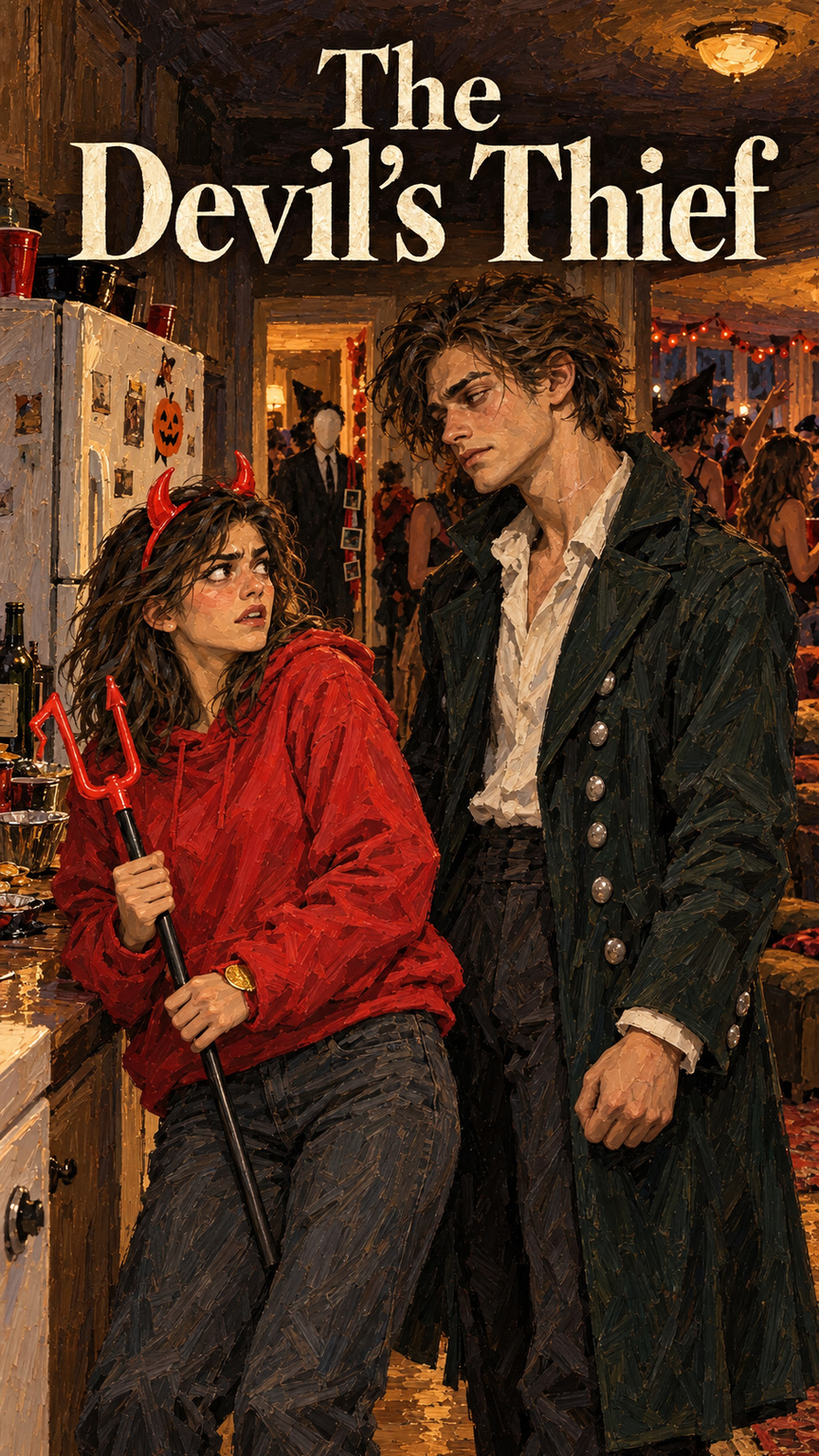
Devin answered the door in a silver astronaut suit. She had helped me buy my horns that afternoon, after learning that I had reached nineteen without going to a Halloween party.
“Your mum?” she asked.
“Thinks I’m studying.”
“You are studying. People. A classic field.”
She steered me through a crowd of witches, superheroes and one exhausted person dressed as a spreadsheet. I had a red sweatshirt, plastic horns and a pitchfork so flimsy that one prong had folded over on the walk. For the first time all evening, I felt appropriately dressed.
In the kitchen, Devin tipped a bag of chocolate coins into a bowl. I took one while she was telling me which of the three men dressed as vampires actually lived in the house.
“Did you just steal that?”
“You were going to offer.”
“I was.” She held out her palm. “Do it again.”
The second time, she watched my face instead of the bowl. I dropped the coin into my sleeve.
“That is wasted on a library,” she said.
I had learned to hide sweets before I learned long division. In our house, an unexplained chocolate wrapper could become an evening’s discussion of the Devil’s Thief.
He stole naughty children. He stole liars. He listened outside windows after dark, and if you answered him, he could carry you away in his coat.
Other families had similar stories. Their monsters usually had the decency to stay out of the genealogy.
Ours had a little painted portrait beside a crossed-out branch: a young man in a green coat, with a crooked left eyebrow and a mouth that looked amused at something unpleasant. Underneath, in my grandmother’s tiny writing, were the words Ephraim Penrose. Do not follow him.
I was thinking about that portrait when the man in the green coat said, “There you are, Button.”
I turned with the chocolate still in my sleeve.
He stood between the fridge and a woman wearing six cardboard arms. The green cloth was dark enough to be almost black. Silver buttons ran down his chest. He had soft brown hair, a white scar at his throat, and the same slight break in his left eyebrow.
He looked about twenty-five.
My grandmother had died when I was eleven. No one outside our family had ever called me Button.
“Who told you to call me that?”
He glanced towards the living room. The music was loud enough to rattle the foil bowls on the counter. He reached out, caught something in the air, and closed his fist.
The music stopped.
People’s voices sprang up around us. Someone shouted that the speaker had died. Beneath the man’s fingers, a tiny bass beat went on thumping.
“You have your mother’s eyes,” he said. “And, I hope, better sense. I’ve been trying to get one of you alone for years.”
I backed into the counter. He put his free hand beside me, barring the gap to the hall.
“You’re going to come with me.”
There was a small, stupid part of my mind that wanted to ask how he had done the music. A bigger part had become six years old.
“No.”
He looked surprised. Then he smiled, which was worse.
“We haven’t much time.”
I ducked under his arm and went into the hall.
Behind me, he opened his fist. The song returned in the middle of a word. Everyone cheered.
I found the front door beneath a plastic spiderweb, pulled it open, and walked into the kitchen.
The woman with the cardboard arms moved aside for me.
I stood holding a doorknob.
Across the kitchen, the back door had a little window showing the dark garden. I went through it quickly, before I could decide I was frightened.
I came out of the pantry.
The man in green was waiting by the fridge.
“That,” he said, “wasn’t me.”
I tried the kitchen window. Beyond the raised sash, another version of the kitchen window rose. I saw my own hand reaching through it from the other side.
I pulled my hand back.
Someone behind me said, “There’s an escape-room thing, apparently. The front door’s amazing.”
“Well, they can pack it in,” someone else said. “My taxi’s outside.”
The man in green took my elbow.
“He’s here sooner than I expected.”
I shook him off. “You expected someone?”
“Laurel.” His voice lost its coaxing edge. “Look by the stairs. Don’t stare.”
I stared.
A tall man in a white mask stood under the hall light. The mask had no eyeholes. His black suit was perfectly ordinary, except for a red ribbon hanging from his belt. Something folded and pale dangled from it, like an elaborate paper decoration.
As he turned, it opened a little. I saw our front porch, no larger than my thumbnail, with the lawn-chair skeleton beyond it. Beside it was the dark garden. Other little openings showed other views of the night.
The man gathered them against his hip and the ribbon went still.
“He collects things for the Devil,” Ephraim said. “At present, me.”
“Good.”
“And anyone he can use to find me.”
The mask turned towards us. Ephraim slipped behind a group of dancing vampires with an ease that made the kitchen seem to lose him.
I was left by the window in my cheap horns.
The collector came over. Up close, his mask looked like the smooth underside of an eggshell.
“Laurel Penrose,” he said. “I thought so.”
“Have we met?”
“No. But I know your mother’s name. And her mother’s. You’re a very persistent family.”
He lifted the red ribbon. In one of its tiny openings, the skeleton’s plastic hand rocked in the wind.
“Tell me where Ephraim is,” he said, “and I can give you a way out.”
The kitchen light shone on the blank places where his eyes should have been.
“What about everybody else?”
“I’m speaking to you.”
Someone bumped my shoulder. The collector moved aside to let them reach the drinks, polite as a visiting parent.
“Think about it,” he said.
Ephraim was waiting at the cellar stairs.
“What are you?” I asked him.
“You know.”
“I know a story.”
“Then you’re ahead of most people.”
He started down. I stayed in the kitchen, watching the man my parents had used to make me finish my dinner.
“Why are you called the Devil’s Thief?”
He stopped.
“Because I stole from him.”
“What?”
For a moment, his face was very plain.
“My daughter. She was four months old.”
The music changed upstairs. A crowd began singing several different versions of the same chorus.
“He took her,” Ephraim said. “I went in and took her back. She lived to be seventy-three. She had six children. You come from the youngest.”
I knew that branch. I had traced it with a finger while my grandmother watched.
“You’re dead.”
“I ought to be.”
He showed me the inside of his wrist. Beneath the skin, something moved slowly, like a clock hand under thick glass.
“The Devil caught me on my way out. He couldn’t keep the child, but he kept my death. Shut it in a watch. Until that watch starts, I continue.”
“For how long?”
“Long enough.”
“Then you want it started.”
“Yes.”
I looked at his young face again.
“Why me?”
“Because the cabinet that holds it will open to living blood of mine. Mine no longer counts.” He pulled down his cuff. “And you’ve finally left home. Your father used to sleep across the hall from you with the door open.”
My stomach tightened.
“You’ve been to our house?”
“You wouldn’t answer your window. Very good child.”
He said it with the same tired approval adults had used on me all my life.
“You thought I’d be easier now.”
“I thought you’d stopped believing in me.”
Below him, a door stood against the cellar’s brick wall. It was narrow, painted white, and quite separate from the house. One edge rested on an old exercise mat. Through its open frame I could see a stone room and a tall glass cabinet. Something black branched inside the glass.
“I borrowed a door into the treasury,” Ephraim said. “Unfortunately, he came through it after me.”
“Then put it back.”
“With him still in the kitchen?”
Above us, the collector asked someone whether they had seen a gentleman in a green coat.
“There’s another problem,” Ephraim said. “I left blood behind when I stole my daughter. He grew something out of it. Every child of hers is on that tree. Every child of theirs. Whenever there’s a way through, he can use it to find us.”
“Use it how?”
“The branches point the way. He reads them and follows.”
“If he didn’t have the tree?”
“Then he’d have to find us like anyone else.”
Through the cabinet glass, a small copper leaf turned. For an instant I could read the writing on it.
Laurel Penrose.
The collector had a way through. He was six steps above me, asking a vampire a question.
Ephraim reached for my wrist.
I pulled back, but he caught it. His fingers were cold and hard. He brought me down one step.
“We can argue after.”
“Let go.”
“Don’t make this difficult.”
My mother used to say that too. Usually over school shoes.
I planted my feet.
“I can scream.”
His grip tightened.
“He’s looking for a green coat,” I said. “I can be much more helpful.”
Ephraim looked up the stairs.
The singing had stopped. Someone was explaining, at length, that they had bought their vampire coat online.
“You’ll be caught as well,” he said.
“He offered to let me out.”
“And you believed him?”
“I believed you could make me loud enough to find.”
We stayed like that, his hand around my wrist, the party moving over our heads.
“What do you want?” he asked.
I looked at his coat. It was where the children in the story disappeared. It was where he had brought a full-sized door into a stranger’s cellar.
“That.”
“No.”
I drew breath.
He let go of my wrist.
It took him a moment to undo the buttons. I watched his face while he worked. He wanted that watch more than he wanted to keep me afraid.
The coat was too long. Its cuffs swallowed my hands. Inside, it smelled of cold earth, old wool, and something sweet that had been shut away for years.
I put my plastic pitchfork into a pocket. It went down to the handle. Then the handle went too.
Ephraim watched it vanish.
“You might have brought something useful.”
“I was going to a party.”
He almost smiled. I didn’t.
We went through the white door.
The stone room was much colder than the cellar. Our breath showed. The tall cabinet stood at its far end, lit by the faint copper glow of a hundred little leaves. On a shelf beside the tree lay a silver watch.
I could still see the exercise mat behind us. I could hear feet stamping above it. Someone was calling for Devin to come and dance.
Ephraim put my hand against a brass plate on the cabinet. The metal warmed. A lock clicked, and the glass door opened outwards.
The tree’s branches stirred towards me.
There was my mother’s name. My father’s appeared on a smaller leaf joined to hers by a curling tendril. Above them were grandparents, great-grandparents, more names than I had ever managed to learn.
High branches bore dark, shrivelled leaves. My grandmother’s name was among them. Beside the branch for my great-grandmother, a short fork had withered. I could still read its leaf.
Hettie Penrose.
Farther down, close to my mother’s generation, another branch had stopped short.
Christopher Penrose.
I stopped with my hand on the glass.
Hettie was my great-grandmother’s sister. Christopher had been my mother’s cousin. In our paper tree, they had names and birth dates and empty spaces underneath. They had gone away young. If I pressed, my mother would say that was why I must never follow a strange voice.
Ephraim was reaching for the watch.
“Did you come for them?”
His hand stopped.
“We need to be quick.”
“Hettie. Christopher. Did you take them?”
“They came with me. Hettie first. Christopher years later.”
I looked back at the white doorway. It was broad enough for a person to run through. It was narrow enough for someone to close.
“What happened?”
“Each time, we were discovered.”
“And?”
He took the watch off the shelf. It lay in his palm, bright and small.
“I got out.”
“Did you go back?”
The branches whispered against one another.
“No.”
“Are they still here?”
He looked at the two black leaves.
“Those wither when we die.”
I could hear a laugh from upstairs. For a second, I hated whoever had laughed. Then I wanted to be them so badly that my throat hurt.
“Were they at the door?”
“Laurel.”
“Both times. When you shut it, were they there?”
“Yes.”
He had been twenty-five for hundreds of years. He had made himself look just as young when he knocked on Hettie’s window. He had probably called Christopher by some small name his mother used.
“You left them.”
He closed his fingers around the watch.
I turned back to the tree.
In the Devil’s cabinet, it would keep pointing to us. In my pocket, it could tell him nothing.
Its roots filled a black iron pot. I got both hands under the trunk and lifted. The pot came with it, impossibly heavy. A branch scraped my cheek.
“What are you doing?”
I hooked the pot over the mouth of the coat pocket.
The weight went away. I fed the trailing roots after it, then the trunk. Copper leaves brushed my chin. My own name passed my face, still bright.
“He’ll come for that,” Ephraim said.
“He’s already here.”
The last black twig caught in the cabinet’s door catch. I leaned in to free it.
Behind us, someone applauded from the cellar.
The collector stood on the exercise mat.
“There,” he said. “I knew you hadn’t lost your appetite.”
Ephraim was halfway to the doorway, with the watch in his hand.
The collector moved aside. For one terrible moment, the path out stood open to him. I was still bent into the cabinet, caught by a branch and the back of the coat.
“Go on,” the collector said to him. “See how far you get.”
Ephraim looked at me.
I knew what his face would look like afterwards. I had just heard how he told it.
He raised the watch.
“Here.”
He threw it past the collector, back into the cellar.
The white mask snapped round. A pale hand caught the watch before it hit the floor.
Ephraim was beside me before I could straighten. He tore the snagged lining off the catch, freed the last twig, and pushed it into my pocket. His hand struck the glass door to keep it off my shoulder.
“Run.”
We went through the white frame together. He shoved me up the cellar stairs ahead of him.
The collector caught his shirtsleeve at the bottom step.
I stopped. Ephraim twisted, leaving a strip of linen behind, and followed me up. At the top he slammed the cellar door between them. Its latch bounced. He held it with both hands.
“Into the crowd,” he said.
I went.
Devin was dancing beneath the sitting-room light. She caught my arm and laughed at the coat.
“You’ve upgraded!”
I clung to her for a second. Warm silver cloth crackled under my fingers.
“The doors are broken,” I said.
“I know. It was funny twenty minutes ago. Is it your guy? People want to leave.”
Two people had propped the front door wide with a chair. A third stood on it, working at the upper hinge with a screwdriver. Through the gap they had made beside the frame, I could see the kitchen again. A man in a Dracula cape was on the phone, insisting that he was at his front door and his taxi driver must be at the wrong house.
Across the room, the kitchen door opened. Ephraim backed through it. The collector followed, his fist closed round the watch.
He would take Ephraim downstairs. He would secure him. If I could get the ribbon, I could let everyone out. Then I could use the coat to take the treasury doorway away behind them.
I could close it with Ephraim on the other side.
“Stay with everyone,” I told Devin.
“Laurel?”
I went back into the kitchen.
Ephraim had ducked behind the fridge again. The collector was working through the dancers, lifting masks to look beneath them. A werewolf knocked his hand away and demanded that he open the doors. The collector slipped past, leaving the werewolf shouting after him.
“He has the doors on his belt,” I whispered.
Ephraim nodded. His hands were shaking.
“You could get close if you gave him me,” he said.
“Yes.”
He looked at my pockets, then at the collector. He seemed smaller in his torn shirt.
“Fair enough. He’ll take the coat as well.”
I pressed my hand over the pocket with the tree in it.
“Then get that back to me first. I can’t take the doorway without it.”
He nodded.
“Can you steal something with your hands tied?”
He looked back at me.
“Something small.” I held my fingers apart. “The fastener on whatever he ties you with.”
For the first time that night, he waited for me to go on.
“When he takes you through the door,” I said, “I’ll be there.”
“You don’t have to.”
“I know.”
I caught his elbow and took him out among the dancers.
“Here!” I called. “I found him.”
The collector turned. His delight was a movement of the blank mask, a slight lift towards the ceiling.
“You see?” he said to Ephraim. “They learn.”
Music still thudded from the living room, but people crowded towards us, angry and curious. The man in the Dracula cape put his phone away.
“Are you the one doing this?” he asked the collector. “It’s my house.”
“One last thing to put away,” the collector said. “Then you can all go.”
“Now,” the householder said.
The collector took a pair of shackles and a short lead out of his jacket. The watch had a long silver chain. He tucked it into his breast pocket. Ephraim held out his wrists, and the collector fastened the shackles. The lead clipped onto them with a small iron clasp.
“And the coat,” he told me.
I made a fuss of undoing the buttons. They were old, and my fingers were trembling. People pressed against us. Someone shoved through from the hall, carrying a useless hinge pin, and the householder had to make room. I got the coat off and held it bunched between the collector and me.
I had spent years looking innocent while my hands did something else.
When he reached for it, I stumbled into him. My right hand went between our bodies, hidden by the wool. The watch came out by its chain and dropped into the front pouch of my sweatshirt. Then I caught the red ribbon, slid its loop off his belt hook, and tucked its folds beside the watch.
The collector’s other hand closed on my shoulder.
“You’re shaking,” he said.
“I’m frightened.”
That, at least, was easy to believe.
He took hold of the coat. For a moment I couldn’t release it. My mother’s name was in there. All of us, back in his hands.
Ephraim met my eyes. I made my fingers open.
The collector folded the coat over his arm, covering the torn lining where the last twig had caught. His other hand took up Ephraim’s lead.
“Wait here,” he told me. “Once he’s safely shut away, you shall have your way out.”
He led Ephraim towards the kitchen. The householder shoved a chair out of their way.
“Get on with it, then.”
I stood in my red sweatshirt with my hands in its pouch until they reached the cellar stairs. Then I followed.
The white door was still open against the wall.
The collector crossed first.
Ephraim went after him, quietly on the lead.
I stayed on the exercise mat.
Inside the treasury, Ephraim closed his fingers over the clasp at his wrists. The end of the lead dropped free. A little iron fastening showed between his fingers.
The collector turned.
Ephraim hooked his bound hands under the coat on the collector’s arm and flung it through the doorway. It landed across my arms.
Ephraim turned to follow the coat. The collector caught his sleeve.
I had the coat. The collector and Ephraim were both on the other side. I could take the doorway now.
Ephraim reached his bound hands towards me.
I let the coat fall across my shoulders and caught them.
The collector still gripped his sleeve. Ephraim’s young face tightened. His shoes slid on the stone. I braced my foot against the frame and pulled with everything I had.
“You shut it before,” the collector said to him.
Ephraim looked at me. He didn’t ask.
I pulled again.
His torn sleeve gave way. He fell through the doorway onto the mat, taking me down with him.
I scrambled up and seized the white frame by its handle. The collector was coming towards us, the empty lead hanging from his fist.
The door tipped. For one moment it was as heavy as any door I had ever tried to carry. Then its lower corner touched the open pocket.
The frame folded down into the wool. The stone room narrowed to a strip. A pale hand reached along it.
I thrust the last inch inside.
There was brick in front of me.
I stayed on my knees, holding the pocket shut.
Above us, the song ended. People shouted for another.
Ephraim was lying on his back, laughing without much breath. His bound hands lay across his chest.
I didn’t laugh with him.
After a while, he stopped.
I went upstairs with the red ribbon. Its folds opened at my touch. The views inside were all familiar now: porch, garden, side path, the ground below the sitting-room window. I pressed each little opening against the place it belonged. They caught and unfolded, as though the house were taking a long breath.
A vampire opened the front door and exclaimed over the cold.
Devin stood beside me.
“What happened?”
I took her hand and put it out through the doorway. The night air moved between our fingers.
“You can go out now.”
“Are you all right?”
“I need a minute.”
She looked past me towards the kitchen, then back at my face.
“I’ll be here.”
I went down to the cellar.
Ephraim had sat up against the wall. Without the green coat, he looked like a man who had lost his way home from somewhere expensive.
I took the watch out of my pocket.
His eyes followed it.
“You got it.”
The hands stood at twelve. The case was warm from the collector’s keeping. Around its edge, in tiny letters, someone had engraved Ephraim’s name.
“Does taking the tree help Hettie?” I asked.
He shook his head.
“Christopher?”
“No.”
I kept the watch in my hand.
“I’m going to tell them.”
He nodded.
“What you did. That you heard each of them and shut the door.”
“Yes.”
He watched my thumb rest on the crown.
I could put it back in my pocket. I had a place to keep it. For once, he would have to wait while someone else decided whether to help him.
“Do you want me to start it?” I asked.
“Very much.”
I thought of my mother’s little heart under the photograph. Of two empty spaces on a paper tree. Of him coming back across the room for me, leaving the thing he had wanted for centuries behind.
I turned the crown.
The watch began to tick.
Grey went through his hair. His face changed by small, ordinary degrees, growing into an age it had never been allowed to reach. He touched the white scar at his throat, as if checking that it was still there.
He became an old man. Then a very old man.
“Laurel,” he said.
I leaned forward, but he had finished.
His hand settled on the mat. The watch hurried in my palm. By the time its hands met at twelve again, there was only a little grey dust beneath his torn shirt.
I sat until it stopped ticking.
Then I folded the shirt around what remained and put it carefully into the coat.
Devin sat with me on the front steps until the first buses began to run. My phone charged just inside the hall. People said goodbye over our heads, and she didn’t ask about the coat again.
When the sky began to pale, we walked back to campus.
I called my mother from the steps of our residence.
“I wasn’t at the library,” I said.
There was a silence at the other end.
“Laurel?”
“He came for me.”
Her breath caught. I heard my father wake beside her.
“I’m here,” I said quickly. “I came back. But I know what happened to Hettie and Christopher. He left them there, Mum. He shut the door on each of them.”
She made a small sound. My father was asking for the phone.
“There’s something before that, too,” I said. “About a baby. I’ll tell you when you get here.”
They asked where I was. I told them.
While we talked, I reached into the coat. A twig caught my finger, and I drew it just above the pocket’s edge. The leaves were the colour of new pennies. My mother’s name trembled beside mine in the morning wind.
I sent her a photograph.
Deep inside the other pocket, someone knocked on a door.
I let it knock.