
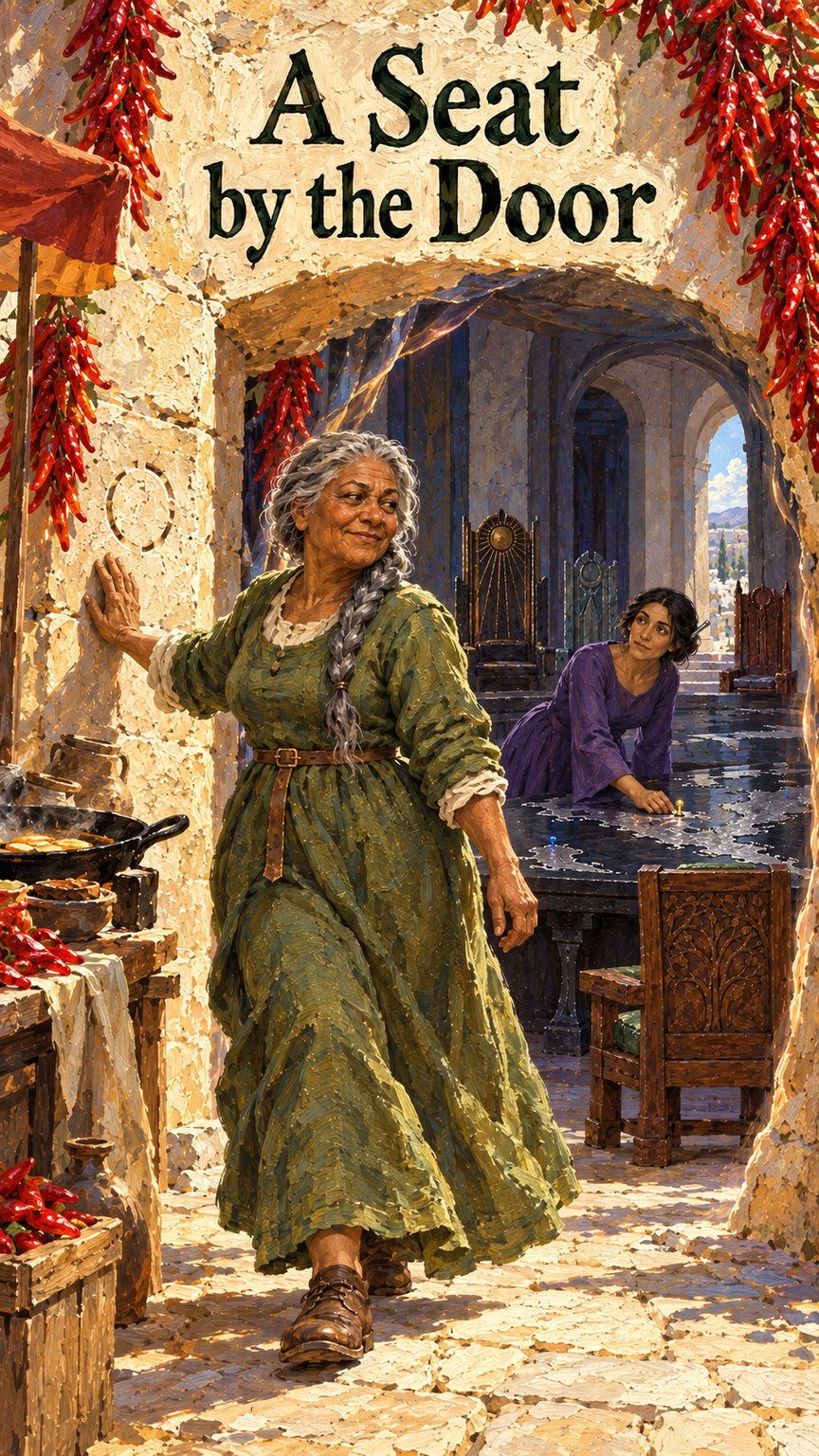
The eighteenth time I died, the gods had put out a chair for me.
It was a good chair. Carved walnut, green cushion, arms broad enough to balance a plate on. Someone had considered my comfort. I found this alarming.
I went to the window.
Lethra got there first.
“That's a long drop,” she said.
“I was admiring the view.”
Below the window lay the orchard of the dead, its white trees bent under ripe fruit. Beyond it was a wall. Beyond the wall was another wall, which was new.
“I thought you might,” said Lethra.
The goddess of death wore a plain violet gown and a silver pin through her black hair. Nothing about her rattled. I had always found that disappointing. If you were going to take the trouble to frighten everybody, you might at least enjoy dressing for it.
Behind us, the other gods watched from their thrones. A man with bronze hands was rubbing a dent out of one knuckle. A woman whose hair moved like wheat had brought her own sunlight. It lay in a square across the floor and stopped precisely short of my chair.
“Am I being tried?” I asked.
“No.”
“Because that looks like a place for the accused.”
“It is a place for a colleague.”
I looked at the chair again.
“Whose?”
“Yours.”
The bronze-handed god closed his eyes.
I had never seen a god brace himself before. It made me stand a little straighter.
Our priests teach that a person gets one life. When you die, you enter Lethra's orchard, lay down your sorrows, and remain there. Reincarnation is a foreign superstition, a doctrinal error, and, according to a priest I married in my eleventh life, a gross insult to the entire arrangement.
I had loved that man. We had argued magnificently.
I also knew the orchard better than any priest. The fruit was excellent. There were people there I would have crossed deserts to see, and had. I generally stayed a while.
Then somebody in the living world would invent a new instrument, or a ship would set out for a coast nobody had reached, or I would remember a thing I had meant to say and find myself looking for a way over the wall.
Getting through was difficult. Getting back into the world meant starting at its beginning: a body that grew with me, milk, teeth, the whole business. My memories returned in awkward pieces. Once I had remembered three languages before I possessed any front teeth. I spent a furious year being congratulated on my babbling.
The gods had tried guards. They had tried persuasion. On one occasion Lethra had given me a lovely house in the orchard with no doors.
I had been a mason twice by then.
Now they were trying a cushion.
“We offer you a place among us,” Lethra said. “Power. Recognition. A living body that does not wear out. You would have an office, a voice in this council, and a name by which we could always find you.”
“Ah.”
“Yes,” she said. “Ah.”
I leaned against the window frame. She did not move aside.
“So it's the finding me.”
“When you return, you have a different face. A different name. By the time we discover which child has begun correcting the local funeral rites, you have usually moved.”
“Only once because of that.”
“There are seventeen of your graves in the world. Some have become places of pilgrimage. We receive complaints at all of them.”
“From the pilgrims?”
“From the priests whose walls they scratch.”
She held out her hand. A little patch of air between us opened onto a street.
I knew that street. Sunlight slanted through its market arch. Someone had hung red peppers from the upper stones, and beneath them, low enough to touch without breaking stride, somebody had scratched a circle with a gap in it.
An old woman passed through the arch. She brushed two fingers against the gap, touched her lips, and went on.
“The One Who Got Out,” Lethra said.
“That's a wheel.”
“It is your sign.”
“I drew it on a prison wall. A door would have upset the warders.”
“You drew it in six prisons.”
“Seven. I escaped the first before anyone could write it down.”
More places flickered in the air: a mark beneath a barred window, one cut into a saddle, one painted inside a child's little fist. The child was singing a song I had taught somebody in my last life but two. The woman I taught had been seventy when she died.
“They invoke you,” Lethra said. “Before an escape. Before a dangerous journey. When a corner looks particularly tight. There is worship enough. You have demonstrated power. We are offering the authority.”
The small street remained open beside her hand. Beyond the arch, a cook turned something in a black pan. I leaned closer.
“Were those pepper cakes?”
Lethra closed her hand.
“We are discussing godhood.”
“I was on my way to buy one when the roof tile hit me.”
“I know.”
“I'd waited all morning for him to heat the oil.”
She drew a breath. I watched it lift the fabric at her shoulders. The gods were alive. They could fill their lungs, bruise a knuckle, bite an apricot. I had to remember to breathe in the orchard; nothing happened when I forgot.
Lethra picked an apricot from the small tree beside the window and gave it to me. A small warmth ran from her fingers into mine. For a few breaths my chest rose by itself. When I bit, sharp juice filled my mouth.
I had been dead for less than an hour. I wanted the whole tree.
For a moment I said nothing. I ate around the stone.
“Like that,” she said. “Without borrowing my breath. Without beginning again.”
I had spent the better part of a thousand years getting old. There had been good knees and bad knees, strong backs and weak lungs, one extraordinarily useful pair of shoulders. In my fourth life I had become a dancer at fifty-six and made a fool of myself until I got good. In my fifteenth I had finally learned to draw a horse that looked like a horse. I was sixty-three this morning, and I had just begun learning the fiddle.
I looked past Lethra at the chair.
“What would I be god of?”
The wheat-haired woman smiled.
“Rest has been proposed.”
“For whom?”
Somebody behind the bronze-handed god coughed. Lethra's mouth twitched.
“The title is negotiable.”
“Escapes,” I said.
The bronze-handed god dropped his face into both palms. They rang.
Lethra studied me. “You would hear those who called on you.”
“I've been hearing people ask me to get them out of things since I was first tall enough to open a window.”
“This would be different.”
“So would having knees that worked.”
She looked at my legs. “You may keep your present appearance if you wish.”
“I earned this face.”
“Then keep it.”
My hands were broad and brown and creased. A long grey braid lay over my shoulder. I had been prettier, but this was the face in which people had begun taking my advice about horses. I was fond of it.
I put the apricot stone on the window ledge.
“All right,” I said. “Tell me about leaving.”
Lethra walked to the great black table in the middle of the hall. I followed her. My chair stood beside it, facing the other thrones.
The world's coasts were inlaid across the table in silver. Tiny lights shone on the mountains and cities. One, a pale blue point on the coast, moved a short distance while I watched.
“Our brother,” she said. “At his temple.”
“Does he know you're watching?”
“He could watch me. We know where the others are. The world has become large, and we have work in different parts of it.”
The blue light moved again.
“Gods can go there?”
“Of course.”
“Themselves? With feet?”
“With whatever feet they possess. Where people make us welcome, we can step into their world. A temple. A household shrine.”
I thought of a thumb brushing the scratched stone beneath the market arch.
“A mark in a wall?”
“A sincere one.”
“Then I accept.”
Lethra raised a finger.
My hand stopped on the back of the chair.
“One year here,” she said. “First.”
“No.”
“To learn your office. To understand what you can do. Under my eye.”
“You can teach me while walking.”
“Orra.”
That was the name I had worn in this last life. Lethra said it very softly. The light in the room dimmed a little, except for the square of sunlight. Its owner drew her feet into it.
“You walked out with the midsummer procession wearing a mask,” Lethra said. “I had to take the privilege of visiting away for seven years while we established how you had done it.”
“The dancer was sick.”
“You knew the dance.”
“I practised. They came every year.”
I remembered the mask's heavy tassels brushing my neck, the living dancers' hands hot in mine. We had passed through the gate singing. I had nearly wept at the smell of their sweat.
Outside the gate, the living had gone on in their bodies. I had had to be born into mine. My next triumph was learning to sit up.
“You persuaded your mourners to put your favourite song into the funeral rite,” Lethra went on. “You waited for the next singer to take a breath and followed it back.”
“That one took longer.”
“Forty-one years.”
“He had a difficult voice to learn.”
“I have closed those ways. The visitors are counted going in and coming out. Nobody sings your song at the gates now. The orchard has been examined from its roots to its highest branch.”
She let me look at the new wall through the window. There was no vine on it, no tree growing near it. Along its top, small figures walked in pairs.
“I believe you can find another way,” she said. “That is why I am making this offer. I also believe it may take you a very long time.”
The chair waited, solid and beautifully made. A thousand years, and they had finally found something I badly wanted. I imagined getting up in the morning without having to plan the order in which I bent my joints. Learning the fiddle properly. Going to see what was on the other side of the mountains without calculating how old I would be when I got home.
One year here was a cheap price.
Lethra knew it. She was watching my face now, not the window.
I took my hand off the chair altogether.
“It's a lovely offer,” I said. “But I've lived through several arrangements that were supposed to become more reasonable next year.”
“This isn't a prison.”
“Then let me leave.”
The bronze-handed god lowered his hands. Nobody spoke for a while.
“Today,” I said. “With the knees. I'll come when the council calls, the same as the rest of you. I'll learn what I need to learn. But if I take a place here, I take it as one of you.”
Lethra looked at the table. The blue light had reached the edge of the coast.
“You can find him whenever you want,” I said.
“Yes.”
“No guards.”
“No.”
“No wall.”
She looked out at the orchard. One of the figures on the new wall had stopped to adjust a sandal. His companion waited, facing the other way.
Lethra shut her eyes for a moment.
“If I can always find you,” she said, “I can teach you wherever you are.”
I waited.
“There will be rules.”
“Yours too?”
“Ours too.”
“And you will always know where I am.”
She opened her eyes. “Always.”
I considered that. There were disadvantages. I had liked being difficult to find. On the other hand, after seventeen lifetimes of being searched for, it would be interesting to make someone keep up.
“Then,” I said, “we have an arrangement.”
“Sit down, Orra.”
I sat.
The cushion was as good as I had feared.
Lethra set her hand against my chest. Something warm opened beneath it. I dragged in a breath, not because I remembered to, but because my lungs insisted. My heart struck so hard that I caught the arms of the chair.
The wood pressed against the soft pads of my fingers. My knees were warm. I straightened one leg, then the other, and began to laugh.
“Orra,” Lethra said, and her voice had changed. There was room in it now for mine. “Will you hold the office you have asked for?”
“Yes.”
“Then we acknowledge you.”
The other gods spoke after her. Beneath the many voices, I heard a little click.
All around me were ways out.
I felt the room's doors and windows, the narrowness beneath the eaves, the space between a guard's attention and the thing he believed he saw. Farther off, little gaps opened in the dark: scratched circles, chipped doorposts, a roughly drawn wheel beneath a market arch. I could feel where hands had touched them.
On the black table a new golden light burned.
The wheat-haired woman stood. “Welcome, sister. We have prepared—”
“Thank you,” I said. “I shall want to see all of it.”
I reached for the small broken circle I remembered. My fingers met hot stone. A man on the other side of it swore as my hand appeared above his basket of peppers.
I put my other hand through, took hold of the arch, and pulled.
For once I did not have to grow teeth first.
My feet landed on dusty paving. The sun hit the parting in my grey hair. I could smell peppers and frying batter and a mule that had been doing its best on a hot day.
Behind me, through the gap I had made, Lethra bent over the black table. My golden light had moved to the city. She laid a finger beside it.
We looked at each other.
Then I let the way close and went to buy a pepper cake.
The cook wanted three coppers. I had no money, which felt like an oversight in a goddess. While I was considering my credit, Lethra laid six coins on his counter.
“Two cakes,” she said.
She had arrived in a doorway across the street. Above it hung a little earthen figure of a woman with a silver pin in her hair. I had passed it for years without once considering where it might lead.
The cook looked from her to the coins. He put an extra cake on the plate and retreated to the far end of his pan.
I carried the plate to a low table in the shade. Lethra followed with two stools. She set mine where she could sit opposite me.
I moved it a little nearer the street.
We ate. The cakes were too hot. I burned my tongue and was delighted.
Lethra took a careful bite of hers. A flake of crisp batter fell on her violet gown. She picked it up and ate that too.
“Well,” she said. “I know exactly where you are.”
“How are the knees?”
She looked down. “Mine?”
“There's a mountain north of here. People have begun climbing it from the other side. Apparently the top isn't where we thought.”
“You have been a god for less than five minutes.”
“And you've already found me. We're both doing splendidly.”
I finished my cake, licked the pepper from my fingers, and stood up.
Lethra looked at the comfortable stool I had left her. Then she folded the last cake in a scrap of paper and came after me.