
“Surely you jest, Lady Knight. Someone of your achievements, prowess, and renown would want more in life than just being a housewife.”
Ameline looked at the marshal's baton lying between them.
It was a handsome thing, black wood capped with silver. She had imagined carrying it once, when she was twenty and had not yet commanded anything more troublesome than her own horse. She remembered how she had practiced holding a stick under her arm.
The king had signed the peace that morning. Now he was appointing his officers to their new commands.
“I also want hens,” she said.
Chancellor Berolt shut his mouth. Behind him, beyond the open doors, the farewell reception continued. A boy in livery was trying to carry away the great silver dish on which the king had presented Ameline with a new pair of gold spurs. The dish was wider than the boy. She caught his eye and indicated that he should put it down and fetch somebody to help.
“Hens,” Berolt repeated.
“Two or three. Piers has made a run behind the house.”
“I am offering you command of the king's cavalry.”
“Yes. Thank you.”
He drew a chair out from the little writing table. His right knee had been stiff since the retreat from the western fortress, and he lowered himself carefully. Ameline sat opposite him.
At the western fortress, she had found him pinned beneath a fallen horse, ordering her to leave him and open the gate. She had opened it. By the time she came back with a horse and two men, the last of their trapped companies was pouring through, and Berolt had worked himself free by tearing the sole off his boot.
He still had her to dinner on the anniversary. There was always a little shoe made of pastry beside her plate.
“I have been looking forward to giving you this,” he said.
That reached her more readily than the silver. She put a hand on the baton.
“I know.”
“No border duty. No sitting outside another fortress for six months. The first circuit would be north, after midsummer. Inspect the remounts, choose your officers. Take the long road if you please. You would be the marshal.”
She could see it: the line of horses climbing out of the woods into the long shadows of the northern peaks. There was a little inn on the northern road with a bed too short for her and a landlord who insisted on singing duets. Her old company would make her take the other part. She had never managed it sober.
She turned the baton beneath her fingers. It would travel easily in a saddle case.
“You have not asked about the salary,” said Berolt.
“I know what marshals earn.”
“You used to know what everyone earned.”
“I still do. You owe the farriers an increase.”
“Then come and give them one.”
For a moment she was arranging it all: which officers to keep, what the young horses would need, whom she could persuade to come north. She had trusted some of those people with her life for fifteen years. It would be a pleasure to have nothing more urgent to do with them than inspect a stable and get rained on.
Outside the room, someone began the ballad about her fight on the fortress stair. They had reached the part where she broke the captain's sword. That part was true. The next verse gave her a speech she would never have had breath to make.
Berolt glanced toward the singing, then back at her.
“Think about it. Properly.”
“I have been thinking about keeping house for some time.”
“And you have had this offer for three minutes.”
She smiled at him. Before she answered, she would spend an afternoon in her own house.
“Until evening, then.”
He pushed the baton toward her.
“Keep it beside you while you consider.”
She left it on the table.
At the palace gate, two guards straightened so abruptly that one knocked his helmet against the stone. Ameline saluted them and went down into the town.
She had no escort. Her sword bumped against her hip; her new spurs were wrapped in a cloth in her pocket. Halfway down the hill she bought pears from a woman who recognized her and tried to put a fourth in the bag for nothing.
“The king has already rewarded me,” Ameline said. “Allow me to buy my fruit.”
The woman laughed and took her copper.
Their house was at the narrow end of a cobbled lane, with a book painted above the shop window and a green door beside it. Ameline had chosen the green from three samples Piers sent in a letter. He had written that the carpenter called it forest green, though the carpenter plainly had never been in a forest.
She stopped before the door and took out her key.
On every other visit, Piers had heard her horse, or somebody had run ahead to tell him she was coming. This time she could let herself in.
She did so with unnecessary stealth, then stood in the passage smiling at her own boots.
The door to the workroom was ajar. Piers stood at his bench in a leather apron, holding a strip of red cloth against the spine of a book. His spectacles had slipped to the end of his nose. Ameline waited while he pressed the cloth down with his thumb.
“There you are,” he said, looking up. “Was it magnificent?”
“Extremely. The king kissed me.”
“I shall challenge him.”
“He had to stand on the dais to reach. It would be cruel.”
Piers came into the passage and kissed her with considerably less ceremony. He was shorter than she was, but he had never appeared to find this a hardship. She put her free hand at the back of his neck and felt him smile against her mouth.
“I've another hour with this,” he said afterward. “Then we can go out. There's a new cook at the Hare.”
“I thought I might make supper.”
“We can, if you like.”
“I can. You finish your book.”
His eyes moved to the fruit in her hand.
“Is that pears?”
“For a tart.”
“Ah.”
She waited.
“How splendid,” he said.
“Piers.”
“Yes?”
“Was that the same ‘how splendid’ you used when I proposed riding twenty miles to look at a very old battlefield?”
He took off his spectacles.
“There is quite a lot of battlefield nearby,” he said. “I hoped we might start with that.”
“You don't like pears.”
“I like plenty of things.”
“I have been sending you pears for five years.”
“Yes.”
“Pears in honey. Dried pears. Those little ones preserved whole.”
He nodded at each item with the gravity of a man hearing charges.
“What did you do with them?”
“My sister is very fond of pears.”
Ameline set the bag on the passage bench. For a moment she could think of nothing to say.
“You said the first box was wonderful.”
“It was. You sent it from halfway across the kingdom. It had a note in it.”
“You could have eaten the note.”
He laughed, and she laughed too, though there was a small hurt beneath hers. She had pictured him eating those pears at his table. In winter quarters, counting out the money for honey, she had enjoyed the picture very much.
Piers saw her face change.
“I should have told you.”
“Yes.”
“The next parcel came when you were outside the fortress. What was I to write? ‘Delighted you are still alive. Please stop sending fruit’?”
“That would have done nicely.”
“I'll remember it.”
He picked up the bag, but she took it back.
“I like pears,” she said. “I'm still making a tart.”
“Then I hope it is a very large one.”
He kissed her cheek and went back to his bench. From the doorway he said, “There is something else. That blue coat you sent. I had the sleeves shortened.”
“I thought you might. I measured you in the dark.”
“I wondered.”
Ameline carried her pears into the kitchen.
Piers had put the bowls on the highest shelf. She reached one down without stretching. The window faced west; there would be sun here in the evenings. Beneath it was a narrow table with two chairs, one of them holding a stack of books. She moved the books onto a shelf and sat in the vacant chair.
Five years married. Twenty-six days together, counting the wedding day.
She had counted them on the journey home. She knew how Berolt liked his wine, which captain could be trusted to wake for the first watch, which farrier sang when he was anxious. She had once recognized a quartermaster in perfect darkness by the sound he made eating an apple.
She had a great deal to discover here.
After a while she got up, unbuckled her sword belt, and hung it on the peg beside the door. Her sleeves would not stay rolled. She found a piece of string in a drawer and tied one back, then began peeling the pears.
She had learned to make pastry from a cook during a long, idle month at a hunting lodge. Her first attempt had been excellent. The next two had been terrible, which had made her stay in the kitchen until she understood what she was doing.
Today the pastry rolled thin beneath her hands. She laid it in the dish and trimmed the edge. There was enough left to make a small lid for the pot of mushrooms she had found in the pantry. Piers could eat those.
Outside, somebody was teaching a child to whistle. The child managed a sharp, startled note, tried again, and could not repeat it. Ameline listened, cutting her pears, until she caught herself holding her breath to help.
She sprinkled a little more sugar over the fruit. There was nobody else to please with it. She liked that, too.
Piers came in carrying a candle that had burned almost down to its holder.
“It was beginning to smell unfair,” he said.
He lifted a fresh candle from the table and held the wicks together. When the new wick caught, he set both candles down.
“I never liked your aunt's song at our wedding,” Ameline said. “Whatever I wrote in my first letter.”
“Neither did I.”
“You asked her to sing it.”
“She was very pleased to be asked.”
“It had eleven verses.”
“Twelve. The dog got into the kitchen before she finished.”
Ameline leaned back against the table. Piers began to laugh, silently at first, then with such helplessness that he had to sit down.
She watched him, delighted.
“What else?” she asked.
“Must we do it all tonight?”
“No,” she said, and liked the answer so much that she said it again. “No. We needn't.”
Berolt arrived as the light began to leave the lane. He had a narrow leather case under his arm and no attendants.
Piers admitted him and brought a third chair from the workroom. Ameline warmed a cup of wine by the hearth and set it on Berolt's left.
“Thank you,” he said automatically.
He opened the case. The baton lay in blue velvet.
For a moment she heard horses again, the easy creak of leather, somebody calling from the head of a column to ask which road. She would miss being able to answer and have them follow. There was no use pretending otherwise.
“No,” she said. “Thank you, Berolt.”
He kept his hand on the lid.
“No alteration I could make?”
“None.”
Piers rose to take the dishes from beside the oven. Berolt watched him, then looked around the kitchen, taking in the small hearth and the one window.
“You could afford a housekeeper on a marshal's pay.”
“I can afford one on my pension.”
“Yes, of course.” He turned the cup between his hands. “I admit I am at a loss.”
She looked at the wine she had warmed for him.
“Piers doesn't like pears,” she said.
Berolt glanced at the tart. “Neither do I, particularly.”
“I know. You like apples. You take your wine warm even in summer, and when your knee is bad you pretend to be busy so nobody will ask you to dance.”
He gave her a suspicious look.
“I've been sending my husband pears for five years. I found out an hour ago.”
Piers paused with the mushroom dish in his hands. He looked down at it, smiling a little.
“We have had very good letters,” Ameline said. “I'd like the rest.”
Berolt looked at her for a long moment. Then he shut the case.
“I shall miss you in the north.”
“Yes,” she said. “I shall miss you there.”
She meant it. He seemed to find that easier to understand than anything else she had said.
They persuaded him to stay for supper. He ate the mushrooms and most of the bread, and told Piers a story about Ameline at nineteen which she had omitted from their correspondence. She allowed most of it to pass. He had earned a little revenge.
When he left, she walked with him to the door. He took her hand in both of his.
“Will you come to dinner on the anniversary?”
“Naturally.”
“Bring him.”
“Naturally,” she said again.
The tart had been better than she expected. Ameline cut herself another piece and took it, plate and all, to the chair beside the hearth.
Piers sat on the floor to unlace his shoes. He had pulled his collar open. Ameline leaned back in her chair and loosened the string around her sleeve.
“I can close the shop tomorrow,” he said. “If there is somewhere you'd like to go.”
“Have you no work?”
“It can wait a day.”
She considered. She would enjoy walking about the town with him. There was also a chest upstairs that she had not unpacked, and she wanted to decide where to put her books. For once she could do both things, on different days.
“What is the hill like behind the town?”
“Steep. A good view at the top. I sometimes take my lunch up and watch the hawks.”
“Next week, then. On your afternoon off. Take me with you.”
He looked up from his shoe.
“What?” she asked.
“Nothing. Next week. Yes.”
She understood then, and set down her plate.
“There isn't anything you have to show me before Thursday,” she said. “I'm not leaving on Thursday.”
“I know.” He rubbed a hand over his face. “I do know. I keep forgetting.”
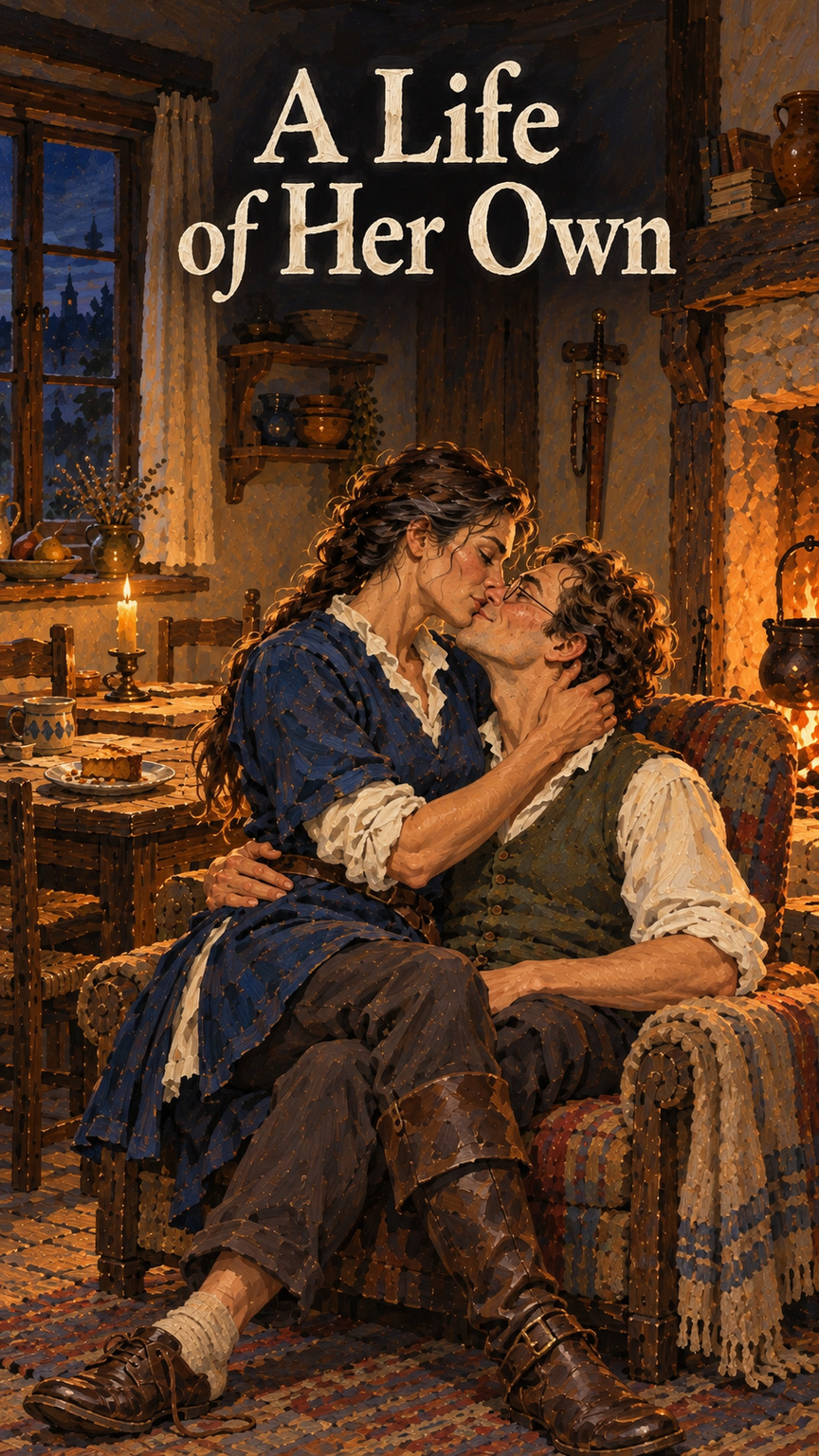
She held out her hand. He came to sit beside her in the wide chair, awkwardly at first, with one shoe on and one shoe off. She moved her leg to make room. His shoulder settled against hers.
Beyond the kitchen window, the last light had gone out of the sky. Somebody closed a shutter in the lane. Ameline put her cheek against Piers's hair.
“You promised to challenge the king,” she said.
“Tomorrow.”
“You'll want the morning for practice.”
“Possibly all day.”
She laughed, and felt his arm tighten around her. He lifted his face to hers. She had kissed him goodbye so often that, when the kiss ended, she was surprised to find herself still sitting down.
She drew him closer and kissed him again.