
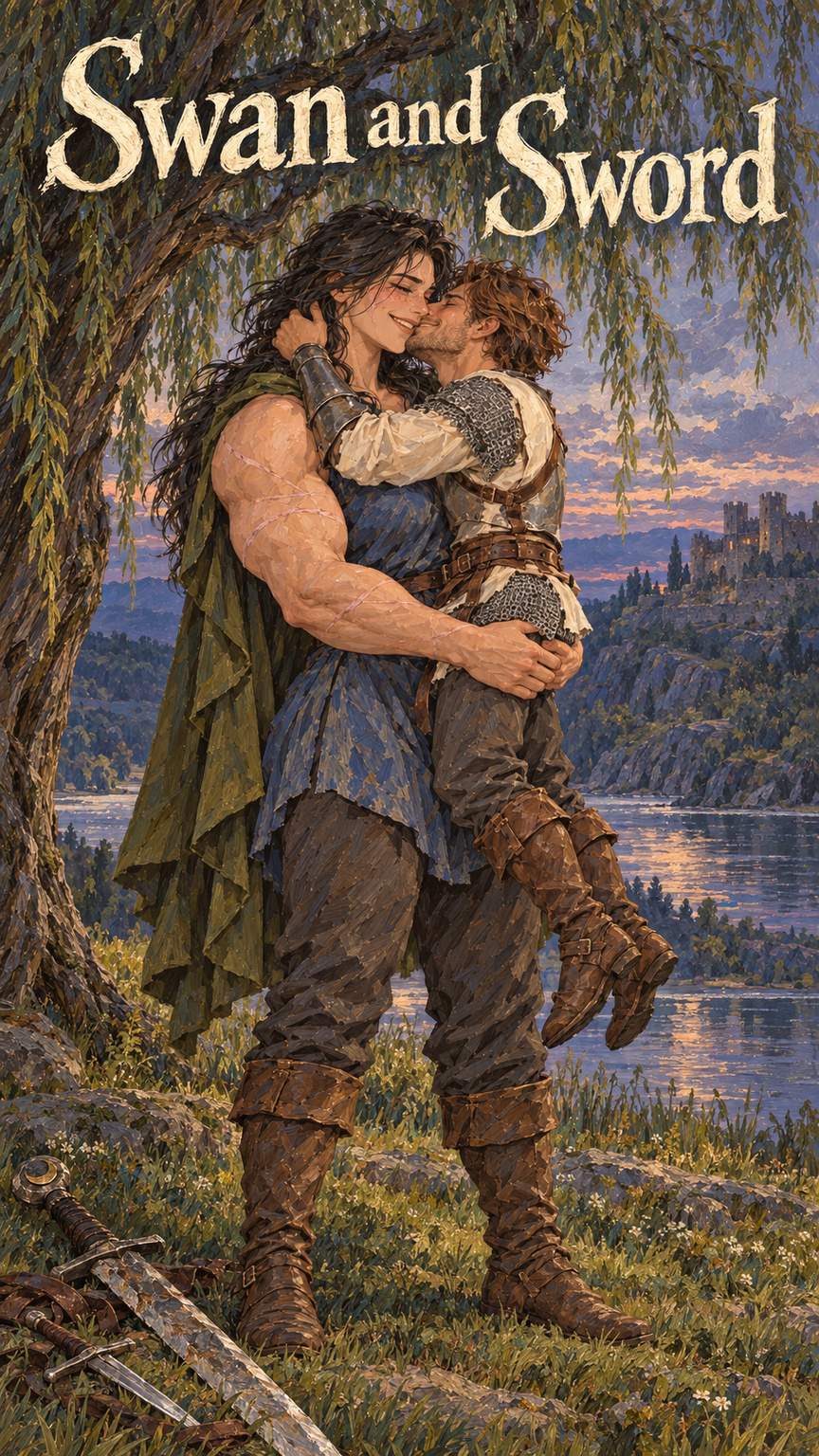
Sir Roland had brought a cloak, a pair of slippers, and the enchanter's knife.
The cloak was his best one. The slippers, purchased that morning, were soft green leather with little silver roses at the toes. The knife had required considerably more trouble than either, but he did not mind. Halla was waiting under the willow. He stepped over a fallen limb on his way down the bank.
She came ashore when she saw him, lifting her white wings clear of the reeds. A narrow silver collar lay against the feathers of her throat. Four tiny faces were worked into its clasp, their eyes closed.
“You got it,” she said.
“As promised.”
“And the soldiers?”
“Still asleep.”
He had passed four of them in the fortress gallery: stone men, each with a stone sword resting between its feet. Halla had told him the enchanter had carved them himself from blocks of granite. Their faces were the larger likenesses of those on Halla's collar. He had also climbed a chimney, crossed a floor that wasn't entirely there, and opened a cabinet whose lock bit him. The little punctures in his thumb had stopped bleeding. He kept that hand behind his back.
Halla noticed anyway.
“It bit you.”
“Barely.”
“I did warn you.”
“You said it might bite. I felt that left room for optimism.”
She gave one of her quiet, breathy laughs. Roland had spent six weeks finding reasons to hear that sound. He had worn a track through the bracken while maintaining, in several letters to his brother, that he was still looking for the western road.
At first he had stopped to rest his horse. A swan had come out of the lake to tell him his girth strap was loose. He had thanked her, gone on half a mile, and returned to ask whether she had said something.
By the third visit he knew about the curse. By the fifth he knew she preferred the cherries to the bread he brought, remembered every word of the songs he forgot, and would rather discuss a battle she had fought in than describe the enchanter's cruelty. She had been a soldier. The enchanter had been dead for a year, which had proved less helpful than anyone might hope.
Yesterday, after Roland had finished telling a very long story that required her to laugh at him twice, she had gone still.
“If you could break it,” she had said, studying a reed, “would you stay a little while afterward?”
“Of course.”
“I mean with me. As we are now. Except I could go where you go.”
He had understood her then, and had needed to sit down.
He had agreed. He had promised, rather breathlessly, to take her dancing at the summer fair. Then he had asked where the knife was kept.
Now he knelt on the bank and unwrapped it. It was a small, ugly thing, with a blade like a black thorn. Halla stretched out her neck.
“The clasp,” she said. “Just put the point under it. It should spring apart.”
Roland spread the cloak beside her. He had thought this out carefully. She would be cold. She would be unsteady on her feet. He would help her up, turn away while she wrapped herself in his cloak, then offer her the slippers.
He had also prepared something to say.
For weeks her voice had been supplying the details of a woman he had never seen: a slender figure, a delicate face, dark hair perhaps. Someone like the dancers who moved through the king's hall with scarcely a whisper from the floor. She would lower her eyes when he took her hand.
“Ready?” he asked.
“Very.”
He slipped the knife under the clasp.
The four silver faces opened their eyes. Then the collar sprang apart with a snap and struck the earth in two pieces. Halla's white wings swept upward, filling his sight, and the air smelled suddenly of snow.
Roland scrambled backward.
Where the swan had stood, a woman was rising to her feet. She rose past him, past the low willow bough, until she had to put up one hand and move it gently out of her hair.
She was nine feet tall.
Her sleeveless blue tunic stretched across shoulders broader than his shield. Old white scars crossed the thick muscles of her arms; a puckered mark ran from one collarbone beneath the cloth, and another divided an eyebrow. Her forearms looked capable of straightening horseshoes. Her boots had settled on his carefully spread cloak.
Then she looked down at him.
Roland had once ridden three days out of his way to see a queen whose face was celebrated in nine kingdoms. He could no longer remember what she looked like.
A small scar crossed Halla's cheek. It bent when she smiled, and a dimple appeared beside it. There were gray flecks in her dark eyes. He was trying to see all of her at once, which was difficult, partly because there was so much of her and partly because he kept coming back to her face.
“Oh,” she said softly. “You're sitting down.”
He was.
She offered him a hand. He put his in it, and she lifted him as easily as he might have helped a child over a stile.
Even standing, he had to tilt his head back.
“Halla.”
“Yes.”
“You're—”
Her smile faltered. She tucked a loose strand of black hair behind her ear and waited.
He had faced a charging boar without losing the use of his tongue. He tried to remember how.
“I had something to say,” he managed.
“Oh.” She glanced toward the lake. “Would you like a moment?”
“It was going to be about how beautiful you are.”
Her eyes came back to his.
“You could still say that,” she said.
“You are the most beautiful woman I have ever seen.”
The color rose in her cheeks. She looked away again, smiling now, and stroked her thumb over his knuckles. His whole hand was still resting in hers.
“Thank you,” she whispered.
He had got the shyness exactly right.
He began to laugh. She looked down quickly, and he tried to stop, which only made it worse.
“I'm sorry,” he said. “The slippers.”
“What slippers?”
He took them out of his satchel.
Halla looked at the little silver roses, then at her own boots. For a moment she pressed her lips together. Then the breathy laugh he knew came out of her, full and warm, and he laughed with her until she had to lean one hand against the willow.
“They're lovely,” she said, when she could.
“I had hoped you'd think so.”
“Perhaps I could keep them?”
“What on earth for?”
She touched one rose with her smallest finger.
“You brought me flowers.”
He looked at her. The amusement was still in her face, but she had said it quite seriously.
“I'll bring you some you can wear,” he said.
“I would like that.”
She stepped off the cloak, stooped, and lifted it from the grass. A dead leaf clung to it. She picked the leaf free with the same precise care she had used, as a swan, to turn the pages of the book he read aloud.
“Were you expecting someone smaller?”
“There was rather less of her, yes.”
“Less of me.”
“You. Yes.” He took a breath. “I seem to have made up a woman and put your voice in her.”
“Was she nice?”
“Very. I was going to help her stand.”
Halla glanced at their joined hands, and her mouth trembled with another suppressed laugh.
“I think I should like to meet her,” she said.
“I'm finding her difficult to remember.”
Her thumb went still against his knuckles. For a while neither spoke. Roland could feel the rough places on her palm, and the slow, careful pressure of her fingers around his. He put the slippers away, then laid his free hand over hers.
“May I—” she began.
A heavy crash came from the fortress.
They both turned.
The gallery shutters burst outward. A stone soldier stepped through, struck the terrace below, and cracked a flagstone under its feet. Three more followed. Their swords scraped the wall as they came down the steps toward the lake.
Roland drew his sword. Halla set his cloak on a willow branch.
“They were asleep,” he said.
“The collar must have been keeping them that way.” She looked at the broken silver on the ground. “He was a very spiteful man.”
The nearest soldier raised its blade.
Roland stepped in front of her.
“Roland,” she said.
He had heard that tone when he had been about to ride the wrong way into a bog. He looked back.
“Would you take the one on the left? I need to get to the gate.”
There was no fear in her face. He moved.
The first stroke drove his sword almost to the ground. He yielded, turned, and let the stone blade bury itself in the bank. While the soldier wrenched it free, he slipped past its shoulder and struck behind the knee. A chip flew off. The leg buckled.
Beyond it, Halla caught another soldier's sword between her hands.
She turned with it, as smoothly as a woman turning under her partner's arm. The soldier went where she sent it. Its feet left the earth, and it crashed into a third with a noise like a cartload of plates falling down stairs.
Roland nearly forgot his own opponent.
“Mind your right,” she called.
He ducked. Stone whistled over his head.
Halla was already crossing the terrace. Above the fortress gate hung an enormous iron sword. Roland had noticed it on his way in, and assumed it was a sign intended to discourage visitors.
She reached up, seized the hilt, and pulled. The brackets tore out of the wall.
For a moment she stood looking at the blade. Her thumb found a worn place on its grip.
Then the last soldier came at her across the terrace.
Halla met it in two strides. Her sword swept up, took its stone weapon near the hilt, and broke it. A second blow struck the soldier across the waist. Its upper half slid sideways and fell with a thud that Roland felt through his boots.
His own opponent dragged its damaged leg after him. He backed toward the fallen willow limb at the edge of the clearing, waited for its sword to rise, and vaulted the wood.
It tried to follow. The cracked knee struck the limb and broke. Roland was on its back before it could lift itself, driving his sword point into the narrow carved joint at its neck.
Across the terrace, Halla brought her sword down on one of the fallen soldiers. Its breastplate split, and its arms fell still. The other struggled up. She caught it by the front of its breastplate, turned, and threw it into the empty gallery. The crash went on for some time. Fragments of a stone boot tumbled out of the doorway.
Roland twisted his sword. The stone head came loose.
Silence returned, apart from a last few pieces falling inside the fortress.
He stood breathing hard, a foot on the soldier's back. Halla looked over her shoulder.
“Are you hurt?”
“No.”
“Your hand?”
He looked down. His thumb had begun to bleed again.
“The cabinet,” he said.
She nodded gravely, although he could see that she wanted to smile.
He freed his sword. By the time he reached her, she had cleaned hers on the turf and was holding it against her shoulder. It was a battered, practical weapon, taller than he was. There was a little crescent stamped into the pommel.
“Yours?” he asked.
“Since I was twenty.”
“I thought it was decoration.”
“So did the enchanter.” She looked up at the empty brackets. “He liked to hang things up where I could see them.”
Roland touched her arm. Under his fingers, a pale scar ran into another, older one.
She turned back to him. He could feel how carefully she kept the great sword still.
“What were you going to ask me?” he said.
“When?”
“Before they interrupted.”
“Oh.”
She lowered her eyes. The gray flecks vanished beneath her lashes.
“I was wondering if I could kiss you.”
He put his sword away.
“I've been hoping you would for about a month.”
Her smile returned slowly. She planted her sword upright in the earth, well away from his feet, and knelt. Even then, they were almost of a height.
The hand she put against his cheek was warm. He leaned into it. She kissed him softly, almost tentatively, and he held her face in both hands.
When they drew apart, she remained close enough that he could feel her smiling.
“There,” she said.
“There,” he agreed, a little unsteadily.
They stayed by the lake until the sun had dropped below the fortress wall. Halla tied his cloak about her shoulders, where it hung well above her knees. She said it was exactly what she needed. Roland wrapped the biting knife and the pieces of the collar in a scrap of cloth and stowed them deep in his satchel, underneath the slippers.
His horse, on being introduced to Halla, inspected her hand for cherries. She had saved two from the little parcel on the bank.
“Sensible creature,” Roland said.
She fed it one, and then, after some consideration, the other.
They could reach the fair by tomorrow evening if they left at first light. There would be a crowd, and music, and other people for Halla to speak to after three years beside this lake. She asked whether Roland would mind staying close to her at first.
He said he could probably manage that.
In the dusk he began to hum one of the songs she had taught him. Halla corrected the third line, then stopped and looked at his offered hand.
“Now?”
“Practice.”
She laid down her sword beside the willow. He took off his sword belt, set it with hers, and held out his hand again.
“I haven't danced in years,” she said.
“You haven't done quite a few things in years. You seem to remember them.”
She gave him a pleased, sideways glance and took his hand. Her other hand settled lightly at his back.
He had known she would be graceful. He had not imagined the strength he could feel even in the gentlest movement, or how much he would enjoy following where it led. Her steps were sure. She made room for his shorter ones without seeming to think about it.
He sang quietly. She supplied the words when he lost them.
At the turn she bent toward him, and he rose onto his toes. It was not quite enough. They stopped, laughing, their foreheads almost touching.
Halla's hands moved to his waist.
“May I?”
“Please.”
She lifted him. He put his arms around her shoulders, and for the first time saw her face without looking up. Beyond it the lake shone between the willow branches.
She was blushing again.
“How is this?” she asked.
Roland kissed the small scar that bent beside her smile.
“Don't put me down yet.”
She turned with him under the willow, very slowly, and did not.