
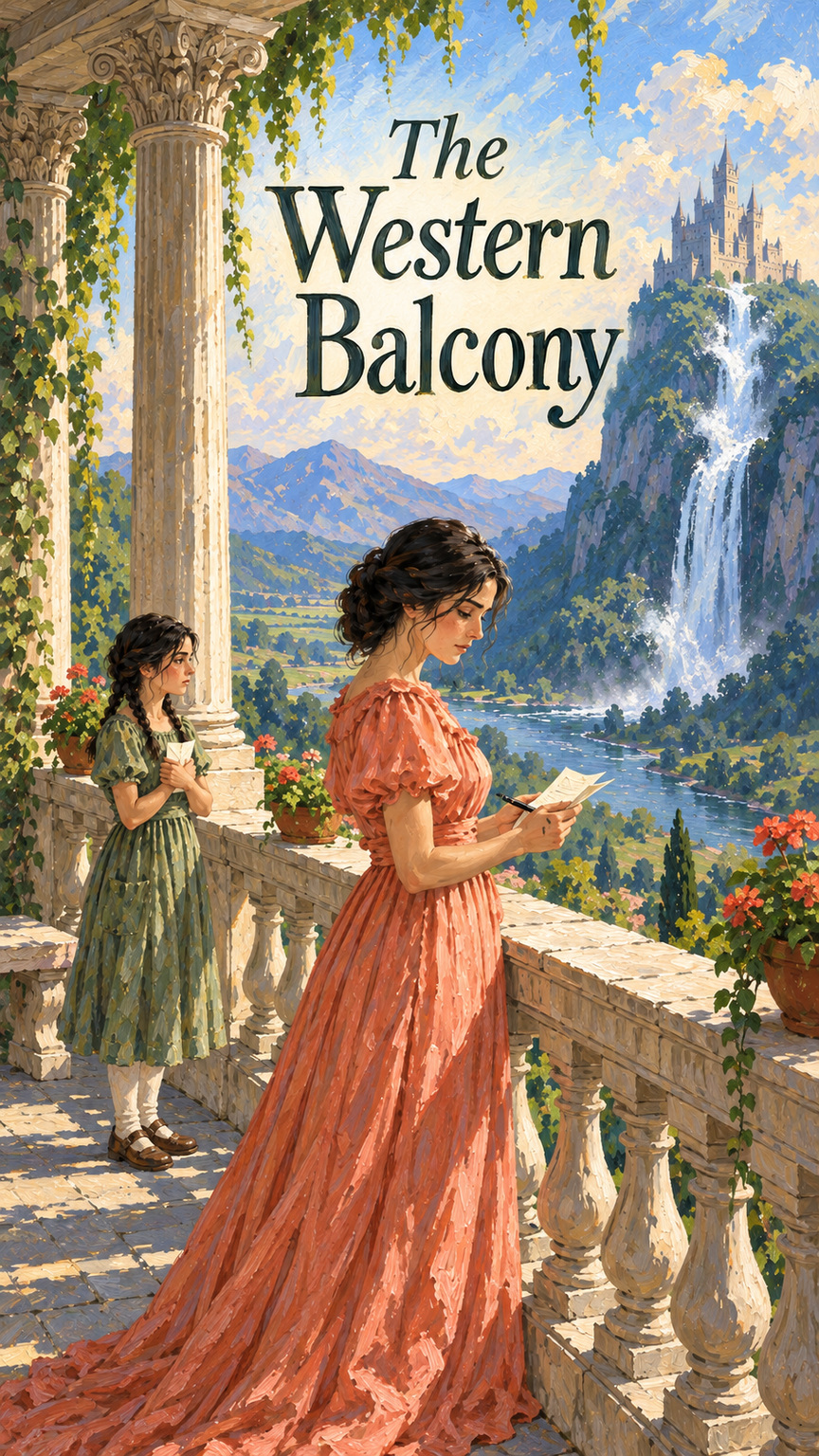
My mother had been dead for thirty years. I had brought her a letter explaining how to stay alive.
It was not addressed that way. On the outside I had written her full name, her title, and the date of the harvest supper, three days before the siege. Inside were ninety-four words. The first six were Do not send the soldiers home.
She had believed the peace treaty. So had everyone else. Its white seal appeared in the surviving accounts with such tenderness that for years I could not bear the sight of white wax. The soldiers went home to gather their own harvests. The army that had signed the treaty arrived before the leaves fell.
My mother died in the palace. The kingdom lasted another three weeks.
“Is this where you played?” Eddra asked.
She was leaning over the balustrade, looking into the garden. Eleven years old, with her father's narrow shoulders and the backs of her stockings wrinkled over her shoes. I had told her twice to straighten them. Now I wished I had not.
“Sometimes.”
The garden had been replanted. There were pink flowers where the kitchen garden used to be, and someone had put pots of geraniums along the western balcony. The columns were clean. Only in the deep cuts of the capitals did a little black remain.
I had expected to recognize more.
Beyond the palace, the river curved through a green valley. The great falls hung white beneath the castle on the opposite hill. A new country owned both palaces now. Its flag moved above the distant towers, too far away for me to hear it snap.
In four minutes the falls would flow backward. Exactly one minute in every hundred years. Each living person on this balcony could release one message to any person, at any past moment. Write the person and the time on the outside, fold the paper, open your hand. The recipient would find it in theirs.
I had practised with leaves, with scraps, with the actual letter until its edges softened. I meant to send at the first upward movement. There would be no trembling, no delay.
“The pear tree was there,” I said, pointing to a bed of pale flowers. “Your grandmother used to say the gardeners were picking them too soon. She'd make us eat one to prove it.”
“Even if it was hard?”
“Especially.”
Eddra smiled. I had told her that story before. I had told her all of them before: my mother's socks drying on the council-room hearth; my mother feeding her brother's solemn hunting dog under the table; my mother saying, You can help me be late, and taking me out to look at the first snow instead of receiving an ambassador.
I had left out the occasion when she was tired and slapped my hand for reaching across her writing. I had forgotten it myself until that morning, finding the same table in a room used now for visitors' coats. I could remember the offended heat in my fingers. I had been seven. I had thought she would never love me again. Then she had asked me to turn the pages of her book because her hands were full of pear juice.
When the pears really were ripe, Tem, the kitchen boy, would hold a cupped hand beneath my chin to catch the juice before it spoiled my dress.
Eddra took a small folded paper from her sleeve.
“Is that your copy?” I asked.
She put it back. “It's mine.”
Of course it was. She had copied my drafts for me, fetched books, held a ruler along columns of dates. It pleased her to get a difficult name right. It pleased me to see her taking an interest.
Below us, the gravel gave a brief crunch. I looked through the balusters and saw Selwin crossing the courtyard toward the lower gate. He stopped to examine something in the wheel of our carriage. He could have had a view of the falls from there if he had turned.
He did not turn.
The night before, he had sat with my mother's coral gown across his knees, sewing a new panel into the side. It was the one royal dress that had reached exile with me, wrapped in the bundle my mother's seamstress had carried out. I had meant to wear it without alterations. Selwin had watched me try to fasten it, then held out his hand.
“You have to breathe,” he said.
I stood in my shift while he worked. Beside the lamp were my pages, the letter to save the kingdom, the shorter one to save my mother alone, the discarded versions meant to preserve this marriage through whatever happened afterward.
“If I tell you where to find me,” I began.
“I know where to find you.”
“Before. At the shop. Even if I never came there for work.”
His needle stopped.
“That boy wouldn't know you.”
“You'd have time.”
“I don't want instructions to marry a stranger.”
“I wasn't going to say that.”
He looked at the pages. I had crossed out marry in three places and substituted meet.
“I'll take you there,” he said. “I'll bring you home if there's still someone to bring home. But I won't help you do this.”
For years I had made the destruction small enough to correct. A false treaty, a misplaced trust, a letter delivered three days earlier. Selwin kept making it large again, filling it with the life that had followed: a girl sweeping the floor of his mother's shop; a boy hiding the good shears because she kept using them to cut paper; their first room with its ugly yellow curtains. Eddra learning to walk between two chairs.
I had told him I would find him in any history.
I had told Eddra too.
She rested her chin on the stone. “Will she still be young?”
“Who?”
“Grandmother.”
“She'll be older than I am now.”
“Oh.” She considered that. “Will she like Dad?”
I nearly said yes. My mother had loved me. Selwin was easy to love. I had made a bridge of those two things so often that I could scarcely see the gap.
“I hope so.”
Eddra looked down into the courtyard. Selwin had straightened. She lifted a hand, although he could not see us from under the arcade.
The little clock I had set on the balustrade clicked toward the hour. Its case was cheap, its face larger than it needed to be. Selwin had bought it when Eddra was learning her numbers. The painted rabbit at the bottom had lost an ear.
I took my pen from the pocket of the gown. I had filled it that morning, although the letter was finished. There was always the possibility of one last correction.
Across the valley, a line of sunlight emerged from behind the castle. I put the pen away, unfolded my letter for the last time, and read the ninety-four words.
My mother had only needed to keep the soldiers at their posts. The villages would have been defended. The army would have found something besides frightened servants at the palace doors. My mother would have reached the age at which she needed spectacles. I could have been with her when she first held them away from her face in irritation.
I folded the letter. Her name and the date lay upward against my fingers.
“Ready?” Eddra whispered.
I nodded.
The falls stopped falling.
It happened first at the bottom, where the white spray gathered itself out of the river. Drops rose through the air. The great sheet of water buckled and began to climb the cliff. The roar thinned to a hiss.
My fingers were opening when another paper appeared between them.
I caught both.
This one had my name on the outside, and beneath it: Today. First rise.
Inside, in my handwriting:
Whatever you do, let it burn.
The ink shone wet. The last stroke of the n ran off the torn edge. I knew that impatient stroke. I made it when I was writing faster than my hand could go.
For a moment I thought I had dropped my own letter and picked up a different draft. But the ninety-four words were still in my other hand. Nothing had been taken from me. I could send them.
I had not spent thirty years believing the past could be changed only to decide now that my own handwriting was a command. A warning was a warning. I could disobey it.
I lifted the folded letter toward the ascending spray.
Eddra touched my elbow.
“What's wrong?”
I looked at her. She was silently rehearsing our first line, the one we had copied together: Do not send the soldiers home.
There was still time. My hand had begun to shake, but hers was steady. She had a message of her own to spend. I could warn my mother, and Eddra could write to the boy at the shop, on the day before I had first gone there. Tell him where I would be. Arrange an encounter. Give us a chance.
“You could send to your father,” I said.
She drew the paper from her sleeve.
“I brought my own.”
She held it against her chest, but I could see the outside. My mother's name. The date of the fire, a moment after I had been carried out of the palace.
For my mother alone. Not the kingdom.
“Let me—”
“I want to meet her.”
“No, Eddra.”
The words came out with the ease of straightening her stockings. I held out my hand for her paper.
She did not give it to me.
Above the falls, the rising spray had reached the first ledge. There were dark rocks I had never seen, hidden all my childhood behind the white water. Now they were bare.
Selwin's hands lay clear in my mind, motionless over the coral silk. He had said no. I had come up here and begun arranging the boy he had been, as if the man waiting below were a flaw I could correct in another draft.
Eddra was watching my hand.
I lowered it.
She opened her letter far enough to show me two lines.
Your little girl is safe. Leave the palace. Come and find her.
I saw my mother reading that. I saw her going down the kitchen stair, holding up her skirts. No white seal, no soldiers, no kingdom saved. Just my mother alive, looking for me.
I wanted it so badly that I bent toward the paper.
“She would come for me,” I said.
“I know.”
My mother had put me into the seamstress's arms. She had wrapped my coat around me over my nightdress, too much wool for the season. I remembered her trying to push my thumb through its cuff. Behind her, Tem was calling that someone was still upstairs.
She had left the coat crooked and turned toward his voice.
She would have searched for me. She would never have left me sweeping floors in a foreign town. I would not have stayed in Selwin's mother's shop, pretending I had no name that mattered. There were instructions I could write to keep us on that road, but my mother would have had to obey them too. Stay hidden. Don't come for me. Let me believe you died.
Eddra folded her paper again.
“You said you'd find Dad.”
“I can't promise it.”
“You promised.”
“Yes.”
She looked away. I wanted to tell her that it had been hope, that I had meant it, that I had spent years trying to make it true. I wanted her to understand how much I loved my mother.
“I meant—”
“Stop talking,” she said. “Please.”
I closed my mouth.
The clock's second hand passed the painted rabbit. Half the minute was gone.
The letter to save my kingdom lay warm and soft in my palm. I could still open that hand. There was nothing holding it shut.
The ninety-four words were for Tem too. His name was on the list of the palace dead. They could have kept the fire from reaching him. I remembered the juice in his palm and how carefully he had waited for me to swallow before taking it away.
The cuff of Eddra's sleeve brushed my wrist. Her arm was warm against mine. In the history I could make, she might never be born. The man waiting below might never know her.
I kept my hand closed and took out the pen instead.
I tore the blank lower margin off the prepared letter and wrote:
Whatever you do, let it burn.
I could have asked myself to wait. To look at Eddra. But I knew what I did with a gentler objection: changed a word, added a safeguard, made another draft. I had needed to hear a refusal. There would be no one else to blame for these words. Three days before the siege, my mother was alive. All the people I could not remember were alive too.
The pen had caught on the last letter as the paper moved under it. I wrote my name on the outside, then Today. First rise. Folded it once.
Eddra stood beside me with her letter gripped in both hands.
I opened mine.
The new paper vanished. The sentence remained on the sheet that had arrived at the first rise.
Across the valley, the water fell.
The roar came back so heavily that I took a step toward Eddra. She moved before I could touch her. She went to the balustrade and looked over it, her folded letter still in her hands.
I put the pen away. A line of ink ran along my thumb. The prepared warning, with its bottom margin missing, was still addressed to my mother. I did not know what to do with it now that it could no longer reach her.
“I almost sent it,” Eddra said.
I waited.
“She might have liked Dad.”
“She might.”
“It could have worked.”
“Yes.”
The falls roared. There was no need to keep our voices quiet anymore, but we did.
“I didn't want to lose him,” she said. “Even if it was only might.”
I sat on the stone bench beside the door. I had remembered it as high enough to swing my feet from. My shoes rested flat on the paving.
For thirty years there had always been another draft. I could wake in the night and change a word, then sleep again because I had made the letter better. I could tell Selwin I would come to bed when I had finished. I could tell Eddra we would go somewhere when the copying was done.
There was no next version.
I held the letter open across my knees. I could see my mother's thumb working at my cuff. She was impatient because I had curled my hand into a fist. I had wanted to hold her skirt. Even when she lifted me into the seamstress's arms, I had kept a little of the cloth caught between my fingers.
Eddra came away from the railing.
“Can we go down?”
“Yes.”
She put her own letter in her pocket. I reached toward the fold, wanting to see the rest of what she had written, but she covered it with her hand.
I let it stay there.
At the door she stopped to pull up her stockings. Then she went ahead of me down the stairs.
I folded the ninety-four words along their old creases and carried them with me.