
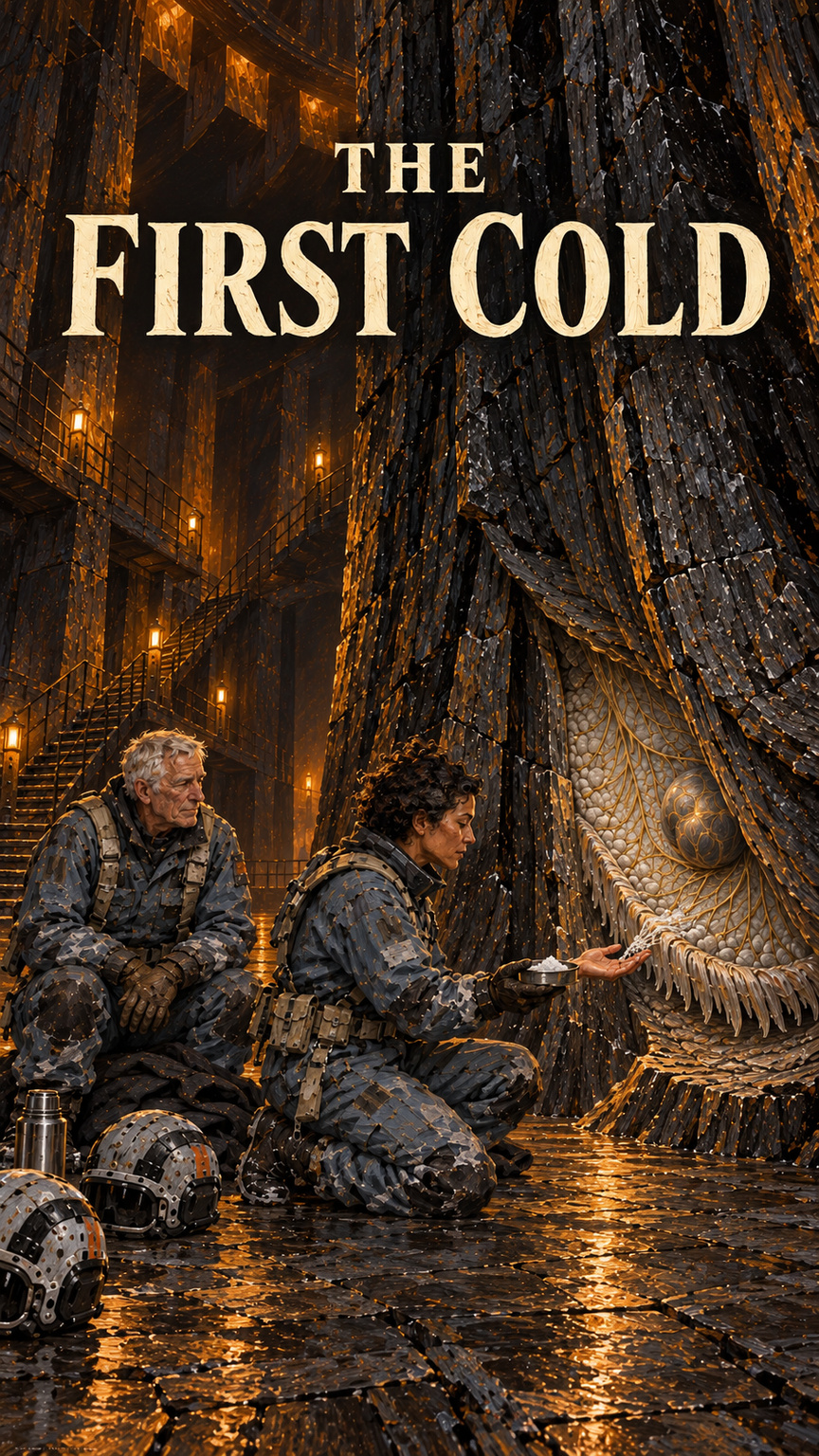
The listening was the part of the round Ivara meant to stop when Deren retired.
There was useful work before it. They cleared the access doors, replaced the rubber on their own instruments, checked the colony's brackets against the towers' immense sides. Ice could prise a ladder loose. A worker could leave a glove in a hinge. The towers themselves had never failed, but there were plenty of things people could do to hurt themselves around a perfect machine.
Then Deren would sit down.
Today he chose a packing crate in the fourth tower's lowest gallery. He eased his bad ankle forward, set his helmet beside him, rubbed his flattened white hair, and shut his eyes. Overhead, furnace light moved along the teeth of a wheel so large that they could see only its lower curve. It had been turning when the colony's first surviving record was written, three hundred years ago. Nobody had ever found the other side of it.
Ivara put the last spanner away with more noise than necessary.
“You can go,” he said.
“And carry your box?”
“Leave it. I'll live here.”
“You've been saying that for nineteen years.”
“I'm close to having the place ready.”
She sat on the other end of the crate. In eleven days the box would be hers, and the rounds, and the privilege of deciding whether two people needed to sit beside a wheel that had turned without their help through every winter of their lives. Deren would go home to his room above the bakery. She had helped him move his chair to a place where he could smell the morning bread.
She wanted him to be happy there. She also wanted him, just once, to ask what she would change.
Through the gallery's narrow outer window she could see the third tower, black against the cliffs. Snow lay on its western face in an unbroken white wedge. Along its eastern edge an orange seam shone through the blowing powder. The other five towers stood beyond it, around the shallow valley that contained the last people in the world.
Under their heat the colony grew barley and beans beneath glass. Beyond the glass lay the husks of older shelters; beyond those, the snow buried everything anybody had once meant to reach. There was no remembered summer. Even the oldest stories began with people walking toward the fires.
Deren opened one eye.
“Something new in the box?”
She pulled out the new probe. Its cable was white, its display unscratched. Until this morning it had belonged to the people who checked the glasshouses: one contact head for temperature and vibration, with a filter that could separate the smaller sounds inside a larger one.
“I thought we'd try a proper foundation profile.”
He picked up his helmet.
“You've finished listening?” she asked.
“I've found something to listen to.”
The tower's foot extended three levels below the gallery. They descended beside a structural rib wider than the bakery, down iron steps the colony had hung from its side. On each landing Ivara pressed the probe against the dark material and waited for a reading. Heat rose steadily. The furnace roared above them. On the screen the roar appeared as a dense trembling band.
At the bottom, where the rib entered the bedrock, a second line lifted out of the first.
Two little peaks. A space. Two little peaks.
Ivara changed the filter. The sound entered her earpiece, small and astonishingly close.
She lifted the probe away. Silence. She put it back.
“Deren.”
He bent his head while she fitted the spare earpiece to him. His expression changed so quickly she thought he was hurt.
“It's picking us up,” she said.
They set the probe in its clamp and backed away. The beat continued.
Deren put two fingers to his throat. Ivara did the same. For a few seconds she could not attend to both sounds. Her pulse jumped under her hand; the double beat in the earpiece kept its slower pace.
“A pump?” she asked.
“Hear the second sound.”
She heard it. The little closing sound, softer than the first. A human heartbeat, of the sort that could live quietly under a shirt while its owner mended a sleeve or complained about bread.
She looked up. The rib continued into the dark above their lamps.
“There can't be anyone down here.”
Deren was already moving his light along the floor.
They found the sound strongest beside an old sounding plate. Someone from the colony had bolted it over a natural recess in the tower's foot. The date scratched into the plate was eighty-six years old; the records for that survey were in Ivara's box. They contained measurements and a drawing of the recess, nothing about what lay behind it. Nobody had cut into a tower. Nobody knew who had built them, much less how to repair one if the impossible happened.
They undid the bolts of their own plate.
Behind it was a shallow hollow with a dusty, pale floor. Ivara had expected a shaft, a cable, something descending farther than their lamps could follow. Instead a dark knot occupied the back of the recess. Fine strands spread from it through the pale floor and into the rib on either side.
Something moved under the knot's translucent covering.
Ivara brought her lamp closer.
There were chambers. She could see them filling and tightening in sequence, no larger together than her closed fist. The strands brightened at each contraction. A dull gold flush passed through them, into the tower.
She caught Deren's sleeve.
For an instant she saw a person folded into the stone. A head somewhere above them, arms stretched up the ribs, someone who had been burning under their houses while they praised the reliable heat. She moved the lamp, searching for a face.
“Where's the rest?”
Deren did not answer.
The light showed the same material throughout the hollow. Soft near the knot, then dense and fibrous, then crusted with the black mineral of the rib. A broken surface at the edge showed layers curling over one another like the grain around a branch. The strands passed through every layer. There was no wall separating the living thing from the tower.
Deren touched the dusty floor with the blunt end of a scraper.
It contracted.
The movement took the dust with it. A thin crease closed, then opened slowly again. Far overhead the great wheel went on turning at the same pace.
He put the scraper down.
“Oh,” he said.
Ivara found herself listening for a cry. There was only the furnace, and the smaller sound in her ear.
She unfastened the probe and carried it back up the steps. Deren called after her. She could not have explained herself yet, so she kept climbing.
Outside, the wind struck the sweat on her face before she closed her helmet. She crossed the apron to the third tower with the probe clamped under one arm. People moved along the lit path below, bent toward the glasshouses. Someone raised a hand to her. She did not recognize them through the blowing snow.
At the third tower's lowest survey point she took a reading.
There it was again.
This heart beat more slowly. She let it fill a minute on the display, then saved the record and stood with her gloved hand flat against the black exterior.
Nothing moved toward her. Snow struck her wrist and blew away. Beneath the mineral surface the slow heart continued, indifferent to the pressure of her hand.
By the time she returned, Deren had put his folded coat beside the open recess and was kneeling on it. He had not touched anything else.
She took off her helmet and set it on the floor.
“The third,” she said. “Forty-two. This one's sixty-one.”
He breathed out through his nose.
“Different hearts.”
She clamped the probe against the fourth tower's rib again. The quicker heartbeat returned to her ear.
“I'll send the profiles up. They can check the others.”
She sent both recordings through her helmet set and asked for the new instruments to be brought to the remaining towers. The voice from the survey room asked her to repeat the last part. She did. Then she turned the volume down. Above her, people could listen to the recordings together. Down here there was the open recess.
“Has it done anything?”
“That edge lifts when I move my knee.”
Ivara knelt beside him. Along the lower rim, a crescent of soft grey tissue rose a little from the pale floor. Deren shifted. The crescent quivered.
“Through the floor,” she said.
He nodded and put his knee back.
“Can you hear me?” Ivara asked.
She felt foolish immediately. She repeated it, louder.
The grey edge shook with her voice. It also shook when Deren coughed. The heartbeat did not change.
“It hears,” he said.
“Something does.”
She spoke quietly, then shouted a number, then whispered the same number. The tissue moved with the loudness. When she held her lamp against it, moving the beam from side to side, nothing followed.
“Maybe the light's too much,” Deren said, and shaded it.
Still nothing.
Ivara tried to imagine receiving the room through her knees. Their footsteps would have arrived first, two uneven impacts growing stronger. The spanners. The scraper. All the years of people coming to the sounding plate, striking it to check its fastenings, then leaving.
She put the soft pad of her glove on the rim.
The crescent sank away. She lifted her hand.
After a while it rose again.
She kept her hand where it was. The tissue swelled against the glove, a touch so light she could see it more easily than feel it. Then it receded.
Deren leaned closer.
She held still. The crescent returned, flattened against her thumb, and lingered there.
“Warm,” Deren said.
Ivara looked at him. “What?”
“Your hand.”
“Everything down here is warm.”
Neither of them spoke for a time.
The tower touched the seam of her glove. It pressed into the stitches, followed them a little, and drew back when it reached the hard buckle at her wrist. Ivara had worn the glove through six winters. Now she became aware of every ridge on it, the grain of the patch she had sewn over the thumb, the stiff place where old oil had dried.
She took it off.
“Careful,” Deren said.
The living edge rested against her bare thumb. It was warmer than she was and faintly pebbled. A small golden strand lay just below its surface. She had to resist closing her fingers around it.
She knew how the furnace's heat felt against her face. What did its fire feel like to the tower?
“I put my hand on the third tower,” she said. “Outside. Nothing.”
“Through all that casing?”
She pictured the immense western face packed in snow, the wind scour along its edge. This softness lay beneath casing like that. Did snow feel like anything against the outer casing? Here the tissue could find the stitches in her glove. Perhaps winter reached it only as weight and a loss of heat, with none of the small, sharp touches that struck her face.
She wanted to ask it about that.
The helmet set crackled. The second tower had a pulse. Then, while she listened, the sixth. Each at its own pace.
She took her hand away to reach the set. The crescent flattened slowly into the recess.
“They're sending someone from the infirmary,” she told Deren.
“Good.”
“I don't know what we should tell them.”
He looked at the scraper where he had laid it down. “Tell them what we've done.”
Ivara picked up the probe. She had readings from two towers, but none from the soft material. Before taking them she checked its temperature head. Her hands were shaking enough that she could not fit the cable into the calibration socket on the first try.
The kit's little vacuum flask held clean snow, packed at the start of the round. She tipped some into its shallow lid and waited until a gloss of meltwater gathered at the bottom. Then she pressed the probe into the wet base. The reading fell toward zero and settled two tenths above it. She adjusted it and tried again.
In the warm air the heap began to settle. She was watching the number when Deren touched her wrist.
The grey crescent had lifted. One side of it extended over the rim of the recess, toward the lid beside her knee.
She moved the probe away. The extension paused.
There were several things there: her hand, the lid, the small cold heap. She did not know which had drawn it. She raised the lid to the level of the opening and held it still.
The tissue lengthened. It unfolded from a crease in the floor, revealing a softer underside, and rested against the metal edge. A thin fringe passed over the rim. Ivara felt almost no weight.
Then the fringe reached the snow.
It snapped back into the recess.
The movement splashed meltwater across her wrist. She pulled the lid away so fast that the remaining snow fell onto the floor.
“Put it down,” Deren said.
She set the lid beside the flask. The crescent had drawn tight against the heart's covering. Its gold strand was bright.
“I didn't put it on.”
“I know.”
“It came out.”
“I know. Leave it.”
Ivara returned the probe to its clamp against the rib. They sat back. In her earpiece the heart was quicker, but the furnace note had not altered. Ivara could hear the wheel above, the old regular passage of its teeth through the firelight.
She wiped her wrist. Where the cold water had run over it, her skin prickled.
“It didn't know,” she said.
Deren leaned forward and picked up the sounding plate.
“What are you doing?”
“Keeping our hands out.”
He did not sound angry. He held the plate carefully, ready to turn its edge past the instruments without touching the tissue.
Ivara wanted to let him. The infirmary people would be here soon. They would have names for parts of this, and instruments made for things that could feel. She could put her gloves on and tell them about the snow.
The plate was nearly upright when she saw the movement behind it.
“Wait.”
Deren stopped.
The grey edge had loosened. Slowly, it unfolded toward the front of the recess. Its fringe reached the rim, paused, and lifted into the space where the lid had been.
There was nothing there now.
Ivara picked up the lid and reached for the flask.
“We just did that,” Deren said.
“Look where it is.”
“It could be trying to get out.”
She stopped with the flask tilted. Snow pressed against its mouth.
Of course it could. It could be trying to escape the scraper, their voices, the light. She had been ready to show him that she understood it. All she knew was that the tissue had extended again, into empty air.
She lowered the flask.
“Move the plate away,” she said.
He looked at her. Then he set it behind his knees.
With the opening clear, the fringe remained extended. It waved once and sagged toward the floor.
Ivara put her bare hand where the lid had been. The fringe touched her knuckle. It rested there, then slid along it and pressed against the gap between two fingers.
She let it go through.
It withdrew, leaving a warm damp line across her hand.
She could have stopped there. The fringe was loose again, but she remembered it drawn tight against the heart's covering. Perhaps the snow had hurt. She had no way to ask it that.
She took a little more snow from the flask, packed it into one side of the lid, and held the lid beside her bare hand. Both were within reach of the rim. She kept them level and left a gap.
The snow softened. A bead of water grew under the lid. Her arm began to tremble, so she braced her elbow on her knee.
Deren shifted on his coat. She glanced at him, expecting him to speak. He was easing his bad ankle.
The fringe still lay flat. She set the lid on her other knee, added fresh snow from the flask before the first small heap was gone, and lifted it beside her hand again.
Above them, the wheel turned. Somewhere in the colony Deren's chair stood empty over the bakery. Soon somebody would be walking toward the access doors with a bag from the infirmary, rehearsing questions whose answers might be useless here. Ivara could hear nothing in the recess beyond the heart and their own breathing.
Her hand was beginning to ache.
The grey fringe lifted from the rim.
It touched her smallest finger, moved across the air between her hand and the lid, and settled against the metal. She kept still. A fold rose behind it, supporting its weight as it extended farther.
This time, when it reached the snow, it contracted only a little.
A white crystal collapsed against the pebbled surface. Water shone in the crease beneath it. The fringe withdrew, stopping at the edge of the lid.
Ivara did not move the snow after it.
The gold strand faded, then brightened. The fold tightened. The fringe crossed the wet metal again and pressed itself into what remained of the heap.
Deren made a small sound through his nose. She looked at him and found he was reaching for the flask.
He filled the other side of the lid, keeping his fingers away from the living surface. Then he settled his hands on his knees.
Far above them the fourth tower's fire shone steadily through its narrow seam. Snow piled against the black casing, broke loose, and climbed the wind. In the foundation recess, the immense body held a little of it against itself until it melted.
Ivara's earpiece slipped. She caught it with her shoulder and could not get it back in place without moving her hand.
“Leave it,” Deren said quietly.
She did.