
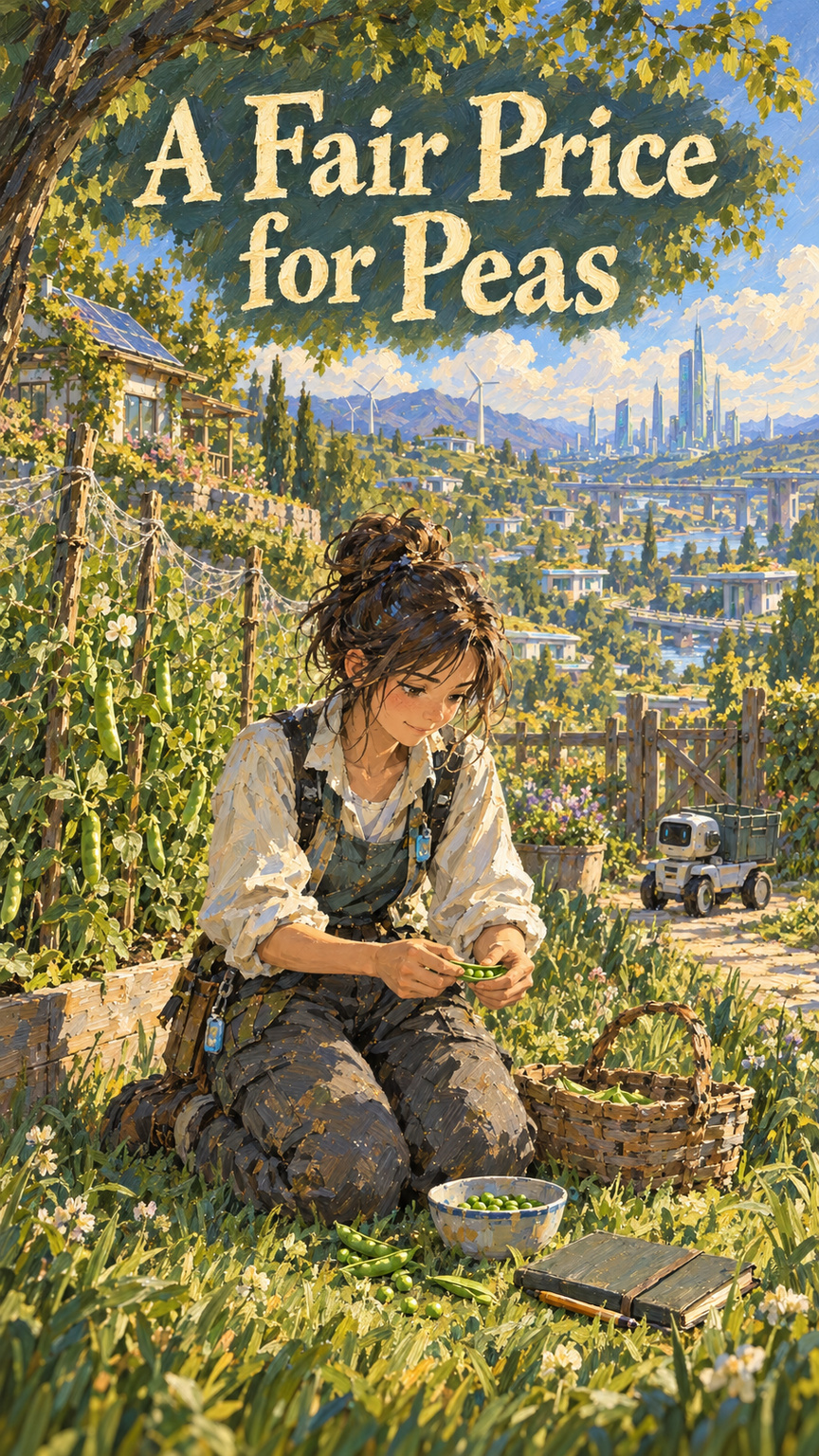
Her family had been very pleased when Romy became a farmer. The trouble began when she mentioned getting paid.
"Paid for what?" her father asked.
"The farming."
He turned a pea over on his fork. "We've been eating the evidence. Should we have kept receipts?"
"I don't mean you. I mean professionally."
Across the table, her mother stopped picking a fleck of dried clay from her wrist.
Romy had chosen dinner because the peas were hers. So were the mint and the little potatoes with their skins rubbed loose. The fish, the butter, the bread, and the strawberries had arrived that afternoon in the quiet white delivery cart, grown or made by machines that were better at their tasks than she was at hers. She had no quarrel with any of them. She especially liked the strawberries.
"A professional farmer," Lise repeated.
"When I finish school. I could start now."
"You can start another bed now," her father said. "I'll help you lift the boards."
"Not another bed. Well, yes, another bed. But I want it to be what I do."
Outside the kitchen window, the settlement stepped down the sunny hillside in terraces of pale houses and green roofs. People had been making things all afternoon. Someone was trying to persuade a wooden wheel to become round. From the next terrace came the uneven thumping of a loom. Down among the communal vegetable plots, a gardening robot waited beside a man who preferred to dig his own holes and have someone else fill them.
Lise had spent the day making bowls. The one holding the strawberries was hers, yellow glaze freckled along the rim. Romy had admired it that morning and her mother had said, as she always did, Take it, then.
"People pay you," Romy said.
"Sometimes. When I have a piece I want to exchange."
"And you get credits. And you buy things other people make."
"Yes."
"I want to do that with vegetables. Only regularly. I want people to order them."
Her father put down his fork. "I think that's a job."
There it was. The word made their familiar kitchen briefly strange.
Nobody in the family had had a job for five generations. Her father had once researched his ancestors and found a woman who had stood at a till for nine hours a day. He had spent the rest of the afternoon unable to settle to anything. The woman had needed to do it to keep her children in a house.
"You wouldn't lose anything," Romy said quickly. "If I stopped. I know that."
"Then what would you be earning a living for?" asked Lise.
"I don't know what the right word is."
This was going worse than the conversation she had rehearsed among the pea vines. In that one she had explained the difference between a profession and a hobby, and her parents had understood it on the first attempt.
"I want to sell somebody peas who doesn't have to say they're lovely."
Her mother looked down at her plate.
"They are lovely," she said, which was no help at all.
On Monday, the civic advice system offered Romy a list of gardening societies, a history of agricultural labor, and support for feelings of purposelessness.
She closed the third window particularly hard.
The human adviser who joined the call had a pencil tucked into her hair. Romy liked this until the woman used it to write down her age.
"Seventeen. And you want to employ yourself."
"If that's what it's called."
"I'm finding out."
The woman read for a while. Behind Romy, her father carried a timber frame past the open door, stopped, looked at the frame, and carried it back the other way.
"You can sell things you've made or grown," the adviser said. "But you asked about receiving regular pay in return for undertaking future agricultural labor. That wording reaches a part of the law we haven't had much reason to use."
"Is it illegal?"
"I don't know yet."
Romy had expected the government to know its own rules.
"The old prohibitions protect people from having their access to necessities depend on their work," the woman said. "Some of the wording is broader than that. I can look at a specific, limited arrangement. Has someone offered you one?"
"Not exactly."
"Then let's start there."
The adviser sent her a reference number. Under proposed occupation, it said Awaiting clarification.
Romy copied it into her notebook beneath Farmer.
Beni Oru held supper at his house every Thursday for twelve people who enjoyed arguing about food. He cooked because he liked feeding them. He had recently spent three evenings shaping a loaf that a kitchen machine could have made in eight minutes, then used the machine to make a second loaf because he had invited thirteen.
He lived two terraces below Romy. For weeks he had been leaning over her fence to ask about the peas.
On Tuesday she took him a basket, a set of figures, and the notebook.
"I thought four Thursdays," she said. "I've got three plantings. They won't all come at once. Then beans."
"I haven't agreed to peas yet."
"Right."
He pulled a stool out from under his kitchen counter. "Sit."
His knife lay on a board beside six onions, each a different size. Through his open doors she could see the tables folded against the courtyard wall, waiting for Thursday. He took a pod from her basket and ran his thumb along its seam.
"How much?"
She showed him the figures. They included her hours turning the bed, setting the supports, tying the stems, picking off beetles, and harvesting. She had left out the time she spent just looking.
Beni put a pea in his mouth. His expression changed so slightly that she nearly missed it.
He ate another.
"These have gone floury."
"They're the biggest ones."
"Yes."
"There's plenty in each pod."
"I can see that."
He tipped the peas into his palm. She could hear each one strike his skin.
"I wouldn't buy these, Romy."
She looked at the onions. One had a patch of papery skin twisted into a curl. She concentrated on it until her face stopped feeling so hot.
"They took eleven hours," she said.
Beni looked at her figures again. "Do they taste different if I know that?"
He wasn't smiling. That made it worse.
"You don't have to be nasty."
"No," he said. "I don't. I'm sorry. But I won't buy them."
At home, someone would have said they were good in soup. Her father would have fetched more butter. Lise would have praised the basket, which Romy had woven badly but with determination. Here the basket sat between them with its handle listing to one side, and nobody tried to rescue it.
Romy closed the notebook.
"I don't suppose there's any reason to buy them anyway. You can get perfect ones free."
"I can. I usually do."
She stood up.
"But I watched you put those sticks up in the wind," Beni said. "I've been asking about the flowers. I'd like to cook what comes out of that patch. Four Thursdays following your crop would be interesting. I'd change the supper as it changed."
She kept her hand on the basket.
"It can't be a basket on my doorstep whenever you're tired of eating peas," he went on. "I'd need to know what was coming. And I'd need you to tell me when it wasn't good enough."
"What if you don't like it?"
"Then we have this conversation again. Preferably without me being nasty."
She managed to look at him.
"Can I bring you some smaller ones?"
"Please."
That afternoon Romy sat between the two oldest rows and ate peas.
The big ones did taste floury. Now that she was paying attention, she couldn't mistake it. She tried to imagine asking someone to pay the number she had written down for a mouthful of them.
Higher on the vines, the pods were smaller. A few were barely filled out. Those peas were sweet, and she wanted another as soon as she had swallowed the first.
She picked six pods, then made herself stop. She was eating the next sample she ought to take him.
When Lise came out, Romy was counting through the next row, writing numbers on the back of her figures.
"How did it go?"
"He said no."
Lise sat on the grass beside her. "Oh, love."
Romy pulled a pod in half and gave her the peas.
Her mother ate them.
"Those are lovely."
"I know. These weren't the ones I took."
Lise waited. Romy counted three more stems before she could say, "I thought bigger was better. And I thought the hours would mean something."
"They do mean something."
"Not to his supper."
Her mother leaned back on her hands. Above them a delivery drone passed toward the towers beyond the hills, a violin case slung beneath it.
"I put a whole week into a jug once," Lise said. "It would not pour."
"What did you do?"
"Put flowers in it."
Romy laughed, unwillingly.
"I still liked making it," her mother said.
"I know."
"You don't have to do this to make the time count."
Romy laid another pod across her knee. She could take the peas to Beni when she happened to have good ones. She could share the rest with her family. Nothing was wrong with that picture except that it wasn't quite the one she wanted.
"I want to see what he'd make with them next week."
She took Beni twelve small pods on Wednesday. He ate three peas, then fetched a sprig of mint. He tore a leaf in half and handed it to her with another pea.
The mint swallowed the sweetness.
"Less," she said.
He gave her a smaller piece. This time she could taste both.
"I think so, too," he said, and asked how much she could supply.
This time she checked her notebook before answering.
She wrote Peas grown and hand-picked by Romy Talas at the top of a clean page.
They settled on enough shelled peas for twelve small bowls of soup, at eight credits per delivery, beginning Thursday of the following week. He would put mint and lemon in it, and serve a loaf he thought he had finally got right. After that they would see what her next planting was doing. If the crop looked poor, she would tell him by Tuesday so he could change his plans.
Romy crossed out eleven hours.
The civic adviser called her back that afternoon while she was washing the returned basket.
"What happens if you want to go away?" the woman asked.
"I tell him. He buys something else."
"And if he's paid in advance?"
"He gets it back."
"Even if you've spent it?"
Romy looked at the eight-credit deposit Beni had sent for the first Thursday. She had already looked up some things it could buy.
"I'll leave it there until he takes the peas."
They added that to the agreement. They added that Beni could refuse a delivery and stop ordering, and that Romy could stop supplying him. Her common provision would remain hers whatever either of them did. Nobody would owe anybody hours of labor.
"I can authorize these four deliveries provisionally as a continuing sale of produce," the adviser said at last. "I've referred the occupation question for a wider ruling. I'm afraid the government isn't ready to tell you whether you're a professional farmer."
"Can I tell Beni I am?"
"You can tell Beni what you like. I'd show him the terms as well."
Romy read the short document through. The last Thursday was four weeks away. It seemed much farther than that.
Lise found her in the garden on Friday, marking the pods she thought would be ready for the first delivery the following Thursday.
She had Romy's windproof jacket over her arm.
"Try this on. I mended the cuff."
Romy put down the pencil.
Every spring they took the little family boat along the coast for two nights. It was her father's boat because he had built it, her mother's boat because she had made the cups that fitted into its absurdly narrow shelves, and Romy's boat because she usually got to steer. This year she and Lise were going to swim out to the flat rock in the sheltered bay. They had been discussing how cold it would be since winter.
They were leaving on Wednesday. Romy had known that when she spoke to Beni. She had kept knowing it, in a part of her mind she hadn't consulted while counting peas.
"I don't think I'm coming," she said.
Lise held the jacket against herself.
"Why?"
"The first supper's Thursday."
"You could ask him to start a week later."
"I could."
"You've got time to ask."
"I know. But these will be floury by the Thursday after. We'd have to start with the next bed."
The next bed was still flowering. She could leave the robot to pick this crop and take it to the communal kitchen. It would be eaten. Beni would get peas from the later planting, and they could begin with those.
A small white robot came along the path with a tray of replacement tool handles. It stopped at the gate, awaiting a place to put them.
"Could that pick them?" Lise asked.
"Yes. But I told him I would. That's part of what he's buying. I'd have to ask about changing it."
"Then ask."
Romy rubbed the mark she had made on her wrist while testing the pencil. She wanted to be on the boat. She wanted to feel it turn under her hands, to hear her mother make the small startled noise she always made when she first went into cold water.
She also wanted to open these pods on Thursday morning and take them to Beni. When she had said "Less," he had put the rest of the mint leaf aside. She wanted to taste the soup they had begun figuring out together.
"I don't want to move it."
Lise folded the jacket over her arm again.
"Why make something you love into something you have to do?"
Romy started an answer. It sounded like something from the gardening society's page on purposeful activity, and she stopped.
Her mother bent to lift a loose corner of the netting away from a vine. Romy moved to help her. For a moment they worked together without speaking.
"I'll miss the rock," Romy said.
"I'll miss you on it."
On Wednesday, Lise put the jacket on Romy's bed anyway. In its pocket was the packet of ginger biscuits they always ate on the first night aboard.
Romy ran down the path with them before the luggage cart left.
"Half," she said, breaking the packet open. "You have to take half."
Her mother held out her hands.
At six on Thursday morning, Romy did not feel especially professional.
She felt cold at the knees, where the dew had soaked through her trousers. The first pod she opened contained one pea and a fat green caterpillar. She put the caterpillar on the far side of the fence and tried the next pod.
The gardening robot waited at the end of the row.
"You can bring the empty crates over," she told it. "And take the pods to the compost when I'm done."
It went briskly to work. Romy wished she had its knees.
She had marked too many pods. Some were not filled out enough; others she had left a day too long. She put those in a separate bowl. Twelve servings had sounded modest when she and Beni made the agreement. By eight she had begun opening the last of the suitable pods one at a time, hoping each would hold an extra pea.
The separate bowl was much fuller.
She weighed the good ones again. Then she called Beni.
"I've only got enough for ten. Small bowls. Like we said."
He was still in his dressing gown. Behind him, a kitchen machine was kneading dough.
"Are the ten good?"
"Yes."
"Bring them. I'll make something else for the first course. We can have the pea soup in cups."
"I could put some of the others in. They'd blend."
Beni looked at her. She looked down at the larger bowl.
"No," she said. "I'll bring the ten."
He agreed to pay her six credits instead of eight. She moved two back to his account before she could think of anything she wanted to spend them on.
When he accepted the peas, he ate one and gave her another. It was sweeter than the sample had been.
"Next Thursday?" he asked.
"I'll tell you on Tuesday."
At the supper, Beni said where the peas had come from. Romy had thought she wanted this, but she wanted to hide under the table when the other guests turned to look at her.
One woman asked what she did to keep the beetles off.
"Pick them up," she said.
The woman nodded gravely. "I was afraid you'd say that."
Afterward Beni let Romy taste the last spoonful left in the pot. He had used less mint than her father did. She could taste the peas under it, then the lemon. She wanted to ask how he had decided the amounts, but he was trying to carry a stack of plates through the doorway.
She took half the stack. "When do you put the mint in?"
"After the peas are cooked," he told her on the way to the kitchen. "Then I can taste how much it needs."
"Not half a leaf each, then."
He laughed and held the kitchen door open with his hip.
Her family came home on Friday evening with salt in the jacket cuffs and photographs of two seals that had followed the boat.
"They came right up," Lise said, showing her the pictures on a tablet. "Your father thought they were inspecting his paintwork."
In one photograph, the seals were two wet heads in a great deal of shining water. In another, Lise stood on the flat rock with her arms wrapped around herself, laughing.
Romy enlarged that one.
"Was it terribly cold?"
"Worse."
Her mother sat beside her, their shoulders touching.
"I'm sorry I missed it," Romy said.
"So am I."
Lise let her keep looking. Then she asked about the supper, and Romy told her about the ten bowls, which had become twelve cups, and the beetle woman, and how she had sent two credits back.
"Six," Lise said. "Then you made six."
Romy nodded.
Three finished bowls stood on the kitchen shelf, ready for Lise to take to the exchange. Romy had kept turning the blue-and-brown one so she could see the brown sweep along its rim.
"You hadn't taken that to the exchange yet, had you?"
"No. Why?"
"I want to buy it."
Lise looked from her to the shelf. "Love, take it."
"I would have chosen it there. What were you going to put on the label?"
Her mother reached for the bowl and set it between them. She brushed her thumb over the place where the glaze changed color.
"Five credits," she said.
Romy opened her account. Her occupation was still awaiting clarification. She sent five credits to Lise, who watched them arrive without sending them back.
Her father came in carrying the remaining ginger biscuits. He put them on the table, then went to fetch dinner from the delivery cart.
Lise slid the bowl nearer to Romy and tipped the biscuits into it. There were three whole ones and a lot of broken pieces.
"There's another picture," she said, reaching for the tablet. "Of your father trying to swim."
Romy moved closer to see.