
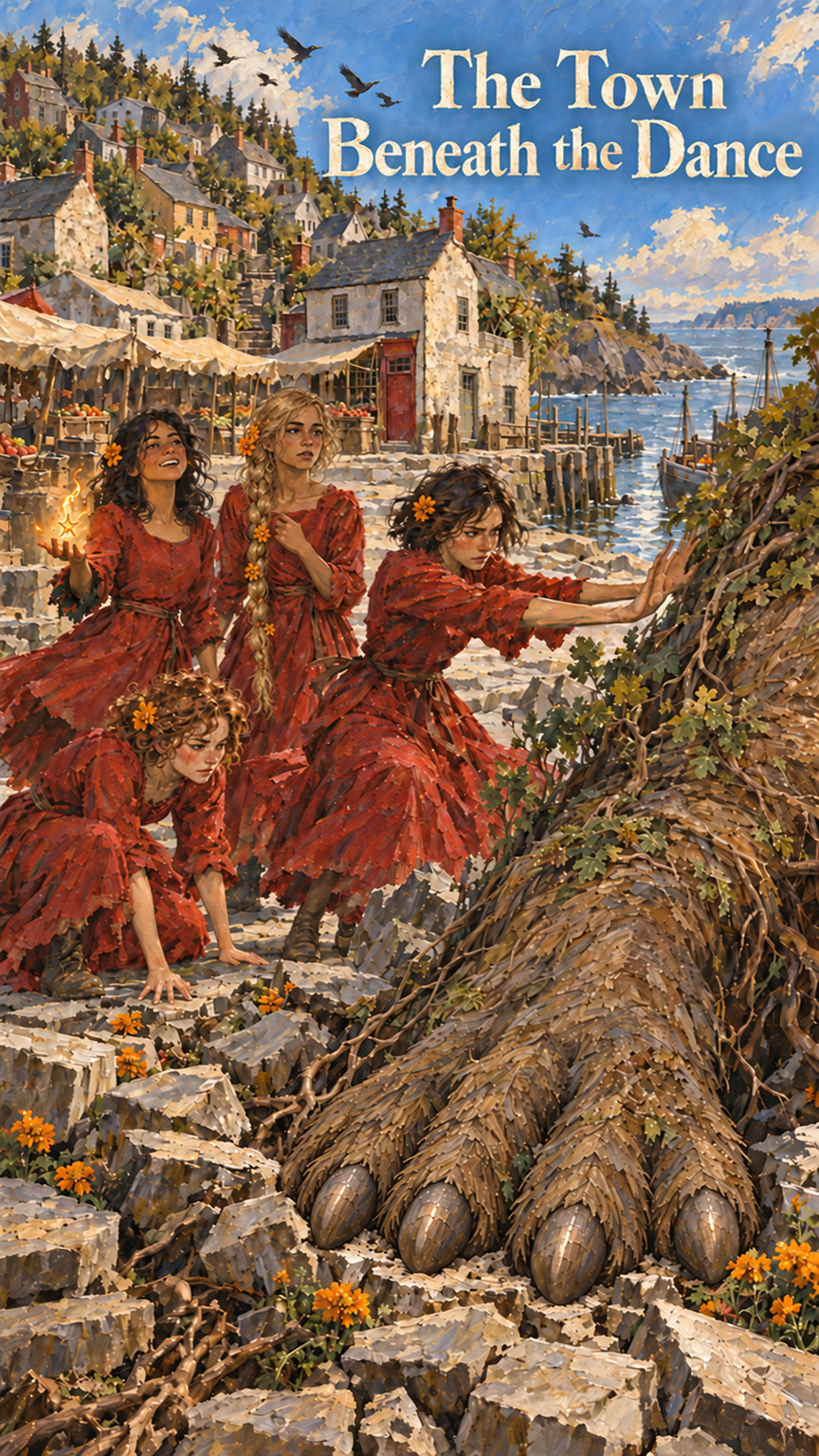
The first thing Mysie sets alight in the town is the cuff of her own gown.
She means to warm a pear. You have two pennies among you, and the woman at the fruit stall has said she might take a little magic for the rest. Mysie cups the pear in her hands, brings up a beautiful blue flame, and squeaks as it runs up her sleeve.
Elspie stamps. Rain falls on Mysie and nobody else. Nort, who has been bargaining with a crow on the stall's striped awning, says, “He thinks we should charge for that.”
The woman laughs so hard she has to put down her knife.
“You had better eat them cold.”
She gives you four pears, the soft places neatly cut away. Her name is Hett. She is broad through the shoulders, with a grey braid she has tucked down the back of her collar. Her daughter, a girl with short dark curls, watches from between the baskets.
“Where will you sleep?” Hett asks.
“We haven't chosen,” says Mysie, wringing out her sleeve.
You have passed seventeen summers without seeing the sea. Now it lies below the market, grey rather than blue, with sunlight running on it like a blade. Boats nose into the mouth of a narrow river. Houses climb the slope behind you, crowded shoulder to shoulder; the market occupies the flat ground at their feet. You had imagined arriving here would be enough. You had not imagined the long business of continuing to be hungry.
“There's a room above my shop,” Hett says. “You can carry baskets in the morning. No fire indoors. And don't let Tib bother you.”
The girl behind the baskets comes out at once.
“I won't bother them.”
Nort gives her the last quarter of her pear.
Tib takes you through the side door at the riverside corner of the shop. There is a back stair that comes out on the upper lane, and your room opens off it. She shows you the way twice, the second time at a run.
You bought one length of scarlet cloth on the road, because it was cheaper than four sensible lengths, and made your gowns in a field. Nort's hem is uneven. Elspie's sleeves are narrow. Mysie's neckline is the only thing any of you measured twice. Yours has a crooked seam at the shoulder which Mysie says she will mend when you stop fidgeting. The marigolds in your hair came from a woman who would take nothing for them.
From Hett's upper room, you can see all the way to the sea. That evening you stand at the window until the light is gone. Mysie leans against your crooked shoulder.
“What does it say?” she asks.
“Clear until morning.”
“No, the stars.”
Nobody at home ever asked the second question. They asked whether to bring the washing in, whether the frost would kill the beans. You had answers for those things some of the time. The rest of what you saw was difficult to explain and therefore, people said, best left alone.
You point out the pale star that looks fixed but is moving, and the dark place beside it that has been widening for three nights.
Mysie squints. “Show me.”
You try. She takes your pointing hand and keeps it raised, though the muscles in your arm begin to shake.
At midnight the four of you go down to the river.
There is a sandy strip below the last house, where the town boys pull up their boats. Elspie takes off her shoes before anyone can suggest anything dignified. Mysie tucks up her scarlet skirts. Nort picks a marigold out of your hair and puts it between her teeth while she braids the rest back from your face.
“If this goes wrong,” Elspie says, “I am going to deny knowing you.”
Mysie gives her a low bow, nearly falls, and drags you into a turn.
You don't know a dance that all four of you know. This turns out to be an advantage. You learn Nort's hopping step and the little heel strike Elspie insists goes before it. Mysie has an elaborate sideways movement which works only if she holds your waist. Whenever somebody loses the rhythm, you begin again, laughing harder. Your bare feet knock against pebbles. The marigold Nort held in her mouth is damp when she gives it back.
Then Mysie catches a little flame between her finger and thumb.
“This much,” she says. “No more. I try to make it bigger and it goes out.”
Elspie blows on it.
“Stop that.”
“I want to see.”
“Then look.”
But the flame has bent without going out. It follows the wind around Elspie's wrist. She cups her hand and it stays there, a gold bead, although Mysie's fingers are empty.
Mysie stares at it. She brings up another flame. This one is as large as her fist.
“Oh,” she says.
The wind has learned something too. Elspie moves her hand and a warm current slips through your wet hems, drying them. She makes it go around the circle, touching each of you in turn.
You had come to this town believing that Mysie knew a little fire, Elspie a little weather, Nort a little of what grew and flew, and that you could read the sky and sometimes wake a seed. Four small things, useful if put together carefully.
You ask Mysie for the flame.
“You'll burn yourself.”
“You did.”
“That was different.”
“How?”
She opens your fingers, smiling. The warmth comes before the light. You feel the tiny place in her breath from which she draws it; you find a place like it in your own. There is a flame in your palm. It does not hurt.
In return you show her the pale, moving star.
You cannot give it to her by pointing. You stand behind her and let her feel what happens in your ribs when you look up: the pull, the unequal distances, the slow alteration. She becomes very still. Her flame opens into five fine points.
“Is that right?” she whispers.
You have never seen anything so right.
Nort wants to know how you did it. Elspie wants to make it move. The four of you begin again, hands crossing, a word misunderstood and said again, someone shouting, “No, like this.” Mysie teaches Nort to warm a root without scorching it. Nort shows you how to listen before you touch. Under the sand is a sleeping knot of grass, alive and folded tight; with Nort beside you, you hear its small patience.
The old words come when you turn it toward the light. They always have. You do not know where you first learned them. A living sleeper moves beneath your hand, and the sounds are waiting behind your tongue.
“Erra va. Erra ven.”
Elspie kneels beside you. You give her the movement as well as the words, the delicate upward pull. Green shoots push through the sand. She laughs, startled, and the wind lifts them without tearing them. Roots under your feet uncurl toward the star in Mysie's hand.
You dance through them, lifting your feet higher.
By the time you stop, the grass has spread down to the river. Mysie can make the whole dark current shine. Nort hears roots across the water, where before she had to lay her cheek on the earth. Elspie sends rain upward in a little sparkling column, and all four of you stand beneath it, useless with happiness.
The gifts have not been divided among you. Each time one of you gives something away, she gets back a thing none of you had before.
Mysie rests her forehead against yours. The star is between your hands.
“We have to show somebody,” you say.
She grins. “Everybody.”
In the morning Tib waits outside your door with a basket she could have carried by herself.
By the fourth night there are nine of you on the sand. By the seventh, you have to move to the market because the strip beside the river is too narrow.
They come with gifts they have hidden or given ordinary names. One girl hums bread into rising. Another can find a lost pin by the ache in her smallest finger. Tib can make a picked flower open again, for a few breaths, if she holds it close to her mouth. They know dances you don't know. They know songs that have never been sung in Hett's upper room.
The baker leaves rolls for you on her window ledge. Fishermen ask Mysie to light the river mouth, and for three nights the boats come in with catches so heavy that Hett runs out of baskets. A man who would not let his daughter watch the first dance brings her himself on the fifth. When she calls rain onto his dried-up bean plants, he goes down on his knees to look at them.
Tib takes you into the little yard behind Hett's house.
An apple stump stands there, broad enough to sit on. Hett cut the tree down after two fruitless summers, when she needed wood. She has never let anyone pull out the stump.
“My grandmother planted it,” Tib says. “When Mother was smaller than me.”
There is a strip of living root beneath the wall. Nort hears it before you do.
“Not dead,” she says. “Hungry. And very cross.”
You kneel with Tib. She sings softly, an ordinary tune, and you let her feel the sleeping root turn toward her voice. You wake it together. A small shoot comes through the bark. Tib gasps, and the shoot divides. You feel its division in your own hands, a strength returning to you from hers.
“Show the others how,” you tell her.
By evening it has reached the bedroom window. The next morning Hett stands in her nightdress under a bough full of green apples. She does not say anything for a long time.
Then she catches your wrist.
“Will it last?”
You listen to the living wood. “Yes.”
That is the first promise you make her.
She walks through the market carrying an apple, showing people the skin, the leaf still fastened to the stem. Tib skips beside her. Everybody wants to touch it.
Two mornings later, a fish stall stands six inches higher at one end than the other.
The owner blames his neighbour for shifting it. But a paving stone has risen beneath the leg. Nort puts her palm on it and then draws it away.
“Something turned over.”
“A root?” Mysie asks.
“No.”
You look down the market toward the river. It is shining in full daylight now, Mysie's last lesson returned to her in a dozen new voices. The bright lines in it bend across the current. You find the pull behind your ribs and follow it downward, where you have only looked upward before.
The dark places between the lines are moving.
There is a body under the market. Another lies beneath it. You cannot count the rest.
Nort tells you that the apple roots have begun to tear. Something below them is dragging its fur through the earth.
“It heard us,” you say.
Mysie's expression changes. Elspie, who is listening from the next stall, folds her arms.
“Then tonight we don't.”
Tib comes out of Hett's shop with two friends. She has brought them to you. You feel, before anything else, the delicious anticipation of their faces changing when they understand.
“Will you teach us the words?” she asks.
You could say no. You have heard the root tearing; you have seen the lifted stone. Something immense has moved when you meant to wake an apple tree. You know enough to be afraid.
But the first night four of you could scarcely warm your hands, and the next morning you were standing in grass nobody had planted. Every time you have reached a limit together, the limit has moved.
“We should find out what it is,” you tell Elspie.
“We did find something out.”
“We can hear farther if we do it together.”
Mysie nods. You are grateful before she speaks.
“Just listening,” she says.
You teach Tib the full upward pull, the words, the reach from a living root toward the open sky. Her friends take her hands. Mysie puts the stars into the river so you can see what answers.
The apple tree flowers again. Your breath catches with Tib's. Down the river, the lights leap from bank to bank.
Below you, something opens an eye.
That night Elspie sleeps against the wall with her back to you. Mysie lies beside you, awake.
“It didn't come up,” she says.
“No.”
“We were right to listen, weren't we?” you ask.
Mysie looks past you at Elspie's back. “Yes.”
She takes your hand beneath the blanket. You let her.
In the morning, the crows will not land on the market. Nort bargains, threatens, offers them her breakfast. They remain on the high roofs, looking down.
Tib has taught the baker's youngest daughter. You learn this because the girl runs through the market shouting the waking words, delighted that Tib's voice answers in her own. She taught two cousins last night. One went home to a village over the inland ridge.
From beyond that ridge comes a long, low sound.
Every bowl on Hett's stall shivers.
Tib looks at you. For the first time since you met, she seems her twelve years.
“Wasn't I meant to?”
“I told you to show them,” you say, before anyone can answer for you. “You did what I told you.”
Then the market moves.
The ground rises in a broad arch. Hett's bowls slide from the stall and break. The apple tree knocks hard against the back of her house. Along the river, a row of boats lifts out of the water, still tied to the bank.
A paw comes through the paving stones.
It is longer than Hett's house. Earth falls from coarse brown fur. There are roots in it, some bare, some carrying entire little trees. Five blunt claws spread, feeling for a foothold. Behind it the ground heaves with the slow effort of a shoulder.
You hear the breath. Warm air pushes out of the cracks, smelling of bruised leaves and soil that has never been turned by a spade. Yellow flowers open wherever it touches.
People run uphill. Someone shouts that the witches have brought a monster. Someone else shouts for you to do something, as though those two things are a single thought.
Elspie is already running down the market.
She throws both arms forward. Wind strikes the paw. The awnings snap flat; apples blow uphill past your feet. She catches the wind back before it sweeps anyone away and puts all of it against the creature.
The paw stops.
Elspie takes a step. The claws drag, fur folding against the stones. Slowly, terribly, she presses it back.
Mysie shouts her name. The girls catch one another's hands. Elspie has taught some of them wind, and others learn it there, copying her breath, feeling the current pass through them. The pressure grows. The raised market sinks an inch.
People stop running.
“There,” says the fish-stall owner. “There, you see.”
Hett clutches Tib to her. Her face is white.
You join the working. With you, Elspie's wind finds the distances in the sky and reaches past the last house, lifting loose stones away from the people below it. A cheer goes up. You have done it. For a moment you can believe that you have done it.
Under your feet, another breath answers.
In Elspie's wind is the small upward pull you gave her on the sand. It has been there all along, but now it is large enough for the bodies below to hear. She is holding a waking creature down and calling to its sleepers with the same breath.
“Nort.”
She is listening. Her mouth tightens.
“There are more moving. This one wants to go inland. They used to come out when the flowers came. The roots in its fur remember. There were no houses then.”
“How many?”
She shakes her head.
On the ridge, something enormous darkens the clear sky.
You cannot tell whether Elspie can hold this one for an hour or a year if the circle grows enough. You have watched impossible things become easy. You cannot tell what else might answer her before that happens.
Hett sees you looking at Mysie.
“You can stop it,” she says. “You can. We need more hands. My sister's up the lane. I'll get her.”
“Wait.” You catch Mysie's sleeve. “Tell her we don't know.”
Mysie looks at Hett's house. The window where you showed her the moving star is tilting.
“We can do it,” she says.
Hett lets go of Tib and turns toward the upper lane.
“We don't know,” you say, loudly enough to stop her. “We're waking the others. It's in the wind.”
Mysie turns on you. “Then teach us something else.”
“I don't know something else.”
“You said we could hear it. You said we should find out.”
“I did.”
Hett looks between you.
You make yourself look back. “The stall moved yesterday. Nort told me something was tearing the roots. I taught Tib anyway. I thought if we had more, we'd know what to do.”
Hett's mouth opens, but it is Tib who speaks.
“The tree is still there.”
It is. Its boughs have reached around the front of the house. White blossom stands against the red shop door.
“We could make it stronger,” Tib says. “It could hold the house.”
Hett pulls her close again. The first green apple she showed the market is in the pocket of her apron; it makes a round bulge under her hand.
Elspie speaks through her teeth.
“I can hold it while you go.”
“We aren't going,” the fish-stall owner says. “We just pushed it back. Another dozen girls and we can put it where it belongs.”
“And whatever's beyond the ridge?”
“We live here.”
Elspie looks at him. The wind howls so loudly now that you can scarcely hear anything else, but she makes herself understood.
“No more into my wind.”
He starts toward her. Nort leaves the circle and stands in his way.
“Don't touch her.”
“She's doing it anyway! Look at the thing!”
He points to the paw. It has gone back almost to where it first appeared. The working is succeeding. Beneath it the shoulder shifts, and behind the ridge the other shape lifts higher.
Hett says, “How long have we got?”
Elspie takes two breaths before she can answer.
“I can give you now.”
Hett looks at the house. You wait for her to go upstairs for something: money, clothes, a box you have never seen. Instead she takes a key from under her collar.
“Tib. Take the little ones through the shop. Back stair to the upper lane. Don't wait for me.”
“But—”
“I heard you.” Hett puts a hand on her daughter's cheek. “I heard about the tree.”
Tib's eyes fill. Then she turns and holds out both hands to the youngest girls.
People begin to follow them. Hett unlocks the narrow back door and leaves the key in it. The apple boughs are crowding the doorway. She puts her shoulder under one and lifts it so a girl can pass.
The fish-stall owner stays where he is.
“You're giving it the market,” he says.
“I'm taking my daughter.”
He calls her a fool. A man behind him says he will stay too. The baker climbs onto a stool and shouts that her children are going up the lane, and anyone who wants bread tomorrow had better go with them.
The growing bough bears against the door frame. Plaster cracks above Hett's head. She ducks the falling pieces, then gets her shoulder under the bough again.
Nort whistles to the crows. She offers them the fish left on the stalls, all of it, a feast, if they will look into every upstairs window. They scatter. Soon she is pointing people toward houses you thought were empty. She goes into one herself and comes out supporting a man with a bandaged foot, swearing at him for thinking he could wait and see.
You keep your hands with Elspie's. The market is sinking under her pressure. It could work. Even now, with the other bodies moving, you want to say it could work.
Across the land comes the old waking phrase in a voice you do not know.
Elspie's fingers tighten around yours.
Mysie has gone to the riverside end of the market. Her fire lights the gap beneath a fallen awning, showing two people trapped behind it. She pulls one out. The other is the girl who can find pins. Her foot is caught under a timber.
Mysie calls for help. You cannot let go of Elspie. Nort is too far up the lane to hear.
Hett turns back from the stair.
She takes her shoulder from under the apple bough, ducks through the shop, and comes out of the riverside door behind Mysie. Together they lift the timber. Then Hett takes the girl's arm over her shoulders and leads her inside.
Mysie follows. She could begin teaching on the stair. She could find ten more girls up the lane and bring them back.
She looks at you once and keeps going.
The fish-stall owner finally runs. He leaves the scales but takes the box beneath them.
Nort returns, alone. The last crow perches on her shoulder and makes a noise in her ear.
“Nobody in the houses,” she says. “Nobody in the boats.”
Elspie's arms are shaking. The wind is still holding; the paw has not gained an inch. Nort gives her a hand, and you turn toward Hett's door.
“Now,” Elspie says.
She lets the wind go.
It lifts you halfway up the steps. You fall on your knees, scramble up, and drag Elspie into the shop. Behind you the market breaks open with a sound like a hundred doors being kicked in.
You run through Hett's house. Past the shelves of bowls, the basket hooks, the nail where she hangs her apron. Past the narrow stair window, where apples are knocking against the glass. You have slept here less than a fortnight. You know where the fourth step creaks.
Hett is waiting in the upper lane. She reaches down and pulls Elspie out by both hands.
The red shop door disappears.
From the high field above the houses, you watch the first creature rise.
It has six legs. Trees cling to its back. Its head, furred and blunt, presses through the side of the market, scattering the last intact walls. A dark eye gleams above its muzzle. It moves slowly, stiffly, as if every joint aches. There is another stirring in the hollow it leaves.
The creature sets a foot on Hett's house and bears down. For a moment the upstairs window stays whole. Then it is gone.
Tib makes a small sound. Hett holds her head against her apron.
The creature turns inland, following something neither you nor Nort can hear clearly enough to name. Flowers spring up in its footprints. One of the little trees on its back is covered with fruit. Nobody cheers.
By dusk three have climbed out. You hear others beyond the ridge. The river glows through the wreckage of the market, winding around things which used to be chairs and roofs and walls.
Some townspeople go away before dark. The fish-stall owner passes you without speaking. Others stay in the high field, where the baker is dividing the last rolls. A woman presses a blanket into Elspie's hands and says she will never let her daughter near you again. Her daughter looks back as they leave.
Hett has found four baskets. She sets them beside you.
“Carry these,” she says. “There are children with nothing to sleep on.”
You want to tell her you are sorry. You have said it twice already, and each time she has gone on with what she was doing.
Mysie helps you carry the baskets. At the other end of the field, you put them down between sleeping children.
“I wasn't putting it on you,” you say.
“It felt like you were.”
You stand beside her in your gown from the same length of cloth. Its hem is muddy. Her cuff is burnt. You can see the crooked seam she never mended.
“I wanted you to say it with me.”
She looks away. “Yesterday you wanted me to say yes.”
There is nothing to put against that.
The first stars come out. Mysie opens her hand. The little burning star hangs above her palm, the one you made between you on the sand. She offers it to you. You reach, and she closes her fingers.
“Just look,” she says.
You look together.
Later a girl you do not know comes from the far side of the field. She has walked down from the ridge. There is yellow pollen all over her shoes.
“Was it you?” she asks.
You tell her about the dance, the apple tree, the stone that rose. You tell her which thing you saw and what you did afterward. She listens without sitting down.
“Our hill's moving,” she says. “My mother won't come away. She says it'll stop.”
From the far side of the sea, too faint for anyone else in the field to notice, you hear a girl singing the old words. You don't know who taught her.
The girl before you looks up.
“Can you show me how to see them? Before they come out?”
You want to. The wanting arrives intact, almost as sweet as it was on the first night. You look across the field at Mysie. She is watching you; she knows that look.
The pin-finding girl sleeps beside Hett's baskets. You close your hand. You could go to the ridge yourself. You picture the stranger waiting for one of you the next time her hill moves.
Just looking, you tell yourself. You do not ask Mysie whether she believes that.
“I can show you what I see,” you say. “I couldn't make it stop.”
“She's still there.”
You open your hand beside hers, without touching. You show her the pull behind your ribs. The pale star is moving; the dark space beside it has widened again. After a while she finds it, and her face changes.
Under the field, far below the sleeping children, something turns toward your two open hands.