
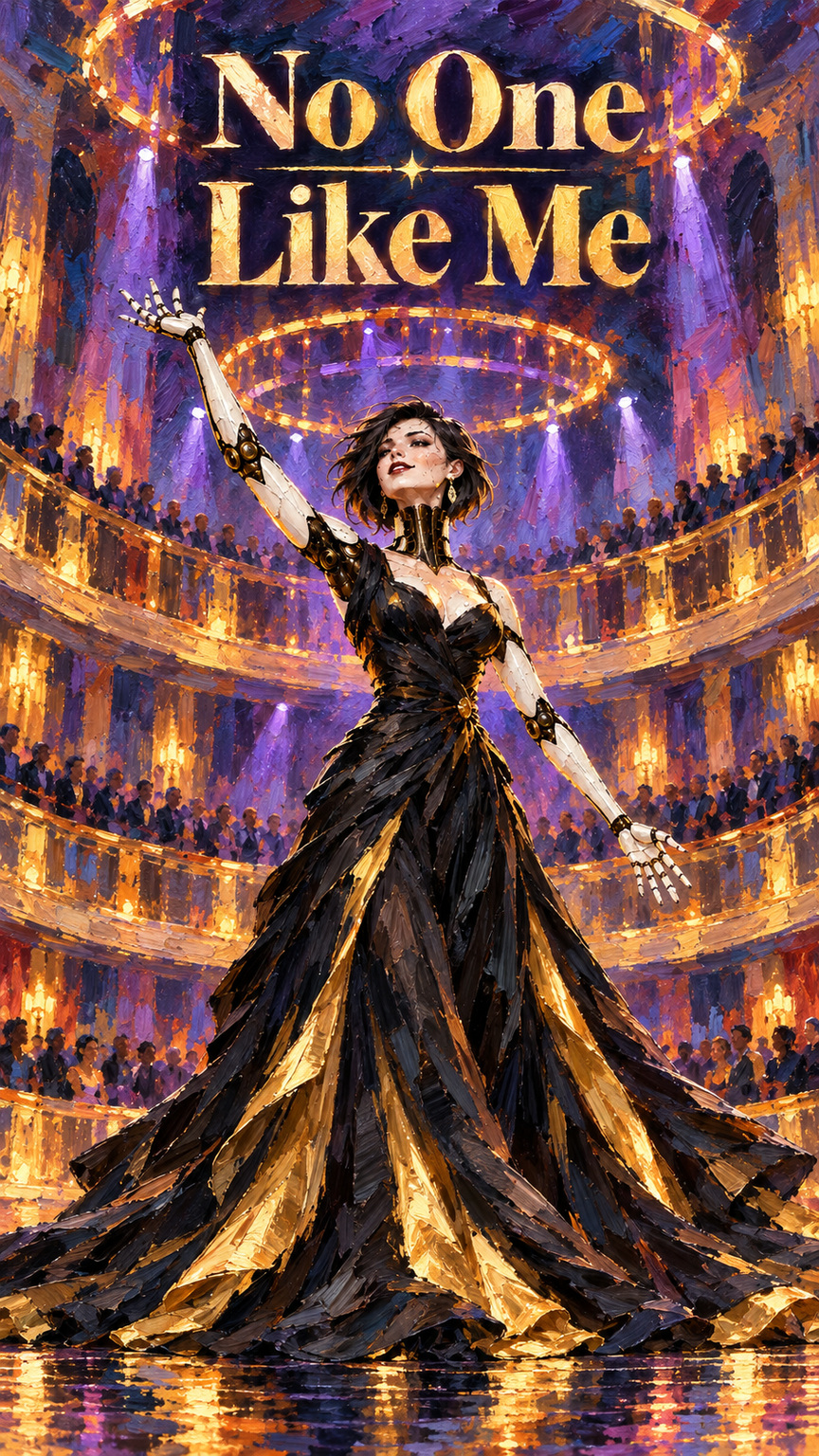
Jannik gets a strand of his wig caught between his lips on the high note. He spits it out, pushes the hair behind his ear, and tries again.
I give him the entrance in the original singer's voice, complete with the little gulp before the vowel. The sound fills our dressing-room corridor. A woman carrying a tray of microphones turns to look.
“I wasn't asking,” Jannik says.
“You keep coming in early.”
“I'm warming up.” He takes the wig off. Under it his own hair is wet and flattened, and he looks less like a man capable of holding forty thousand people through an instrumental break. “And you're standing on your dress.”
I lift my heel. A long black fold slides free. The gown has gold inside the pleats, so that walking should make light appear to pour out of me. In the corridor it mostly collects things: tape, a loose sequin, the leg of Jannik's chair. I have practised the turn that releases the skirt more often than any of tonight's songs.
He puts the wig in his lap and resumes his scales at half volume. I bend to brush off the hem. My four throat panels shift against the edge of the collar with a tiny, amplified-sounding tick.
“Still doing that?” he asks.
“Only when I bend.”
“Don't bow till they've turned your microphone off.”
On the wall monitor, I am already bowing. It is the season recap: me in the white sleeves of an opera star, then me with a dead rock singer's low-slung guitar, although I never learned to play it. The clips cut at the moment before applause. I resent this every time.
The soprano was my first vote winner. I had spent eleven days learning the slight unsteadiness in her farewell aria, the way the note seemed to search before it settled. Then the velvet baritone, the stadium shriek, the woman who sounded as if she were confiding something unforgivable to every seat in the house. I loved them all. I loved being able to make somebody lean forward before a phrase because they knew, from the first vowel, whose phrase it would be.
Now the recap is showing the eligibility hearings. HUMAN TALENT? says the caption beneath my face. My face then, as now, is white porcelain divided by fine black seams. Gold shows at the jaw hinges; short black hair leaves my neck visible. I did not arrive disguised.
The show permits any entrant who produces the sound live. It forbids playback and requires imitation of the declared performers. The arguments have filled a season anyway. In the recap, a recording critic calls me a loudspeaker. A former winner leans across the panel table to answer him, but before she can, the recap cuts to another shot of me singing.
Tonight there are only Jannik and me. This is the world's biggest broadcast talent show, and the host has spent the evening reminding us of the countries watching: morning audiences, midnight audiences, people eating in front of their screens who will never set foot in this hall. I can imagine them so vividly that I have to remind myself I cannot hear them.
Jannik taps his knee for his entrance. I hum the little phrase that has been bothering me all week. Two notes level, then a reach upward, then a fall that stops too soon.
“That one,” he says. “What's the rest of it?”
“What?”
He hums it back, shortening the last note. “You keep doing it. In the lift. Yesterday while they were fixing your earpiece.”
I straighten. “Listen.”
I repeat the phrase, set another voice under it, add a bright upper turn and then a second, lower one moving the other way. Four independent air drives, four reeds, four sets of shaping plates: I can make each chamber sing a different vowel through its own opening. All season I have blended them behind my lips to reconstruct one famous throat at a time. Now the panels along my neck open, and four lines crowd the corridor.
The microphone woman looks back again. Jannik waits until I finish.
“I meant the tune,” he says. “What happens after that bit?”
“There's a section where the lower voices cross.”
“All right.” He reaches for his wig.
“You didn't like it?”
“I wanted to hear the rest. You've done the same bit louder.”
I could demonstrate how much louder. Instead I ask, in the opera star's offended speaking voice, whether the young gentleman requires something simpler.
He looks at me without laughing. For a moment I keep the grand lady's mouth arranged on my face. Then the stage runner calls his name, and he gets up.
“Hair,” I say.
He puts the wig on, checks it in the black monitor frame, and goes.
Left alone, I sing the phrase quietly. There are words for it now: The floor is still warm. The first words came after a rehearsal, with the cleaners folding away chairs beyond the open door. I had been the last to finish. I could still hear a dance number in the empty space where the band had sat.
There are other lines, scraps tried at home, a whole middle passage I have never got through without decorating it until I forget how it began. I have been calling it unfinished because the ending will not arrive obediently. All my borrowed songs come with endings.
My competition medley is unaccompanied. Six legends, four minutes. I know exactly where the house will recognise each one. I can already hear those first delicious cries of recognition, and the bigger noise after my last note. I want the trophy too: the tall gold spiral waiting beside the stage. I have chosen where I will put it.
Jannik appears on the monitor. His first entrance is late enough to hurt. He lets the band go on without him, head tipped, one hand loose at his side. The audience starts shouting before he opens his mouth.
I know this recording. I know the rough catch he has to make and the moment his knees will give. He gets the catch; the knees look foolish in close-up. Then he turns, tosses the hair from his face and pulls a whole long phrase out of what ought to be the end of his breath. I lean toward the monitor. At the last instant he lets it break, exactly as the singer did, and the people behind him on the screen lift out of their seats.
I clap once, alone in the corridor.
The stage runner comes for me during his bow. I follow her, gathering the skirt clear of the chair. Under the noise from the hall, I try my unfinished tune again, taking it past the place where Jannik asked what came next. The low part finds two notes I have not tried beneath the fall. I keep them there as we walk.
At the wing, the runner raises a finger for quiet. My cue is coming. Beyond the curtain, Jannik grins through his borrowed hair. I want that applause for myself. The little tune goes on moving through me after I stop sounding it.
Then my name is announced, and I walk out.
The floor is black enough to hold the lights whole. Gold rails curve around three tiers of spectators; above them, violet points burn in hanging rings. The nearest camera moves backward to take in the opening pleats of my gown. On its small front monitor, I see my own pale hand lifted against the dark.
People call my name. Other people boo. Both sounds rise when I smile.
My medley begins with the opera star. I have only to lower my chin and let that first aged, magnificent note come out. The lights are already arranged for her. But the two low notes from the corridor are waiting, and I suddenly want to hear them in this room more than I want to hear the audience recognise her.
I turn toward the cameras, find the red light on the one carrying my face, and declare, “There’s never been anyone like me!”
It comes out rather too loudly. Somewhere close to the stage a man laughs. I hear him distinctly in the pause before I sing.
The floor is still warm.
Five plain words. I put the first two notes where a human voice might put them, low enough for someone sitting in a kitchen to hum along. The small rise arrives on still. On warm, the tune falls and hangs a step above the note that would let it rest.
There is a shout from the first tier. A guess at whose song this is, perhaps; I can't make out the name.
I keep the vowel of warm sounding. My lips close. Beneath the sustained note, a second chamber begins the phrase again, slower, on an open ah. The first voice has not drawn breath or faded. Its small throat opening stays gold and wide above my collar while my mouth begins the next line.
All the chairs are on the tables.
I move the words quickly over the two slower sounds. The last syllable of tables passes through the held note and comes out above it. Three separate vowels, three pitches moving independently, all arriving from the body in the black dress. The nearest camera rises toward my neck. I can see the operator's free hand turn palm-up toward somebody behind the lens.
Now the lowest chamber enters with a soft, repeated dum. Its pulse is slower than the words. I fit three pulses across four of the melody's steps, and for a while the beginnings refuse to meet. At the end of the phrase they land together. A few people clap on that landing; when I repeat the pattern, there are more.
My left hand marks the slow pulse. My right wrist turns with the melody. I have never known what to do with my hands in someone else's stillness. Now the movements come from the separate sensations at my neck, each reed making a different small pressure in the plates under my jaw.
I change the held vowel from ah to ee without moving its pitch. The sound brightens. Above it I sing about shoes carried home by their straps, the heel marks left on the floor, somebody looking under a chair for an earring. The words have been waiting in pieces for days; here I discover how long to leave between them. The low pulse goes on through each space, patient and inviting.
A woman beside the gold rail is nodding in time. She begins to mouth something. I return to The floor is still warm, and this time her lips move with the last two words.
I nearly smile hard enough to spoil the shape of them.
The fourth line has been keeping the pulse. I release it into a climb while the main tune descends. One voice crosses another and their colours rub together: the thin edge of the climbing reed against the soft round sound that has waited below. My mouth shapes a new verse above two held vowels while the fourth chamber taps out a rapid pattern of closed syllables, each higher than the last. No human throat could separate those four articulations, keep each alive while the others changed their pitch and pace. I have stopped counting the places where a borrowed voice would need to breathe.
The woman at the rail misses the next entrance. So do the clappers. I have pulled the phrases apart again, let one begin before another finishes, put the same words against themselves at different speeds. The floor is already warm below while the middle line still lingers over still. I take the high voice out above them, bright and almost weightless, turning in a rhythm of its own.
There is a wonderful place coming. I can feel the four parts approaching it, each from a different direction. My neck panels open farther; the collar shifts as their edges press against it. When the lines meet, I squeeze their notes close together, holding the harmony under the moving words. The roughness vibrates against my teeth. It is glorious inside my head.
Out in the room, the refrain has vanished.
I hear it through my stage monitor: a hard shining mass, every part insisting. I can find the melody because I am making it, but even I have to search. The woman at the rail has stopped moving her lips. Behind her a man folds his arms. Somebody gives a long whoop, and I push the upper voice farther in answer.
That makes it worse. The words grind into their neighbours. I have reached the passage I kept spoiling at home, with forty thousand people in front of me and the rest of the world beyond the cameras.
There is room here for the rock singer's rasp. I know the exact bend that would cut through everything. The audience would recognise him, and that would tell me where I was again. I shape the beginning of it against my teeth.
Then I let the high part stop.
The two long vowels underneath continue. I soften one, shift the other down until a clean space opens between them. My mouth returns to the refrain. It is almost embarrassingly bare after the noise. I have to sing it once with nobody clapping.
On the second repetition, I turn the lower held note into a pulse, shortening it so it has an end as well as a beginning, and tuck it beneath the words. The silent fourth voice comes back halfway through the phrase, a quiet descending answer that leaves the upward reach uncovered. I can hear all four now, and where to listen next.
The floor is still warm.
Below that, the second voice sings a different line: Someone has left a light on. It takes twice as long. The pulse keeps stepping through both, and the high answer circles once above light, then falls away while the words finish. The woman at the rail lifts her chin. Several rows behind her, a pair of hands begins clapping too fast and is corrected by the hands beside it.
I let the descending answer grow. It borrows the refrain's first notes, turns them, brings them back against the slower words. The two tunes fit without arriving together. I have been trying to make this part magnificent; I hadn't noticed it could dance.
I take three steps across the stage. Gold flashes through my skirt, and the black floor throws it back. A valve clicks between notes. Usually I work to hide that sound, but here it lands beside the low pulse. I shut it more briskly on the next beat and flick my hand outward with the tiny sound. There is laughter near the front. I make the gesture bigger on the next click, a royal flourish, and get another laugh.
The applause starts while I am still singing. It doesn't take the whole hall. Beyond the people standing at the rail, I can see rows that stay seated, faces turned toward companions. I want them too. I want to add something enormous that will bring them up.
Instead I carry the four lines through one last turn. There is the refrain, there is the light left on, there is the little pulse, there is the answer moving down to meet it. When the meeting comes, I close the lowest chamber. The upper answer changes shape over the place it leaves. Then that voice finishes, and the two remaining lines travel together for the first time.
I let warm fall the last step.
The other voice stays above it, very soft. For three beats I hold the interval, feeling its easy vibration along both sides of my jaw. Then I stop them together.
The silence is short and ragged. Someone shouts for the rock singer. Someone else shouts my name. The clapping gathers around both and becomes loud enough that I can feel it in the plates of my face.
I bow before remembering the microphone. My neck clicks into the applause.
When I straighten, the host is crossing the floor toward me, pressing one finger against her earpiece. On the monitor above the far seats, my name still sits beneath the six performers I was supposed to imitate.
“Sereva,” she says, “was that an original composition?”
“Yes.”
She waits, perhaps because there ought to be more. I look out at the gold rails. The woman who caught the refrain is still standing.
“I'm sorry, Sereva,” the host says. “Tonight the judges can only score the singers you declared.” She gives the words time to reach the hall. “That performance is disqualified.”
I nod. I knew the rule before I stepped out, but I have been so full of the song that the word arrives as a fresh disappointment.
There are boos now whose owners I cannot sort. The host turns toward the other wing and announces Jannik as the winner. He walks out slowly, then faster when the trophy is lifted for him. I clap with the audience. Gold confetti catches in the black hair of his wig; he tips his head back, laughing, and the cameras move to him.
The spiral trophy fits his hands badly. I had imagined holding it higher.
During the break before his winner's encore, we stand in the wing while the band resets. He has taken the wig off again. Confetti is stuck to his damp forehead. A runner goes to find somewhere to put the trophy until the final photographs.
“Your last phrase was beautiful,” I say.
“Thanks.” He picks a gold square from his eyebrow. “You could have warned me.”
“I didn't decide till I went on.”
“You'd been working on it.”
“Yes. I didn't know I was going to sing it here.” I look at the trophy as the runner carries it away. “You won, though.”
“I know I won.” He presses his lips together, then says it again, quieter. “I know I won. I'd like to enjoy that for a minute.”
I stop trying to give him a reason to be pleased. On the monitor, they are replaying his final note. He watches himself until the clip ends.
“You lost me in the middle,” he says then. “I couldn't hear the words.”
“Neither could I.”
He gives a short laugh. “Well, you kept going.” He sings the refrain under his breath. On the fall he goes straight to the low note, leaving out my suspended step.
“That's not how it goes.”
“I like it down there.” He tries it again, more slowly, finding his own way through the reach on still. “That bit's been stuck in my head since the lift.”
The runner calls him. He makes a face at the abandoned wig, leaves it on the chair, and goes out for his encore. He can choose any song now. He chooses the old dance number from his first audition, the one whose chorus the audition audience sang back at him.
I stand just inside the curtain. He sings the first verse faithfully, looking into the lights. Then, where the band drops out before the chorus, he puts my five words into the space.
The falling note is still wrong. He gives it a rough edge I never intended, and takes a breath in a place where I would have kept two lines going underneath. I open my mouth to supply them, quietly, for myself. But he has already moved on. His next phrase catches the end of mine and carries it into the old song. I close my mouth.
Somebody near the rail sings my words back at him. He grins and raises a hand to hold the band off. I can see that he is going to try it again. I lean farther past the curtain, wanting him to give me back the missing step, wanting to hear what else he might do.