
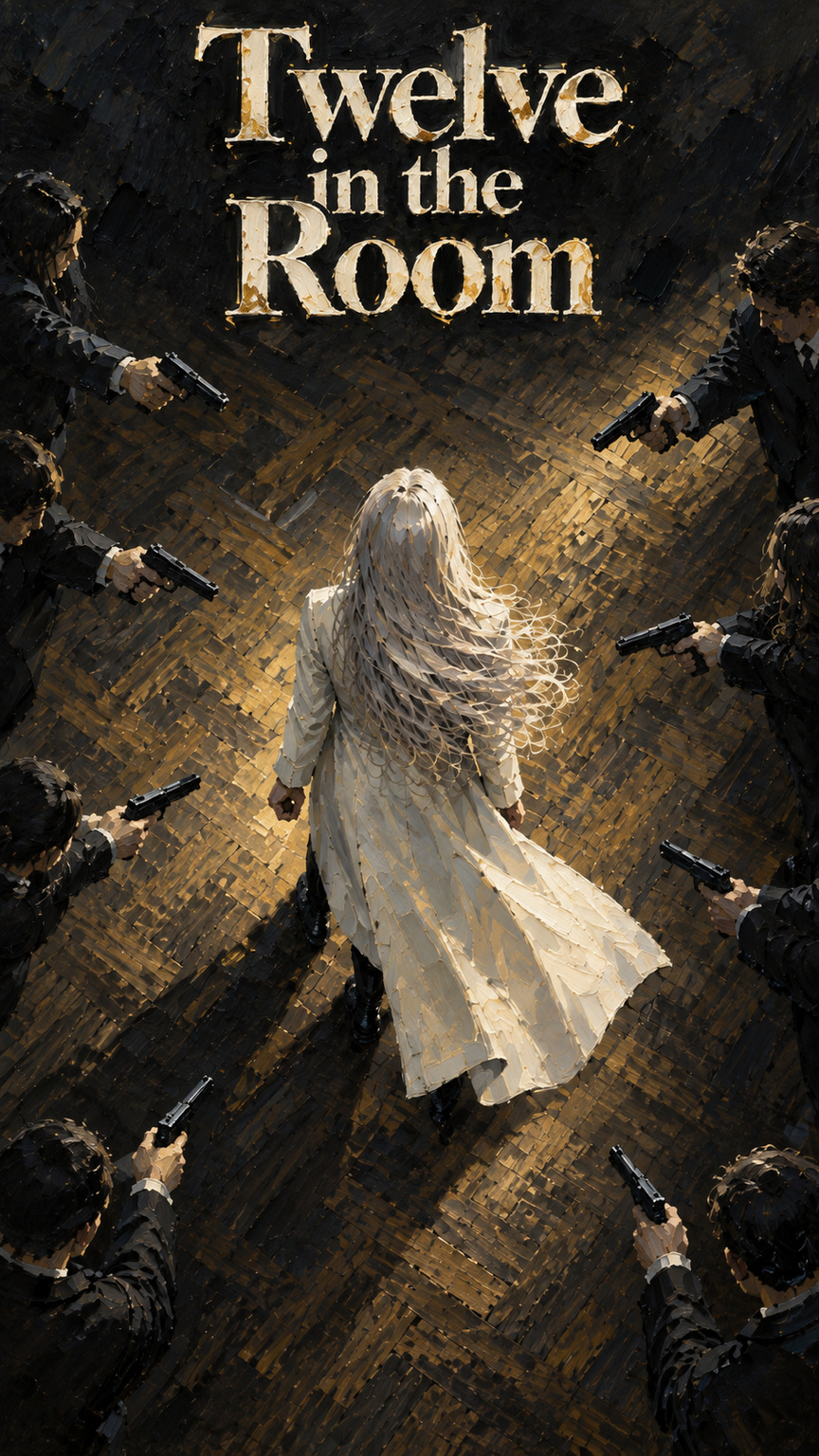
Hesk raised his pistol because eleven other weapons were already pointing at Osselin, and he didn't want anyone noticing that he had hesitated.
His left hand was empty. The packet was supposed to go there. Collect it from the woman in white; check the seal; kill her before leaving. His phone sat in his breast pocket with the lens clear of the flap. It was filming, and the footage went straight to an address the buyer had given him. The buyer wanted her alive on the footage, identifying the papers she handed over. Half the money had arrived yesterday; the rest depended on that handover and her death. Other buyers might attend, his instructions said, and might be armed. He had understood that to mean he would have to shoot his way out afterward.
He had not understood that he would know them all.
The woman beside him still held her pistol with a crooked forefinger. A pink scar ran from her ear beneath her chin. On his other side stood the bald man who had driven Alvera to the house where she died. Eight years had put flesh on him. Hesk himself had provided the address, then said yes when Paske called to ask whether they should finish it before the girl could speak to her mother again. Yes, finish it. He remembered the exact words, although he generally permitted himself to remember only the address.
All twelve had been on that call. Alvera had stolen accounts of the killings they had carried out for her mother. Hesk had heard each of these people agree that she couldn't be released.
Osselin stood beneath a hanging worklight, pale hair loose over a white coat. A crate at her feet held brown envelopes. She looked past Hesk toward the arched double doors through which he had entered. There was a clunk behind him, answered by another at the far end of the ballroom, beneath the empty musicians' gallery.
He moved away from the doors. Osselin watched him take his place in the circle.
“There,” she said. “All of you.”
Across the light, Paske grinned at a man in a red tie. The man didn't grin back. He was looking at the long gun beside the double doors, its barrel wavering now between Osselin and the people surrounding her.
“Mine said private,” Paske said to him.
“Other buyers might attend,” Osselin said, “and might be armed.”
Hesk had read that sentence on his own instructions, word for word.
“Buyers.” Paske gave the word to the man in the tie, inviting him to enjoy it. “Right.”
Behind the long gun, a gray-bearded man pushed the double doors. They didn't move. At the opposite entrance, a man who walked with a stiff leg kicked its lower panel. Osselin bent toward the crate.
“Slow,” Hesk said.
She stopped, looking directly at him for the first time. She used to summon him with that look, past better-paid men, and find him something that mattered. She was sixty now. The skin of her throat had loosened, and the worklight showed scalp through her parting.
“Your envelope first, then,” she said.
“Don't move,” said the scarred woman. “Tell me who gets the original.”
Osselin straightened. “There are twelve originals.”
Hesk noticed the envelopes' corners. Each had one clipped away, a habit of hers from the days when she handed him work across her kitchen table. He had once asked why. So you can find the opening in the dark, she'd said, amused that he needed telling.
“Who booked you?” he asked the scarred woman.
“Fuck off.”
“Was it half yesterday?”
Her pistol moved a fraction toward him.
“Half yesterday,” Osselin said. “A quarter on receipt of the papers. The balance when you sent proof I was dead. Yours were better terms than his. You insisted.”
The bald man made a small choking noise. Paske's grin had gone.
“For you, Paske, a private guarantee concerning the money you lost last spring. I didn't offer that to anyone else.”
Hesk looked around the ring. Near the service door in the left wall, Vestrin was watching Osselin's coat pockets. Beside her a short woman in green gloves had turned her gun toward Paske. At the far entrance, gold spectacles caught the light as their wearer leaned in to whisper to the man with the stiff leg.
“She's the client,” said the woman in green gloves. Her gun swung from Paske back to Osselin. “She's paying all of us to kill her.”
“Every one of you,” Osselin said.
“Then you've overpaid,” Paske said.
He was still looking around for a laugh when she took her left hand out of her pocket. Her fingers enclosed a black control, her thumb pressed flat along its side. With her other hand she pushed back her coat, showing a small pistol in a holster.
“If this hand opens, the room goes.”
The woman in the riding coat, who had joined the gray beard at the double doors, gave a sharp laugh. She stopped when the man with the long gun pointed beneath the gallery. Some of the decorative panels had been removed. Hesk could see dark packages in the cavities, too new against the old dust. More waited behind a fallen strip of paneling near the service door.
“You can put your guns down,” Osselin said. “Or keep them. It won't make a difference.”
Nobody put a gun down. Vestrin took one step backward.
“Stay there.”
Vestrin stopped with her heel against the service door. “Does that one open?”
“Stay there.”
Osselin stooped, awkwardly protecting her closed hand, and lifted an envelope from the crate. She tossed it toward Hesk. It slid across the parquet and stopped against his shoe. He crouched with his pistol raised. The seal had already been broken.
Inside was the note he had written eight years ago: an address, a description of the back room, the hours Alvera worked. Beneath it lay a photograph of her sitting in a chair with her hands tied. She was twenty-seven in the picture. Hesk had last seen her at twenty-six, putting a pink paper umbrella into Osselin's drink because she knew her mother would hate it. She'd stood back to admire the result before either of them laughed.
He folded the picture against the note. He had been promised the only surviving account of his part in Alvera's death. The promise had finally done what three years of offers on Osselin's life had failed to do. He'd wanted that account in his hand, burning.
“Are there copies?” he asked.
Her eyes went to his breast pocket. “There are now.”
He had read the note and looked at the photograph at chest height, square to the lens. Every frame had gone to the buyer's address. He left the phone running. Nobody else was looking at his pocket, and a hand going to it would bring the circle round on him.
The scarred woman bent her knees, as though testing whether she could reach Osselin before anyone else reacted. Hesk straightened quickly. Behind him the gray beard swore at the doors.
“Leave them,” Osselin told the gray beard. “You'd only have run. I take one of you and the other eleven disappear. Some of you had already, new names and new friends and all of it, so I paid people for years just to find you, and then I had to pay you to come.” Her eyes returned to Hesk. “You were the last to say yes.”
He wished she hadn't said it like that, as if she'd been waiting for him to visit.
Paske took out his phone and held the lit screen toward her, his thumb over the transfer button. “What's left in the pot, after twelve of us?”
“Enough to pay the balances.”
“I'm offering you mine back. With something on top.”
She shook her head. The movement set her hair against the pistol grip at her hip. Hesk remembered the woman who cut it herself above the kitchen sink, who hated a stranger touching her neck. She used to hand him the scissors to straighten what she couldn't see.
“Osselin,” he said, “look at me.”
She was already looking. He had needed a moment to think of what came next.
“You know what I did for you. Before all that.”
“I know.”
“When you were ill. Who came? Who stayed?”
“You brought the pills and ate my food. Alvera stayed.”
He hadn't known that. She'd never been there when he came. He had imagined the long afternoons afterward, Osselin grateful for the brief relief of his company.
“I never touched her.”
“I read what you wrote.”
He could feel the folded photograph becoming wet in his fist.
“You sent us to get her,” he said.
“I wanted her home.”
“She wasn't coming, though. You know she wasn't. She knew what you were, she'd taken the accounts, and I only gave them an address. That's all I—”
Osselin's lips drew back from her teeth. For a moment he thought she would shout. Instead she looked down at her closed hand, the knuckles white.
“I paid you to take my daughter off a street and tie her up,” she said. “Yes. I did.”
Paske spread his arms. “There we are. We all made mistakes. Put the thing down and we can—”
“It doesn't stop if I put it down.”
He lowered his arms.
Hesk watched her swallowing. She had brought them here, spent what she had, laid out the envelopes. Now there was only her hand to open. Her breathing grew loud enough for him to hear it.
“You don't want to,” he said.
Her eyes came up.
He knew that look too.
“We can sit down,” he said, and took a half step toward the crate. “Nobody has to do anything just yet.”
“Don't come closer.”
“All right. I'm here.”
“Stay there.”
The service door rattled. Vestrin had turned its handle behind her back. Osselin pulled the pistol from her holster, and every barrel in the circle shifted. Hesk could see the scarred woman's crooked finger whitening on her trigger. Sweat slipped down the side of his neck. He wanted to tell her to take the pressure off it, but he didn't want her attention.
“Let her try it,” Paske said. “She won't get far.”
Osselin kept her pistol on Vestrin. While she watched the door, Paske had worked round the ring to the far entrance. He tipped his chin at the man with the gold spectacles. The man shook his head. Paske showed him the phone and spoke too quietly for Hesk to hear. After a moment the man left the far entrance and drifted along the ring toward Hesk's side, stopping just past the bald man. A shoe squeaked beside Hesk. The man in the red tie had come around the outside of the circle and stopped behind the bald man.
“I can come and sit by you,” Hesk said. “Like before.”
Osselin's gaze flickered toward him.
“Now,” Paske said.
The man in spectacles threw himself at her closed hand from beyond the bald man. Paske came from across the circle. The scarred woman swung her gun after the man in spectacles, and Hesk found himself looking into her barrel as it crossed him. He fired.
Her lower jaw burst open. She staggered against him, spraying his face, then went down with both hands trying to hold the loose part in place. Her gun struck his shoe. He stepped away, dropping the papers, and saw Osselin shoot Paske in the belly.
Paske hit her hard enough to fold them together. His gun went off beside her leg. She screamed and fell to one knee, still gripping the control. The man in spectacles had stopped short, clutching a wrist that hung wrong, though Hesk hadn't seen who had shot him.
At the double doors, the man with the long gun shouted and swung his weapon toward Hesk's side of the room. The man in the red tie hooked an arm around the bald man's neck and dragged him backward. He fired over the bald man's shoulder. The answering shots knocked them both down. The woman in the riding coat fell against the doors and slid to the floor; the gray beard flattened himself beside her, his mouth wide.
Hesk could no longer hear individual shots. The room had become a continuous pressure inside his skull. He kept his gun pointed at Osselin because he didn't know where else to put it.
Paske crawled away from her on his elbows. Blood poured from the front of his shirt, and something pale and folded worked through the hole below his belt. He tried to stuff it back. Osselin pressed her right wrist against her wounded thigh, pistol dangling from that hand. Her left remained closed.
The scarred woman caught Hesk's trouser leg.
He looked down. She lifted her ruined face toward him. The upper teeth were still where teeth belonged; beneath them her tongue moved in a shape that could no longer make words. She kept trying. He couldn't tell whether she was pointing at the gun by his foot or reaching for his hand.
He pulled his leg free.
Vestrin had found a broken chair beside the service door and was hitting the wood with one of its legs. He could see the blows more clearly than he could hear them. The woman in green gloves stood behind her, waiting. The man with the stiff leg came limping across the floor to join them.
Osselin tried to stand. Her knee buckled. Hesk went toward her without deciding to.
She raised the pistol.
“No.”
He stopped.
Paske was saying something. Hesk caught “doctor,” and then “please.” The man with the gold spectacles had begun to cry, staring at his wrist. His lenses were spotted red.
Osselin got her good foot beneath her. She leaned on the crate, tipping envelopes across the floor, and forced herself upright. Hesk watched the control. Her hand shook so badly he thought she must lose it.
Behind him, the service door cracked.
Vestrin pulled it toward her. The upper hinge tore loose and the bottom caught on the raised parquet. She put her shoulder into the narrow opening and heaved until the wood dragged free. Beyond her, Hesk could see a brick wall scarcely an arm's length inside the passage. The way out turned sharply left around it.
“Come away from there,” Osselin said.
Vestrin looked back at the pistol. “I'm leaving.”
Osselin shot her.
The bullet struck below Vestrin's knee. She dropped into the gap, the door sagging onto her back. The woman in green gloves flinched away. Hesk ran past her and got his shoulder against the wood before it crushed Vestrin forward.
“Up,” he said.
“My leg.”
He had been expecting her to help push. He looked down and saw the blood pumping into her boot. She shoved with her sound foot, scraping her shoulder along the jamb. The passage was right there. Cold air touched his wet face.
“Pull me,” she said.
He put his left hand under her arm. She was heavier than he expected. He lifted until she could shift, then squeezed past her into the passage and tried pulling again. Her boot caught against the threshold.
“Both hands, you cunt.”
His right still held the pistol. He could have put it down. Over her shoulder he saw the limping man shoving the woman in green gloves toward Osselin, trying to put someone between himself and her gun. Osselin was coming away from the crate. She dragged her bad leg, leaving a thick track across the papers.
Vestrin gripped his sleeve. He had his feet now, both feet in the passage. He tucked the pistol against his chest and pulled his arm backward until the cloth began to tear.
“I opened it,” she said.
He wrenched free. She fell sideways across the threshold and the door struck the back of her head. Her hand went on reaching into the passage. He turned the corner.
The brick return was thick enough to crouch behind. Ahead, the passage ran through the abandoned kitchen toward a narrow rectangle of night. He could have kept going. But he would have been on his feet in that passage when Osselin opened her hand.
He lay down behind the brickwork and edged one eye past it. Through the doorway he could see Vestrin's fingers closing on the floor. Beyond them, Osselin stumbled into view.
“Hesk,” she called.
He pulled his face back. A shot broke brick from the corner above him. He lay with his cheek against the grit, tasting the scarred woman's blood on his lips.
“Come back here.”
She hadn't opened her hand. She had left the others to come after him. He could use that time to run farther, perhaps. Vestrin's hand had still been moving when he looked. He could go back for her.
He pushed his pistol past the brick edge. Osselin had reached the doorway. Her hair stuck to her open mouth. He aimed above the white coat and fired.
The light vanished. Brick struck his shoulder, and then he couldn't feel the floor beneath him.
When he could see again, he was lying on his back in the kitchen. Dust fell onto his face. He tried to close his mouth, found it full of something, and dug out a piece of wood with two teeth lodged in it. The phone was still in his breast pocket. Its glass had split, and it was warm against his chest.
His right hand still held the gun. He couldn't make the fingers move. Blood soaked his sleeve and dripped from the end of his little finger. Farther down, a beam pinned his left boot. His leg hurt when he turned, but it turned. He pulled until the boot stayed behind and his foot came out of it.
The passage into the ballroom was gone. He saw brick, a dark break in the ceiling, dust. Nothing in that direction told him who might still be alive. His ears gave him a high, thin sound that didn't change when he shouted.
He crawled toward the rectangle of night. There had been a door there once. He got his good hand around the frame and hauled himself over the sill, dragging the pistol because he couldn't let it go.
Outside, his bare foot left a wet print. Then another. He made it three steps before the leg folded and put him face down on the stones.
He tried to get up, but his injured hand folded under him and drove the gun against his mouth. His other hand was good. He put it flat on the stones and pushed until the arm shook. He couldn't get his knee beneath him. He lay still until he could draw breath, then began shouting that he was alive.