
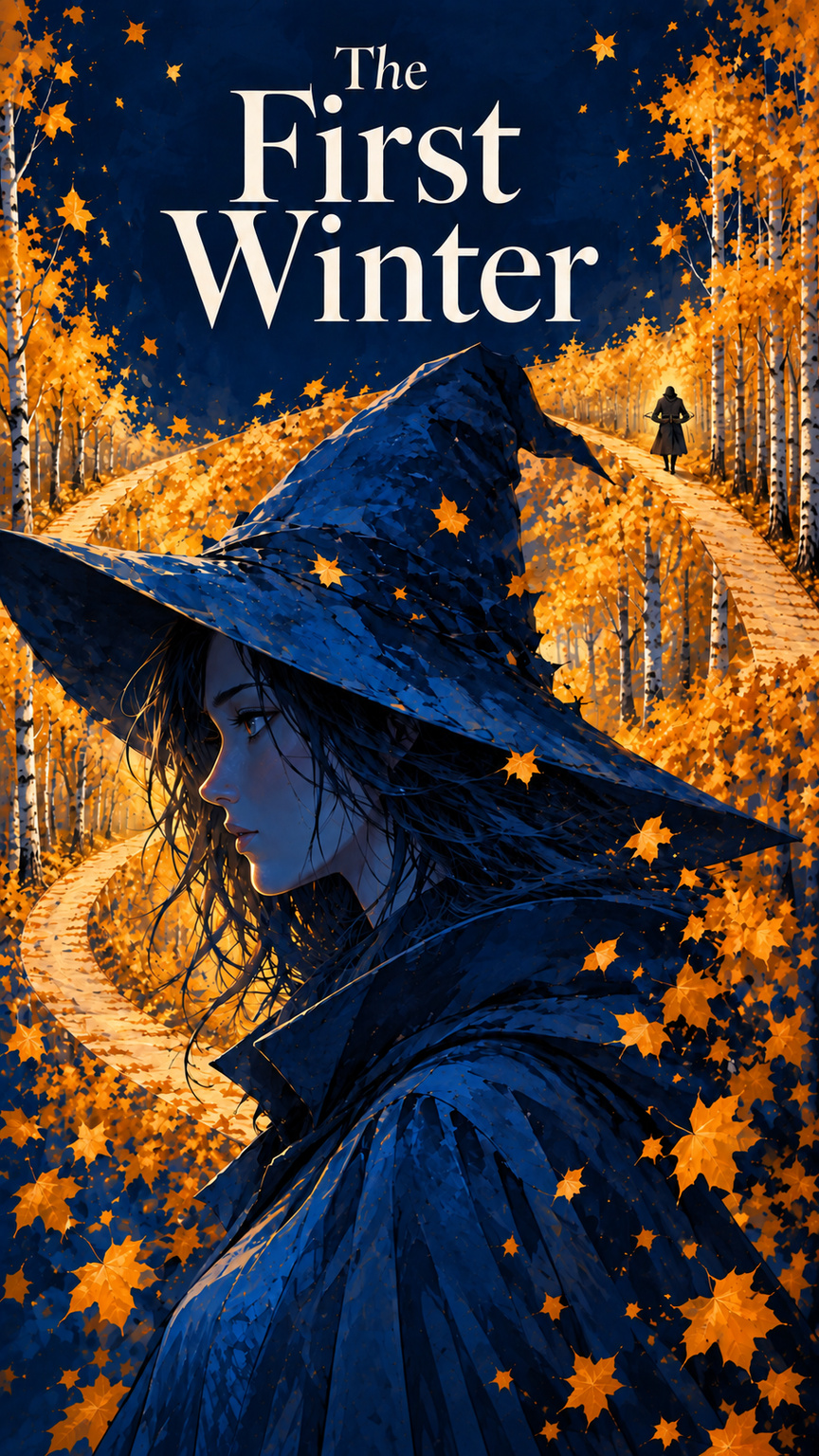
I was two hours down the valley with Besset's frying pan knocking against my leg when she caught up with me.
I had been walking carefully in the dark. She had run. Her blue hat hung down her back on its cord, and strands of hair stuck to her open mouth. For a moment she could only bend over, hands on knees, while I tried to remember the speech I had composed on the way.
"I'm eighteen," I began.
She caught my sleeve and pulled me behind a boulder.
That spoiled the speech. I tried to shake her off. Below us the path wound through birches, pale enough to follow without a lamp. Beyond them lay country I had never walked, where people had birthdays with guests and weather happened without Besset deciding whether it should.
"Look," she said.
A man was coming up the lower path. He carried a crossbow against his shoulder. I had never seen another person in the valley, and I leaned out before I thought about the weapon.
He stopped. His head turned straight toward me.
"Down."
Besset's weight struck my side as the crossbow clacked. A bolt hit the birch behind us hard enough to shake its branches. I landed on my knees among the stones, with her over me and the pan's handle digging into my hip.
She shoved my head lower. There was blood on one of her knuckles.
I could hear the man running. The path doubled back below the rock, and his boots scraped first to our left, then to our right. Besset kept looking up at the rim of the hills.
"Who is he?"
"Stay there."
"Who is he?"
"The man I brought you here to escape."
His footsteps stopped. A stone clicked against another stone. I knew that sound from hunting: someone trying to place a foot quietly after making too much noise.
Besset held out her uninjured hand.
Light reached the highest birch. She closed her fingers, slowly, with an effort that pulled the muscles tight beside her jaw. For an instant my ears filled with a pressure I had felt every morning of my life.
The bolt disappeared from the tree. Its torn bark became smooth. Leaves we had knocked down were hanging overhead again, and the man's next footstep never came.
I waited for it.
Up in the branches a bird gave the same three notes it had given before Besset caught my sleeve.
She sat back on her heels. I could see the path now. There was nobody on it.
"He'll start walking again," she said. "At the broken pass. Where he started yesterday."
My knee stung. I pulled up my trouser leg and found grit in the scrape. Dawn had left that alone.
I knew what dawn did to the valley. Apples returned to their branches. Ash became wood. A shirt left half-mended on the table would lose the stitches I had put into it; I slept wearing anything I wanted to keep. Besset had taught me to tuck drawings inside my clothes and carry a gathered basket until sunrise. I had learned those things before I learned to count.
She had told me that she kept the valley in autumn because winters here were cruel.
"The country beyond the pass," I said. We were still crouched behind the boulder. "Does it do this too?"
"Yes."
"How far?"
"All of it."
I looked downhill again. I had imagined leaving our morning behind and reaching a place where it was spring. Somewhere there ought to have been people living through all the seasons I had missed.
"There isn't a different day outside," she said. "I bring the whole world back to the same dawn."
The dent in the frying pan was new. I ran my thumb along it while she spoke.
"He has to come around the mountain," she said. "The short crossing is gone. He walks all day and all night, and dawn catches him two hours short of the cottage. That's why I don't let you hunt below the white stones."
"And I walked down to him."
She nodded. Her eyes moved over my face, my shoulders, my hands. She looked ready to search me for a wound I was concealing.
"What does he want?"
She began to reach for my trouser leg. I moved it away.
"Besset."
"He was dying when you were born. He came to your mother as a healer. Instead he bound his blood to yours."
I covered my scraped knee with my palm.
"He can feel which way you are," she said. "Being older won't fool him. Changing your name won't help. He means to take the years you haven't lived."
"How?"
"He has to kill you. Take your heart while his own is still beating."
I remembered the small correction of his shoulder before he fired. He hadn't shouted for me to stop or asked who I was.
We stayed behind the boulder long after he had gone. Besset picked the grit from my knee with the tip of her knife, and I let her.
On the way home she told me about my mother. I had known there was a mother, and that she was dead. Besset had given me those facts years apart, whenever I grew old enough to ask a question that could no longer be put off. This time she told me how.
The footbridge across the pass had been narrow, with room for one person at a time. My mother waited until Besset was across with me before cutting its ropes at our end. The man reached her while she was still cutting. Besset saw him strike her, saw the bridge swing away against the far cliff with both of them on it. He caught a ledge there. My mother fell.
"It took me until morning to finish the working," Besset said. She had stopped where a low branch crossed the path. "He was climbing out by then. Without what she did, he'd have reached us in minutes."
I ducked under the branch. Besset followed.
"So she's still there."
"Yes."
"Below the bridge."
"Yes."
We walked a little farther.
"Could you bring back the day before?"
"No. I can only return to the dawn I caught. She had already died."
A yellow leaf had lodged in the fold of her blue sleeve. I nearly picked it off. Then I put my hands in my pockets.
At the cottage she washed our cuts. The room was exactly as it had been that morning: three apples on the sill, the same wood ready by the hearth, the stool with a split that never widened. My bed was too short. For two years I had slept with my feet sticking beyond its end.
I set my pack beside the door. Besset saw where I had put it. "You can't go yet."
"I know."
She rubbed the cloth between her palms. I had expected relief, but she kept doing it until I reached across and took it from her.
"Have you ever tried to kill him?"
Her left arm rested crookedly against her ribs. She could use that hand to hold bread while she cut it, but she could not raise it above her shoulder.
"When you were four. I waited for him in the birches. I missed, and he didn't."
"You said you fell."
"I did fall. After."
I looked at the arm against her ribs. "And this stayed."
She pulled her sleeve back. The scar puckered across the inside of her elbow. I had seen it hundreds of times while we washed clothes.
"I don't go back any more than you do," she said. "If he kills me, I won't be here to renew the day."
I began to understand what she did every dawn with her eyes closed, while I complained about breakfast or tried to sleep. I also remembered telling her, three days ago, that I was going.
I folded the cloth over my hand. "When I said I wanted to leave. You could have told me then."
"I was going to."
"You let me pack."
She looked at the bag beside the door.
For a while we listened to the fire. It settled with a familiar pop, and a spark jumped onto the blanket over Besset's knee. She pinched it out.
"I can shoot," I said.
"So could I."
She turned the burnt spot in the blanket toward the light and rubbed it with her thumb.
"There's a gully below the white stones," I said. "Wounded deer go up it. I've followed them in."
She opened her mouth. Then she looked down at the blanket again. I waited. I had learned patience in the woods, though Besset seldom saw any evidence of it at home.
"Let me help," I said.
She kept her head bent.
I put my good knee against hers beneath the table. That made her look at me.
By noon the little crossbow was lying between us. Besset had brought it down from the roof beams, where I had always been told to leave it alone. She could hold it steady with its stock against her shoulder and its front resting on something solid. She could no longer draw it back.
I loaded it for her.
Outside, she knelt behind a stump and put a bolt into the centre of a scrap of cloth. Then she stayed there, staring at what she had done, until I went to fetch the bolt. When I came back I loaded the crossbow again.
We chose the gully I had told her about, below the boulder where she'd pulled me to safety. It was stony, and it bent sharply at its upper end. A flat shelf overlooked the bend; on the other side, a fallen beech offered Besset cover and a rest for her crossbow. Behind us the path climbed toward home.
I would let him see me at the bend. While he watched my bow, Besset would have a shot from his side.
We went down early to clear the branches that would obstruct her aim. In daylight the place looked smaller than I remembered. The shelf was hardly higher than my head. Above the beech, loose stones reached into a thicket of hazel that met the homeward path.
"Keep that way clear," Besset said, pointing through the hazels. "If he stays under cover, we leave."
"And you turn the day back."
"If we can stay ahead of him until dawn."
I looked at the path between her hiding place and mine.
"No going down to see where he's got to," she added.
She took off her hat and tucked it under the beech.
"What if he's dead?" I asked. "You'd bring him back as well."
Besset's hand stopped on the hat brim.
"Yes."
"Then we have to be sure. And you have to let the morning come."
"I know."
She pressed the hat farther out of sight. This time, when I looked at her, she did not look away.
The moon came up in its usual place. I had always hated knowing precisely where it would be. That night I watched it move through the branches and wished it would hurry.
Besset waited beyond the gully, mostly hidden by the beech. Once she lifted a hand to show she was awake. I had no need to signal back; she could see me whenever she wanted.
A long time later, a boot scraped on the path below.
He came slowly through the birches, looking up as though he had heard me breathe. At the mouth of the gully he stopped, a few steps short of the bend, where its wall hid him from the beech. The moon showed a narrow face, a grey beard, a dark patch of sweat at his collar. His hand shook when he lowered the crossbow.
I stood on the shelf with my bow drawn.
His eyes went to my feet, then to the empty ground behind me. He touched the inside of his wrist.
"You," he said.
I had thought I could loose as easily as I did at a deer. I had never imagined having to watch a man discover me first.
He raised the crossbow.
I fired. My arrow struck the rock beside his shoulder. He threw himself backward into the birches, and the bolt he shot went whining up the gully. Besset never had a shot.
I reached for another arrow. The last one had left my fingers badly. I could feel it happening again before I had even set it to the string.
For several breaths nothing moved. Wood creaked in the birches as he reloaded.
Then leaves rustled on our right. He was climbing around the outside of the gully, toward the hazels and our way home.
Besset picked up her crossbow and stepped past the broken end of the beech, toward our way out.
"Besset, down!"
The second bolt struck before she could lower herself. She dropped out of sight.
I scrambled off the shelf and across the gully. My ankle turned on a stone, and I fell against the beech beside her. There was a bolt through the flesh above her knee. She was making a sound through her teeth, trying to keep it small. Her crossbow lay beside her, almost covered by the blue skirt of her coat.
Above us I could see the man coming through the hazels. He had found the open ground behind our hiding place. His crossbow hung empty from one hand, and he had drawn a knife with the other.
I pulled at Besset's shoulders. She cried out and the sound stopped my hands.
"Run," she said.
He watched us over the beech. Then he put his crossbow down, where he could reach it again, and moved toward the tree's broken end.
"Leave her," he told me.
The bow was still hooked over one wrist. I freed it and reached for an arrow.
"Put it down."
I kept fumbling with the arrow. He put his boot against the wounded leg. Besset's breath caught; she tried to pull away and couldn't.
The arrow fell out of my hand.
"That's it," he said. "Now the bow."
I laid it in the leaves.
Up close he smelled of old sweat and bitter medicine. His breath whistled. He looked at my chest with such concentration that I hunched my shoulders to hide it.
"You'll kill her too," I said.
"Come here and I won't have to."
He kept the pressure on her leg as I moved. I wanted to believe him for the length of time it would take to get beside him. Besset reached for the back of my coat and missed. Beneath her coat I could still see the tip of her crossbow.
I stepped past her toward the man. He caught my coat at the throat, dragged me across the gully, and shoved my back against the rock below the shelf. Besset lay by the beech behind him. His knife touched the cloth over my breastbone.
"Hold still."
His hand was trembling again. I thought of the scar in Besset's elbow, the blood on my knee that hadn't gone away.
I caught his knife wrist with both hands.
He drove me against the rock. Something tore in my shoulder. I tried to keep his arm away from my chest, but his elbow kept bending, steadily, bringing the point toward me. There was hardly room left to breathe.
I stamped at his foot. Missed. He shoved his knee between my legs and I slipped lower against the rock.
Wood scraped behind him. Besset was pulling her crossbow up onto the trunk.
He heard it. His grip on my coat loosened as he began to turn. I let my knees fold and slid down the rock, hauling on his knife arm with both hands. He stumbled forward over me as I struck the ground on my back.
The crossbow cracked. He fell across my legs, Besset's bolt standing in his back. His knife hand hit the earth beside my ear, and I caught it again before I understood that his fingers had opened. I kept holding his wrist.
Besset called to me. I could see her mouth moving. The crossbow had fallen from her hands into the leaves, and she was reaching across the space between us.
I could not make myself let him go.
We waited until he had stopped breathing. Then we waited longer.
Besset had to tell me twice how to find the pulse beneath his jaw. I held my fingers there while she watched his chest. There was nothing. When I finally got clear of his body, I was sick against the roots of the beech.
We bound Besset's leg with strips from my spare shirt. My shoulder hurt when I lifted my arm. I could move my fingers, and she kept asking me to do it, as though this one small success might become more convincing with repetition.
We couldn't get her up the path before dawn. There was no need to, but both of us kept looking toward home.
As the sky paled, I dragged his crossbow beyond reach, then his knife. Besset watched. She didn't repeat that he was dead.
I sat beside her. Our coats were wet with dew. Below us the bird began its three notes, and Besset's good hand lifted from her lap.
I caught it.
She looked down at our hands in surprise. For eighteen years her fingers had closed at this hour.
The light reached the birches. She spread her hand against mine and kept it open.
A leaf turned in the air and landed on the man's sleeve. It stayed there.
We watched the sunlight move along the trunk until it reached his face. His mouth had slackened. Nothing took him away.
Besset began to cry. She leaned forward with both hands over her face, and I held her so she wouldn't fall against her wounded leg. I was still angry with her. I wanted her to stop crying, and I wanted her to keep making a sound I could hear.
It took us most of that new morning to get home.
The following dawn I woke with the spare shirt under my head. Its missing strips had not returned. Neither had the wood we had burned, or the apples we had eaten. Before noon it began to rain, which our day had never done. I stood in the doorway and watched it.
The valley took weeks to lose its leaves. I had expected the season to change all at once, as if winter had been waiting just behind the morning. Instead the gold thinned from the trees a little each day. Bare twigs appeared. Besset learned to walk with a stick, and I learned which movements made my shoulder hurt.
My pack stayed beside the door.
When I finally lifted it, the first snow was blowing across the upper hills. Besset came with me to the white stones. She wore her blue hat with a scarf tied over it against the wind.
There she stopped. I went a few steps farther before I noticed.
"You can come down," I said.
"I know."
I waited on the path while she negotiated the last uneven stretch. When she reached me, she looked beyond my shoulder toward the birches.
"Will you come back?"
"I think so."
She nodded too quickly.
"I don't know when," I said.
She put her hand against the side of my face. I stood still for it. Then I shifted the pack to spare my shoulder and began walking.
By evening I reached a village. Smoke lay over its roofs, and somebody was calling a dog. I stood outside the inn for a while, listening to more voices than I could separate.
Snow caught in my hair while I hesitated. When I brushed it away it melted against my fingers, much colder than I had expected. I wiped my hand on my coat and went inside.