
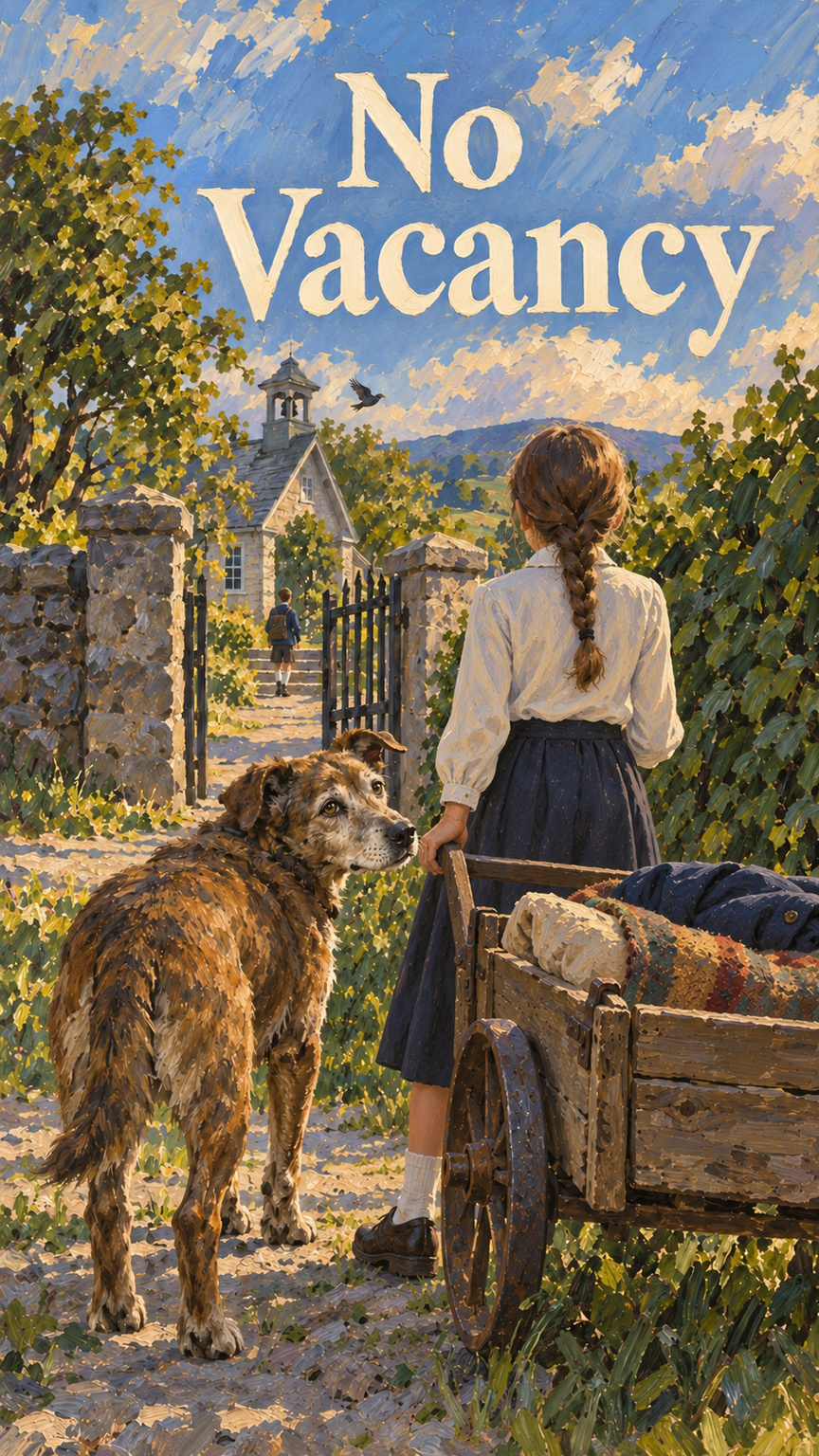
By Friday I had learned to carry an empty perch with considerable dignity. If I kept it level and occasionally looked up, people might think my familiar was somewhere overhead.
This worked until Imby asked whether she should shut the window.
“No,” I said.
“In case it comes back?”
“For the air.”
She shut it halfway. Her starling hopped off her shoulder and went to inspect the brass ring on my perch. I had polished that ring every night since Monday. I had also made a blue leather jess, learned how to tie it one-handed, and selected three names, depending on whether my familiar turned out to be dignified, ferocious, or a girl.
The starling relieved itself on the leather.
“Sorry,” Imby said, and helped me wipe it off. She was being perfectly kind. I would have preferred her to be dreadful, because then I could have hated her.
Tomorrow our class was making its first ascent. We were going to rise from the south lawn, pass over the school roof, and come down in the orchard. Imby and I had agreed to wave at the classroom window where we had spent last winter adding columns of figures. She had asked whether we should wave with both hands. I had said that would be showing off.
Now I was the only one who hadn't bonded.
Mr. Hasp had brought out more creatures for me on Thursday: a little owl with eyebrows like Father's, two glossy bats, a gliding lizard. The lizard had tasted my finger and climbed back onto his. None were frightened. That would at least have been interesting. They simply declined.
There was still the kite-fox.
He lived in the open aviary above the orchard. He was red as a new brick, with black feet and narrow wings that folded so neatly against his flanks that you could mistake them for part of his coat. Once, when Mr. Hasp was demonstrating lift, his pigeon had taken off and the fox had gone after it. Mr. Hasp rose beneath the pigeon without moving his legs. His boots had passed my face. There was chalk on one sole.
That was what I wanted: not having to decide where to put your feet.
I had begun counting the days until familiar week before the last snow melted. My school coat had an inside pocket I had persuaded Mother to make particularly large. I had told her it was for books.
That morning, while I was dressing, I knew Father was cutting the yellow cheese downstairs. I went down before my collar was straight.
“There's a knife in my hand,” he said when I tried to take the end piece.
Crumb sat beside the table, watching the knife too. He was our dog. His muzzle was nearly white now, although the rest of him was brindled brown, and one of his ears had never learned to stand. When he got up, his back legs took a moment to agree with the front ones.
I gave him a piece of rind. Then I moved him from where he had lain across the door, because he seemed to have put himself exactly where my clean coat had to brush his fur.
At school, our lessons ended at noon so we could prepare for tomorrow. I left my perch behind a cupboard and went to the aviary.
Mr. Hasp had said that an invitation was something you offered, not threw. I had offered very politely all week. Perhaps I was doing it so politely that the creatures couldn't tell I meant it.
The kite-fox was on a low branch. He watched me come through the gate, then stretched one wing. The red fur thinned to copper along its edge. I held out my palm, breathed as we'd been taught, and let the small warmth behind my breastbone travel into my hand.
This time I didn't stop where Mr. Hasp had told us to stop. I reached farther.
The fox leaned toward me. His black nose touched the centre of my palm.
For half a second I was sure it was happening. Then the warmth jerked sideways, and I was full of the smell of hot leather, cheese rind, and the sour corner of the hearthrug. My right shoulder twitched. The fox sprang backward, landing with both wings spread.
“Hands down, Fenna.”
Mr. Hasp stood in the gate. I closed my fingers. The hearthrug went away.
“I wasn't making him,” I said.
“I know. Come along.”
“He nearly did.”
“Yes.”
That made me follow him. All week he had said things like a different temper and we'll try again. He had never said yes.
In his workroom he put two stools beside the desk. Mine was low enough that my knees looked foolish. He sat on the other one and held out his hand.
“Once more. Toward me this time. Only to your fingertips.”
“I'm not bonding with you.”
“I should hope not. I've a pigeon.”
I put my hand into his. When I made the little warmth, he touched two fingers to my wrist. Something tugged behind my ribs. Again I smelled the hearthrug.
Mr. Hasp let go.
“You told me there was no familiar at home.”
“There isn't.”
“What animals are there?”
I looked at a crack in the desk.
“A dog. But he isn't one.”
“How do you know?”
“He's Crumb.”
Mr. Hasp waited. Outside, somebody was whistling the first-ascent signal and getting it wrong.
“He doesn't do anything,” I said. “He sleeps under Father's bench. He steals things. He was sick on my arithmetic book.”
“Did he take the book flying first?”
“No.”
“Then we must rule that out.”
He rubbed his thumb over the mark my invitation had warmed on his wrist.
“The fox answered you. I saw him begin. But you were reaching along a connection already there. That's why he pulled away.”
I looked up.
“The owl could tell. So could the others. I couldn't, from outside it. I assumed you were finding the exercise difficult.” He glanced toward the door, where his pigeon was strutting past. “I should have asked about animals instead of familiars.”
“You're saying it's Crumb?”
“Unless someone keeps another dog under that bench.”
“But he's old.”
“Was he always?”
I hated that question. I hated it enough to say nothing.
He went to a shelf and took down the ground-course timetable. I recognized it because the children in that class had lessons while we were in the orchard. Their familiars included burrowing things and things with many legs. There was a girl whose familiar was a sow.
He didn't put it into my hands yet.
“Can you fix it?” I asked.
“I can help you end the connection. Your dog would have to let his part go. It won't hurt him, and he'll still be your dog.”
“And then the fox?”
“Then you can invite the fox. I can't answer for him.”
I wanted him to answer. He had been a teacher longer than I'd been alive; surely there was something he could make certain.
“Can Crumb learn to take me up?”
“A kite-fox can lend you his lift. He has to keep flying while you use it. Your dog can't lend you something he hasn't got.”
“He's very good at jumping.”
I had not seen Crumb jump for two years.
Mr. Hasp pushed the timetable a little closer.
“Bring him at four. We'll find out what you're working with before we do anything to it.”
I carried the perch home by the foot. Its brass ring knocked against my knee.
Crumb was asleep in the patch of light inside our door. I watched him for a while. He had one paw on the corner of Mother's shawl, which he wasn't allowed to sleep on. Whenever she pulled it away, he woke up as though she'd done something completely unreasonable.
“You're supposed to be extraordinary,” I told him.
He woke, looked at me, and put his head down again.
I fetched his lead.
We usually went to the orchard wall. There were smells he liked there, and I could look into the school's grounds without seeming to. Today I planned to try what Mr. Hasp had shown me along the way. I held the lead loose, made the warmth, and reached toward Crumb.
Nothing happened.
“I'm doing it properly.”
He inspected a doorstep.
I tried harder. His ear flicked, and a little door seemed to shut inside my chest.
I stood there with a hot face, being refused by my own dog.
At the end of our lane he stopped. I tugged gently toward the orchard. He braced his front paws. There was nothing remarkable in the other direction: a cracked wall, a patch of nettles, the back of the baker's shed.
“It's hardly any farther.”
He looked away from me.
I remembered his legs when he had stood up at breakfast.
“All right. The shed.”
The lead sagged. Crumb went three yards and stopped with his nose at the bottom of the wall. I leaned against it. We had forty minutes before we needed to leave for school, and he would sometimes keep at one stone until I began to feel we'd taken it for a walk.
Without much hope, I offered the little warmth again.
This time something opened.
The wall was an enormous mess.
Not dirty. I knew what dirt smelled like, or had thought I did. There was old lime, wet roots underneath, mouse droppings behind a stone. There was the baker, who had come this way in his floury apron, and his apprentice, who had come later carrying onions. Somebody's left boot had stepped in horse dung. A fox had passed close to the wall during the night. The fox was gone, but its passage was laid against the stones as plainly as if it had left red string.
I saw none of this. My eyes were still looking at nettles. The two ways of knowing wouldn't fit together at first, and I shut my eyes.
There were more mice than I had guessed. There was a cat Crumb disliked so thoroughly that I disliked it for a moment too. Beneath everything else lay a smell I couldn't name, rich and marvellous. I bent toward it.
Crumb shoved his nose under the nettles and found half a sausage wrapped in a skin of fur.
“Oh, absolutely not.”
I caught his collar. He managed to get it into his mouth before I could pull him back.
I hadn't understood until that moment how much a creature could want a sausage. The wanting went through me from gums to stomach. It was disgusting. It was delicious. I was going to be sick if he swallowed it.
“Drop it.”
His joy shut out my invitation. I had to put my fingers behind his jaws, as usual. He spat the thing into my hand and stared after it when I threw it over the wall.
On the way home he walked on the opposite side of the lane from me. Once or twice I offered again. He ignored me until we reached the doorstep where the cat had rubbed her cheek. Then he let me have his opinion.
I laughed so loudly that Mother came to the door.
“What?”
“Nothing.”
“Has he been eating something?”
“Not much.”
She looked at my hand.
I washed it twice.
To get Crumb to school, we borrowed the grocer's little handcart. I put his blanket in it. He climbed in after I laid a piece of cheese on the blanket; then he climbed straight out because he'd eaten it and couldn't see the point of staying.
Mother held his collar while I tipped up the handles.
“I thought your familiar was going to be one of the flying ones,” she said.
“So did I.”
She looked at me, then put Father's worn cushion beneath the blanket. Neither of us said anything else about it.
Halfway to school Crumb stood up. The cart rocked, and I had to stop and persuade him to sit. I had imagined the kite-fox riding my shoulder, turning his head when I did. Now I was arguing with a dog in a box while the baker's apprentice watched from his doorway.
In Mr. Hasp's workroom I lowered the handles. Crumb climbed out and inspected the legs of the desk. Mr. Hasp checked him with one hand against his ribs and the other around my wrist. Crumb licked his cuff.
“Yes,” he said. “This is him.”
“Could we see what it's like first?”
“Without it?”
I nodded.
He put my hand on Crumb's chest.
“Let yours go quiet. I'll hold the connection open until you decide. There's still no room for the fox. If he keeps reaching, we'll stop.”
Crumb was warm through his thin fur. I asked for the smell of the room and got ink, pigeon, and the remains of Mr. Hasp's lunch. I let my reaching settle back inside me. The dog held it a moment, then stopped too. He turned his head toward the wastebasket.
There was no dramatic emptiness. The room was still the room. Crumb was still beside my knee. When I rubbed the base of his ear, he pressed into my fingers, and when I stopped, he bumped my hand for more.
I could do this. I could take him home, give him dinner, love him exactly as before. I could come back and offer the kite-fox my hand.
Outside, the class was rehearsing. Imby's voice called, “Both arms? Is it both arms?”
Someone answered her, laughing. An owl passed the window, then a shadow: the flight instructor rising after it to check the wind above the roof. I leaned sideways to see him, his boots dangling. In another moment he was higher than the chimney.
Crumb got his head into the wastebasket.
Mr. Hasp lifted it out of reach. “No.”
The dog sat down underneath it. I knew that sit. He could keep it up for hours. I could see him perfectly well; I had known him all my life. But I couldn't catch the particular savour of whatever he'd found in there. I missed the horrible eagerness that wasn't quite my own.
The instructor came down past the window, coat lifting around him. I gripped my knees.
“How long have I had it?” I asked.
“Can't tell from here.”
“Years?”
“Possibly.”
Years, possibly, of the lane and the hearthrug and Father opening cheese. I'd told Mr. Hasp he didn't do anything. I had been very stupid. I was probably going to be stupid again, whichever way I went.
Crumb leaned against my shin. I offered the little warmth toward him. His nose lifted, and the room filled with lunch.
“Put me in the ground class,” I said.
Mr. Hasp kept his hand at my wrist a moment longer, then took it away.
“You'll need to be here earlier. They start at eight.”
“Does he have to come every day?”
“For the first week. After that we'll see.”
“And where can he sleep?”
He glanced around his crowded workroom.
“Not here. Ask the ground instructor about the cloakroom. Get him out from under that basket, please.”
I pulled Crumb away. On Mr. Hasp's desk, underneath the timetable, lay the first-ascent list. My name had a space beside it where the familiar's should have gone. I looked until he turned the paper over.
The next morning I arrived before eight. My nice blue coat was rolled up in the cart because pulling the cart had made me hot. Crumb had decided the cushion was worth lying on after all. I had pinned his loose ear back for a moment while I fastened the lead, then let it flop where it wanted.
Imby was on the south lawn with the others. She saw us through the gate.
“Is that yours?”
I looked behind me, although there was nobody else.
“Crumb.”
“Hello, Crumb.” She held out the back of her hand. He sniffed it. “You're not coming up?”
I shook my head.
“Oh.”
The signal whistle blew. Imby looked toward the instructor, then back at me.
“You'd better go,” I said.
She hurried away. Her starling took off ahead of her and circled low while she found the warmth. Then her heels left the grass. Her mouth opened. I could see that from the gate.
I watched them rise past the classroom window. Imby waved with both hands. I waved back with one, keeping the other on the cart handle. By the time they reached the roof, my eyes were wet and I couldn't pick her out anymore.
Crumb stood up, so I lowered the handles and let him climb out. He went to the hedge by the gate. We were supposed to go straight to the cloakroom, but he planted his feet when I took up the lead.
“We are already late.”
He put his nose farther into the leaves.
I could still hear the children above the roof. I loosened the lead and offered my attention. Under the clipped green leaves was a small, busy trace, warm from the creature that had just gone through. Crumb followed it along the hedge, checking one stem and then another. At the corner it vanished beneath the lowest branches.
I knelt on my clean skirt to see where it went.