
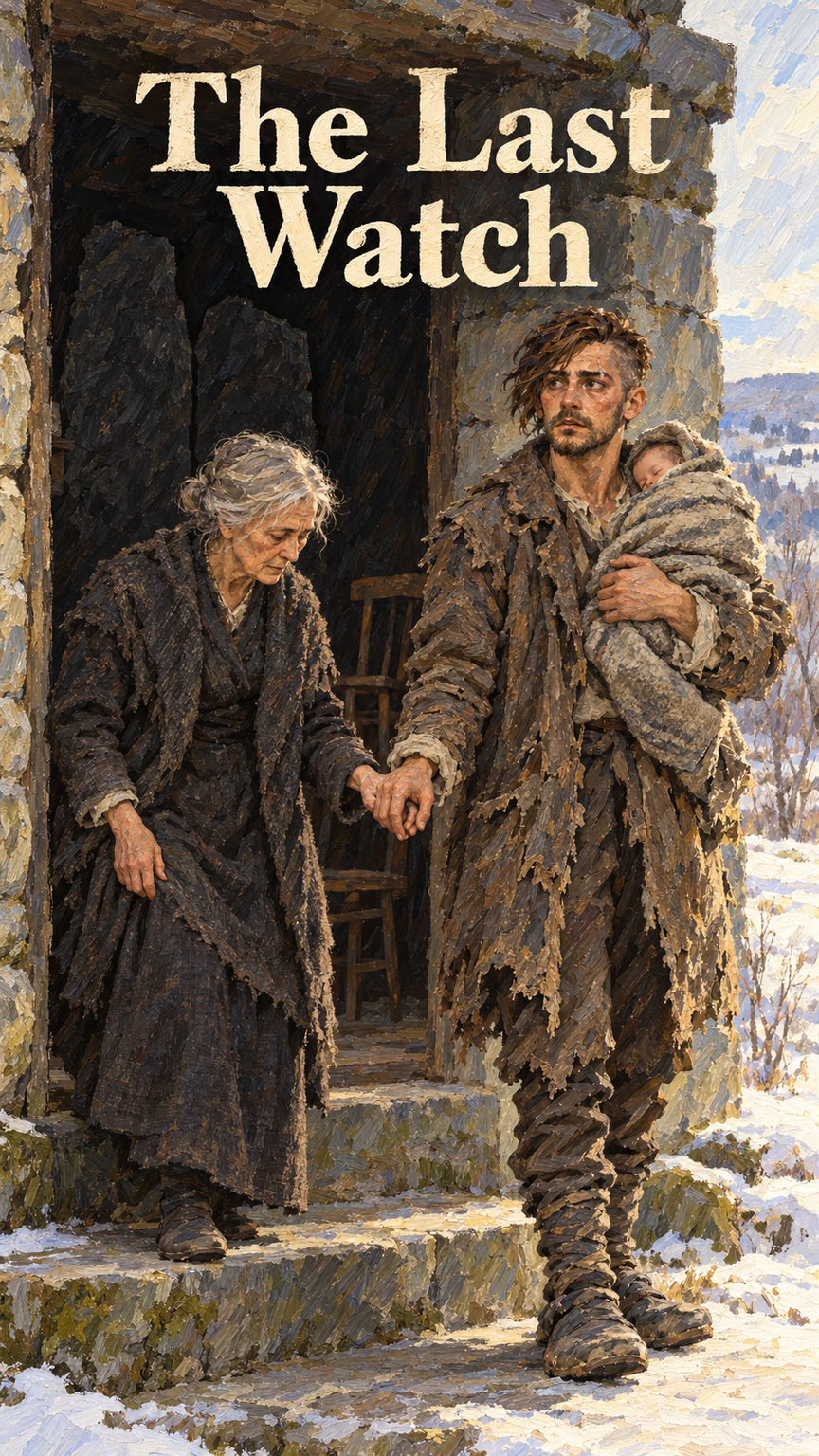
My daughter's letter lay on the stone beside me, held down by a cup. She had put a bed in her front room. I could live on one floor, she wrote, and the window faced the plum tree.
I had been trying to answer her since autumn.
Four of us held the rift that morning. My binding came out of my right wrist, thin and white, and disappeared into the upright crack between the two black stones. Marda's ran beneath mine. Across the opening, Len stood on a folded blanket to keep the cold from his feet. The fourth keeper was asleep in her chair; she could do that now, after forty years. I had never learned.
We relieved one another, slept, ate, had children. The world had continued on our side. But somebody had always been here with the near edge caught on their living bindings, stopping it from tearing wider. Once, in the third winter, two keepers had died within an hour of each other. Before their reliefs took hold, the opening had swallowed half the hillside. My daughter's first school was somewhere beyond it.
We could hold this edge. We could not reach the other. Stepping through was easy enough; on the far side, the way back moved. Someone had to find it, carry the far edge home, and join it to ours. The man who had promised to do that had a sun worked in gold on his breastplate. He had gone through on the first day with six others.
My husband was one of the six.
Fifty years later, we still kept the passage narrow enough for a man to squeeze through.
Len was humming. He was twenty-seven and could not remember a world without the opening. He had been born in the little house where we rested between watches. His mother had set him in a basket beside her chair and held a binding over him while he slept.
“Does your daughter want an answer?” he asked.
“She has an answer.”
“The same one?”
I slid the letter under the cup again.
The white line over Len's wrist jumped. He stopped humming and set his feet apart. At the opening, the darkness folded in on itself. A hand came through, gripping the stone. Then a shoulder and the side of a face.
He was carrying something against his chest.
“Hold,” Marda said.
We held. The sleeping keeper woke with a gasp. Len's blanket slid under one heel, but he stayed upright while the man dragged his second leg free.
He had one boot. His bare foot was wrapped in a piece of blue cloth, dark with dirt. He crouched on the stone, covering the bundle with his body, and my binding pulled hard enough to bring me out of my chair.
“Get clear,” I told him.
He tried. A white loop rose from his left wrist and stretched back into the opening. He caught that arm against his ribs, breathing through his teeth.
Marda stared at the loop.
The man looked up at me.
“Olla?”
He had grown a beard. There was a pale scar through one eyebrow, and his hair had been cut badly, close on one side and long on the other. Under those changes was a face I had spent fifty years becoming less certain I remembered.
I had forgotten how brown his eyes were.
“Talven,” I said.
He looked at my face, then at my hands. His gaze came back to my face and stayed there.
The bundle began to cry.
“Is that yours?” I asked.
He shook his head. “Biri.” He loosened the cloth around a small red face. “I need to feed her. Have you anything?”
There was milk in the resting house. Len called through the door for it. Talven kept looking at me while Biri rooted against his torn coat.
“How long?” he asked.
“Fifty years.”
He sat down very carefully.
“How long for you?”
“A year. Nearly two. We lost count of the days when the sky stopped turning.”
I had things to tell him. Our daughter had learned to whistle before she could say his name. I had kept the red coat he hated until moths got into it. His father had died in a chair, holding an apple he had meant to eat. Once I had gone three whole days without thinking of Talven, and when I noticed, I had put on his coat in the middle of summer.
What I said was, “Your father died.”
He bowed his head over the child.
“And our girl?”
“Alive. Fifty-two. She has children. One of them has children.”
His mouth moved. No sound came out.
A girl brought the milk in a jug, along with a little cup and a spoon. She was one of the people who cooked for us, old enough to be Talven's sister, young enough to be my great-granddaughter. Talven tried to thank her, but Biri's crying broke into little breathless snatches and he was fumbling with the cup.
“Here,” I said.
He brought the baby to my left arm. I drew her close while he spooned milk between her lips. She swallowed, spilled it, got angry, and swallowed again. Her body was hot through the cloth. I remembered this weight. I had not expected to remember it with him kneeling beside me.
My binding tightened when I leaned too far. I settled back.
“Where is her mother?”
“At the red camp. Unless they moved.”
“Why isn't she with you?”
He wiped milk from Biri's chin with his thumb.
“We were crossing a place where the ground wouldn't stay still. There were ropes. Biri's mother was behind me, and I had the child because we thought—” He looked at Biri. “We thought she'd be safer tied to me.”
“Did you see her fall?”
“No.”
Biri closed her mouth over the spoon. He eased it free.
Len had come as close as his binding allowed. He was looking at Talven's wrist.
“You brought it,” he said.
Talven rubbed the back of that hand against his leg. The loop shone through the dirt on his skin. Unlike ours, it lay doubled, one white strand going into the rift and the other ending in a tight turn above his knuckles.
“Where's the man who went with you?” Marda asked.
Talven did not answer at once. He tried another spoonful; Biri turned her face away.
“The man with the sun,” Marda said.
“I know who you mean.”
“Is he coming?”
Talven set the spoon in the cup.
“I held the far edge while he looked for a way through. When he found one, he came back for us. There were people following us who hadn't got across the moving ground. I couldn't leave the post. Not without dropping this.” He lifted the doubled loop a little. “He took the weight so I could carry the loop. And her.”
“Then he'll follow,” Len said.
Talven looked past him into the opening.
“He said, ‘Go. I'll keep it.’”
“He'll follow,” Len repeated, more quietly.
“I don't know.”
Talven's left arm was trembling. I gave Biri the last of the milk while Marda leaned forward to examine his binding. Her white hair had come loose, and a lock fell across his knuckles.
“Let me see,” she said.
He opened his hand.
Marda brought her own line down toward the turn of his. Before they touched, her binding slackened. The crack narrowed by the width of a finger. A little chip of stone fell from high above us.
She tried to ease the doubled turn onto her wrist, as we relieved one another on watch. The white line passed through her arm and lay against Talven's knuckles. His arm was still trembling.
She withdrew. The two lines tightened, and the gap resumed its old width.
Nobody spoke.
I could see how to do it. We had been shown as children, long before there was any need: two living ends, one carried all the way around the break, joined while the holders let the near edge go. We had played at it with loops of wool. The far turn stayed with the person who had carried it around the break. We had never imagined a man would come back with one boot and a hungry baby, too tired to keep his hand open.
“We can close it,” the keeper in the chair said.
Marda put her left hand over her mouth.
For fifty years we had awaited a man bright enough to face the opening and make it nothing. We had told our children what his coming would look like. I had privately believed Talven would step out behind him, and that I would be waiting in the red coat.
Talven took Biri from me. He wiped her mouth on a clean corner of the blue cloth from his foot.
“Not yet,” Len said.
Marda lowered her hand.
“You heard him. There are still people.”
“There have always been people,” she said.
“That's why we hold it.”
He spoke without looking at me. He had both feet planted firmly now. I remembered his basket beneath his mother's white binding.
Talven gathered the loose cloth around Biri's legs. His left hand shook too much to tuck it in. I did it for him.
“Can you wait?” I asked.
He looked at the doubled loop.
“I can't leave it here. If I go away from the seam, it comes off me. Then you'd have to wait for someone else.”
He stood, holding Biri against his right shoulder, and took a step toward the door. The white loop stretched. The turn above his knuckles opened, showing a dark gap through its middle, and Marda's binding jerked sideways.
“Stop,” she said.
He came back. The turn drew tight again.
“It won't hurt you if I drop it,” he said. “But you won't have the far end.”
“You would drop it?” Len asked.
Talven's face changed. He put his cheek against Biri's hair and closed his eyes.
“He took my place,” he said.
“Then wait for him.”
“I waited there.”
Len opened his mouth. Talven looked at him, and he closed it again.
Beyond the doorway the girl was washing the spoon. I heard her set it on the jug. That small sound went on after the others had stopped.
“Which way does our girl live?” Talven asked me.
“Down the road. The house with the plum tree.”
He shifted Biri higher on his shoulder. His bare foot rested on our cold stone. The blue cloth hung over my chair, wet with milk.
“Will she know me?”
“I don't know.”
He nodded as if I had given him directions he could follow. I could see him on the road, looking for the house. I could see my daughter opening the door. My binding ran from my wrist into the rift; when I moved my hand, the white line moved with it.
“You could stay beside me,” I said.
He looked down at my chair.
“We'd have another chair brought in. There's room.” I pointed with my left hand. “Biri could sleep in the resting house. We'll find someone who can nurse her. She ought to have her mother, Talven. If we wait—”
I had nearly said, if we wait together.
He crouched beside my chair again. Biri had gone to sleep with one fist caught in the hair at his neck.
“I'm sorry,” he said.
“A little longer.”
His lips pressed together. He looked at my right wrist, at the white line that had rubbed a bare track through the hair there. Then he looked at his own.
“Olla, I can't.”
I wanted him to say more. Even a lie would have given me something to answer.
He laid his unbound hand on the arm of my chair. His little finger was crooked at the first joint. A horse had bitten him when he was seventeen; I had never let him forget whose fault it was. I put my left hand over his, and for a moment I felt the young hand I had been reaching for whenever somebody woke me from a dream.
He turned his palm up under mine. His eyes filled, and he blinked hard. I could not tell whether he was seeing me or looking for me.
Across the gap, Len lowered himself onto his blanket.
“You don't know she's dead,” he said, looking at Biri.
“No,” Talven said.
“You don't know about any of them.”
“No.”
Len sat with his binding stretched above his knee. Then he began to feed it back through his fingers, shortening it. The gap shivered, putting more weight on our three lines. I braced my heels.
He had not released it. He was passing his share to us.
Marda bent her head and took the added weight. So did the keeper in the chair. Len drew the last white turn down to his wrist and slipped it off. It went dark against his palm.
“Where are you going?” I asked.
“To the far post.”
Talven caught his sleeve as he rose.
“You can't get there from that side. I came out miles from where I went in.”
“You got back.”
“It took us nearly two years. You may not find them. You may not find this.”
Len looked at Talven's hand on his sleeve.
“You want us to shut it with them in there.”
Talven let go.
Marda was leaning sideways under the strain. I could see a muscle beating in her neck. Three of us could hold until the next shift came; we had done it before. Len could go, and Talven could go, and we would carry on.
Len knelt to fold his blanket. He folded it badly, twice, then opened it out and tried again. All the time, he watched the dark place between the stones.
“Len,” I said.
He stopped with one corner in his hand.
“I may close it before you're back.”
He looked at the doubled loop on Talven's wrist. Then he looked at me.
“I know.”
“Will you come back?”
“I'll try.”
There was no promise I could ask of him that I had not once believed.
Talven drew his hand out of mine and stood up. For a moment I thought he was going after Len. He took one step toward the rift, and Biri woke against his neck with a soft, questioning sound. He stopped.
Len's blanket lay half folded. He looked at the child, then at Talven's bare foot. He put the blanket down beside him.
“For the road,” he said.
He went through before any of us answered. For an instant his bare wrist caught the light of our bindings. Then there was only the opening.
Talven stood where Len had left him. He had not picked up the blanket.
Marda turned her face toward me. Her eyes were wet. She said nothing about closing it. I felt her binding tremble beside mine.
I lowered my wrist and settled the binding back along its old track. The pulling eased.
“We can hold until relief,” I said.
Talven nodded. He picked up Len's blanket and tucked it around Biri, drawing the wool under her chin. Then he straightened and gathered her close.
“I'll go, then.”
He lifted his left wrist to take the loop off.
“Bring the far end,” I said.
Talven did not move.
I stood. My knees had stiffened while I sat. I caught the arm of the chair with my left hand and waited until I could straighten.
“Olla.”
“Bring it.”
He gave Biri to the girl at the door. She gathered the blanket around the child's feet and held her without asking whose she was. Talven came back to the opening and lifted his left wrist.
Marda laid her loop against the turn of his. The keeper in the chair did the same. I brought mine last.
Len was on the other side of that gap.
Our bindings crossed above his knuckles. He closed his other hand over them. The pulling stopped.
“Let go,” he said.
Marda slipped her wrist free. The keeper beside her followed. I had held mine through fires, fevers, my father's funeral, and the morning they brought my daughter's first child to the door. I turned my hand inside it and drew it out.
Talven pulled the joined ends tight.
The black stones touched. There was no flash. A line remained between them, narrow and dry, and a little powder fell onto his foot.
He put both hands against the line. We waited. When he took them away, the stones stayed together.
The girl stood at the door with Biri wrapped in Len's blanket. Len's mother was due at noon. She always called to him from outside before coming in. I would have to tell her myself.
Marda sat down and began to cry. The other keeper leaned toward her, but neither of them seemed to know what to do with their hands.
Talven retrieved Biri. The girl found him a pair of shoes from the resting house. They were too large; he stuffed folded cloth into the toes. I put my daughter's letter in my pocket, though I knew the way.
At the door, he reached back for me. His hand was still held at the height mine had been fifty years ago. He lowered it when he saw me moving down the step.
I took it. The light outside hurt my eyes. Biri had woken and was sucking the edge of his coat, and we went slowly down the road toward our daughter's house.