
Sahar tapped the coin hanging between them. Della flinched, and it fell into the sawdust.
“Still need misdirection,” Sahar said.
Della had hoped for something warmer after eleven months.
“It was actually floating.”
“I saw.” Sahar retrieved it and rubbed the sawdust off with her thumb. “I was watching your face. So would an audience.”
Nine nights earlier, a white light had passed over the city without making a sound. Since then the woman at the corner bakery had been serving rolls hot from an unplugged oven. Della could hold a small object still in the air, provided she kept her attention on it. So far she had managed a coin, a plum and an overdue bill. The bill remained overdue.
Della had lived with dissociative identity disorder for years. Amos and June shared this body and its days; they had new powers, too. Some days Della could hear June commenting on things. Some days she found a week's worth of shopping in the fridge and remembered none of it. The powers were new enough that their notebook still had questions in the margins instead of answers.
Sahar set the coin on the workbench.
“You said you had work.”
Della pulled the sheet off the cabinet.
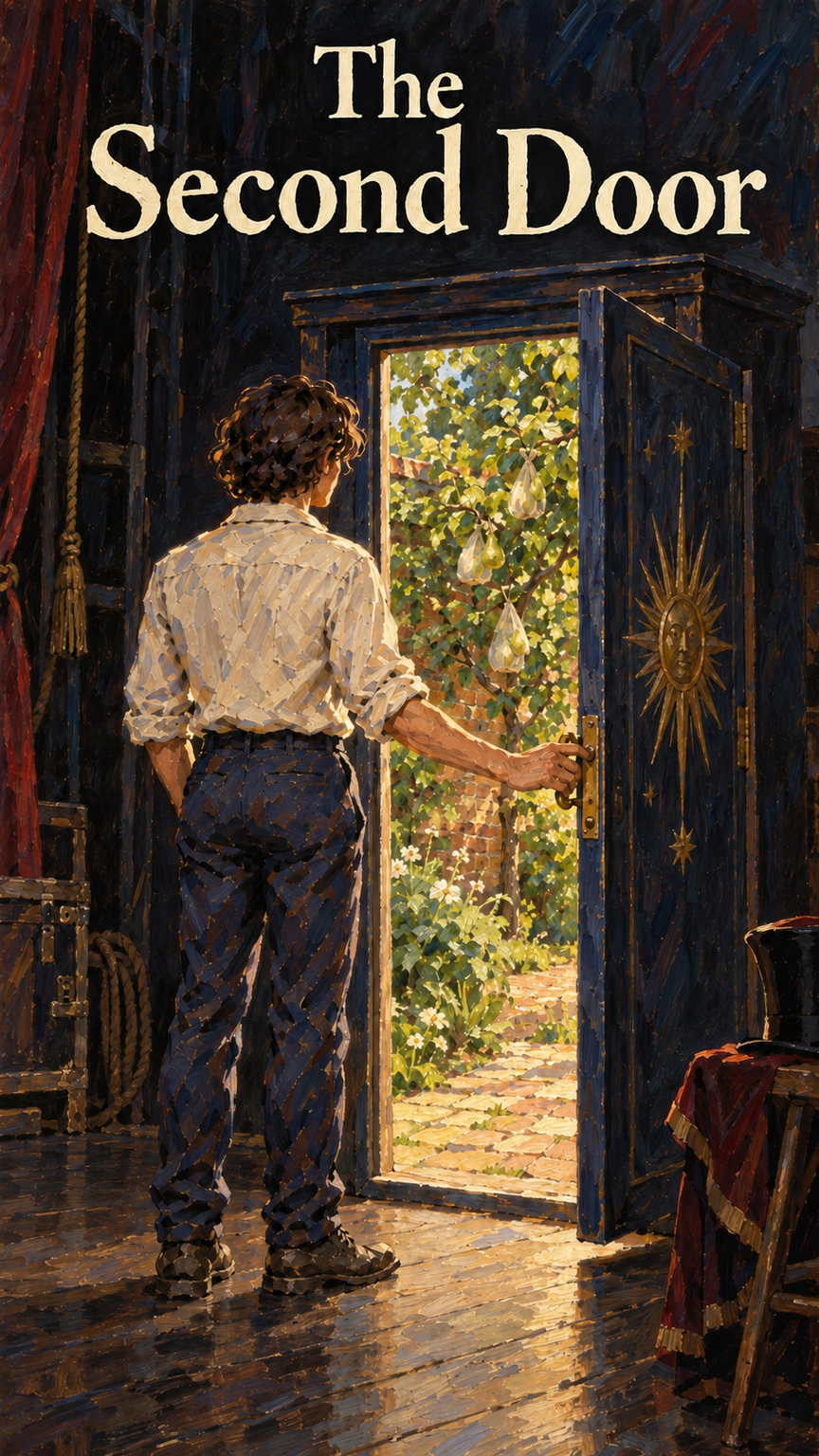
It was taller than they were, painted midnight blue, with a brass sunburst on its front door. Della had bought it as a plain wardrobe when she was nineteen. Sahar had made the concealed side door six years later, in the summer when their entire act fitted into a borrowed van. Their initials were still scratched beside its hinge.
They used to end with Sahar disappearing from it and Della bringing her back. On their last night together, Sahar had stayed backstage after the disappearance and let Della fill four horrible minutes.
Afterward she had said, “Try introducing me as a magician sometime.”
Della had said something about what was printed on the tickets. She remembered the precise thing, but preferred the shorter version.
Now the side door was screwed shut. Without it, the inside looked honest.
“We won't need that bit,” Della said. “Amos can open the front onto another door. Anywhere he knows.”
Sahar examined the screw heads.
“And what am I doing?”
“Going somewhere impossible.”
“Will I have a chair there?”
“What?”
“For the eleven months until you remember to bring me back.”
Della laughed before she could help it. Sahar didn't, but one corner of her mouth moved.
The Bellwether had offered four hundred for an evening of ordinary illusions. After hearing about the powers, Mr. Brack had offered twelve hundred and sent six hundred as a repair advance. Della had spent it on hinges, new casters and someone capable of making the warped front door close properly.
She had gone home with a contract and an old hunger awakened: the warm dark beyond the footlights, Sahar beside her, a roomful of people waiting for whatever they would do next.
She showed Sahar the provisional poster.
DELLA. THREE POWERS. ONE BODY.
Below that, in much smaller type: with assistant.
“I was going to have him change that.”
“Which part?”
“Your part.”
Sahar folded the poster along Della's face.
“Let's see this door.”
*
When Amos was present the following afternoon, Sahar was eating a cheese sandwich on the cabinet's steps. He recognized her shoes before her face. She still wore the red ones she'd bought for the doomed summer tour.
“I thought you'd burned those.”
“They're good shoes. The tour wasn't their fault.”
He had missed her. He didn't say it immediately. Sahar offered him the half of the sandwich that had more cheese, which helped.
She had brought a small terracotta pot.
“Mrs. Orley's cuttings,” she said. “You left this at my place.”
The stems were bare.
“You overfed it.”
“Or it died of loneliness. That was my other diagnosis.”
Mrs. Orley's garden was six hours away by train. During the year they'd rented her upstairs rooms, Amos had helped her grow pears against a sunny brick wall. She tied old stockings around the fruit to keep the wasps off. Della disliked the quiet there. June had loved Mrs. Orley's radio, which received three stations and insisted on playing two at once.
Amos had been trying to open the garden's back door from their kitchen. Twice he had succeeded. Both times he'd discovered the same difficulty: he had to keep his hand on the kitchen handle. He could reach across. He couldn't get the whole body through without letting go.
The first pear leaves had appeared in the doorway. He'd stood smelling them until his hand cramped, then gone to buy groceries in the usual way.
“We could take the train,” Sahar said.
“After paying the electrician.”
“Ah.” She put the pot down. “Well. Show me what happens when you let go.”
The theatre's prop room was a doorway Amos knew. He opened the cabinet's front onto it. Instead of the blue-painted interior, there were rolled carpets, a plaster moon and the back of Sahar's head: she'd gone around the scenery to wait there.
She stepped through onto the stage. He let go of the handle. The prop room was replaced by the cabinet's ordinary interior.
Sahar went back around, and they tested it the other way. She crossed from stage to prop room and stood well clear. He released the handle. The plaster moon vanished from view. Sahar remained in the prop room.
Ninety-three seconds later she came back onto the stage, chewing the last of her sandwich.
“Scenery's in the way,” she said. “You have to go right around the back.”
Sahar set a little cue lamp in the wing and took its wireless switch.
“Blue means I'm ready to come back,” she said. “You open the front; I step through.”
They tried the routine. She crossed into the prop room again. Amos shut the front, keeping his hand on the handle to keep the passage there.
The last clear thing Della remembered was Sahar folding the poster, the day before. Now she was standing beside the cabinet with one hand on its handle, the rehearsal lamp blinking blue.
Sahar was gone.
There was a bite of cheese sandwich in Della's mouth. Her stomach growled.
She swallowed, looked at the clock and opened the front door. An empty blue cupboard looked back at her. With Amos no longer present, the door led into its ordinary interior again. Sahar was still in the prop room, waiting for a way back that Della couldn't open.
“Sahar?”
“Coming.” The voice was muffled and distant.
Della waited through the blue lamp's next six flashes. Sahar finally appeared from behind the far end of the scenery.
“Where's Amos?”
“I'm Della.”
“Hello, Della.” Sahar sat on the cabinet steps. “That's our problem.”
Della knew what she meant. She still tried.
“We could rehearse more.”
“I've rehearsed plenty. So has he. I can't get through a door that isn't there.”
The lamp went on blinking. Della unplugged it.
“You used to be out of this thing in three seconds.”
“I had a second door.”
Sahar pointed stage left. The old cabinet had stood there, its side tight against a masking flat. A performer could slip through its concealed exit into the wing, unseen by the audience. Della had moved it to centre stage so nobody would suspect such a route. Then she'd screwed the route shut.
She looked from the flat to the cabinet.
“I put it in the wrong place.”
“You did.”
*
Later on the day Della and Sahar met, June had made her own visit to the Bellwether.
She'd stood in the dressing room singing along with a radio serial while Sahar changed for a children's matinee. The detective was pleading innocence in a mournful tenor. June preferred the villain's part.
“You're swallowing the last word,” Sahar said through the partition. “Take a breath before it.”
June stopped singing. The partition was brick.
“You can hear me?”
“They can hear you in the office.”
June looked at the wall. She'd been imagining singing right through it, into the empty room beyond. When she stopped imagining it, the radio in her hand went thin and tinny again.
“Well,” she said. “That's going to spoil some eavesdropping.”
Sahar came around the partition in her red shoes and a waistcoat full of pockets.
“You should audition. They've got a vacancy on Tuesdays.”
“I haven't sung for people.”
“Apparently you have.”
June filled in a form at the box office. Under special requirements she wrote, A pianist who won't hurry the middle bit.
She found the poster on her way out.
Her voicemail to Mr. Brack was brief. “I'm June. That sound demonstration Della mentioned isn't booked. I haven't agreed to it. My application is for the Tuesday singing job.”
She saved a copy of the message for Della. Under it, in the notebook, she added: Sahar says I should do the sad one. She's wrong.
Della read the entry sitting on the theatre floor with the screwdriver. Then she played the message again.
She had planned an unseen orchestra. June had applied for a pianist.
Della backed the first screw out of the side panel.
*
Mr. Brack kept a radiator under his desk even in summer. Della sat across from it, sweating.
“You have the door power,” he said. “I saw your video.”
“Amos has it.”
“Fine. Amos has it. And if Amos isn't around, you've got floating things. We'll make an evening of it.”
“You promised three miracles.”
“We'll change that to extraordinary feats.”
There was the door back into the contract: a softer promise, a few floating coins, an audience who'd paid for something nobody could be certain of supplying. Della could almost feel the brass coin between her fingers.
“Sahar's doing the cabinet act,” she said. “Ordinary illusions. She can finish the programme on her own if she has to.”
“At the original fee.”
“Yes.”
“And I need the advance back.”
Della looked at the photograph behind him: Mr. Brack, much younger, standing beside a sword box. He had spent twenty minutes admiring the cabinet when it arrived. He'd run his fingers over the repaired sunburst.
“The cabinet covers it.”
He waited.
“It's worth more than the advance.”
“It takes up a lot of room,” he said.
For a moment she wanted to take everything out into the street: the cabinet, the caster grease, the poster folded along her face. She'd made strangers gasp beside that brass sunburst when she was young enough to believe they'd keep coming forever.
“You own it,” she said. “From today. We use it tonight.”
Mr. Brack turned a piece of paper around and pushed his pen across.
Della signed. Then she asked for another sheet.
“New poster.”
He sighed. “What name?”
She wrote SAHAR & COMPANY, and brought it out to Sahar.
“One night,” Sahar said.
“I know.”
Sahar looked at her for a while.
“Help me move this bloody thing.”
*
Amos came back to the smell of sawdust and warm stage lamps. It was evening. Their shirt cuffs were rolled up; one wrist ached. He found the notebook open beside the screwdriver.
The cabinet had its side door again. Below the brass sunburst was a little paper label: BELLWETHER PROPERTY.
Sahar was testing the gap between the cabinet and the masking flat. She turned sideways, passed through the concealed door into the wing, and came back through it carrying her bag.
“Amos?”
He nodded.
“Della left the timings there. Don't worry about them yet.”
He read the short entry about the fee and the cabinet. Beneath it she'd drawn the blue lamp, the front door and two little knocks beside the side panel.
He'd performed this trick with Sahar before. He'd been dreadful at the grand announcement; she'd told him to open the door and look surprised. Looking surprised had proved easy.
They checked the repaired cabinet. Amos opened the front onto the prop room. While he watched its plaster moon, Sahar slipped through the cabinet's side door. He heard her knock on the blue wooden wall beside him.
“Let go,” she said.
He released the handle. The moon disappeared from the doorway's view; Sahar stood in the ordinary blue chamber behind it.
“There's our return.” She came out through the front.
“What if I don't do it?” he asked.
“I do the card act. I can keep them going.”
He had enough of Della's afternoon in his head to know how dearly she'd wanted this night. A few images, the pressure of the pen, her hand flat against the cabinet. The rest he'd have to get from her later.
“I don't want to give them the prop room,” he said.
“What do you want to give them?”
He told her.
Sahar rubbed the last trace of glue off her fingers.
“Nobody goes through that one.”
“No.”
“I use the side door. Blue when I'm out in the wing; two knocks when I'm back inside. Let go, then.”
He tried the handle. The repaired hinge made no sound.
“I'll do it.”
They waited together while Mr. Brack introduced Sahar, mispronouncing her name. Sahar closed her eyes for a second. Then she stepped into the light.
*
First she made a woman in the front row find her own watch inside an orange. Then she invited Amos to check the cabinet.
He went in through the front, turned, and came out. Empty blue walls, a brass handle, good hinges. Sahar stepped inside. He closed the front door.
The audience counted to three.
Behind the closed front, Sahar slipped through the side panel into the wing. Amos saw the rehearsal lamp turn blue.
He took the brass handle in his right hand and opened the front again.
Warm air touched his face.
Beyond the doorway, pears in old stockings hung against a brick wall. A wicker chair stood beneath them. Mrs. Orley was at her kitchen step in slippers, trying to persuade a blackbird out of a saucer.
Somebody in the audience whispered, “That's a very good screen.”
“Mrs. Orley,” Amos said.
She looked up.
“Oh, there you are. I thought you were the blackbird.”
Amos laughed. His right hand tightened on the handle.
“How are the pears?”
“You're looking at them.”
“I mean, are they ripe?”
Mrs. Orley glanced past him into the auditorium. She bent toward the doorway, squinting.
“Have you got people there?”
“A few.”
“You might have warned me.” She straightened the front of her cardigan.
“Sorry,” Amos said. “Shall I close it?”
“No, stay a minute. I've had no difficulty growing these pears this year. Picking them's another matter.”
In the wing, Sahar passed behind the masking flat. The cabinet's side door opened inward, into the blue chamber concealed behind the garden view.
Amos listened to Mrs. Orley complain about her neighbour's ladder. He saw the little branch he'd tied flat against the wall last winter. It had put out three new shoots. He could smell fallen leaves warming on the brick path.
He shifted his foot forward, then stopped. The handle was still here. The garden was over there.
Mrs. Orley noticed his hand.
“Still can't come in?”
He shook his head.
“Hang on.”
She took a pear from a bowl beside the kitchen step and removed its stocking.
“Catch.”
It came across the doorway in a short, untidy arc. Amos caught it against his chest with his free hand. There was a burst of applause that made Mrs. Orley blink.
“Good heavens. They're easily pleased.”
He was laughing too hard to answer.
“Is Sahar about? Here's another.”
He put the first pear into his shirt pocket and caught the second. Two small knocks came from the cabinet's side. Sahar was back inside.
“I have to go,” he said.
“Well, eat them before they soften. And come by train next time.”
He let go of the brass handle.
The garden was replaced by the blue chamber. Sahar stood inside with her hands raised. For a second she blinked as if she'd come from a bright place; then she bowed and stepped out onto the stage.
Amos offered her the pear.
She accepted it without flourish. She took a bite before her second bow.
*
Afterward Mr. Brack came to ask about more nights with the garden. Amos told him he could ask about card tricks. Sahar was good at those.
They watched a stagehand wheel the cabinet toward the theatre's store. When the paper label brushed the masking flat, Sahar smoothed it down.
“June's audition is Tuesday,” she said. “Tell her I'll come if she does the ridiculous detective song.”
“She'll do the villain.”
“Of course she will.”
Sahar put the bitten pear into her bag, wrapped in the old provisional poster. Then she took her own small case of tricks and went out to catch her bus.
Amos sat on the empty steps for a minute, writing the things he wanted Della and June to know.
The cabinet was waiting by the store-room entrance. Its front faced the wall. Someone had left the little side door open, exposing the narrow blue chamber and the scratches beside the hinge.
He put one hand over the pear in their shirt pocket and went out to find his bus.