
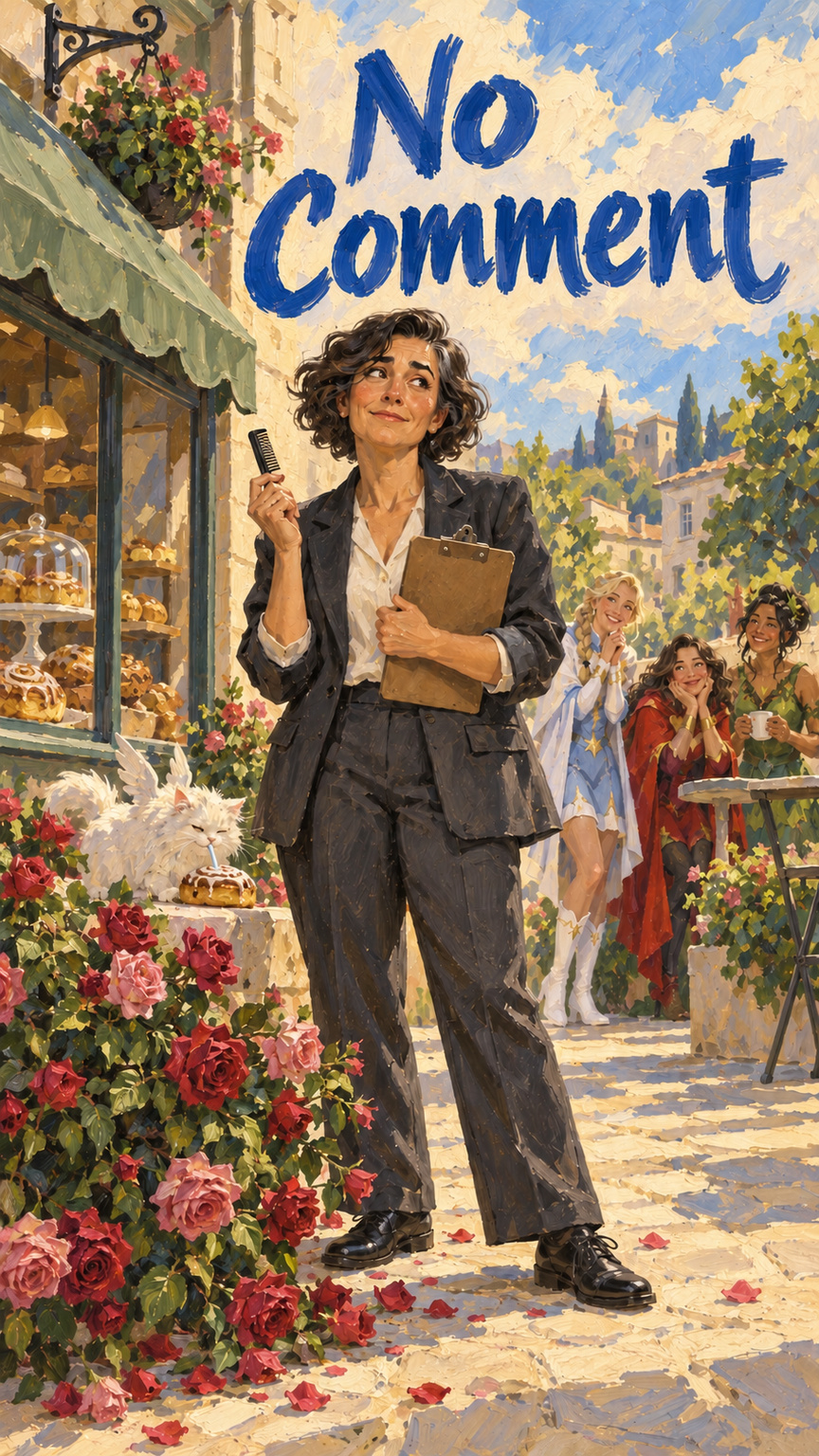
"No comment," said Honest Pearl.
Above her head, in luminous blue letters, appeared:
MARNIE HAS FORBIDDEN ME TO ANSWER THAT.
"Better," I said. "At least you've stopped naming my solicitor."
Pearl consulted the notes she'd made on the back of her wrist. She had written them very small, so they wouldn't show in photographs. "Would 'We have nothing to add' be preferable?"
"Do you have anything to add?"
"Several things."
"Then probably not."
We were rehearsing beside the cake fridge at Bell's Bakery. In twenty minutes, the bakery would reopen, and the Bright Side would make their first paid promotional appearance under my management. There would be one newspaper photograph, a brief video interview, and the cutting of a ribbon. Mr. Bell had paid us six hundred pounds. Three hundred would go toward repairing our office window; the rest would pay me for the previous month.
The window had been Fanfare's fault, technically. She'd caught a chair falling from an upstairs balcony. The resulting brass flourish had startled a man carrying a ladder, who put it through our office window.
Now she was practising a song in the reflection of the fridge door.
"There isn't a solo," I told her.
"I know. I'm warming up in case there's an opportunity."
Petal Riot had already found an opportunity. She stood at the counter with a cinnamon twist in each hand.
"Those are for the guests."
"I'm going outside. Then I'm coming back in."
"You'll still be working."
She put one twist down. The other disappeared in two bites.
The girls had saved Bell's three weeks earlier, when a delivery van had rolled through its front window. Petal had stopped it against a bank of dahlias, Fanfare had lifted the driver out, and Pearl had carried Mr. Bell to the pavement. The man from the Gazette arrived just in time to photograph the baker being held horizontally by a young woman in white boots, beneath the words HE IS VERY HEAVY.
It was a perfectly good rescue and a perfectly bad photograph. Mr. Bell had looked as though he was being abducted.
Today's photograph would be different. I had sketches. I had a shot list. I had brought a comb.
"You should be in it," Pearl said.
"No."
"There's room beside me."
"I'm your public relations manager. My face is for recognising at meetings. Yours are for recognising on posters."
Fanfare turned from the fridge. "But you got us this."
"And if I do my job well, I can buy groceries in yesterday's cardigan without anyone asking me to strike a pose."
Petal swallowed. "You could have a good pose."
"You haven't seen the cardigan."
Mr. Bell emerged from the kitchen carrying a cake the size of a baking tray. He had piped his business name across the top and the girls' emblems down the front. The centrepiece was a sugar model of his new shop window. He seemed to have taken a great deal of satisfaction in making it intact.
I put down my clipboard to help him. Fanfare lifted the whole thing from his hands.
"Where?"
"That table, please. Gently."
She set it down without disturbing a crumb. Then the trumpets began.
Mr. Bell shut his eyes.
Fanfare's music accompanied relief after physical effort. The more relieved she was, the louder and longer it played. Once she'd held up a collapsing cinema balcony, and the orchestra had continued through the evacuation, the paramedics' arrival, and most of a subsequent interview about whether the building had been inspected.
Our radio campaign hadn't lasted long.
"It'll be over in eight bars," I told Mr. Bell.
It was twelve. Fanfare hummed the last four, trying out a harmony.
While we waited, Petal slid the remaining cinnamon twist toward the edge of the counter.
"I can see that," I said.
"I haven't eaten it."
"Yet," said Pearl.
YET, agreed the lettering above her.
The photographer arrived with a reporter, two bags of equipment, and a pollen allergy. I had asked about allergies. I had asked his editor, who had answered, "Only to missing deadlines."
We moved Petal's pose away from the pastry display. She could stop the force of an impact by turning it into flowers. It was a wonderful power. I had once spent an entire afternoon persuading a picture editor that the photograph of a man waist-deep in peonies showed a thwarted bank robbery rather than a proposal.
"No flowers today," I reminded her.
"I don't make them for decoration."
"I know. No impacts, either."
The photographer unfolded a reflector. Mr. Bell turned to greet the reporter, and caught the edge of a stacked tray with his apron. Petal reached past him just as it fell. Six tulips opened beneath the tray. It landed softly on their heads.
The second tray fell behind the first. Petal couldn't see it until too late. It hit the floor with a crash.
"Sorry," she said, bending to gather both trays. "The big one was in the way."
The photographer sneezed into his elbow.
"Could we do that again?" he asked. "The flowers coming out?"
"No," I said.
"That was lovely."
"Thank you," said Petal, pleased. "Usually people just ask whether I can do lawns."
"We could have her stopping something bigger. A sack of flour."
"We are going to have three girls standing in front of a cake."
He glanced at my shot list. "Right."
I took the tulips out to the bin. On the way back, I noticed that the sun had reached the little square outside the bakery. Indoors, the cake's sugar window was throwing a shadow across Petal's face, and Pearl's captions were reflecting in the fridge door, which made her look twice as indiscreet.
"We could do the photograph outside," I said.
Mr. Bell considered his cake.
"Sugarwings," he said.
I looked beneath the awning. No white tufts. No beating wings. Nothing in the branches of the little ornamental tree.
Sugarwings were the reason Bell's had a mesh screen door. They were fluffy, cat-sized pastry thieves with wings too small for their bodies and the determination to compensate. They couldn't bite a person; their mouths were more like drinking straws. But they could empty an éclair while you were paying for it.
"Ninety seconds," I said. "Petal can keep watch. Then we bring it straight back in."
Mr. Bell shook out the cloth he used to shoo them away. "All right. Ninety seconds."
Fanfare carried the cake outside to one of the pavement tables. I let the music finish before bringing out the reporter.
The guests were beginning to arrive. Petal directed them toward the counter, where Mr. Bell was setting out little plates. Pearl read through her wrist again. Her boots were white, her plait was immaculate, and she looked as anxious as someone waiting to sit an exam she had revised for very thoroughly.
"Don't try to sound official," I told her. "Give her one thing you actually want to say about the bakery."
"I like the cinnamon twists."
"Excellent. Say that."
"Won't it make me sound greedy?"
"It will make you sound like someone outside a bakery."
The reporter switched on her camera and asked how it felt to see Bell's reopening.
"I like the cinnamon twists," said Pearl.
I LIKE THE CINNAMON TWISTS.
The reporter smiled. I made a small tick on my clipboard.
"And it's been wonderful working with Mr. Bell," Pearl added.
HE PAID US BEFORE WE ARRIVED.
I put my finger over the tick.
"She's new to commercial appearances," I said.
"Is there someone else I could ask about the rescue?"
"Absolutely."
I brought Fanfare over. I had told her to walk from the door. She had walked from the door. We were making progress.
"When you saw the van coming through the window," the reporter asked, "what went through your mind?"
"Petal's in front of me, and Pearl's got the baker, so I can go for the driver. The door was stuck. I bent it back."
"Were you frightened?"
"Of course. He kept trying to get his seat belt off, and I couldn't make him sit still. I thought he might fall when I lifted him."
It was a good answer. Simple, vivid, generous to her teammates. Then she glanced down at the clasp of her red cape. It had gone crooked. She tried to straighten it, pulled too hard, and tore the clasp free.
The cape slipped off her shoulders. She caught it before it touched the ground.
A snare drum rattled. Trumpets celebrated. The reporter's microphone filled with a choir announcing no words at all, just immense satisfaction.
"I didn't want it dirty," Fanfare said under the music.
"I know. We'll do that answer again."
She looked at the clasp in her hand. "Have you got a pin?"
I had three.
The photographer was trying to arrange the girls beside the cake. Petal had her back to the tree so she could watch the square. Pearl was rubbing a line of ink from her wrist. Fanfare waited patiently while I pinned her cape, and then leaned over to look at my shot list.
"You could stand here," she said, pointing. "That bit's blank."
"It's blank because it's meant to be blank. Negative space."
"You'd fit in it."
I smoothed her cape and stepped away.
The first photograph contained the cake, the girls, and a luminous DO I LOOK ALL RIGHT?.
"Yes," I told Pearl. "You look lovely. Don't ask during the next one."
The second contained all three girls looking at Pearl, who had asked whether she should smile with her teeth.
For the third, I stood behind the photographer and held up the comb. It gave them something to look at. They all smiled. No captions. No flowers. Fanfare's cape lay correctly over her shoulders. The cake's lettering faced the lens.
The shutter clicked.
"There," the photographer said.
I lowered the comb. We had been outside much longer than ninety seconds, but we had a picture.
Then a small white body dropped from the awning onto the cake.
Nobody screamed. Mr. Bell came out with his cloth, calling, "Shoo!" The sugarwing plunged its straw into the icing and shuddered with happiness.
Petal waved both hands at it. It flapped backward and went straight through the centrepiece.
The new sugar window collapsed.
"We have the photograph," I said quickly. "We can cut around that."
The sugarwing landed on the photographer's shoulder. He flung a hand at it. It bounced off his cheek, leaving a smear of icing across his lens, and he stumbled into the cake table. Petal stopped the table from tipping in a burst of carnations.
He sneezed into the flowers. The guests at the counter backed into one another. Nobody was hurt, but they were crowding the screen door. If I carried the cake through it, the sugarwing would follow me straight into the shop.
I had brought it outside. I tucked the clipboard and comb under my arm and picked up the board beneath what remained. There was nobody at the far end of the square.
"Pearl, clear the doorway. Fanfare, cloth. Petal, stay where you can see me."
I carried the cake toward the empty end of the square. The sugarwing followed, leaving the photographer to wipe his cheek with his own sleeve. Mr. Bell tried to intercept it with his cloth, but it climbed beyond his reach.
"Wait," I called. "Let it come down."
The girls moved with me. Petal stood to my left with an unobstructed view. Pearl eased the nearest guests away from the doorway and back toward the counter, then joined us. Fanfare took the cloth from Mr. Bell and held it spread between her hands.
The sugarwing circled. I crouched to put the cake down. Petal raised her palms.
"No flowers unless it knocks into someone."
She nodded.
The creature folded its little wings and dropped. Fanfare swept the cloth over it. Its wings battered the fabric; she gathered the corners and held the squirming bundle away from the cake.
"Got you," she said, with heartfelt relief.
The full orchestra entered.
I had been crouching beside a broken sugar window. When the cymbals crashed immediately above me, I lurched upright. The comb slipped from under my arm; my heel found it, and I went backward.
Fanfare had a live sugarwing in both hands. Pearl was on the other side of the cake. Petal could see me clearly.
She stopped my fall.
It was gentle. I didn't so much as bruise an elbow. But a grown woman's worth of falling force produces a prodigious quantity of roses. They burst beneath me, swept my shoes upward, and left me suspended for a moment with my backside in a floral cradle, the soles of my sensible shoes facing the newspaper.
Pearl reached me before I could settle into the flowers. She scooped me up, one arm under my knees, the other behind my shoulders.
"You're all right," she said.
I HAVE YOU.
The photographer, who had finished cleaning his lens, took seven pictures.
"Put me down," I said.
She did. Petal took the clipboard from my locked fingers. Fanfare stood beside us holding the sugarwing, which had begun to drink icing through the cloth.
"That's your cue," she told me, over the choir. "You could wave."
I did not wave.
We went back inside. Mr. Bell washed the icing from the sugarwing and released it behind the bakery. This time, we kept the cake behind the screen door. Petal swept up the flowers. The reporter bought a cinnamon twist and asked whether we could finish the interview another day.
"Certainly," I said.
We cut the ribbon. This produced two bars of music and no casualties.
The photographer brought his camera over while I was checking that Mr. Bell didn't intend to ask for his money back.
The group picture was good. He had given it enough depth to include the intact sugar window, the bakery sign, and all three girls. Even I couldn't find something to adjust.
He swiped to the next frame.
There I was in Pearl's arms. My hair stood up. My blazer had ridden halfway to my ribs. I still clutched the clipboard. Petal was reaching to retrieve it, her face serious, and Fanfare was grinning above a bag that contained the world's smallest vanquished opponent. Roses filled the bottom of the picture. Over us, clearly legible, hung I HAVE YOU.
"This is the one," he said.
"The other one is the one."
"The other one's an advertisement. This one's a story."
"We're here to make an advertisement."
Mr. Bell put on his spectacles. "There's enough room for the shop name at the bottom."
I looked at him.
He looked at his ruined centrepiece. "People might stop saying I was abducted."
The photographer held the camera toward me again. "Your call. I won't run your face without permission."
The girls were watching from beside the counter. Pearl had brought my comb in and cleaned the icing from it. Fanfare was trying to mend her clasp with the remaining two pins. Petal stood between them, holding a cinnamon twist she had broken into four pieces.
She offered me the largest.
I took it and looked once more at the picture. Pearl's eyes were on my face, not the lens. They had left very little negative space.
"You can use it," I told the photographer. "My name is Marnie. My title is public relations manager. Please print both."
"Anything else?"
"Yes. Crop out the soles of my shoes."
He considered the screen. "I can get one of them."
The advertisement appeared on Monday. The Gazette used the same photograph on its front page, with my title printed in full.
On Tuesday, I went shopping in yesterday's cardigan.
The cashier looked at me, then at the clipboard sticking out of my bag.
"You're the fourth one," she said.
"I'm their manager."
"Oh, I know. My daughter loves you. She's made herself a clipboard."
I put a tin of soup on the belt. The cashier took a bakery leaflet from beneath the till and found me a pen.
"Would you write your catchphrase?"
I stood there in my cardigan, holding the pen, trying to think of one.