
"Found the spares. By the way, what's with the demon living in your basement?"
Ned laid four wooden hands on the kitchen table. Two belonged to the royal cook, one to the princess, and one to a pirate I had retired for biting a spectator. The pirate's mouth had been under my control. It was still a sore subject.
"Did you speak to him?" I asked.
"He called me a creature of no discernible ambition. Then he asked whether you still did the voices."
"What did you say?"
"Yes. Was that wrong?"
I put the cook's hand into its socket and pressed until it clicked. "He'll have opinions."
Ned pulled out a chair. He had come to help me carry chairs into the front room, and to stand at the door taking money. This was his understanding of theatre: his cousin worked very hard behind a curtain, strangers sat on borrowed furniture, and afterward there was soup. He had agreed to the soup. I had been careful not to mention the basement.
"Bea. You have a demon."
"Only the one."
"Could we see what he can do?"
I looked through the kitchen door at the six chairs facing my green puppet booth. There had been three chairs last month. The third had held a coat. Tonight all six were reserved, and one family had asked if I would be performing something different next time. I had nearly put that letter in a frame.
"He isn't equipment," I said.
"I know. He told me that."
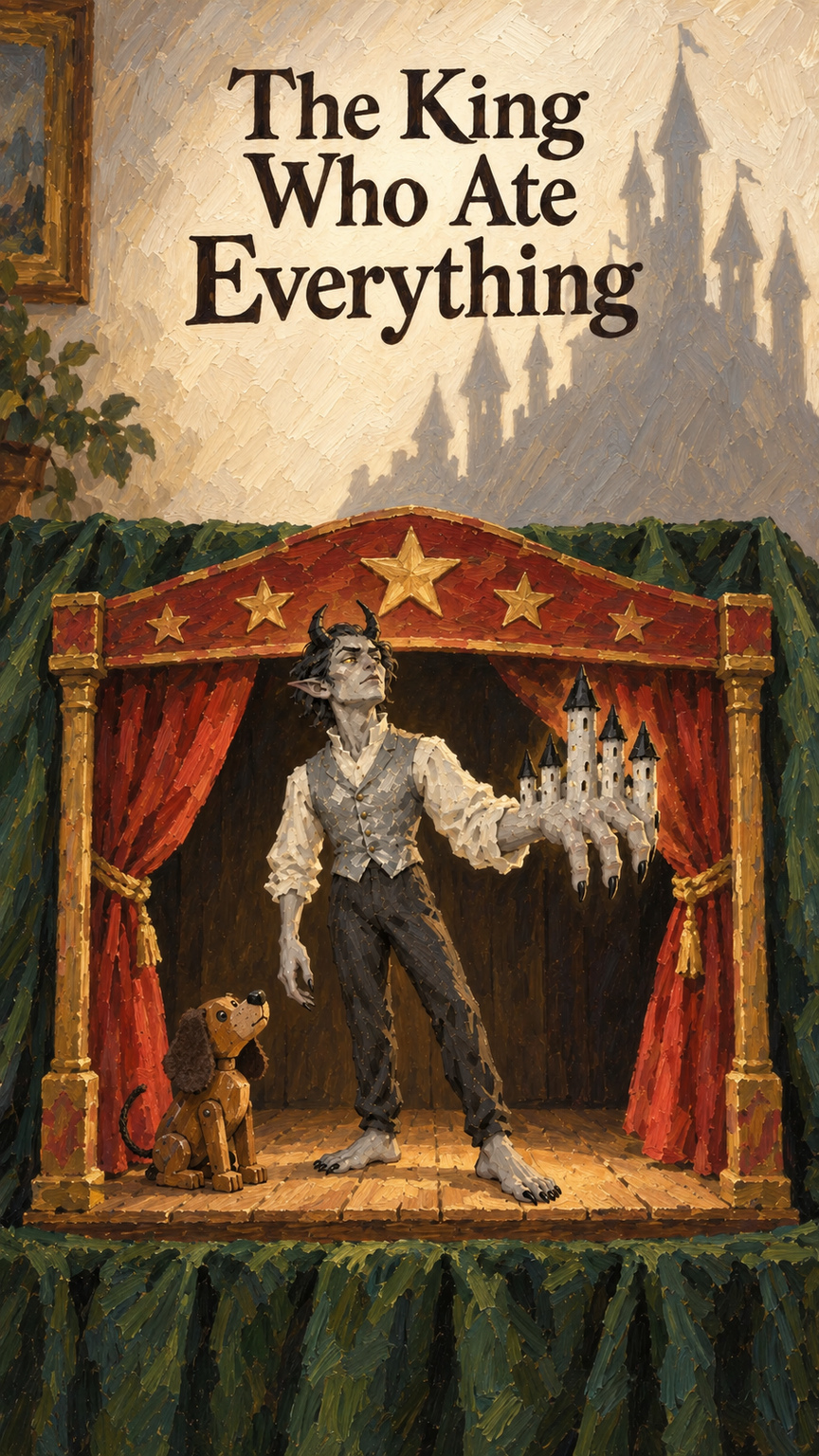
Downstairs, Vask stood on the stage of a much smaller theatre. It was a wooden box with a proscenium, two red curtains, and gilt stars I had painted when I was eight. His horns almost reached the top. He wore a silver waistcoat and had folded his long grey hands behind his back. In the basement bulb's light he was nine inches tall.
"Your associate has interesting questions," he said. "Unlike you, who asks only if I intend to be quiet."
"Have you found a new answer?"
"I intend to be heard."
Ned crouched beside the box. "How long have you been down here?"
"Eighteen years," said Vask.
"He's only been in this basement since March," I said. "Before that he was in a cupboard."
When I was eight, Vask had put a pea under one of three cups and promised me a real theatre if I could find it. I had put a pea of my own under each of the other cups. He had been so offended that he conjured this little box and said no one would ever applaud anything I performed in it. I told him to stand on its boards until they did.
He should have left then. Instead he swore himself to those boards, and couldn't lift a foot beyond them.
"I've offered to release him from that oath," I told Ned. "Several times."
"She offers pity," said Vask. "Do I resemble a recipient of pity?"
He was standing beneath a gilt star that had peeled loose at one point. It touched his horn. Ned carefully pressed it back into place.
"No," he said. "What sort of part would you want?"
Vask's fingers came out from behind his back.
I had known they could grow. When I rehearsed in the basement, he would occasionally extend one to tap the side of my booth. It was difficult to work while an enormous finger delivered three slow taps every time you missed a cue. I hadn't known what else they could do.
He cupped his left hand. The knuckles rose into towers, with black nails for steep little roofs. A pale window opened below his smallest finger. His right thumb lengthened into a king: a stout, offended king with a gold crown and a lower jaw that hung loose. Vask made him lean from the palace and survey Ned.
"Insufficient," the king said.
"He's playing your king," whispered Ned.
"I recognize him."
Vask spread two fingers. Courtiers bowed between the towers. A third finger became a narrow, bowing cook. Shadows jumped up the basement wall, crisp and enormous, so that the cook bent nearly to the ceiling. Then the king's jaw opened. The palace tipped toward it. Roofs, window, court and cook disappeared into the hand, and the wall held only a crowned profile with a cavernous mouth.
Ned said, very softly, "Oh."
I saw that mouth on the front-room wall, above people who had come to watch me coax a wooden king through the same old scenes. I saw their heads tip back. Someone might bring a friend next time. Someone might say they had never seen anything like it.
"You could do that with my puppets?" I asked.
The king's lips closed. "I could do it with your house."
"The puppets, Vask."
"Naturally."
I was supposed to ask what happened afterward. My play ended with the king realizing he'd eaten his favourite little dog, giving everything back, and dancing with the court. It was not a complicated play. Turnip the dog got the most applause, especially when he stopped in the middle of the dance to scratch his ear.
But Vask's king stood looking at me, hungry and magnificent, and I didn't ask. He would call my dance feeble. He would be right about the dance. We could settle the ending later, when he had seen how the audience liked Turnip.
"We'd have to take your theatre upstairs," Ned said.
"Obviously," said Vask.
We carried it between us. Vask stood amid the painted stars, hands neatly clasped, and complained each time we tilted him. Halfway up, Ned suggested he sit down. Vask said kings did not sit down when being conveyed into battle.
"This is a puppet show," I said.
"You must decide how badly you want it."
We set the box on the ledge inside my booth, its little stage level with the green opening. Ned and I would have to crouch behind it. Vask's palace shadows spread over the white wall behind the booth. I put the wooden king away and showed him the other puppets: the princess, the cook, the three identical councillors, and Turnip, whose felt ears were soft from years of squeezing into my bag.
"The king eats these," I said. "One at a time. I give you the cues."
Vask inspected the dog. "This has been repaired."
"He's been loved."
"His tail is a bootlace."
"So was his previous tail. Ned, would you read the councillors? I can't do their voices and the cook together."
Ned looked at the six chairs. "I said I'd take the money."
"Behind the curtain. No one will see you."
He took the script. While I showed him the lines, Vask grew a king's head large enough to fill the stage opening. Its cheeks were formed from his folded fingers; its chin rested on his thumb. My wall became the inside of a palace. Even Ned forgot the chairs.
"And when he eats everything," Vask said, "we go larger."
People were knocking at the door. I made Ned practise the councillors once more.
Our first spectator was a small girl wearing a knitted fox on her head. She pointed at the booth and asked her father if the dog would be in it. Her father said they would have to wait and see. Then he looked at me with the expression of someone who had promised a dog on very slender evidence.
"He's in it," I assured her.
The other four arrived together. There was a woman with a paper bag of sweets, her elderly mother, and two boys old enough to pretend they hadn't chosen to come. Ned took their money. I shut the front door and went behind the curtain.
"Six," I whispered.
"I can count," said Vask.
We began.
Turnip stole the cook's spoon, hid it in the princess's wig, and sat down when the king demanded to know where it was. The girl in the fox hat laughed before the spoon even appeared. One of the boys gave her a superior look, then laughed when Turnip scratched his ear and knocked the wig clean off.
Vask waited for his first entrance. I could feel his enormous head beside me. He had made one eye in the side of his palm, and it followed the dog through every scene.
Then the king declared that the kingdom was his and therefore he would eat it.
The councillors begged him to begin with the soup. Ned delivered their pleas in three increasingly anxious voices, the last so much like my aunt that I nearly lost the princess. Vask ate the first councillor with a wet little snap. The wooden head vanished between his finger-lips.
The girl gasped. Her father laughed. The king rolled his eye toward them and grew another foot.
"A larger supper," he announced.
His shadow crossed the ceiling. The towers unrolled across the white wall; nails became windows, the gaps between fingers were long corridors, and a tiny procession of shapes hurried through them. The woman's sweet stopped halfway to her mouth. The older boy sat forward with his elbows on his knees.
Vask swallowed the next councillor. Ned made a splendid squeak. The shadow palace buckled into the king's mouth, and the crowned head opened until it seemed the whole room stood between its jaws.
They clapped.
The woman clapped first. Her mother joined her, then the boys, then the father with the girl beating her palms against his. It was bright, astonished applause. It was applause for my play, in the theatre Vask had given me. I had spent eighteen years imagining a proper curtain call at the end, and had forgotten that people could like something in the middle.
Behind the green curtain, Vask lifted a foot.
He looked down at the little boards. For a moment he stood with one foot raised, so still that I thought something had gone wrong. Then he stepped over the rim of the box and jumped down onto my carpet.
I nearly congratulated him.
His body grew behind me. His waistcoat buttons climbed past my shoulder. He set a grey foot, long as my forearm, flat on the floor and spread the toes into the pile. The king's hand-head remained at the opening. Above me, two black horns pressed the curtain rail.
"Now," he said.
He ate the princess, the cook, and the last councillor. I gave their lines, trying to watch both the enormous hand and the enormous man attached to it. Vask had never stood behind me before. His other hand held the palace in the wall, and the king grew so large that his painted crown scraped the ceiling.
Turnip ran along the ledge barking at him. The girl barked back. Ned gave the dog his little outraged bounce, exactly as I had shown him.
"Too small," said the king, and ate Turnip.
Then the entire palace folded shut.
Vask held the great crowned head in the centre of the opening. There was no kitchen, no court, no dog, no dancing. Just the king, immense and satisfied.
It was beautiful. I couldn't stop looking at it. Neither could the spectators. The younger boy had both hands clenched on his chair. I could hear the woman's mother breathing through her nose.
After a long silence the girl said, "But Turnip."
Her father leaned toward her, then reached beneath his chair for his daughter's coat. He thought we were finished.
"The dance," I whispered. "Give them back."
Vask looked at me from above the curtain. "Why?"
"Because that's how it ends."
"It has ended."
I'd known perfectly well what he meant when he'd closed that mouth in the basement.
"They want the dog."
"They applauded the king."
He could go. He could step out through my front door, take his wonderful hands away, and leave me six people whose evening I had decided to improve.
Ned was looking at the script. Its last page lay open on a dance with no dancers.
"The king missed something," I said.
Vask's eye narrowed.
I put my empty fist above the ledge. I bent my wrist, stuck out my smallest finger, and made a creature as unconvincing as anything I had ever made when I was eight. I couldn't do Turnip without Turnip. But I could do the thing that lived behind his ear.
"He missed," I said in a high voice, "a flea."
The girl stopped putting her arm into her coat.
My little finger waved. It was meant to be a leg. It looked like a little finger. I hopped my fist onto the huge king's lower lip.
Nothing happened. Vask watched it. My face began to burn.
"Your Majesty," said Ned's third councillor voice, from somewhere inside the closed hand-mouth. "There's been an omission."
The king's lips twitched.
"A what?" he said.
Ned looked from my fist to Vask's forearm stretched between us behind the curtain. He pulled the curtain off its hooks.
It fell around our feet. There I crouched in my work shirt with my fist in the air. Ned knelt beside a theatre built for an eight-year-old. And Vask, taller than the door, stood on my front-room carpet with one gigantic hand stuck out in front of him.
For a second nobody moved. The girl tipped her head until the fox's nose pointed at Vask's horns. "Is that the king too?" she asked.
"A great deal of him, yes," said Ned in the councillor's voice. He was red right up to his ears. He had never wanted an audience to see him.
"An omission, Majesty." He made his own fist hop onto Vask's wrist. "It's when you miss one."
The older boy began to laugh.
Vask turned toward Ned. His real face was a narrow, furious face with yellow eyes and a mouth full of small teeth. His king's face had one rolling eye and a great empty mouth. He could close that hand and walk out. There was space behind him, all the way to the door.
Ned's fist scrambled up his forearm.
"Several omissions," it said in my aunt's voice. "Who took the minutes?"
Vask looked back at the boy, who had put a hand over his mouth and was trying not to laugh any harder. Then at the woman, who was already laughing without trying. He offered the king's nose to my flea.
The king began to itch.
It was a terrible, magnificent itch. His jaw wobbled. His crown slid down over his eye. The palace opened again, this time upside down, with every tower shaking. Ned's fist chased mine along Vask's arm, and the king tried to scratch his nose with a castle.
The girl howled. The boys were making flea voices of their own. Vask let the crown fall, caught it on one nail, and sneezed out the royal cook.
I caught her by the rod. Her wig was backwards.
"Bless you," she said, and made a desperate bow.
The councillors tumbled out next. Ned scrambled to recover them. The princess emerged sitting on the king's tongue, which was still visibly a thumb. She demanded her kitchen back. Vask gave her the entire palace, balancing it on one enormous fingernail. She slapped him with the pirate's spare hand.
I had no dance for any of this. I barely had words. Vask kept opening things I thought he had closed, and Ned kept sending fleas into them. Sometimes a puppet fell down. Once we all reached for the same rod and banged our heads together. Vask's king reeled as though the collision had happened inside him, and got a laugh so large he did it again.
Finally the girl stood up.
"Turnip!"
The king looked at her. His enormous mouth opened slowly. Ned and I held our hands still.
Something small and brown appeared between his lips. Two limp felt ears. A black painted nose. The dog came out backward, with his bootlace tail wrapped around his head.
The girl clapped once, sharply, as if ordering him home.
I caught Turnip. Vask's hand shrank beneath my fingers, the palace came folding down from the wall, and I put the dog on the bare boards of the little theatre. He sat. He scratched his ear. My flea fell off him and died.
The girl laughed so hard she sat down on the floor.
This time the applause went on. Vask kept his hands small. He looked at the little dog, at the scattered rods, and at the six people laughing in front of us. Ned tried to stand up in the fallen curtain, tripped, and took his first bow on his knees. The audience clapped harder. Vask took a bow so deep his horns nearly lifted the woman's bag of sweets off her lap.
When they stood to leave, the father asked what we were doing next month.
I said we hadn't decided yet.
"This," said his daughter. "Again."
The older boy wanted to know how we had made the palace. The woman wanted to bring her sister. Her mother told Vask his king needed a handkerchief. He showed her the hand that had been the king. She considered it, then gave him hers.
I took reservations on the backs of the programmes. Six names, then two more. Ned stood by the door holding the curtain, and told everyone the fleas had been his idea. They hadn't. I let him tell it.
Vask watched the last spectator go. Then he walked to the front door. He was large enough that he had to turn his horns sideways to get through.
I held Turnip against my chest. His nose was damp. I had lost the princess's proper hand, which mattered much less than it had at six o'clock.
"You can leave the waistcoat," I said. "If it helps you fit."
Vask glanced back at the overturned box. "I require a larger stage."
"You required one yesterday."
"Yesterday I was not performing."
"You aren't obliged to do it again."
He looked at me as though I had offered him a spoon with a hole in it.
"Eight names," he said. "I counted."
Then he ducked through the door and went down my steps, growing smaller as he went. At the gate he was once again nine inches tall. He stood on the top rail, very far from his painted boards, and looked in both directions along the street.
Ned reached past me to shut the door. Vask raised one long finger.
"Do not," he called, "put the dog in the cupboard. I haven't finished with his fleas."