
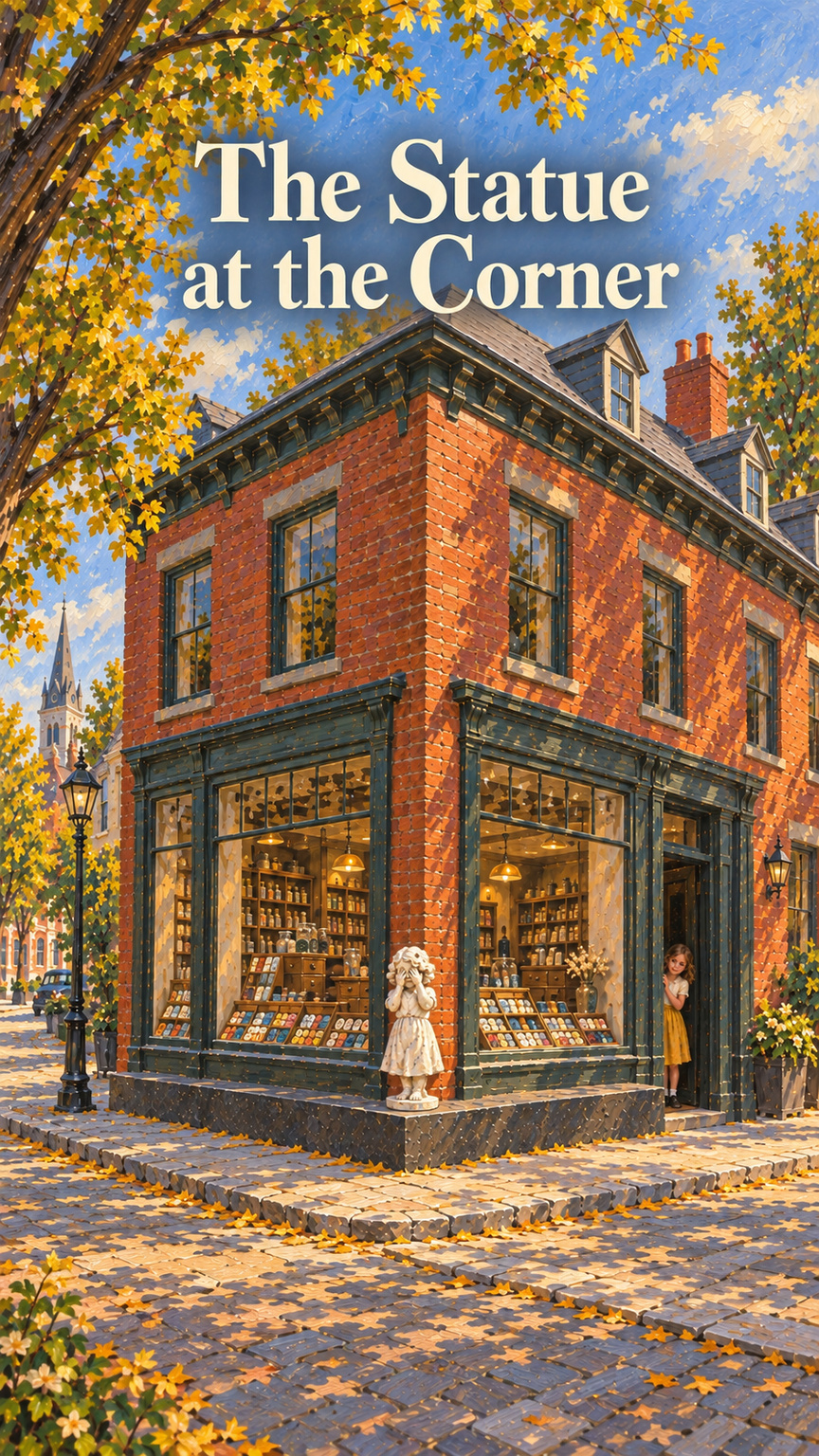
The doorway was perfect. It belonged to the button shop, and it went so far into the wall that a person standing inside it could see the street without the street seeing the person. Iona had discovered this yesterday while waiting for her sister to choose six buttons, which had taken longer than choosing a whole dress.
Today she had been found first twice. The first time, her yellow skirt had stuck out behind a tree. The second time, she had sneezed. Now her sister was counting beside the bakery, and Iona was going to get to that doorway before anyone else thought of it.
She ran past the button shop's first window, cut the corner close, and hit something with her face.
It was cold and white and much harder than a face ought to encounter. She sat down abruptly. For a moment her nose seemed to occupy her entire head.
Above her, the marble child took its hands away from its eyes and blinked.
Then it shifted on its plinth. Stone scraped against stone, a harsh little sound that went right through Iona's teeth.
“Now look,” it said. “I've forgotten.”
Iona pressed both hands over her nose. The statue had a marble bob of hair, a marble skirt, and toes sticking out below its hem. It stood on a round slab of its own, exactly where the shop's low stone ledge turned the corner. One short arm of the ledge ran beneath the window Iona had just passed. The other ran beneath the second window and ended beside her doorway. White marks curved across the darker stone. It was like a bench nobody sat on because the stone child was there.
Its mouth was moving.
Iona looked behind it for a person doing that.
“Seventy-six,” said the statue. “Or seventy-seven. Which was it?”
“You hit my nose.”
“I was here.”
“Well, you shouldn't have been.”
This was what her sister always said when Iona trod on her foot. It sounded less reasonable now.
The statue looked down at her. Fine grey lines ran through its white cheeks. There was a nick in one ear, and dirt lay in the carved curls above its forehead. Its eyes moved to her hands.
“Is it broken?”
Iona took one hand away and examined it. No blood. She felt the end of her nose very carefully.
“No.”
“Good. What comes after seventy-six?”
“Seventy-seven.”
“Then it must have been that.” It raised its hands.
Iona got to her feet. A voice in the square shouted, “Ready or not!”
Her doorway was three steps away, past the statue, beyond the second window. She could still make it.
“Move over,” she whispered.
The statue separated two fingers.
“Are you ready?”
“No. I need to get in there.”
“I can see you in there.”
“You're not looking for me.”
The fingers came down. The statue considered this.
“Then who am I looking for?”
Iona pointed back toward the bakery. “They're playing. You're just copying.”
She regretted it when the statue put its hands carefully against its skirt. It made the same small click a teacup made when you set it on a saucer.
“Someone usually answers,” it said. “I thought they might answer me.”
There were footsteps on the other street, coming toward the doorway.
Iona scrambled onto the shin-high ledge, squeezed between the statue and the first window, and crouched with her skirt pulled over her knees. She kept her head below the statue's waist. If her sister came around the corner quickly enough, perhaps she would look at the doorway instead of behind the statue.
The statue bent at its waist, peering.
“That is not a good place.”
“Shh.”
“Your elbow is out.”
Iona tucked it in. The statue slid toward her to conceal the rest of her.
The scrape rang down the street.
“Iona!”
Her sister stood at the corner with one hand still on the bricks. She pointed at Iona, opened her mouth, and stopped pointing.
The marble child was looking back at her.
“Did that just move?”
“You found her,” said the statue.
Her sister took a step closer. Iona had never seen her approach anything so slowly. She reached toward its skirt, then stopped before touching it.
“Can you do it again?”
“It already moved,” Iona said. “That's why you found me.” Her nose still hurt when she spoke loudly.
“But it—”
The statue turned its head. There was a dry rubbing sound beneath its chin.
Her sister's hand went to her own chin.
“Oh. You really can,” she said.
One of her friends called from the square. He wanted to know whether Iona was found, and whether that meant it was safe to come out.
“Yes,” her sister called, without looking away from the statue.
“I was going to use the doorway,” Iona said.
“We can play again. It's your turn to count.” Her sister looked at the statue's toes. “Can you get down?”
The statue tried to lift a foot. Its whole round slab tipped a little and knocked against the ledge. It grabbed the window frame.
Iona's sister jumped forward too late to be useful, then kept her hands out while it settled flat again. The two feet, the hem between them, and the slab beneath were all the same piece of marble.
“No,” it said.
“Then you can't be it.”
“I don't want to be it.”
“What do you want?” Iona asked.
The statue looked at the doorway.
“To hide.”
Her sister leaned around it to inspect the little recess. “You won't fit.”
“I know.”
Iona looked back toward the square. The other two had come out. One was balancing along the low wall, and the other was knocking seed pods off his socks. They would get to hide while she counted. She knew where they would go: behind the bakery steps, behind the wall, up the tree if her sister didn't remind them that climbing wasn't allowed. She could find them all quickly. She wouldn't have to be the one who was always caught.
Iona stepped down from the ledge toward the square.
The statue put its hands over its eyes again. It wasn't counting this time.
“You can play without me,” Iona told her sister.
“You're supposed to be it.”
“I know.”
Her sister looked from her to the statue. “I'll count, then. Are you sure your nose is all right?”
Iona nodded.
“I'll be by the bakery.”
She went backward for the first few steps, watching the marble child. Then a seed pod hit the pavement near her shoe and she turned around.
Iona brushed the grit off her knees.
“All right,” she said. “You hide.”
The statue lowered its hands.
“You're looking.”
“I haven't started yet.”
“You have to shut your eyes.”
She faced the window and shut them. “One. Two. Three.”
There was a scrape.
“Four. Five.”
Something knocked against the glass.
“Sorry,” the statue said.
“You don't have to talk.”
“You don't have to count so quickly.”
Iona counted to twenty. Behind her there had been three more scrapes, a grunt, and a sound like a finger drawn down a window.
“Ready or not!”
The statue was pressed flat against the bricks beside her. It had bent its head and covered its face, but its marble skirt stuck out nearly as far as before.
Iona looked at it.
“You aren't hidden.”
“I'm being very still.”
“I can see all of you.”
It straightened, bringing its hands down slowly. One palm had acquired a streak of window dust.
Iona had been behind that tree with her yellow skirt outside it. She didn't want to be told it looked just like that, but it did.
“Round the shop corner,” she said. “You could hide there.”
The statue looked past her, along the street.
Iona pointed to the ledge continuing around the corner. “On there.”
There were old white scuffs all along the stone. She had thought they were bird droppings. At the square end beside the doorway there was room for the statue and its slab. From here she couldn't see that end at all.
“Do you go round there?”
“Sometimes. When there's someone in the other window.”
“Then go there now. I'll count again.”
“I don't think you should say where I'm going.”
“Fine.”
This time she counted in the solemn way the statue had counted, leaving a great deal of time between numbers. The sliding went on for longer. When she reached twenty, only the marble skirt's edge was visible beyond the corner.
“Ready or not.”
She walked toward it. The edge vanished with a scrape.
One of her laces was trailing. A few steps short of the corner, Iona turned her back to the shop and crouched to tie it. The scraping went on behind her, closer and then farther away. It was probably trying to press itself against the bricks again.
Around the shop corner, the ledge beneath the second window was empty. She hurried to the square end beside the doorway. Nothing. A scrape came from beneath the first window, where she had been standing.
“You're moving!”
“You didn't say I couldn't.”
She hadn't. She had crept from one tree to the next when the boy with the green cap came close. It had helped until her yellow skirt stuck out.
“Well, I can hear you.”
There was no answer. The statue might have been any still thing around the shop corner.
Iona undid the knot she had just made, took off her shoes, and set them together beneath the second window. The pavement was warm through her socks. She crept to the corner, avoiding the gritty bits, and leaned her head around it.
The statue was waiting beside the first window. It saw her eye and swung backward so hastily that its slab bumped the wall. Iona pulled away in case it tipped. It didn't. There was a long scrape, then silence.
She stayed where she was.
“Are you in the button shop?” she called.
Nothing.
“Are you in the bakery?”
A faint rubbing sound.
“Are you hiding in a bun?”
The rubbing stopped.
“I've found a bun. It's a very big bun. It's got toes.”
There was a small, choked noise around the corner.
“And a skirt. I think I'll eat it.”
The statue laughed.
It was a dreadful laugh, all little stone knocks, and Iona ran toward it before it could stop. The child was doubled over beside the first window, one hand clutching the frame. Iona put her palm against its cold chest.
“Found you!”
The statue straightened under her hand. It looked down at her, then at the corner she had come around.
“You said I didn't have to talk.”
“You didn't talk. You laughed.”
It seemed to be considering whether laughter was allowed. Iona took her hand away. Its white chest held a small grey print from her palm.
“Again,” it said.
“You'll know the bun thing now.”
“Not me. You hide.”
Iona looked along the street. From the middle of the corner the statue could see both ways. But it couldn't follow her into the doorway, or off the ledge at all.
“That's not fair.”
It let go of the window frame.
“I could just stay away,” she explained. “You'd never find me.”
The statue looked toward the square, where her sister's voice rose through the numbers.
“Oh.”
Iona considered the doorway. She would have to get out of it eventually. Across the street a woman was unlocking a bicycle, and soon there would be nothing between the doorway and the statue but pavement.
“What if I have to get back?” she said. “I hide, and then I have to come and touch you. If you see me first, you call my name.”
“Iona.”
“Yes. But you have to see me.”
The statue turned its head one way, then the other. It slid toward the corner, watching each street as it came into view.
Iona fetched her shoes from beneath the second window and put them on. From the doorway she would have to watch until the statue looked the other way, then try to reach it. She wasn't certain about the last bit. Perhaps the statue would be certain, and that would make it careless.
“Hands over your eyes,” she said.
It covered them.
“No looking between your fingers.”
It pressed the fingers together with a series of little clicks.
“How far?”
“Twenty.”
“One,” said the statue.
Iona hurried toward her doorway. It was still perfect. She slipped into it sideways and tucked in her yellow skirt.
“Two.”
She could see the statue's white fingers through the gap beside the doorframe. One separated from the others.
“No peeking!”
The finger snapped shut.
“Three,” it said, much more loudly.