
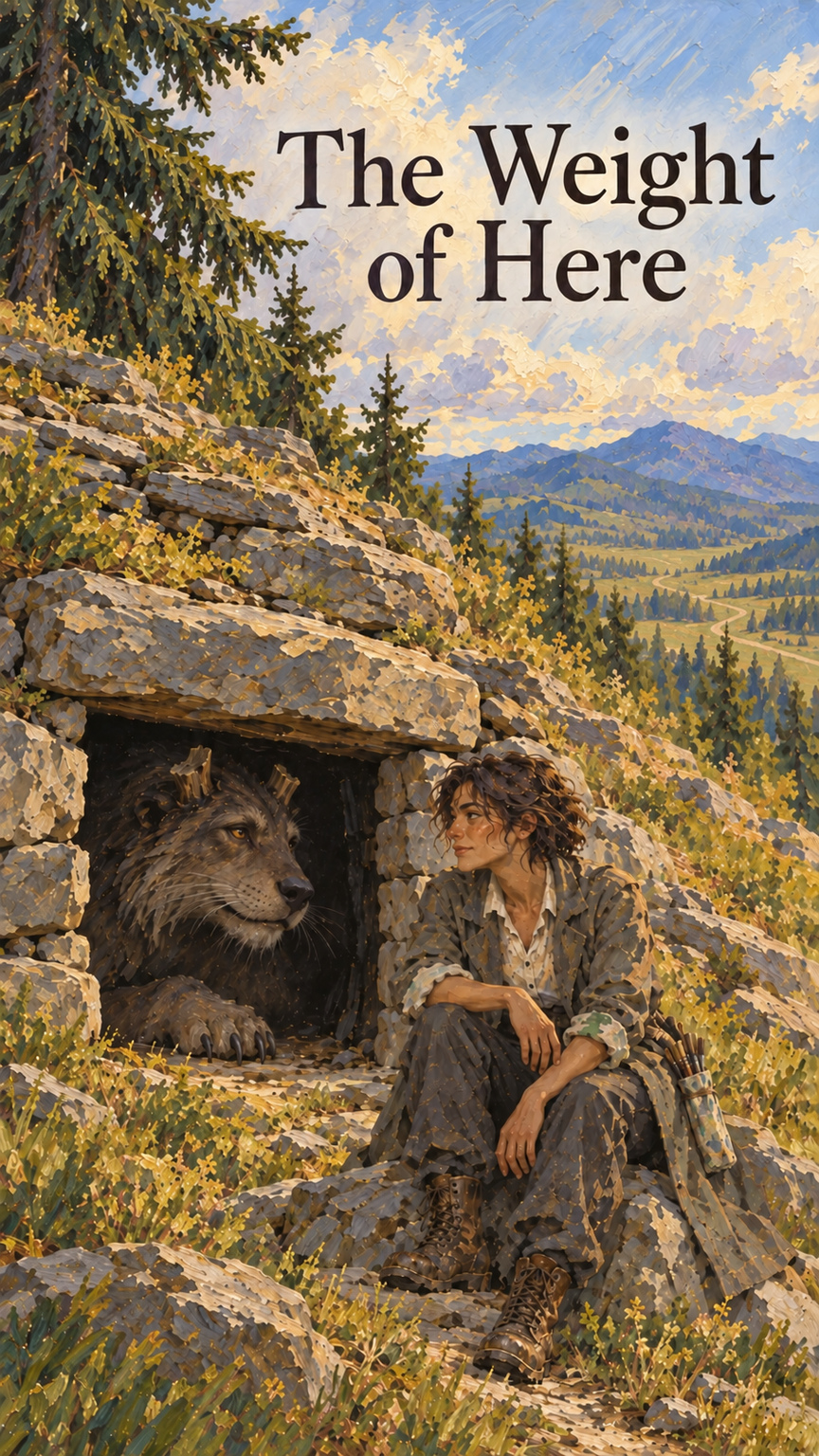
I told Osa's mother she could have had a knife that cut iron.
“I've got a knife,” she said.
“Does it cut iron?”
“I don't cut much iron.”
The baby was asleep in the crook of my foreleg. She had arrived awake and furious, but the sound inside my chest had pleased her. Human babies enjoy the same noises as mine. It is one of the few sensible things about them.
Her mother had brought a basket of wool scraps and a cake made with cherries. These were for me. For the smallest of my young she had brought a wooden ring too large to swallow, although it was making a thorough attempt.
“You could name a hearth to stay warm,” I said. “A door to keep thieves out. You have only so many namings in you.”
“I know.”
The oldest of my brood came to inspect the baby. It had a short left back toe and dragged that foot when it walked: five little taps, then a scrape. It put its nose against the baby's fist.
She caught a whisker. My child sneezed in her face.
“Look at that,” I said. “She can't even let go.”
Her mother unwound the fingers, one by one.
I had heard the name bestowed that morning. From my den I could hear a ewe cough at the far end of her pasture, and humans do not conduct their important affairs quietly. The woman had said Osa, and for an instant I had felt the familiar tightening behind my teeth. A naming spent. Its small brightness had settled into the baby, who was now using my foreleg as a pillow.
I shifted my front foot so that the coarse joint would not mark her cheek.
“What does it do?” I asked.
“It's her name.”
“I heard. What does it do?”
The woman scratched between my child's new antler buds. “I can call her.”
This did not explain the expenditure. I could call mine perfectly well. The one with the short toe heard the drag of my claw on stone and came running; the slow eater needed two scrapes. The smallest felt for me with its whiskers. I knew which child was crying by the catch between its breaths, even in sleep. No one had to spend a naming on that.
But humans in our valley persisted. They named babies without knowing whether they would ever grow useful teeth. Later those same children did things such as haul a loaded wagon out of a ravine single-handed or cross a burning field without singeing their clothes. We heard the accounts, examined the people, and found nothing suitable in their names. Their parents seemed scarcely better informed than we were.
The woman held out her hands. I gave the baby back.
She had to bend beneath the lintel to leave. It was a single long stone, resting on two stone jambs, with the hillside's shale packed above it. My own antlers ended in old broken stumps. By folding my legs close and turning my head, I could get through. A man could not bring a lance inside.
I had named the lintel Here after the hunters came.
The child that had died before that naming had liked to bite the ends off roots and leave the middles. I still found them under things.
On sound days the jambs took the weight. Here kept the lintel in the place I had chosen for it, drawing through me when the shale tried to shift. The stone had no strength to spend. Mine was the strength that answered.
The woman ducked out with her sleeping daughter, and my oldest followed her as far as the sunlight. She had to wait while it unhooked its little antlers from the fringe of her shawl.
“They won't always be little,” she said.
I knew that. I was their mother.
Osa was eleven when she came through the wall.
She and my oldest had been to watch the players who camped each summer on the high meadow. My child liked the horses. Osa liked the painted forests that rolled up around wooden poles. She had promised her mother to be home before the milking, and had remembered the promise rather late.
“You took the gate,” I said.
“We didn't,” said my child.
“You climbed.”
“She didn't.”
“Did you take a stone out?”
Osa stood on one foot, pulling at her boot. “Can you get this off?”
The heel had folded inward. I took the boot between two claws while she tugged her foot free. A strip of its leather sole stayed in my hand.
“She walked into it,” my child said. “I thought she'd hit her nose. Then she was on the other side.”
“I thought there was a way,” Osa said.
“There wasn't.”
“I know that now.”
They had tried again. Osa had met the wall with her forehead and had gone around by the gate, limping, to get back to my child. It was still angry about being left on the wrong side.
I went down to look. The wall was old fieldstone, thick enough to sit on, with a thorn growing out of one end. There was no gap. I smelled Osa on both faces of it. Under a stone halfway up, a tuft of boot leather was pinched as neatly as a leaf between two teeth.
I asked her mother whether Osa meant Through in some other valley.
“It was my aunt's name.”
“Did your aunt do that?”
“She made cheese.”
This was no help.
Back at the den, I was sewing the sole onto the boot with a thorn and a length of waxed thread. My oldest held the leather taut between its front feet. Those feet had grown clever; sometimes I woke to find it taking apart a basket to see where the shape began.
Osa was painting a forest on an old board. She had borrowed my green bowl and three colours from the players. My child looked over her shoulder.
“Those trees won't smell right,” it said.
“It's a picture.”
“Then how do you know where you are?”
“You look.”
It considered that. “I could look and smell.”
Above us a stone clicked.
I dropped the boot. All six of my feet went flat against the floor. The pressure came through Here into my shoulders, down my back, and into the long muscles beneath my belly. A chip fell from the left jamb.
Osa caught the bowl before the paint spilled.
My youngest tried to climb onto me. I bared my teeth, and it stopped. I could not have carried its little weight just then.
We waited until the hillside settled. I kept my feet spread for a while after the others began moving again.
“Does it hurt?” Osa asked.
“Pick up the boot.”
She did, and held it while I finished the seam.
My oldest ducked beneath the lintel to try the sunlight. Its antler tips struck the stone.
“Lower,” I said.
It crouched, went out, came back in. Osa was still staring at Here.
“Could you make it higher?”
I explained that the old naming had to be let go before the stone could take another. Something would have to hold up the roof in between.
“Could we put wood under it?”
“I will attend to it when it needs attending to.”
Osa glanced at my child. It had to turn its head sideways to get inside now, but it got inside.
She put on the mended boot.
At the entrance they began arguing about the players' horses again. My child wanted to know whether horses could climb a scree slope. Osa said they would take roads. It wanted to know how many roads there were.
“I'll find out,” she said. “You can come.”
I pulled a frayed thread from the boot and wound it round my claw. Osa was eleven; my child was barely out of antler velvet. The milking was already late. There was time for roads later.
Osa grew taller and stopped bringing painted trees for my child to sniff. She brought maps instead, which smelled of grease and other people's hands. Then she brought the contract.
She was to paint scenes for the players. There were wages written down, meals, a place to sleep, and three provinces she had never seen. She read the whole paper aloud to me. I made her read the part about meals twice.
My oldest had been preparing a bag since autumn. It had six pockets and no way of fastening. I had kept meaning to put a tie on it.
When Osa arrived for the last time that spring, she wore a grey coat with green paint on one cuff. Her brushes were rolled in cloth at her hip. The company was beyond the ridge, waiting until sundown.
“Its antlers aren't ready,” I said.
My child lay just inside the entrance. Its new branches had hardened through winter, pale at the tips, wider than the span of my front legs.
“Ready for what?” Osa asked.
“They'll settle.”
“Mother.”
I turned towards my child. It very seldom used the human word.
“I've turned my head all winter. I've tried every way.”
It looked back at me, then through the entrance at Osa. I could touch it, if I reached.
“Then we must be patient.”
Osa set her pack on the ground. “Where can we put the wood?”
My child got up. It had heard that question asked before. It lowered its chest, folded its front legs, and put its head beneath the lintel.
“Don't,” I said.
“If I turn this branch first—”
It turned. One antler passed into daylight. The backward fork on the other caught under the inner lip of the lintel. The child twisted its shoulders to get the fork free.
There was a sharp sound on my left. A piece of the cracked jamb dropped onto the floor, and the lintel tipped towards my child's neck.
I set my feet and called Here.
The stone stopped.
My child went still. Dust lay on its eyelashes. Its nose was outside, in the light; the rest of it was in the den with me.
“Back,” I said.
It tried. Its caught antler pulled the lintel sideways, and the pressure across my back became a pain that took away the rest of the sentence.
Osa was down on her belly beside it, looking into the den. Between my child's flank and the right jamb was a low strip of daylight. She pushed her brushes through, then crawled after them. I could not have fitted my head into that gap.
“Can you take the side away?” she asked.
I lifted a front foot towards the broken jamb.
The lintel dipped. My child cried out. I put my foot down and pushed everything I had into Here.
Osa looked at the stone, then at my six planted feet. She pulled off her coat.
I told the smaller ones to go through the gap. The youngest would not. It had heard its sibling cry.
“Follow her sleeve,” my oldest said. “The grey sleeve. Bite it.”
Osa pushed the coat ahead of the youngest. It caught the cuff and crawled after it. The others followed, dragging the rolled brushes and my oldest's bag. From outside came a quarrel over who could keep the coat, and I heard each of them in it.
Osa crouched beside my child's shoulder, on the den side of the lintel. She shifted until her shoulder was beneath the stone, then pushed up from her bent knees.
“Let some of it come,” she said.
“You don't know what it weighs.”
“No.”
“You went through a wall. This is different.”
“I can't take us through that one either.” She nodded at the shale behind me. “Try a little.”
I eased my strength. The stone stayed where it was.
Osa shut her eyes. Her boot soles creaked against the floor.
“More.”
I let another part of the weight leave me. Her knees bent, then straightened again. I heard the rough breath she took through her nose.
I had held her once in one foreleg. She had not been heavier than a basket of cherries.
“Tell me to stop,” I said.
“Just get ready.”
My child moved its eyes towards her. It could not turn its head.
“Osa?”
“I'm here.”
“Do it,” my child said to me.
I let go of Here. Its pull left me, and the lintel sank against Osa's shoulder. For an instant she sagged with it. Then her legs stiffened.
Under the dust on Osa's neck, a small brightness moved. I knew the feel of a naming. I knew her mother had spent one. I could not see how that sleepy baby had grown into someone who could hold a hillside.
The relief nearly folded me onto the floor. I caught myself, hooked my front claws into the damaged left jamb, and pulled.
A slab came free. My child's antler lurched downward. The lintel tilted towards the opening, and more shale settled onto it. Osa's back bowed. She pressed upward until the stone was level again.
“Again,” Osa said.
I tore out the next stone. There was room now to swing the caught fork towards the empty side. My child did it slowly. I got a foot beneath its chest and lifted, guiding its legs past the rubble.
Osa made a sound I had never heard from her.
I shoved my child sideways through the opening where the left jamb had stood, folded my legs, and followed. The little ones huddled against the hillside directly beside the mouth. I crouched over them, facing the entrance, and shouted Osa's name.
She ducked. The stone came down as she flung herself through the widened entrance. I caught her wrist and dragged her clear. Shale poured after her, covering the threshold, the place where I had sewn her boot, and the hollows where the children slept.
Osa lay on her back, looking at the sky. One hand was still clenched as though it held a brush.
“Don't get up,” I said.
“Wasn't going to.”
My oldest lay beside her. Carefully, with its eyes still on the fallen stones, it put its nose against her fist.
After a while she opened her hand.
The sun was on the upper branches by the time Osa could sit. She had two dark marks where the lintel had rested. Her arms shook when she tried to roll her brushes, so my oldest rolled them for her, badly, and tried again.
The other children were under the firs. They had recovered the coat, the pack, and the bag with six pockets. My slow eater had found a cherry stone left from some earlier visit and was turning it over in its mouth.
We needed somewhere to sleep. We needed dry bedding. I could dig beneath the roots until I found stone, but the young would have to carry branches, and the oldest was good at carrying branches.
It put the bag across its back. Three pockets hung on each side, trailing in the needles.
“You'll lose it,” I said.
Osa took a spare strip from her brush roll and tied the bag fast.
My child stepped towards her. I closed a front foot around its back leg.
It stopped. The short toe rested against my claw. I had cleaned grit from that toe when it was small enough to fit inside my mouth.
“We haven't a roof,” I said.
“I know.”
The smaller ones had begun pulling needles into a pile. They did not know how much bedding we would need. If I asked the oldest for tonight, it would stay. Tomorrow the players would be gone, and there would be the bedding, and then the food to move, and another season's weather.
My child waited.
“Please let go,” it said.
I could feel its pulse against my claw.
I opened my foot.
It bent its head and rubbed its nose beneath my chin. Its antlers passed on either side of me. I held still until it had finished.
Osa got up, leaning on my child's shoulder. They would have to go slowly. Perhaps the players would see them from the ridge.
“Will you come back?” I asked her.
“I'll bring some timber. When we come through again.”
“You can come without timber.”
She looked at me, then nodded. My child nudged her brushes into a better place against her hip.
I watched them find the path. The bag swung until my child shortened its stride to hers.
Five taps, then a scrape. Five taps, then a scrape.
At last they were too far away for me to hear the scrape.