
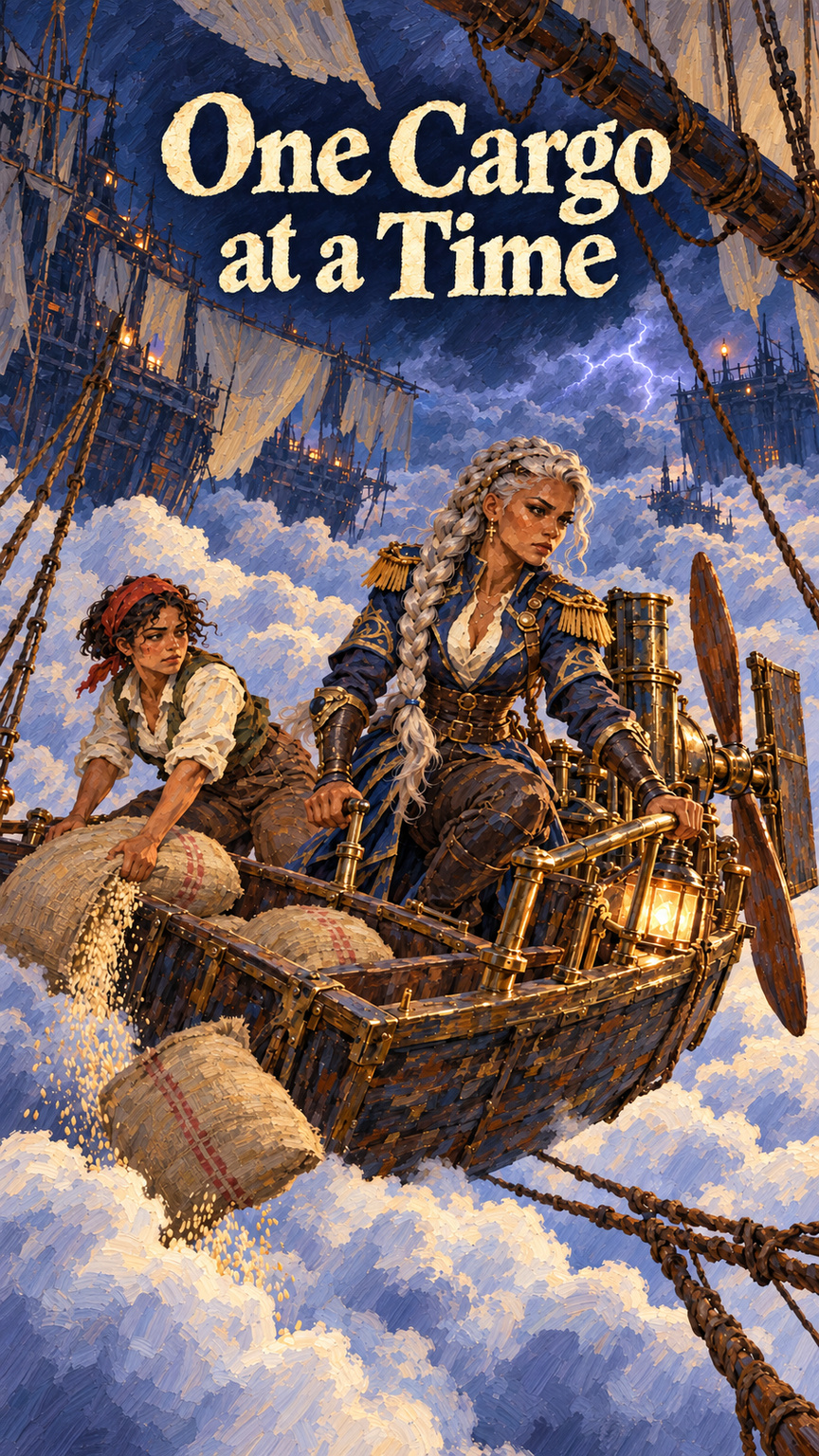
Ruzha first noticed the silence because she could hear Cobb swearing.
Usually the wind took his words away. It snapped the end of her silver braid against her shoulder, drummed in the blue skirts of her captain's coat, and made the brass rails too cold to hold. This morning his complaint about the pressure gauge reached her perfectly.
She looked up.
Above the Spindle's loading cranes, the flags hung against their poles. A mile out, a grain carrier's great red sails folded inward, slowly, like hands coming together. Beyond it another ship lost its shape. Then another.
Ruzha waited for the gust.
The Midge's airscrew chattered behind her. It pushed a narrow wind along the deck, flapping her coat and nobody else's. Across the harbor, a lookout leaned from his tower and shook a perfectly good weathercock.
“Cobb.”
“I know. The needle's sticking.”
“Listen.”
He lifted his head from the engine housing.
For three hundred years, a shipmaster had been able to buy wind charts for the cloud sea. They showed the high eastbound streams, the lower westbound roads, the curling approaches to the cities. On the oldest surviving chart, the winds had the same names and directions as on the one in Ruzha's pocket.
Now she could hear a spoon ring against a cup on the next berth.
“Take us around the Spindle,” she said.
“We were going to test the reverse.”
“We will.”
She turned the wheel. Under its own little clattering power, the Midge passed the carrier's motionless stern.
Men came to the rail to watch them go.
For five days, everyone waited.
Ships climbed to try the upper air and descended with empty sails. Captains whistled, as captains had always whistled for wind. One struck his weather reader. Ruzha saw that man afterward, sitting beside the reader on a coil of rope, both of them looking out to sea.
The Midge spent those days carrying messages between the vessels caught around the Spindle. Cobb had built her to take freight through awkward harbor approaches without a long tack. Until this week, the merchants had considered that a very expensive improvement on patience.
On the sixth morning, their agents came down to the experimental berth.
The Spindle was a bonded transfer station: one narrow rock bristling with cranes, warehouses, and iron galleries, with no city on it. Cargo had been unloaded there before the stillness. There was grain under its roofs, coal in its bins, and an insulated chest of fever serum sweating against a warehouse wall. All that had failed was the journey onward.
Three agents reached the gangway together. Ruzha let them talk until she could distinguish the demands.
Asterfall's physicians had used their last serum. The signal tower had received a new count of failing patients at dawn.
Kersey wanted the grain it had already paid for.
Rimehold wanted coal. Up there, above most of the cloud, the nights froze a cup solid.
“There's oil here,” the Kersey agent said. “Put an engine on a proper ship.”
Cobb, who had spent nineteen months making one engine turn one screw, shut his toolbox.
“Certainly. Which nineteen months were you thinking of?”
“Then tow one.”
“At what speed?” Ruzha asked. “We can shift a freighter. We cannot bring it to your city before the people aboard eat its cargo.”
The agent took off his hat and worked its brim between his fingers.
“They've begun boiling the grain sweepings.”
Rimehold's factor stepped closer. He was wearing his fur-lined harbor coat indoors now.
“Captain. Your commission has not been struck from the rolls.”
Her own blue coat still carried its gold braid, an absurd quantity for someone who stood in weather. It had been altered for the Midge. The skirts could be hitched clear of the screw, and Dessi had sewn pockets where the dressmaker had considered pockets unbecoming.
“I know what's on the rolls.”
He held out a folded paper. “The council offers you permanent command of a powered service. Rank and funding. Coal to Rimehold first.”
Through the open warehouse door she could see the mountains of it, close enough to blacken her glove. Rimehold's towers were pale points high in the north.
“Keep the appointment,” she said.
“Will you keep the coal?”
That was a better question. She did not answer it quickly.
Dessi came back from the warehouse with the serum's weight chalked on her sleeve. She had been a cargo handler before Cobb hired her, and never trusted a painted number on a crate.
“Four hundred pounds,” she said. “Chest and packing.”
Four hundred pounds was the Midge's loaded allowance. Below the deck, the engine and its oil bunker occupied the space a sensible vessel would have given to freight. The remaining well took one consignment, secured close against the ridingstone. The stone would hold the ship aloft. At full weight it left very little lift to spare.
“Can they unpack it?” Ruzha asked.
“The physician says the packing keeps it cold. He'll sign for the weight. He won't sign for warm serum.”
Ruzha looked from one agent to the next.
“Asterfall first. Kersey, Rimehold, I'll give you the next departure when we get back. Tell your cities how long this trip takes.”
The factor folded the offer carefully.
“You should tell mine yourself.”
“I will.”
The Midge did not clear the Spindle's crane on her first approach.
Ruzha tipped the bow upward, feeding the airscrew's thrust into the climb. The crane arm seemed to hang at the same height forever. Cobb watched the pressure gauge, then reached past her and eased the throttle back.
“Not more. Longer.”
They circled below it, landed again, and left their spare tool chest on the dock. Cobb took six tools out first. Dessi made him put one back.
On their second attempt they rose past the crane arm slowly enough for a gull to walk its length beside them.
Out in clear air, Cobb made her finish the reversing test. Even at harbor speed, with the chest aboard, full astern took four of the Midge's lengths to bring her still.
“Four hundred,” Cobb said. “That's a limit. It's not an invitation to see what else fits.”
Ruzha put her hand flat on the warm wheel and waited for clear sky below the keel.
Asterfall stood on three great hanging rocks joined by bridges. Its towers were the color of apricot skin in the afternoon light. Once, reaching it had meant approaching from below, catching the turning stream, and showing the harbor a broad spread of sail. Ruzha had made that entrance a hundred times.
Today she came between two motionless freighters whose crews had put chairs out on deck.
An upright wall of cloud stood east of them. Lightning lit its interior, and the light stayed trapped in it for a moment, showing chambers and columns no wind was coming to tear apart.
Ruzha marked the bank on her chart. Then she put the chart down. Half its familiar instructions concerned things that were no longer happening.
At Asterfall, the people on the landing stage waved at the little ship. Their cheering stopped when they saw the size of her.
The physician did not stop. He climbed into the well before Dessi had the last restraint unbuckled, held a thermometer up to the light, and shouted for his bearers.
“Careful of the corners,” Dessi told them. “They're not handles.”
The chest disappeared through a broad door into a hall full of beds. Ruzha followed as far as the threshold to get the receipt. A woman sitting beside the nearest bed had been keeping a spoon poised above a cup. When she saw the chest she set the spoon down, shut her eyes, and stayed that way while people went around her.
“We need the next chest too,” the port officer said.
“Kersey's next.”
“Kersey has grain.”
He tapped the trade notice pinned beside the door. Its neat columns recorded purchases, cargoes, and arrivals. The whole city could read there that Kersey had acquired a substantial new stock.
Dessi put a finger on the date.
“No. That's the transfer date.”
“It says delivered.”
“Delivered to the Spindle. I weighed it this morning.”
The officer took the notice off its pin.
Dessi brought out the freight copies she had carried in her shirt. One cargo number matched. Then another. The stock existed. It was sitting under a roof, four hours away from the people who were boiling sweepings.
“You should take these to your physicians,” Ruzha told him. “So they know why we're going.”
He looked through the open door at the beds.
“They'll still want the chest.”
“I know.”
When the Midge lifted, the woman beside the bed had opened her eyes. She raised one hand. Ruzha held hers up until she could no longer distinguish the window.
It was dark when they reached the Spindle. Without wind to carry away the smoke, the warehouse lamps burned inside their own brown halos.
The tower sent a runner down before Cobb had stopped the screw.
Ruzha read the signal sheet while Dessi swung the first grain sack into the well.
Rimehold had closed its upper houses. People were sleeping in the lower halls. Two heating furnaces were out; the third had fuel until morning. The last line was an instruction to recall Captain Ruzha under her commission.
Kersey's latest message lay beneath it. Its children's kitchens had enough for one thin breakfast, then nothing until grain arrived. Ruzha had allowed eight hours for that voyage, twice the clear-air crossing: they would have to thread the stranded fleet in darkness.
She read the figures twice.
“How long for the climb?”
“Six hours loaded,” Cobb said. “Better part of four back. Why?”
“Could we do Rimehold, then Kersey?”
Dessi stopped with a sack against her shoulder.
“Kersey would get nothing till late tomorrow afternoon.”
“I can count the hours.”
“Then don't ask him to make them smaller.”
Cobb went to the oil cage on the dock. He measured the Midge's next fill himself, using the marked dipstick he did not permit the warehousemen to touch. Their bunker took little beside a ship's cargo of heating coal, but every outward journey required the oil that would bring them home.
When he came back, he said, “People will freeze.”
“Yes.”
“And that's your city.”
Ruzha folded the signal sheet.
In Rimehold's harbor were ships built from whole groves of timber. She had walked the decks of the Vigilance through seventeen winters. There were cabins aboard it warmer than many houses, beams deeper than a man's chest, masts that a shipwright could reduce to furnace lengths.
The factor was waiting under the crane.
“Have they begun on the ships?” she asked him.
His eyes went to her face, then away.
“They've taken the spare spars. Packing cases. All the timber at the yards that wasn't already in a hull.”
“The hulls next.”
“You know what you're asking.”
“Yes.”
“My brother owns a share in a freighter. His father left it to him. He hasn't been paid on a voyage this year because they had to replace the keel.”
Ruzha waited.
“When the wind comes back, what do you propose he does?” the factor asked. “Stand on a dock and tell his children how warm they were?”
Behind him a chain creaked as Dessi lowered another sack.
Ruzha could remember every handhold on the Vigilance's quarterdeck. That familiarity offered no answer to the man.
“If we go now, I can get coal to you before dawn,” she said. “But then Kersey's kitchens have nothing after breakfast. I'm taking the grain. That means your furnace goes out before I can reach you. You still have the ships. Ask your brother. Ask the shipwrights. Ask the council to open the stores aboard the ships they're taking apart.”
“They've been arguing about it all afternoon.”
“Then tell them we are taking grain.”
He stayed where he was for a moment. Then he went up to the tower.
Ruzha walked the length of the Midge, checking restraints that Dessi had already checked. Eight sacks. Fifty pounds each. Kersey's agent had obtained an allocation for the children's kitchens, the infirm, and the gangs still doing necessary work on the docks.
“Has Rimehold agreed to cut the ships?” Cobb asked.
“Not yet.”
He put on his leather gloves. “Engine's ready.”
Kersey's lamp was below the horizon for the first two hours. Rimehold's remained visible, high and small behind them.
Ruzha kept looking back at it.
The direct approach to Kersey passed between the still fleet and the electrical cloud they had marked that afternoon. Ordinarily the cloud would have moved on. Ordinarily the ships would have spread out along the roads of wind. Now their ridingstones held them at different heights, their masts and yards presenting a forest of obstacles to anyone who could move.
Their lanterns were beautiful at a distance. Among them, Ruzha had to call out for each passage. Sleepy watchmen raised lamps to show the ends of their rigging. One captain stood on a bowsprit with a boathook, ready to help the Midge off if she drifted too near.
“No pole,” Cobb called up. “Please. We are already going somewhere.”
Kersey's lamp appeared between two sterns.
Ruzha turned toward it. The wheel gave a sharp kick against her palm.
Then it would turn no farther.
The Midge continued turning.
“Steering.”
Cobb was already lifting the stern hatch. She pulled the reversing lever. The screw faltered, then caught astern; the hull began to slow, still swinging.
Across her bow hung a freighter's open cargo boom, less than two of the Midge's lengths away. The loaded stopping run would carry her straight through it. Beyond it were the taut lines of the freighter's standing rigging. To port, blue light flickered in the cloud. Ruzha hauled at the wheel.
“Don't force it,” Cobb said.
“It's taking us into that ship.”
“I can see the ship.”
He struck something below the deck. The wheel jumped free and spun uselessly under her hands.
“Dessi. Stern lines. Through the fairleads to the rudderhead.”
She had them out before he finished. Cobb had made her practice it at the berth, when there had been all the time in the world to complain about his instructions.
Ruzha stepped aft, pulling the long braid clear of her shoulder. Her weight lifted the bow. Too slowly.
The man with the boathook began shouting. She could see his mouth, wide and dark above them.
“Over the boom,” she told Cobb. “Can we?”
He looked at the pressure, then at the crane marks painted on the freighter's side. He knew how badly she had climbed out of the Spindle.
“Lose a hundred pounds.”
“How long for the lines?”
“Not enough. A hundred pounds, Captain.”
Dessi had one line attached. She braced it round a cleat and crossed the stern for the other.
The grain well was open at Ruzha's feet. On the top sack was Kersey's seal, a little tower printed in green. She had watched the agent press it into the cloth at the Spindle, taking care that it was legible.
“We could clear the end,” she said.
“If the rudder answers. If the line holds. If we don't catch a stay with the screw.” Cobb had come out of the hatch. “We can climb, or we can find out.”
Dessi fastened the second line. She crawled forward to the well and pulled the retaining bar from the top two sacks.
“Four hundred suppers,” she said.
Ruzha looked at her.
“Quarter pound to a bowl. That's what they wrote. Four hundred.”
The boathook struck their rail. Ruzha ducked. Above them, the watchman tried to push their bow away from his ship. The Midge shuddered and came on.
She could hold the grain and require Cobb and Dessi to stake the only moving ship on the next few seconds. She could see, with terrible clarity, the sack arriving whole and the children eating it. The other possibility was harder to make herself look at: no Midge returning to the Spindle, no coal, no second chest, all the waiting warehouses still full.
“The two sacks,” she said. “Let them go.”
Dessi dragged the first over the low cargo rail. It tipped, caught on a loose fold, and split. Grain poured past the brass plates into darkness. She heaved the second after it.
The bow lifted.
“Both of you aft,” Ruzha said.
Their weight settled the stern, pointing the airscrew's thrust into the climb. She put the drive forward and opened the throttle. Cobb took the jury-lines and hauled the rudder toward center. In the narrow wind behind the screw, the blade bit.
The freighter's boom moved down across Ruzha's sight.
She waited. A spar scraped the underside of her rail. The Midge shook again, and she wanted so badly to turn that her hands reached for the disconnected wheel.
“Not yet,” Cobb said.
The spar dropped away.
“Now.”
Ruzha went forward to level the hull. Cobb pulled the starboard line, turning them past the freighter's last mast. Its watchman stood gripping his boathook, his face green in the light from the cloud.
The Midge came into open air.
For a little while no one spoke. Dessi knelt in the well, tying the remaining six sacks down. Ruzha could hear each of her breaths.
Behind them, a distant lamp began the attention signal.
Rimehold. Ruzha watched while its light shuttered and opened.
CUTTING BEGUN.
She read it once, and then again to be certain.
“Tell me,” Cobb said. He could not turn his head without losing the course.
Ruzha told him.
He eased one line through his gloves. Ahead, Kersey's answering lamp was asking their time of arrival.
They reached the city in the first gray light, after a night of picking their way between the ships. Its houses crowded the top of a flat stone island, with long quays projecting over nothing. People stood at the outer ends, watching for the Midge.
A dock gang caught her lines. One man laughed when he got hold of the bow rope, as though he had expected his hands to pass through it.
“Six?” the ration clerk said.
Dessi stood beside the open well.
“We left with eight. We lost two.”
“Wet?”
“Dropped. We had to get clear of a ship.”
The clerk looked past her at Ruzha, then back into the well. He had a list on a board, with meal allocations written beside each destination. He worked down it with his pencil.
“Twelve hundred portions.”
“Yes,” Dessi said.
He went down the list again, more slowly. Then he crossed out a line near the bottom.
The man who had caught the bow rope leaned over to see.
“That's ours.”
The clerk kept his eyes on the board.
“That's the wharves.”
“I know.”
“You said there'd be breakfast when we finished.”
“I can leave the wharves on. Which kitchen do I take off?”
The man read the list. There were children's ages in the margin beside some of the entries. He sat down on the bollard and rested his forehead on the rope he was still holding.
Dessi stayed beside him while the others brought the sacks ashore. She did not ask him to look up.
The port master had come down the quay.
“You must go straight back for the rest,” she told Ruzha.
“I'm going for coal.”
“You promised us a full load.”
“I did.”
“And now you're leaving us short.”
Across the landing stage, Cobb was testing the jury-lines. His hands shook when he stopped pulling.
“Rimehold's burning ships,” Ruzha said. “They started while we were coming here.”
The port master glanced toward the pale northern sky. Rimehold itself was hidden from this low quay.
“We can't eat that.”
“No.”
The woman stood in her path for a moment. Ruzha had no further explanation that would give back a bowl of grain. At last the port master stepped aside.
Before departure, Dessi took the clerk's board and added the loss beneath the receipt. Two sacks jettisoned. She signed her own name, then handed it to Ruzha for hers.
The man on the bollard got up and cast off their bow line. He did not wave.
At the Spindle, Cobb removed the damaged powered steering gear. With a length of crane timber, he turned their emergency ropes into a proper hand tiller. Ruzha tried it from stop to stop while he watched the rudder answer.
“You'll feel everything,” he said.
“Good.”
“That wasn't a recommendation.”
Dessi slept on the dock while the coal was weighed. Ruzha made herself eat beside the engine. She had begun making foolish small mistakes, putting a gauge cover down and looking for it, starting a sentence twice. They needed another six hours of her.
The Rimehold factor brought their receipt from the signal tower. Under his city seal, the council had authorized the dismantling of three vessels. The shipowners' objections were recorded beneath it. So were the heating halls to which the timber would go.
“Your brother's?” Ruzha asked.
“One of them.”
She held the paper out to him, but he shook his head.
“Take it home. They should have the actual order.”
They climbed north through the afternoon. Dessi lay forward of the engine with her boots beneath her head. Cobb took the tiller for an hour while Ruzha sat on the deck and slept against the rail.
When she woke, the clouds were far below. Rimehold stood alone in cold sunlight, its narrow spires joined by bridges hung on heavy chains. The windows of the abandoned upper houses shone. Lower down, the common halls had smoke rising from their chimneys in straight, thick columns.
There were gaps in the harbor.
Not empty moorings. The ridingstones and stripped bottoms of ships still hung there, fastened to the quays. Men were sawing down into the wood around them. A mast lay across the landing stage, its gilded truck already cut off. The sawdust was bright on black ice.
Ruzha found the Vigilance by its white lower hull. A section of the quarterdeck was missing. Beside it hung a merchantman without its bowsprit, and beyond that a freighter whose painted name had been split through by a saw.
The crewmen waiting to unload the coal wore the badges of all three ships.
The Midge's well looked very small between them.
An old quartermaster checked the coal weight and directed the first baskets toward the heating halls. When he had seen them on their way, he came back to the ship. Ruzha knew him from the fleet victualling office. He had once refused to issue her a replacement coat because the old one had only been scorched.
“Can the men stop cutting?” she asked.
“For tonight, if we bank the fires properly.”
He looked at her coat. There was a torn seam at the hip where the freighter's spar had caught it.
“Council says there'll be a hearing.”
“Send me the date.”
“Where?”
She looked south, toward the Spindle. A signal light was winking from the northern watchtower, too fast for her tired eyes to read without starting again.
“Leave it at the depot.”
He made a sound that was almost a laugh. Then he looked at Dessi, who was sweeping coal dust from the well.
“Did you get the grain through?”
“Six sacks,” she said. “We dropped two to clear a boom.”
“People fed?”
“The children's kitchens. The infirm. Not the dock gangs.”
He watched the last basket of coal go up the steps.
“Wait here.”
There was another argument on the quay. Ruzha could hear pieces of it: shares, stores, who had paid. The quartermaster did more listening than speaking. At last two sailors went into a shed and came out rolling a cask between them.
Ship's biscuit. Dry, hard, fit to survive a long voyage. More casks followed it.
“Voyage stores from the ships,” the quartermaster said. “The crews have agreed. There's enough here for your well.”
Dessi put a hand on the first cask to stop it rolling.
“For Kersey?”
“For the people who catch your ropes.”
He handed her a sheet with the contributing vessels listed, and room for a receipt below.
“They'll want paying eventually,” he said. “Don't let them forget that because their ship's in a furnace.”
“I'll take the bill,” Dessi said.
While she arranged the casks, Cobb went with a dock lamp-keeper to fill the working bunker from the fleet's oil reserve. Ruzha checked the jury steering and the new restraints. One cargo. Four hundred pounds.
The quartermaster waited beside the gangway.
“We'll need coal again.”
“I know.”
“Asterfall's asking for you. Saw it from the tower.”
“Did they send a new ward count?”
“No. Another urgent request for serum.”
Ruzha looked at the casks. She could take this food directly to Kersey tonight; another serum chest meant returning to the Spindle first.
“Send them our course,” she said. “I'm taking this to Kersey. Tell them their next chest waits for that run.”
He looked as though he might say something else. Instead he stepped back so she could lift the gangway clear.
Ruzha let the Midge rise from the quay. With the biscuit aboard, they climbed slowly past the sawn ends of the masts. She kept her hand steady on the tiller. Behind her, Cobb listened to his engine, and Dessi unfolded Kersey's freight copy on top of the casks.
The quartermaster was still watching when they cleared the harbor. He lifted a hand toward the south, indicating the way they already knew.
Below the Midge, the cloud sea lay without a ripple. Every sail she could see hung empty.
Ruzha tipped the bow toward Kersey and opened the throttle. The little ship's noise went ahead of them into the stillness.