
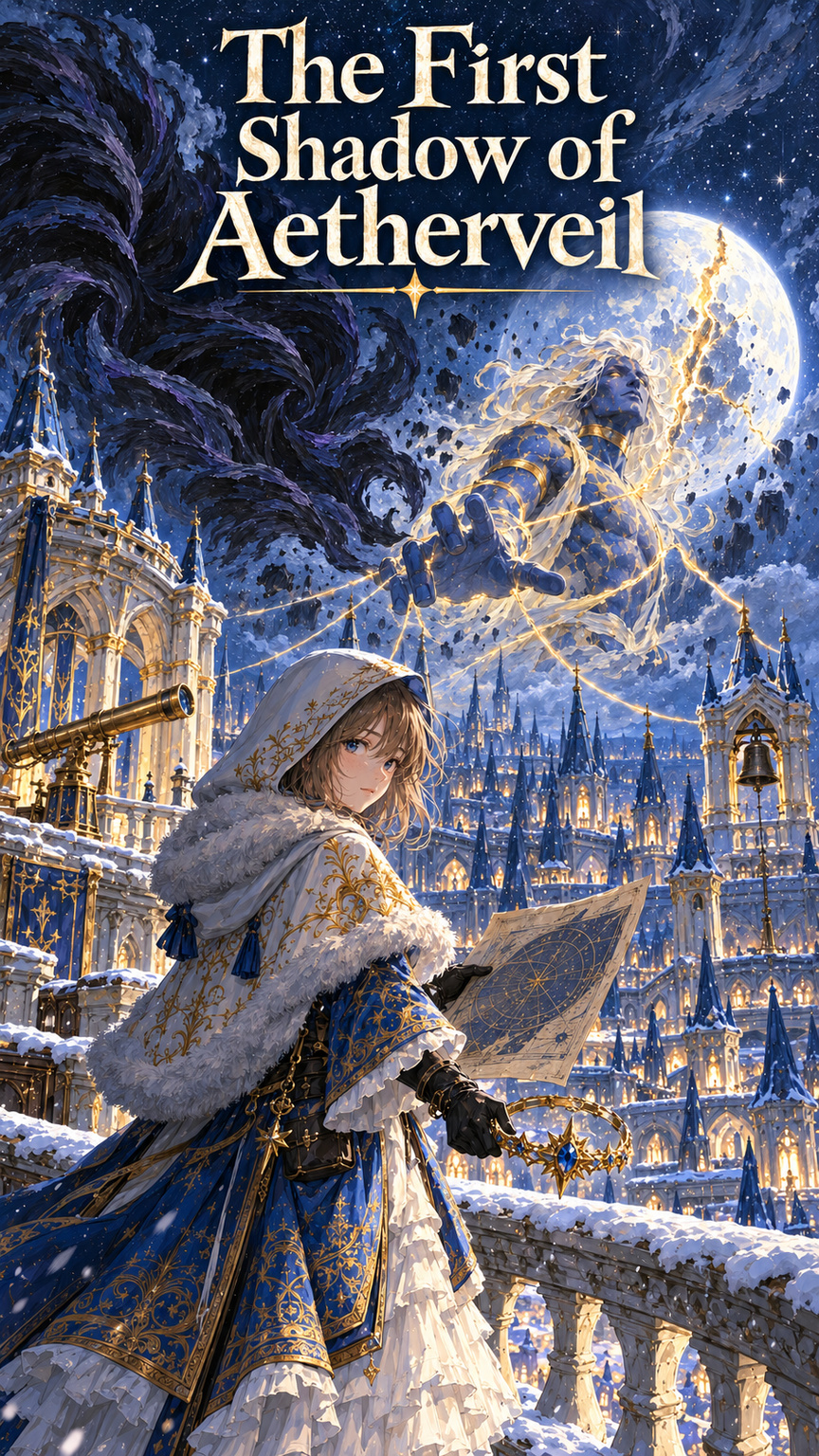
On the six-hundredth anniversary of the night that did not end, Princess Orienne stole a map of the morning.
It was considerably older than the maps she was allowed to study. Those were round, with Aetherveil at the center and seven royal towers at the edge. Roads beyond the towers curved back into the city, as roads always did. This map had corners. One was marked EAST, and beneath that, in small, unembarrassed letters, sunrise.
She folded it into her sleeve before her mother came to fetch her.
“Your hood,” said the queen.
Orienne put it up. The white fur made an excellent hiding place for several lockpicks, a pencil, and the blue ribbon that ought to have been holding her hair away from her face.
Her mother removed the ribbon from the fur and held it out.
“The Council will be watching.”
“They've watched me do my hair before.”
“They will be listening.”
That was worse. This year, for the first time, Orienne was to stand beside the crown and say the words her mother said every anniversary: As it was freely given, so shall it remain.
She knew them. Everyone knew them. Children sang them while they skipped between the pale squares of the streets.
From the balcony, Aetherveil rose around them in snowy tiers. Blue roofs pierced the glittering sky; bridges hung on braids of light between towers whose carved beasts wore soft white caps. Far below, a pastry seller was sending little hot parcels up to the windows in baskets. Every balcony had its blue-and-gold banner. Even the snow falling beneath the immense, motionless moon seemed dressed for the occasion.
Nothing in the city had a dark side. Light entered under doors, gathered beneath tables, made a silver seam inside a closed fist. The queen had once demonstrated this to Orienne when she asked why the horses in an old picture had black shapes beneath their feet.
“Shadows,” her mother had said. “A thing the moon keeps from us.”
She had sounded exactly as she did when she spoke of fever.
Now a shout rose from the square. A little boy had climbed a banner pole and lost his hold. The queen lifted two fingers. A ribbon of light uncoiled from the nearest spire, caught him around the middle, and lowered him into his father's arms. Applause traveled up the streets.
Her mother gave the boy a small, private wave. Orienne loved her so much in that moment that she nearly put the map back.
The bells fell quiet enough for her to hear the moon-song, that low, beautiful note which had been sounding before her grandmother was born. Soon the choirs would take it up, and the queen would put her hands on the seven-pointed crown, and Orienne would swear that nothing must change.
“I'll meet you in the hall,” she said.
Her mother looked at her boots.
“Use the stairs.”
“Of course.”
She did use the stairs. After the first window, she had to make them herself.
Royal light was easy to persuade into steps. Orienne had learned that at eleven, after the third attempt to keep her out of the roof gardens. Usually she needed only six or seven.
This time the stair went up until the city became a jeweled clasp beneath her.
The old chart showed a narrow line between the observatory and a mark on the moon. She had thought it might be a surveyor's measurement. At the observatory's map table, beside a little brass globe on an iron spike, she had unfolded it beneath stone arches lashed together with royal light. There she had seen that the line was labeled door.
The light had answered her hand.
She climbed with her white cloak pulled tight and her eyes on her boots. The steps were translucent. Somewhere beneath them, seven towers shone through a great thickness of air. Snow swept sideways past her; higher up there was no snow and no wind, only the enormous moon-song entering through the soles of her feet.
The moon had a seam.
She could see it now: a fine gold join running around its white surface. Beside it was an indentation the shape of a hand. She put hers against it.
The note stopped.
In the silence, a section of the moon swung inward.
Orienne stepped through and saw a hand bigger than the palace gate.
Its palm lay upward on the floor. Beyond it, knees rose into the white brilliance. There was a chest, a throat, a face bowed between vast shoulders. Stars moved slowly beneath deep-blue skin. The being's hair flowed upward in pale strands, though there was no wind here either.
Seven bands of gold held him. One crossed his throat. Orienne followed it with her eyes until it passed through the wall, and understood that she had climbed beside it all the way from the city.
The being opened his eyes.
They were the color at the heart of the queen's brightest light, too fierce to look at directly.
“How long?” he asked.
Orienne had to swallow before she could answer.
“Since what?”
He lifted one finger. The gold band tightened. Far below, through the white curve of the wall, a bell rang once and faltered.
“Since they closed it.”
“Six hundred years.”
His finger came down.
She had never heard the moon draw breath before.
“Who are you?”
“The Dayfarer.” His gaze went to her sleeve. “That was my sky.”
The edge of the chart had slipped out. She drew it free, unfolded it, and held it up with both hands. His face changed at the sight of it. Not toward her; he scarcely seemed to see her now. He was looking at a little ink sun.
“You know this place?” she asked.
“I've carried the moon through it.”
“But the moon doesn't move.”
“It did.”
She looked around the white chamber. The moon-song was beginning again, a thin sound behind his closed teeth.
“They say you gave us your light.”
“I gave your king light to fight by.”
“And then?”
He turned his wrist. The band bit into the stars beneath his skin. In the city, one of the towers brightened.
Orienne's face grew hot inside the fur.
“What were you fighting?”
“Something hungry. It followed me here.”
“Is it gone?”
“Listen.”
She heard the great held note, and beneath it her own quick breathing.
“The sky is still,” he said. “So is the thing inside it. Your king stopped our pursuit in the middle of a stride.”
Beyond the opened door, the moon was fixed above Aetherveil. Of course it was. She had never questioned that. She had questioned tutors, locked doors, the tedious lists of suitable visitors. She had thought herself very good at it.
The Dayfarer moved his hand again. He placed it edgewise between her and the white wall.
Something dark crossed her glove.
Orienne jerked back. The shape moved with his finger. It had a clean edge, and through it she could still see the stitching on her glove.
“A shadow,” she whispered.
“Yes.”
She slipped off her glove and put her bare hand into it. There was no pain. The skin cooled a little. Then he lowered his finger, and it was gone.
“Can I open this?” she asked.
For the first time he looked fully at her.
“The crown closes the circle. Open it and the sky can move.”
“And the hungry thing?”
“The Hollow Star will wake.”
“You would bring it down on us.”
“I would take it toward the sun. It has burned there before.”
He looked at the little ink sun again. She followed his gaze. The map gave her no idea of how large it was, or how hot, or how far a wounded being might have to carry a star.
“Would we be safe?”
He was silent long enough that she knew he could have lied.
“I have been burning for six hundred years,” he said. “I don't know what I can still do.”
Orienne refolded the chart. Her fingers would not make the old creases lie flat.
“Then why should I let you out?”
“Because I want to go.”
She looked up sharply.
He was waiting, his vast hand open on the floor.
Her mother was waiting in the Gallery of Gifts.
All the portraits were lit. Here was the first king, whose lifted palm supported a painted moon; here the great-grandmother who had taught the light to mend a broken bone; here Orienne's grandmother with a golden bird on her wrist.
The queen stood beneath that last portrait.
“The song stopped,” she said.
Orienne shut the door behind her.
“You knew.”
“Yes.”
She had rehearsed questions on the descent. The simplicity of that answer took them all away.
“Grandmother?”
“She taught me how to hold him.”
Orienne looked at the golden bird. She remembered it flying out of the old woman's hands at dinner, landing on the rim of her cup, dipping its tiny, shining head.
“All of you?”
“All of us who wore the crown.”
“And you were going to make me say it was freely given.”
The queen crossed to a cabinet Orienne had never seen opened. Its lock was ordinary iron. Her mother wore the key against her skin.
She brought out a book with a warped leather cover and put it beneath the portrait of the first king.
“Read it.”
“I have read his account.”
“You have read the account we give the city.”
The pages smelled of dust and something sharp, like the inside of an old silver box. Orienne bent over a drawing. Seven unfinished towers. Houses she recognized beneath them. Above the houses a shape had been scratched into the paper so fiercely that the pen had torn through.
In the margin: It took the northern stair and all who were upon it. No bodies. No fall. There is no place now where the stair was.
She turned the page.
The Dayfarer had told the king that sunlight could destroy his pursuer. In an earlier passage, a strip of its darkness had been caught by the sun and burned away. He meant to drag the whole thing into it. The king had watched him falter above the roofs. He had watched the shadow reach for another street.
He held out his hand to cover us, the king had written. I took the light he offered, made a circle of it, and closed the circle on his wrist. At once the devouring stopped.
The next lines were darker, written with a newly dipped pen.
He says there could have been a dawn. I have three daughters. I could not spend them on could.
Orienne sat down.
Her mother let her read the rest. The sleeping horror. The towers completed around the seven bindings. The roads that began to return travelers to their own gates as the enchanted sky closed over the city. The first king's instructions to his heir.
And, several pages later, in a careful ornamental hand, the account for the city.
“He saved them,” Orienne said.
“Yes.”
“The Dayfarer saved them.”
The queen drew the book closer, but did not shut it.
“He was stronger then. You saw what remains.”
Orienne remembered the stars paling around the golden bands. A tower flaring as he tried to lift his hand.
“We could give him back the light.”
“What remains of it. He cannot have back what we have spent.”
Below them the celebration continued. The choirs had recovered the note. People were singing the little song about the moon's generosity. Her mother had sung it when Orienne was small and ill, holding a cool cloth to her forehead.
She bent over the book again, looking for something the queen had missed. A different way out. A later entry that said the danger had died. The king's pen scratches remained what they were.
“Why didn't you tell me?”
“Because for twenty-one years you have looked up at the moon without fear. I wanted you to have that.”
“What did you think would happen when I wore the crown?”
Her mother lifted the crown from her head.
Without it, her hair sprang loose above one ear. Orienne had a foolish urge to smooth it down.
The queen set the crown on the open book. Seven golden points surrounded a clear blue stone. A fine join ran through the gold beneath it. On the stolen chart, beside the moon's door, Orienne had seen a drawing of that circle standing open.
“I thought you would look at the people you loved,” her mother said, “and know why we do it.”
Orienne looked through the windows at a thousand light-filled rooms. She could see the pastry seller now, perched on his stool with a cup between his knees. His empty baskets bobbed above him.
She remembered the little dark shape on her glove.
“Did you ever open the book hoping you'd find a way?” she asked.
“Every year.”
That hurt more than an excuse would have.
Her mother reached to close it. Orienne caught the crown before the covers met.
“Orienne.”
She backed toward the window. Her mother's face changed.
“Give it to me.”
The queen reached out. Light rose around her wrists.
Orienne jumped.
The crown was hot against her chest. Steps flared beneath her boots, answering before she could shape them properly. She landed hard on one knee, slid, caught the next step with her heel, and ran toward the observatory.
Behind her, her mother called her name again.
There were children on the observatory terrace, waiting to sing the moon's blessing. When Orienne came over the parapet, their choirmaster made the pinched face of a man who had been presented with a princess at an inconvenient angle.
“Your Highness, we were told—”
“Take them down. All the way to the square.”
He glanced at the crown in her hands.
“Now,” she said.
He gathered the smaller children first. An older girl stayed to collect the sheet music that was blowing from the benches.
“Leave it,” Orienne said, more sharply than she intended.
The girl let it go. White pages skated across the terrace.
She crossed a short eastern roof walk to the bell tower. Inside, a ringer had his hand on the festival rope. Orienne pointed at the other one, unused so long that a spider had joined it to the wall.
“The warning bell. Tell them to get off the bridges. Under stone, away from the towers.”
“What is coming?”
She gripped the crown until its points hurt her palms.
“The moon is going to set.”
He stared at her. Through the doorway, she could see the last choir children hurrying under a stone arch. The people on the northern stair had been standing on stone, too. She had told them where to go as if she knew a safe place.
“Ring it, then get down,” she said. “Don't wait for me.”
After a moment he took the rope.
The bell's first stroke made people stop dancing. By the third, the square was emptying. Old instructions outlived their reasons; mothers hauled children toward doorways, and the pastry seller dropped his cup and ran.
Orienne crossed back to the observatory and climbed to the open platform above the great telescope. Her map table stood where she had left it, its iron spike piercing a small brass globe. She laid the chart beneath the spike. Snow had melted across the western corner.
The crown's join was almost invisible. She put her thumbnail into it.
Light ran over her fingers.
The voice of the Dayfarer came through the metal, a note too low for words.
“I know,” she said, though she did not know whether he could hear her.
She opened the clasp.
For a moment nothing happened.
Then the moon moved a finger's breadth toward the western towers.
Across the terrace, the telescope cast a black bar on the snow.
Orienne had expected fear. She had prepared herself to stand still through it. Instead she bent down, laughing once in astonishment, and touched the edge of the shape. It lay so precisely beside the brass instrument, copying every wheel and little handle. Snowflakes crossed it, each with a dark companion of its own.
Below, someone screamed. A man was running from the shape attached to his boots.
The moon moved again. Shadows spread from the spires in great blue blades. For the first time the carved beasts on the roofs had eyes full of darkness. Light slid off a thousand windows. Behind their glass, rooms grew deep.
Orienne straightened.
A piece of sky above the eastern roofs had lost its stars.
The blankness widened. Its edge folded outward, and something like an immense head turned toward the sinking moon.
The warning bell stopped halfway through a stroke.
Its tower was gone.
Orienne could still see the shape it had left in the snow on the adjoining roof. There was no falling stone, no rolling bell. Between two familiar buildings, a patch of stars showed all the way down to the street.
Then a gold thread flashed across the gap. The bell-ringer swung at its end, clinging with both arms. It lowered him onto a balcony.
The queen landed on the observatory platform.
She was breathing hard. One foot was bare.
“Close it.”
Above the western towers the moon split along its golden seam. A vast hand came through. Fingers pushed against the white shell, and the Dayfarer's bowed head rose into the sky.
The Hollow Star unfolded toward him.
He struck it. Light passed through its darkness and came out scattered, like sparks blown from a fire. He struck again. This time the darkness closed around his hand.
The golden bands stretched taut between his body and the seven towers. His face turned toward the observatory.
The queen seized the crown.
Orienne held on.
“Look at him,” her mother said. “He can't.”
She pressed the two ends of the circlet toward each other.
The Dayfarer cried out. Light rushed from his shoulders down the bands. A blue-white roof spread above the city, forcing the Hollow Star upward. Its reaching edge slowed. Fold by fold, it began to close.
Orienne saw it happening. The gap where the bell tower had stood would remain, but the rest could still be saved. The moon was drawing itself around the prisoner. His shoulders sank backward into the torn shell.
Her mother was crying silently with the effort of holding the crown.
“Help me,” she said.
Orienne put her hands over hers.
For an instant they held it together. The blue stone burned between their fingers. Under their feet she could feel the held note finding its pitch again.
She could close it. Her mother would take the crown. They would go down into the frightened city together.
The Dayfarer's free hand moved across the roofs. He turned it palm upward beneath the darkness, trying to lift the thing away from the people below. The band at his throat tightened. His hand fell.
The clasp had opened the sky, but the bands still held him. The gold was drawing his light down into the blue stone. She would break the circle itself.
Orienne pulled the crown sideways.
“No,” her mother said.
Orienne brought the crown down over the iron spike of the map table.
The first blow cracked the blue stone. Her mother caught her wrist. Orienne put all her weight against the circlet, driving it down the spike until the circlet tore in two. A piece of the clasp snapped free and hooked in her cuff.
The crown came apart.
Every light in Aetherveil went out.
For one heartbeat Orienne could see nothing. Her mother's fingers were still on her wrist. There was a small, animal sound, and she realized she had made it.
Then the light rose.
It streamed out of the broken crown, out of the seven towers, out of the golden birds and jeweled windows and doorway lamps. The bands tore free of the spires and whipped upward. Light poured into the Dayfarer's skin. The stars along his arms flared, but many of the faded points in his chest stayed gray.
He pulled his trapped hand out of the Hollow Star.
This time the darkness tore.
The roof beneath Orienne lurched. Without its bands of royal light, the observatory's high arches were falling apart.
“The stair,” she said.
Her mother lifted a hand. A few sparks died against her fingertips.
Orienne caught her elbow and pulled her toward the ordinary stone steps. The map table tipped behind them. Paper, brass globe, broken crown slid out into the sky.
They stumbled down beneath the great telescope. Through its open shutters, Orienne saw the Dayfarer turn toward a clear path above the western mountains. The Hollow Star was between him and the east.
He could have gone west. For a breath his whole body leaned that way.
Then the darkness bent toward the roofs again, and he turned back.
He passed low over Aetherveil. His hair streamed through the spires; his open hand swept the remaining white shell of the moon aside. The Hollow Star followed him, lifting its reaching folds out of the streets. He drew it upward, away from the houses, and east toward a narrow, unfamiliar line along the mountains.
Orienne stopped at the lower terrace door. Her mother struck her shoulder from behind, unable to stop quickly enough.
“Move.”
“Look.”
The line was red.
She had seen red lanterns, rubies, blood on her skinned knees. This was a color spread along the very edge of the world. It stained the snow on the highest roofs. Above it the stars were growing pale.
The Dayfarer seized two folds of the Hollow Star and pulled them around himself.
Orienne lost sight of his face. Only his arms remained outside it, bright as the old moon, holding the darkness tight. He dragged it toward the red line. The sky went with him. Stars slid above the mountains in long, slow arcs.
The terrace split.
Her mother shoved her through the doorway. They fell together onto a landing as the outer stones broke away. For a while there was only the crash of the telescope overhead, and the queen's weight across Orienne's legs, and dust that tasted of old plaster.
They crawled toward the next flight. Through the place where the terrace had been, an enormous brightness was rising.
The Hollow Star's outer edge touched it and burned.
The Dayfarer held on.
Darkness writhed around his shoulders. A long strip came loose and reached backward across the sky. He caught it in one hand, reeled it in, and carried it forward with the rest. Orienne could see the whole terrible shape now, outlined against a round blaze climbing free of the mountains. It was larger than the city. It closed around the Dayfarer, swallowed his light, and for an instant made a black wound in the rising sun.
Her mother held her so tightly she could hardly breathe.
The black shape shrank.
Its edges burned inward. Something bright moved inside it. The last trailing fold lashed once above the mountain and was pulled into the blaze.
There was no darkness left there.
Orienne waited for a hand, a face, any sign of him.
The sun rose another fraction. Gold filled the shattered doorway. Warmth touched her cheek.
“There,” her mother said.
High above the new light, a figure was climbing. One arm shone. Where the other had been, a few stars followed him like scattered beads. He turned slowly as though testing the freedom of the air.
For a moment Orienne thought he was looking back.
Then he went on.
It took them a long time to get down.
The stairs ended two floors above the courtyard. Orienne gave her boots to her mother before they climbed out through a window and crossed a sloping roof. She went in her stockings. A cook and two guards had made a bridge of a fallen door. They pulled them through the last gap without bowing.
Below, people were calling names. Some called Orienne's. She could not tell, in the confusion, what they wanted of her.
The crown's blue stone lay in three pieces beside a drift of sheet music. She recognized the older choir girl's careful handwriting. The page was pinned beneath a roof tile; the song ended halfway down it.
Beyond the ruined observatory, the city blazed.
It had been bright all her life. She had never seen it like this. Every blue spire stood beside its own dark twin. Gold windows threw fire across the snow. The gap where the bell tower had stood was plain and terrible in the sunlight, and people were gathering at either side of it, staring across.
Over the western mountains, the moon was setting: a small, pale curve, moving while she watched.
Her mother stood beside her, one hand holding her torn sleeve closed.
“It will be dark again,” she said.
Orienne looked from the retreating moon to the sun. Between them lay a sky too large to fit on the maps she had been given.
“Yes.”
The queen said nothing more. She eased the broken clasp out of Orienne's cuff and held it in her palm.
On the snow at their feet, two shadows reached across the courtyard.
Orienne lifted her hand.
A long dark hand opened.