
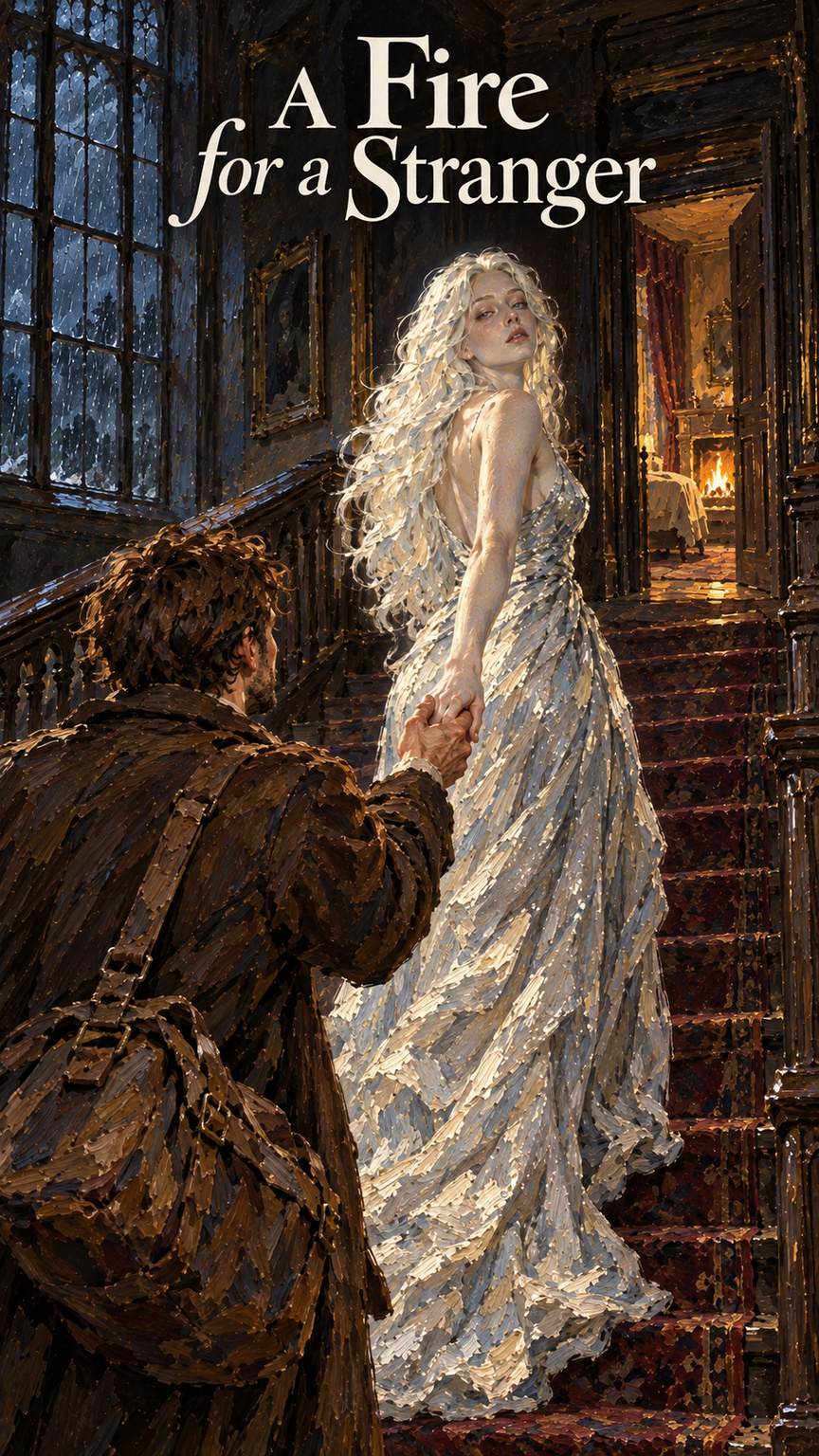
By the time he reached the gate, Cale had stopped feeling the water inside his boots.
The man who had shown him the hill road had said four miles to the village. Cale had asked whether there was an inn, whether the morning coach stopped there, and what he should expect to pay. He had not asked about shelter between the crossroads and the village. It had been a fine afternoon.
Now the road was disappearing beneath his feet. Each flash showed him a little more of it, white stones running into a blackness that swung sideways with the rain. He had walked for some time with one hand against the wall, feeling his way. When the wall gave way to iron bars, his hand slipped between them, and he stumbled.
There was a light above him.
He waited for the next flash. Beyond the gate, a drive climbed between overgrown shrubs to an old manor. Most of the house was hidden by trees, but he could see a steep roof and a single high window with a light in it. He pushed at the gate. Its lower edge scraped the stones.
At the door he found a bell-pull that would not move. He struck the wood with the side of his fist, then took off his glove to knock properly.
The door opened before he could raise his hand again.
“Come in,” the woman said.
He stepped across the threshold with so little ceremony that he was ashamed of it afterward. She had to reach past him to close the door. For a moment the wind held it against her; then the latch fell, and the rain became a distant, steady noise.
“Forgive me. I lost the road. I was trying to get to the village.”
“You are shaking.”
“If I might stand here a little. Until it eases.”
She looked at the water running from his coat onto the floor.
“There is a fire upstairs.”
He could see her better now. She was a young woman, or at least not an old one, though her loose hair was white. Her gown was silver, its folds catching a dim light he could not trace to any lamp in the hall. The bare skin of her shoulders and arms had the pallor of someone who spent much of her life indoors.
He began to draw his wet glove on again. She held out her hand.
It was not a gesture of greeting. Her palm was uppermost, the fingers slightly curled, as though there were a gap between them over which he must step.
The staircase rose behind her. Its rail was within reach. Cale looked from it to the waiting hand, then tucked the glove into his pocket and put his hand in hers.
Her fingers were colder than his own. He felt each one distinctly, a separate pressure. The grip was firmer than he had expected.
“This way.”
She went a step ahead of him, holding his hand behind her. He tried to keep his boots on the edge of the stair carpet. Water fell from his coat in little taps. Above them, something loose at a window rattled whenever the wind struck the house.
On the upper landing she stopped.
He thought she was waiting for him to catch his breath. He was preparing an assurance that he was quite all right when her fingers tightened. She was looking down the stairs.
He looked too. The hall below was dark. He could see the front door by the narrow pale line beneath it, and his wet footprints fading into shadow.
Then she drew him on.
The room stood open at the far end of the landing. He felt its warmth before he entered. On the hearth a fire was only just taking hold: slender sticks glowed under two pale logs, and a curl of smoke rose from a splintered edge. The smell of newly split wood filled the room.
“Oh,” he said, and could not immediately think of anything else to say.
There was a bed with a high wooden footboard, a chair beside the hearth, and a tall window whose small panes shivered under the rain. An ornate mirror hung above a narrow chest. Much of its silvering had darkened around the edges. In its clear centre, he saw the open door and the landing beyond.
“Put your coat by the fire,” she said.
He peeled it off. The relief of losing its weight made him laugh, briefly and foolishly.
“I shall ruin your chair.”
“It will dry.”
He spread the coat over the chair back, put down his bag, and knelt on the hearthrug. As the heat reached his hands, the fingers began to hurt. He held them farther from the flames and worked them slowly.
The woman had remained beside the door. In the mirror he could see her face turned toward the landing.
“Are you expecting someone?” he asked.
Her eyes met his in the glass.
“People sometimes arrive in this weather.”
“They're fortunate, then.”
She looked at him for a moment. Then she came to the fire and moved a log with the iron poker. A tongue of flame ran along its underside.
He stood, fumbling for his purse.
“I must pay you for the room, at least.”
He offered a shilling on his palm. There was a small split in its rim beside the king's head; it had caught his thumbnail as he drew it out.
She put the poker down and laid her hand beneath his. With the other she folded his fingers over the coin.
“There is no charge.”
“But the fire—”
“You were very cold.”
She released him. For a little while he held the closed hand awkwardly between them. Then he put the coin away.
“Thank you,” he said. “I will be gone early. I have a coach to catch.”
She had turned toward the door.
“You can sleep now.”
He watched her cross the landing and pass out of sight. He listened for the sound of her going downstairs, thinking he ought to offer once more to pay. The window rattled. A stick settled in the grate. He heard nothing else.
After a time he took off his boots and set them near the hearth. He sat on the edge of the bed while the fire worked on his stockinged feet. There was no bell beside the bed, and he did not know his hostess's name. He should have asked it. He should also have asked at what hour the household rose, rather than announcing that he would be gone before it did.
He lay down meaning only to rest his back. The blanket was heavy across his legs. With his eyes shut he could still see her in the mirror, listening toward the stairs.
When he woke, a little grey light was showing between the curtains.
The fire had sunk to a red hollow under the logs. His boots were dry enough to put on without shrinking from them. He felt the lining of his coat with the back of his hand, found it dry too, and dressed as quietly as he could.
There was no movement in the house.
He opened his door and waited on the landing. He could see the patch where they had stopped together, close to the turn of the stairs.
“Madam?” he called, softly.
No answer came.
He did not wish to knock at doors. Back in the room, he took out his purse and found the split shilling. She had refused it, but he could not bring himself to leave a stranger to bear the cost of his bed and fuel.
He laid it face upward on the hearth, just outside the fender, where she would see it when she came to tend the fire. He drew his purse shut and put it in his inner pocket.
At the foot of the stairs he called his thanks again. Then he lifted the latch and went out.
The air had the washed, metallic smell that follows a night of rain. From the drive he could see the village in the valley, a church tower and a few roofs under low smoke. He looked back once. The manor's windows held the colourless sky. He could not distinguish the one that had been lit.
An hour later he was eating eggs at the village inn.
He had been given a table beside a window. Carts were passing outside, the wheels dark with mud, and somewhere at the back of the building a woman was calling instructions to a boy who seemed determined to carry them out in the wrong order. Cale had a second cup of tea. His boots were beginning to pinch pleasantly as his feet grew warm.
When the landlady brought more toast, he asked the name of the house above the hill road.
“The manor? Aderley.”
“And the lady is Mrs. Aderley?”
“It belonged to her.”
“I must write and thank her. She took me in last night.”
The landlady kept hold of the toast plate.
“Where did you say you went?”
He described the gate, the drive, the window that had shown a light through the rain.
“That is Aderley,” she said.
“I knocked rather late. I hope I didn't frighten her.”
“Who opened the door?”
“The mistress, I supposed. A pale woman. White hair, though she wasn't old. She wore a silver gown.”
The landlady put the plate on the table, missing the clear space beside his cup so that its edge rested on his knife.
“Nobody lives there, sir. The house has stood empty since Mrs. Aderley was murdered.”
He was looking at the plate. It rocked a little when she took her hand away.
“When?”
“Thirty-six years ago.”
His right hand had drawn itself closed on the table. He opened it against the cloth.
“There must be someone else there now.”
“There isn't.” She pulled out the chair opposite him, but did not sit. “My mother was her maid. I used to go up with the bread. She had white hair from a girl. And a silver dress that was all little lights when she moved.”
Cale could see the gown in the hall, where there had been no lamp.
“It may have been a relation,” he said.
“What room did she put you in?”
He described it: the high window, the chest and its mirror, the fire still catching when he entered.
“A fire?”
“It had just been lit. I could smell the wood.”
The landlady sat down.
“My mother saw her let a man in that night,” she said. “He'd come out of the rain. Mrs. Aderley took him upstairs herself. Mother found her on the upper landing in the morning.”
Cale felt again the sudden pressure of the cold fingers. He saw the front door far below, the narrow line under it. His hostess had been looking down the stairs.
“Do they know it was him?” he asked.
“I don't know what they proved. That was what Mother saw. She never went back to the house.”
His neck was stiff from sleeping in one position. Under the eggs and tea he could still taste the smoke of the newly lit fire.
The landlady watched him without offering another explanation.
Beyond her shoulder, the boy came through with a basket of bread. He caught his sleeve on the door handle, pulled free, and went on. Cale found himself attending to each small noise: the latch, a wheel outside, his own breathing.
“I ought to pay you,” he said.
He took out his purse. The cord was drawn tight; he had to pick it loose with his nail. He tipped the money into his right palm.
The coppers were cold. One coin was too hot to hold.
He let the coins fall. They struck the cloth, the edge of his plate, the saucer. A shilling spun against his teaspoon and lay still, its split rim beside the king's head.
He had left it on the hearth. He could see it there, face upward, just outside the fender.
The landlady reached for it.
“Don't,” he said.
She stopped with her hand above the table.
He rubbed his palm against his trousers. The coin had left a small red place. Around it he could still feel her fingers, cool and careful, closing.