
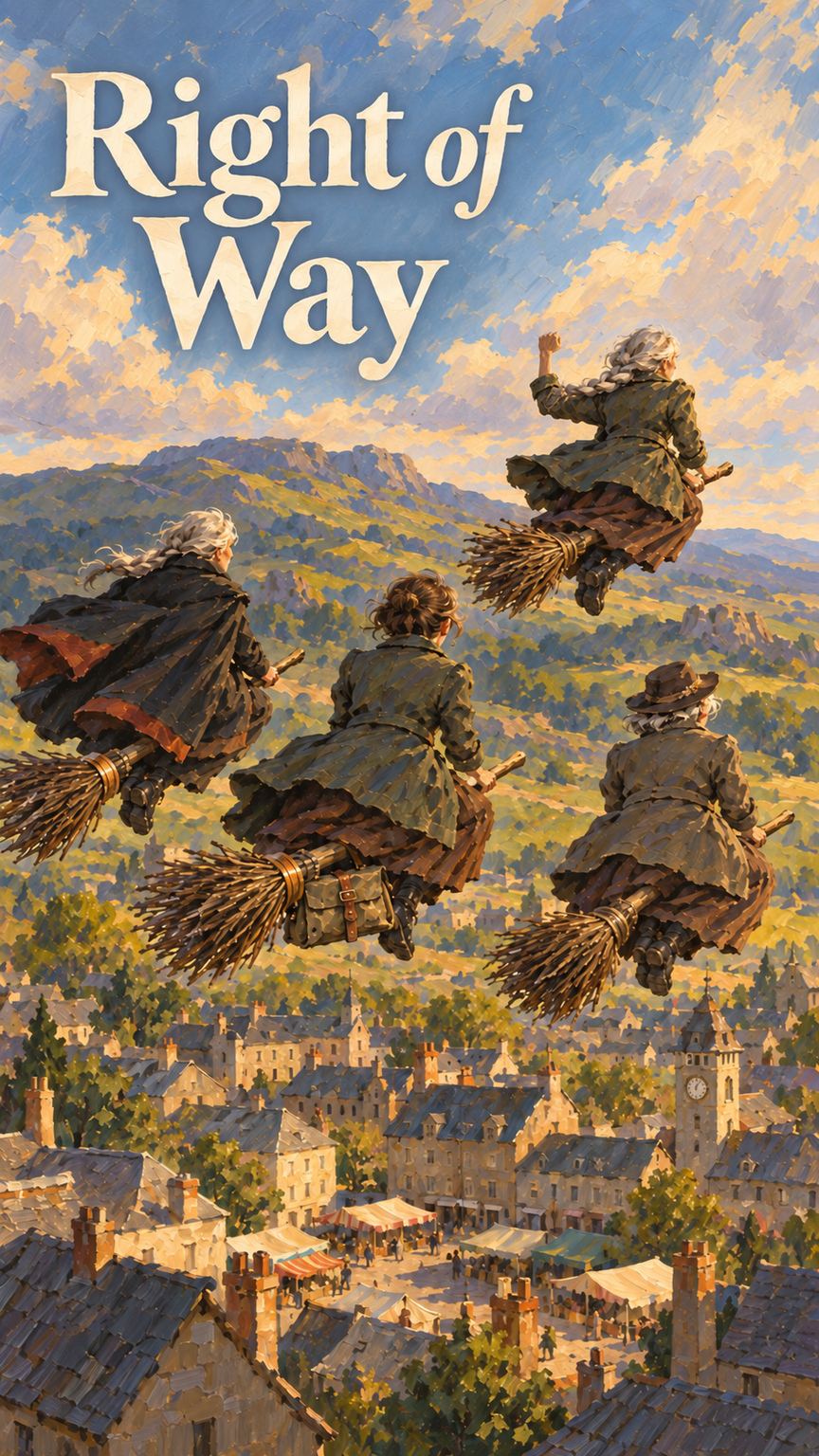
Grandma's invitation to tea had said, Bring your stamp.
I hoped this meant she needed a letter posting. When I arrived, Aunt Hesta had her broom across the kitchen table and Aunt Minta was trying to decide which hat would look best in a government photograph.
“You can't wear a hat in the photograph,” I said.
Aunt Minta put both hats away.
“Well, then,” she said. “That's settled.”
Grandma pushed a plate of seed cake toward me. She had cut it into four pieces, but mine was still attached to hers by a strip of crust.
“I haven't brought the stamp,” I said. “It stays at work.”
“You can bring the forms back to work.”
“What forms?”
She took three applications from under the plate.
In the space headed Evidence of competence, she had written her own name, Maud Flax, and underlined it twice. The others were blank.
“Grandma.”
“You were very pleased when they hired you.”
“I'm still pleased.”
“And we were pleased for you. Weren't we, girls?”
Aunt Hesta made a noncommittal sound. Aunt Minta, who was a hundred and one and still answered to girls, said she had told everyone at the bakery.
I had been at the Department of Moving Vehicles for six weeks. I processed registrations, took photographs, and explained to motorists that an appointment at ten did not mean they could arrive at eleven and argue backward. My relatives had been proud of me until the town voted to require a license from every broom rider in the district.
The grace period ended Friday. Grandma's hundred and fourth birthday was Sunday.
“There must be an allowance for experienced witches,” she said.
“Experienced riders can book a test straightaway. They don't have to take lessons.”
“I don't mean an allowance that involves allowing someone to examine me.”
I separated my cake from hers. It took two careful pulls.
“I can't get you an exemption. There isn't one for relatives.”
“There ought to be one for people who can fly.”
Aunt Hesta picked a splinter from the broom's handle with her thumbnail. She had repaired that broom so often I wasn't sure how much of the original remained. The bright copper binding round the bristles was new. The hollow worn by her right thumb was older than my mother.
“What do they test?” she asked.
“Takeoff. A controlled stop. Keeping a safe distance. Signals. Who gives way.”
“Who do they think gives way?” asked Grandma.
“It's in the booklet.”
“Yes. You left three booklets.” She pointed at the windowsill, where all three lay beneath a pot of thyme. “The pot needed raising.”
“Did you read any of them first?”
“I know how to fly.”
“Other people don't.”
“Then examine them.”
I looked toward Aunt Minta for help. She was smoothing one of the forms.
“It says full legal name,” she said. “Will the whole thing go on the card?”
“If it fits.”
“Minta Rose Flax. I want the Rose. On the birthday invitations last year, I was ‘and sisters.’”
“There was limited space,” said Grandma.
“You had room for ‘No presents, please.’ Nobody listened to that.”
Aunt Hesta reached for the cake knife. “Did you vote for this?”
“Yes.”
Grandma withdrew her piece of cake before Hesta could cut it.
“You voted to make us ask permission.”
“I voted to make everyone show that they've learned the same rules. They sell flying brooms in the ironmonger's now. You get an afternoon's instruction and a voucher for a saddle cushion. People use them to go to work. They bring children home on them. The sky over the market is crowded.”
“The sky has always been crowded over the market.”
“With people you knew.”
“I didn't know everyone.”
“You knew who taught them.”
That got a pause. Grandma had learned from her mother, who had taught half the witches on the west hill. Aunt Hesta had taught the other half after an argument about how far forward to sit in a crosswind. When I was seven, the argument had been revived over my head for an entire summer.
“The young man delivering groceries yesterday didn't know what my raised fist meant,” I said. “He thought I was angry with him.”
“Were you?”
“After he landed, yes.”
Grandma tipped the teapot. I held out my cup, and she filled it.
“If they're going to sell people brooms,” she said, “they should teach them properly.”
“That's what the license is for. Read the rules, show an examiner you understand them, show you can ride safely. A leaflet can't tell us whether anyone's learned it.”
“Quite right,” she said. “Put that on the ironmonger's counter.”
She slid her application closer to me.
I pushed it back.
Aunt Hesta got up and took a booklet from under the thyme.
“Go on, then.”
“What?”
“See whether we can do it. You haven't ridden with us in a while.”
I had missed the last two birthday flights. The first year I'd been working late; the second I'd let working late excuse me from finding a way to come. They flew to the ridge above town with a cake tin and a bottle of something Aunt Minta kept in the wardrobe. For nineteen birthdays I had ridden behind Grandma, close enough to see her plait lift in the wind. Then, somehow, the ride had become something I would do next year.
“We could practice,” I said. “I can't examine you. You'll have someone else for the test.”
“Good,” said Hesta. “You'd be trying to make it easy.”
Grandma looked at me for a moment, then went to fetch her riding coat.
Outside, Aunt Hesta sat astride her broom with one foot on the garden bench. Her black cloak had wide sleeves lined with rusty red wool. I stood behind her with the booklet open.
“Show me a right turn.”
“I am showing you.”
“I can see your fist. Where's your elbow?”
“Come round here.”
From the front I could see her left arm stretched sideways from the shoulder and bent upward at the elbow, fist closed, exactly like the illustration. From behind, her fist stuck out above a fold of black wool. The shape of her bent arm was lost in the rest of the cloak.
The illustration showed a man in a close-fitting jacket. He had no broom beneath him; they had removed the handlebars from an old motoring picture.
“Hesta, use your other coat,” said Grandma.
“Why? This one keeps my knees warm.”
I went behind her again. She repeated the signal, and the sleeve repeated its silent refusal to tell me which way she meant to turn.
“You're right,” I said. “They need a picture from the back. And someone in riding clothes.”
Hesta held out her hand for the booklet. She wrote in the margin, pressing so hard the pencil nearly went through the page.
“Give that to whoever makes these.”
“I will.”
She unfastened the small brass pin at her throat and used it to gather the loose sleeve above her elbow. This time I could see the signal from behind.
“Now you,” she said.
My new work coat had narrow sleeves. I made the signal with more confidence than I should have.
“Can't see your hand,” said Hesta.
I'd tucked my elbow in, putting my fist behind my head. I moved it out.
“There.”
We tried the remaining signals. Grandma objected to three of them and demonstrated each correctly. At yielding, she raised an open palm.
“People already do that,” she said.
Grandma had mounted her crooked hornbeam broom. Her gray plait was tucked into her collar, and a flat canvas bag hung beneath the handle.
“You brought cake?” I asked.
“We might get hungry.”
She took off before I could ask whether she had packed my piece.
We went up through the apple branches. Aunt Minta kept her hat under her arm until we were clear of the tree, then put it on with both hands. Her broom stayed level beneath her; she steered with her knees and fed it power as casually as breathing. I gripped my handle while I ducked a branch that she had missed by an inch.
At the ridge, Grandma landed between two stones no farther apart than her boots. Hesta stopped beside her and pressed her thumb into the copper binding, settling the last quiver of the bristles. Minta went a little farther to find somewhere with a view.
I landed, stepped off, and had to take two quick strides after my broom before I'd drawn back all the lift I'd put into it.
“Controlled stop,” said Hesta.
“I'm still practicing too.”
She nodded, apparently satisfied with this answer.
The town lay below us in the late afternoon light. At least a dozen riders crossed above the square. Two carried long boxes; another had a child strapped in front, its red boots sticking out on either side. A broom with a violet handle rose from the ironmonger's yard, wobbled once, and steadied.
Grandma watched it until it passed the clock tower.
“That one's sitting too far back.”
“You could say that to them.”
“I'm eating.”
She opened the tin. All four pieces were there.
On the way home, I took my old place behind her.
We descended toward the market, where the broad route down from the ridge crossed the climbing route up between the clock tower and the east roofs. A rider in a brown jacket was rising from our right. His shopping bags hung close beneath his knees, one on each side.
Grandma kept descending. He kept coming.
Then both of them slowed. Grandma leveled her broom. The man stopped several broom lengths away, his toes pointed toward the crossing. Hesta and Minta spread out behind us, giving everyone room.
Grandma pointed down her route. He pointed along his, which ran across it.
Neither went.
“Climbing gives way to descending,” Grandma called. “You can see me against the sky. I can't pick you out against the roofs.”
“I'm on your right,” he said.
“I can see that.”
“The booklet says I go first.”
His shopping bags swung gently. He steadied them with his heels. He wasn't frightened or rude; he looked as though he had arrived at the correct answer and then found somebody else's answer occupying it.
“He's trying to get home too,” Minta murmured behind me.
Grandma glanced back. I had the booklet tucked inside my coat, and for a moment I thought she would ask me to produce it.
Instead, she raised her left hand, palm toward the man, clear of her shoulder. I recognized the booklet's yielding signal from the page we had practiced. She held it until he saw it, keeping her broom level and short of the crossing.
He nodded, pointed along his course, and went through.
“Thank you,” he called.
Grandma waited until his bags had cleared us, then continued down.
Nobody said anything until we had landed in the garden. Grandma dismounted, leaned her broom against the wall, and began unbuckling the cake bag.
“He ought to know the climbing rule,” she said.
“It was the only rule I knew until I read the booklet.”
“Then they ought to tell people why it was there.”
Hesta took out her pencil again.
Grandma watched the point move across the margin.
“He'd read his,” she said. “And he couldn't tell whether I'd read mine.”
“No.”
“I could have read it and ignored it.”
“You could. A license can't make you considerate.”
Hesta touched the pin gathering her sleeve and looked at Grandma.
“I did it just like the picture. Somebody still had to stand behind me.”
Grandma worked a stiff buckle with both thumbs. I reached for it and she let me finish.
“I don't like that right-hand rule for a steep climb.”
“You can put that in the complaint.”
“I will.”
Hesta offered her the pencil. Grandma took it, then looked up at me.
“Are there appointments before Friday?”
“Thursday afternoon.”
“All three?”
“I'll check.”
“All four,” said Minta.
“I've already got mine.”
“I mean you'll come with us. There'll be nobody to look after the bags.”
On Thursday I took an hour of leave, wore my ordinary coat, and sat in the waiting room with three handbags on my knees. Grandma's had the seed-cake tin in it. Hesta's contained enough small tools to reassemble the furniture. Minta had brought both hats.
An examiner took them out to the test yard. I heard Hesta ask where he would stand to observe her signals, and then heard him move.
They all passed. Grandma lost a mark for distance at a crossing. She did not tell us this; Hesta did.
The annotated booklet went to my supervisor. She read the first page, looked through the window at Hesta's cloak, and asked whether she could keep it. Hesta said she could keep the booklet.
For the photographs, Grandma wore the expression she used when someone charged her too much for firewood. Hesta had to be persuaded to put down her broom. Minta waited until I had typed Minta Rose Flax before she came anywhere near the camera.
On Sunday they arrived at my door while I was still fastening my coat.
“We said six,” Grandma told me.
It was five to six. I didn't argue. I had bought the cake this time, and I was trying to work out how to secure it without tipping the icing.
Hesta took the bag, adjusted the straps, and handed it back. Minta showed me her license through the little clear window in her purse. She had put it where her photograph of us used to be, and moved us to the pocket beside it.
We rose together. The low sunlight caught Grandma's silver plait as she drew it out of her collar. I moved into place behind her, with Hesta on my left and Minta on my right.
At the first turn, Grandma raised her elbow with exaggerated care. Her wrist was visible, her sleeve clear. She held the signal long enough for us all to see it.
“Is that satisfactory?” she called back.
“Very.”
“Good. Keep up.”
She took the turn faster than I was expecting. I tightened my knees, steadied the cake, and followed.