
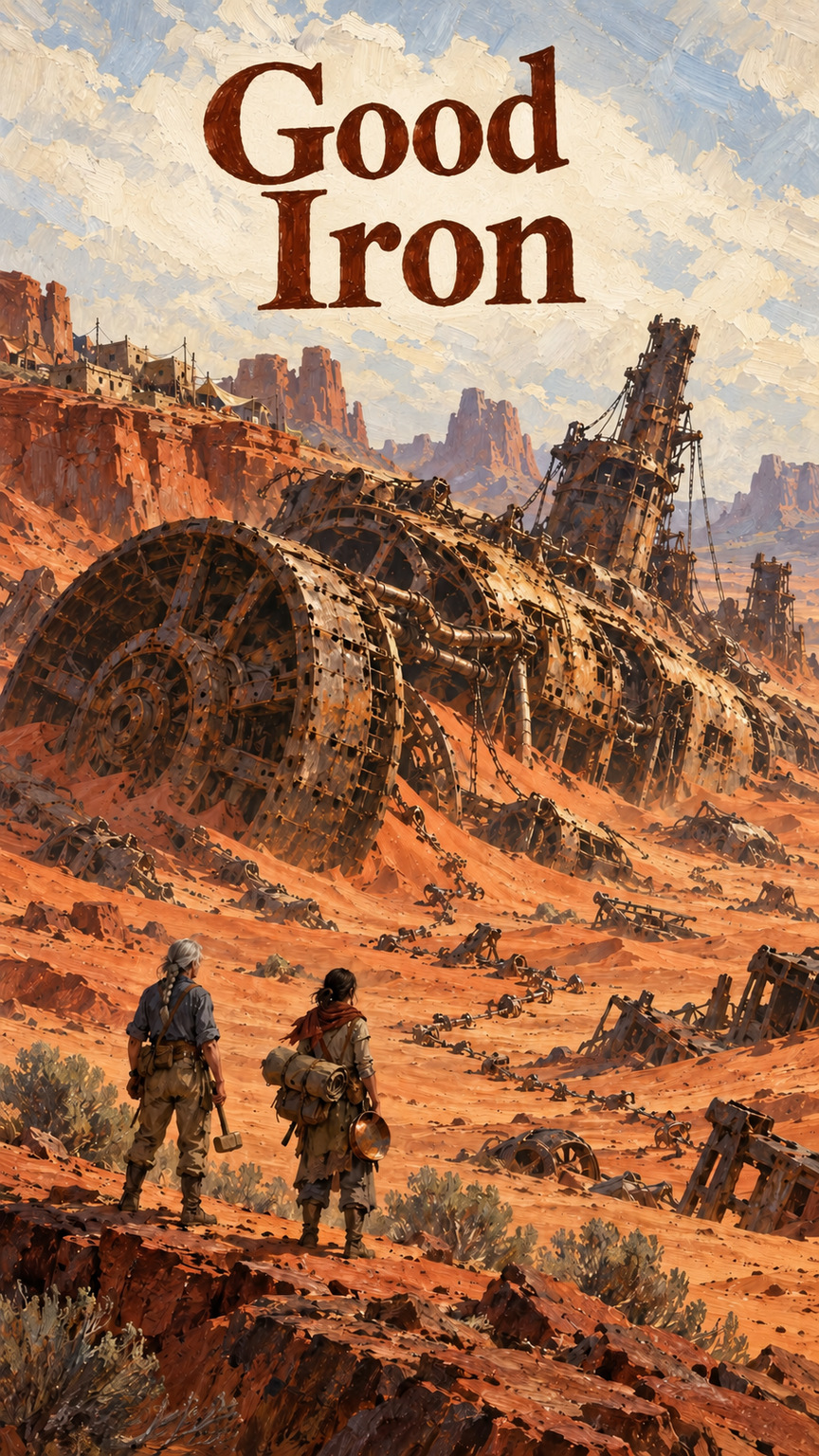
There had been nothing wrong with Anka's axle until Sivet took it out.
She had wrapped it in sacking and laid it above the ceiling poles, where she kept long pieces that might come in useful. Then she had put a split shaft through the handcart's wheels. A child could have seen the flaw. Her daughter was twenty-seven and had helped build the cart, but Sivet had told her to leave it alone while she found a replacement.
Now Anka stood beside it with her bedding tied up and her good copper pan in a bag.
“I can walk,” she said.
“With all that?”
Anka lifted the bag. She put it down again without answering.
The caravan left from the eastern ridge at sunset. Her passage was paid; her name was on a wooden tally in the trader's hand. Beyond the desert, a woman who made hinges and window catches had offered her a bench. Sivet had seen the message. There had been no quarrel when it arrived, only supper and the usual sorting of the day's metal. She had said the hinges sounded like good work.
For three evenings afterward, she had found reasons why the cart needed attention.
“Come out with me this morning,” she said. “There's bronze in the Big Sleeper's near wheel. Enough to buy you a shaft at the ridge.”
“I had a shaft.”
“A better one.”
Anka looked up at the ceiling. Not quite in the right place. Then she untied her work scarf from the bundle.
“Until noon,” she said. “If you haven't fixed it by then, I'll leave things.”
Sivet took her mallet from beside the door. It had belonged to her mother, its pale head worn shallow in the middle. She could swing it all morning with either hand. Her left knee troubled her on slopes, and lately she needed Anka to go into narrow places, but there were still jobs in the waste nobody did as well as she did.
Outside, the first sun lay along the rims of the wrecks. The settlement's houses occupied a shelf of rock above a broad basin. People had built there because its nearest machine gave shade before noon, and because three generations had been able to walk to work. Their walls were stone and their roofs were canvas stretched over scavenged ribs. Farther off, wheel rims stood on edge, their open centres framing the distant cliffs. A long gun on the western heights had kept its shape after the body beneath it collapsed. Children used it to tell one part of the waste from another. No one could have said which way it had been meant to fire.
The Big Sleeper lay below the shelf, sunk to its belly. Its near wheel was taller than Sivet's house. The upper hull continued under a dune and emerged farther away as a row of bent towers. On the other side of the basin an overturned machine showed four wheels to the sky. A cable thick as Anka's waist crossed between them, most of it buried.
Sivet's grandmother had called the cable a towline. Other people called it a leash. Neither name explained who had attached it, or why both machines had stayed there.
Anka slipped through the near wheel's broken rim. Sivet passed her the bronze drift and went in after her.
They had exposed the bearing cap the previous afternoon. It was yellow metal under a skin of green, as broad as a dinner plate. A steady hour's work would free it. Sivet might stretch that to two by insisting they preserve the little screws.
Anka knelt, fitted the drift and held out her hand for the mallet.
Before Sivet could give it to her, something knocked behind the cap.
They kept still. Loose sand ticked down the inner wall.
“You hit it?” Sivet asked.
Anka looked at the mallet, still in Sivet's hand.
The second knock had a longer sound beneath it. Sivet felt that sound through her boots. A strip of iron beside Anka's knee rose on one end, fell, and rose again.
“Out,” Sivet said.
Anka took the drift. They backed through the broken rim as the cap began to turn. Not the little screws. The entire plate turned, slow enough to watch the green stains move. Beyond it, in a gap they had cleared of sand, an inner drum shone black and smooth.
A third knock sounded. The iron strip struck the cap and stuck there.
Outside, Sivet's chisel pulled at its belt loop. She unclipped it. It jerked from her hand and crossed the sand, point first, to the wheel.
For several breaths they heard only a deepening hum. Then the hum fell and the chisel dropped.
Anka went to pick it up.
“Leave it.”
“It stopped.”
“Listen.”
The first knock came again.
Sivet had stripped little motors whose cores clung to iron. She had used a broken core for years to collect filings from under her bench. This was that pull enlarged beyond sense. She felt for the steel blade strapped inside her boot and flung it away. Anka watched, then stripped off her own knife and the iron hook that held her bag shut.
Three knocks; the pull; the falling hum. Their knives dropped among the scraps.
“Something's driving it,” Anka said.
Sivet could see no flame or smoke. They had opened engines full of ash and engines with bundles of glass in them. Inside some, there was nothing they could name. She wasn't going to learn this one's fuel by standing in front of it.
“Go up,” she said. “Tell them to get their iron off.”
“What are you doing?”
“Watching.”
Anka hesitated, then ran toward the houses.
Sivet counted. Twenty-three breaths from the falling hum to the next first knock. Four between each knock. The loose chisel made a dark line in the sand when the pull took it. This time it stayed against the cap longer before dropping.
With the hum came a movement under her feet. The near wheel turned a fraction. The hull rose, the buried cable snapped straight across the basin, and the wheel stopped. When the hum fell, the machine rolled back. The cable settled onto the sand.
The next turn scraped a fresh trench in front of the wheel. It pointed into the waste, below the houses and away from the ridge.
Sivet stood through another pulse. The sleeper's upper towers shifted. A pane, somehow whole until then, came out of a high window and fell glittering through its ribs.
She had measured a day's work against a lifetime of wreck. Suddenly she could reach places her grandmother had died without reaching. There would be copper below that cap. Uncracked casings, bearings, the black drum itself. If she could stop it, Anka could take her cart and Sivet would still have work enough for years.
She ran uphill while the hum was low.
People were coming out of the houses carrying metal. Berr, who sold by weight, stood in his doorway holding his scales as though they were an animal that had bitten him. Anka was telling him to put them down.
“On the rock,” she said. “Don't wear it. Don't try to hold it.”
“I'm not leaving my weights.”
“Then carry them by the string, and drop the string when it pulls.”
Sivet ducked inside her own house. The good cart stood where they had left it. She seized two wooden wedges from under her bench, then heard the roof poles creak.
The sacking above them unrolled.
The axle pushed out of its hiding place. It slid between the poles and dragged a line across the canvas, heavy end first. Sivet caught the sacking. The iron pulled it taut in her hands.
Anka came through the door. For a moment both of them watched the thing suspended between Sivet and the roof.
“That's mine,” Anka said.
Sivet let go.
The axle dropped through the doorway, ploughed down the slope and joined the iron gathering at the wheel. Behind it went a roof tie, then the knife Anka used for cutting bread. The canvas lifted, revealing the dusty bundles overhead.
Anka looked at the split shaft in the cart.
“You changed it.”
Sivet had a mouthful of explanations. The old shaft was sound but heavy. The ridge seller might have had a lighter one. A cart could overturn on the descent. None would have survived being spoken.
“Yes.”
Anka took the copper pan from her bag. She set it on the floor, beside the clay dishes, and left the house.
Sivet followed with the wedges.
Down in the basin, everything was dropping again. Berr's weights rolled apart. A dozen objects hit the wheel, fell, and skittered downhill in the lee of its rim. The axle lay across a patch of pale sand.
“We can get it back,” Sivet said.
Anka was watching the cable.
“If that comes loose, it'll go.”
“Yes.”
“Then loosen it.”
Sivet held up the wedges. “Or stop the wheel.”
At the ridge, a red cloth appeared on the caravan mast. The traders had seen the movement below. They were leading their animals farther along the crest.
“Your things are all there,” Sivet said. “Everybody's are. We stop it, we can go and pick them up.”
“And how many mornings have you stopped one of those?”
“I've held heavier wheels than this.”
“Dead ones.”
Sivet walked toward the machine. Anka followed.
The next pulse took a sheet from Berr's porch. It sailed edge on, struck a stone and folded. They stayed behind a rock until the noise subsided, then ran to the near wheel. Sivet pointed out a broken spoke through which they could reach the inner drum.
“When it goes quiet, drive these in opposite sides. Keep your fingers back.”
Anka looked through the gap. “That will take the whole head off your mallet.”
“The head can be replaced.”
They waited for the third knock, the pull, the falling hum. This time Sivet counted only eighteen breaths before the next cycle.
She set her wedge against the drum. Anka placed the other. Together they hammered. The wood bit, the black surface stopped moving, and the first knock cut short.
There was silence enough to hear people calling up on the shelf.
The chisel fell. So did a row of nails that had arranged themselves across the bearing cap. Sivet felt a wide, sudden relief. She was already seeing the work ahead: shore the housing, split the cap, take the drive apart. Months of careful stripping. Not one great harvest followed by hunger, but daily work.
Inside the drum something struck once.
Her wedge split along the grain. Anka's leaped out of its gap. Sivet ducked as it passed her face. The drum turned, dragging a smear of pale wood around its edge.
They got behind the rock before the iron lifted.
Anka put the mallet down. There was a fresh dent on its head, but it was whole.
“It isn't waiting for us,” she said.
From there they could see the other end of the cable. It was attached to the overturned wreck by an eye in a forked coupling. Anka pointed to the keeper pin across it.
“I can knock that through.”
“Not now.”
Anka took the bronze drift and stood.
Sivet caught her scarf. “Look at the fork.”
The first knock came. They watched the sleeper's wheel turn, the hull advance, the cable rise. The fork on the overturned wreck twisted. A flake of rust as large as Sivet's hand sprang from it. If the keeper came out under that strain, the eye would cut across where Anka meant to kneel.
Anka crouched again. After the pull, the cable sank, and the fork eased back.
“While it's down, then.”
“You can't knock a pin that size out in a breath. And the next pull will close it on your hand.”
Sivet watched the near wheel roll backward into its old hollow. There was slack then: a shallow curve in the cable lying on the sand. The machine advanced only a handspan before taking it up again.
“We hold it back here,” she said. “Before it reaches the end.”
Anka looked at the splintered wedges.
“Not that,” Sivet said.
At the foot of the rock shelf lay a thick timber with one sloping end. They had used it for years to support a different hull while cutting its belly plates. Anka had once tried to sell it to a trader short of firewood. Sivet had refused. Wood like that did not grow anywhere near the waste.
Anka laid the drift beside the mallet and ran uphill for it.
Sivet waited for the falling hum, then saw her chisel below the wheel. Beyond it lay the axle. The pull was weaker outside the broken rim; most of the fallen metal settled there instead of against the turning drum. At this distance she could hear every knock distinctly.
She collected the chisel. She pulled the axle into a hollow behind a stone. There were nails at her feet, a length of chain, two good iron handles. The hum rose. She let the chain go and lay flat while it travelled above her toward the wheel.
When it was quiet, she went out again.
She took the bread knife, the handles and a pair of tongs. Those were hers, long enough to keep her hands safe in the forge. They had fallen within reach. There was time to bring the lot behind the stone, time to go out again for a roof tie.
Then Anka called.
She had rolled the timber down the slope, end over end, and dragged it into the wheel's hollow. Its sloping face was pointed under the front of the rim, ready to stop the next forward stroke before the cable tightened. But each time the wheel rolled back, it nudged the timber aside. Anka had no hand free to drive it into place.
“I need you here.”
Sivet wound the chain around the axle. She slid the tongs and knife beneath a link. They made a compact load; she could haul it up between pulses, in two trips if her knee held. Others were doing it already. Berr had recovered three of his weights and was lying behind a rock with them.
“Mother.”
Sivet looked up. Anka stood at the timber, hands braced on its end. The bronze drift lay beside her. When the machine travelled, it would take the field with it. Every iron thing here would lift and follow; it was reaching farther with every turn. The load she had gathered would go. The exposed engine would go. Even the cap they had spent yesterday loosening would go.
If she carried the load uphill now, Anka would have to wait. Another delay that Sivet could defend, with the difference that this time the iron was truly worth saving.
The first knock sounded.
At the highest house on the shelf, a stovepipe began shaking against the sky. Nothing that high had moved during the earlier pulls.
She put down the chain and moved behind the rock. At the third knock, the tongs jerked clear and hit the axle. She could have retrieved them when the hum fell. Instead she ran to Anka.
They waited for the wheel to roll back. Sivet held the timber against the sand with her shoulder. Anka swung the mallet, driving its thick end. The thin end nosed under the rim.
“Again,” Sivet said.
Anka struck twice more. Sivet's knee hurt. A jagged edge of the rolling rim nudged the timber's exposed end sideways. She shifted her foot and leaned harder, keeping the wedge straight beneath the wheel. There was no doing that from behind the rock.
The first knock came before Anka could put the mallet down.
The powered wheel turned and climbed onto the timber's sloping face. The timber groaned and bit into the sand. The hull lifted on its springs, but it did not advance far enough to take up the cable. Across the basin the cable rose an arm's length, then dropped again, still curved.
Anka looked at Sivet.
“Go,” Sivet said.
Anka picked up the drift and mallet and ran along the cable toward the overturned wreck. Sivet stayed beside the wedge. Loose iron was moving past, rattling against the sleeper's flank. A hinge struck the rock by her head. She tucked her chin and pressed her shoulder into the timber's exposed end.
The pull subsided. Anka knelt at the coupling. Her arm rose and fell. Bronze made a blunt, familiar note on iron.
Sivet could see the keeper move. Not far enough. Anka changed sides and struck again.
At the next first knock, a long crack opened in the timber.
The wheel chewed down into it. Sivet scrambled back onto her knees. The hull advanced a finger's width and the cable began to straighten. Anka was still bent over the coupling.
“Out!” Sivet shouted.
Anka gave one more blow. The keeper fell, the cable eye dropped from the fork, and she hurled herself away from it. Her boot caught the torn edge of a plate as she landed. The freed cable slid across the sand toward Sivet, sweeping a low ridge ahead of it.
Sivet got behind the rock as the wheel crushed the timber.
This time there was no recoil. The machine rolled forward. One wheel climbed out of its hollow, then the next. Sand poured from the body in curtains. Above them, an old tower leaned and fell; it struck the ground where the bearing cap had been a moment before.
Iron rose all around the basin.
The axle went first. With the tongs still caught under its chain, it slid from the hollow behind the stone and followed the sleeper. Roof ties skated downhill. Berr let go of his weights and crawled away from them. The cable dragged after the machine, its eye knocking a deep, regular mark in the sand.
Anka came around the back of the rock, limping. Sivet reached for her. She had scraped a foot; the cloth of her scarf was torn. She sat, breathing through her open mouth, and pushed Sivet's hand away when it went to the scarf.
They watched the sleeper pass below the settlement. Its wheels found an old hard surface under the sand and kept going. Beyond the basin it veered a little to the south. Neither of them could see what made it turn.
The hum weakened. Loose iron no longer leaped, but travelled in little starts, a broad ragged train behind the hulk. Here and there a piece caught on stone and stayed. Most went on.
“Your foot,” Sivet said.
Anka bent it, testing. “I can walk.”
Up on the shelf, their roof had gone slack. One corner of the canvas hung into the house. Someone's stove lay broken on the path. The copper pan Anka had set on the floor was still there, bright in the open daylight.
They went home before the afternoon heat settled in. Sivet tied Anka's foot with clean cloth. Anka held the ends for her, then took over the knot.
The cart wheels had followed the axle. What remained was a wooden box with two handles, tilted against a stone. Sivet lifted the bedding out of it. She held it while Anka decided what to carry.
The pan went into the bag. So did two changes of clothes, a comb, the bronze drift and a small wooden box of letters. Anka left the plates. She opened the larger chest and took out a shirt she had been saving for the journey, shaking the dust from it. Its buttons were bone.
From the doorway Sivet could see a small moving shape against the southern hills. The forgotten machine was still going. There was no one standing on it, no flag, no voice carrying back across the sand.
She had enough clay pots to cook in. Her hands would still work. Tomorrow would ask more than that, but it had not arrived.
Anka tied her bag shut.
“I would have stayed until you found another pair of hands,” she said. “If you'd asked.”
Sivet put the bedding down. “I didn't want another pair.”
Anka's fingers stopped on the knot. Then she tightened it and lifted the bag.
Sivet fetched the mallet. There were marks where Anka had struck the keeper, a fresh bruise on the pale head and an old hollow worn by three generations of hands.
“Take this.”
Anka looked at it. “You'll need it.”
“I know where to borrow one.”
She laid the handle across Anka's palm. Her daughter closed her fingers, tested the weight, and tucked it through the ties of her bedding.
Outside, the red caravan cloth had returned to its first place on the ridge. Anka looked toward it. Sivet followed her out of the house and down the path to where it forked. The left branch led into the basin; the right climbed toward the waiting animals.
At the fork Anka shifted her bag and put an arm around her mother. Sivet held her carefully, leaving the sore foot clear. Her daughter's scarf smelled of dust and the wool chest in which they kept their winter things.
She let go while Anka was still standing close.
Then she watched her take the right-hand path.