
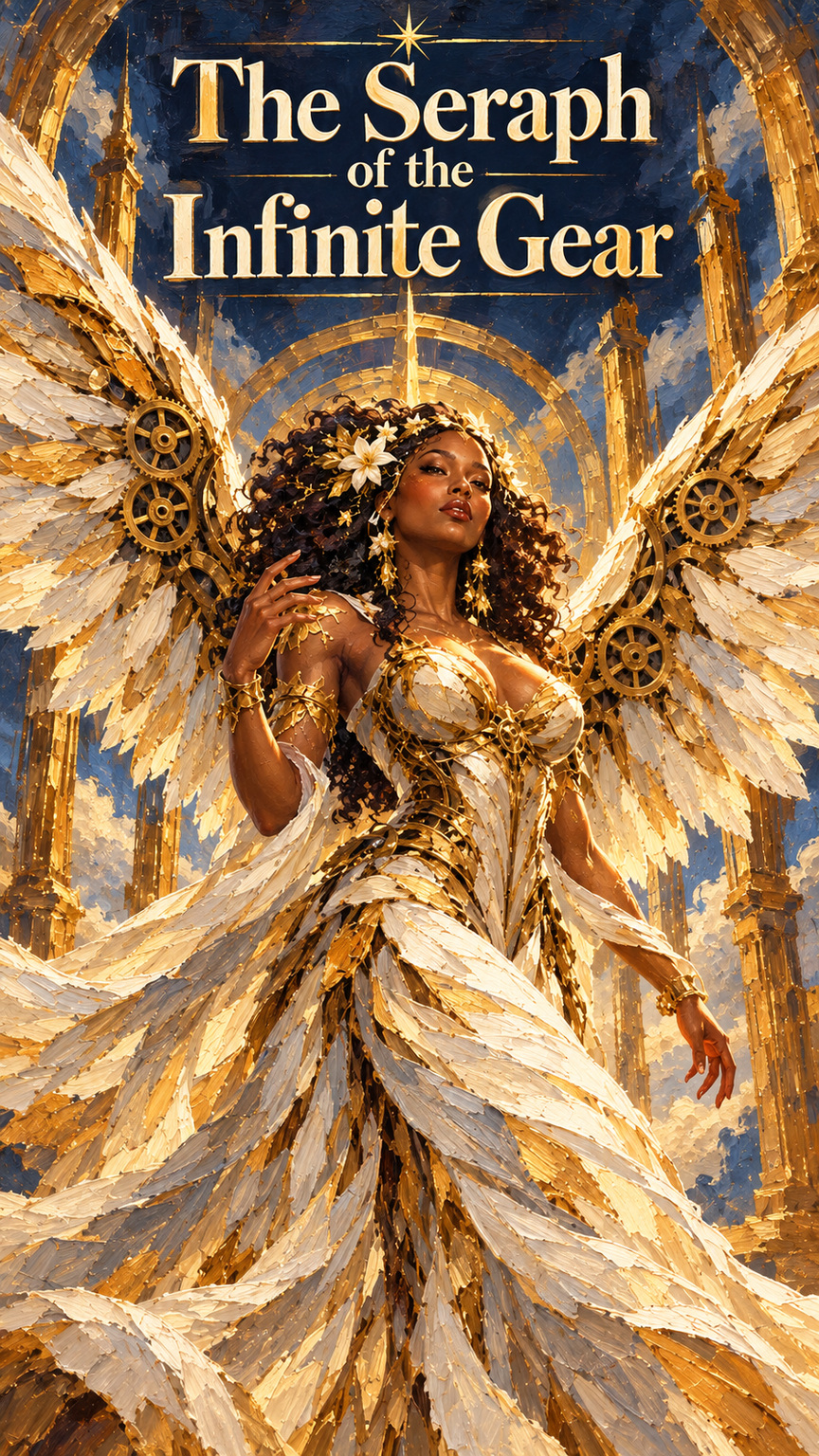
The false dawn caught the undersides of her wings. For a moment every ivory feather was pink, every turning shaft among them the color of hot copper. Below, on a thousand terraces, people lifted mirrors to greet a sun their astronomers had made.
The Seraph descended through her rings. Their gold opened around her, warm as flesh. They had enclosed the country three mornings ago, when its rulers committed themselves to repeating the ignition that had melted their ancestral capital. Beyond the mountains, travelers waited at a bright, impassable edge. Inside it, the descendants of the dead had built a larger instrument.
She had watched them polishing its mirrors. Even knowing what they meant to do, she had admired the patience, the ingenious ladders, the little cloth hoods that kept dust off each facet. They had stitched gilt suns on their children's slippers. They wanted so badly to have made a morning.
Now the trial light was rising. When it whitened, they would open the instrument fully.
At the last ring she spread her hand toward the final gear and stopped.
Someone had moved it.
The gear's rim stood higher than a house. Her palm belonged in a depression on its flank; no other hand had ever fitted there. Yet fresh scratches crossed the gold beneath it, and red dust lay in a tooth that should have been clean. A short bronze bar rested on the platform.
From somewhere inside the ring came singing: a man's voice, carrying an unfinished phrase over the machinery. She waited for its resolution. It began again instead.
She slowed the shafts in her wings until she could hear his breath.
“Come out where I can see you.”
He emerged between two spokes, brushing his sleeve against his mouth. A broad man, grown well into adulthood, with a singer's lifted chest and an embroidered collar that had chafed his neck raw. He had lost a fastening from one shoe. His eyes went first to her face, then to her left wing.
“Could you fold your left wing around me?” he said. “I'm very cold.”
She kept it spread.
“Did you move this?”
“A little.” He looked at the bronze bar. “I couldn't get it past the catch.”
The catch still held. Without her living power, he could only rock the gear through the play between its teeth. No hour below had shifted. She touched the scratched gold, and it slowly filled beneath her fingers.
“Why did you try?”
“I wanted you to come down.”
“The light brings me down.”
“Yes,” he said. “I got impatient.”
He said it with such rueful familiarity that she looked behind her, toward the empty upper rings.
“Who are you?”
“Sovekh. I sing the invocation at the opening of the mirrors. Or I'm meant to. I climbed the ceremonial stair the night before your enclosure shut. I brought food. It's mostly gone.”
The stair ended beneath this platform. Each year singers climbed it to send their voices through the great ring, which amplified them across the country. Usually they went home when the ceremony ended. He had stayed beyond its last step, out of sight of the cradle where she woke when a civilization approached an old catastrophe.
“That phrase,” she said. “You keep leaving it unfinished.”
“The high note is difficult when I'm cold.”
She drew her left wing inward. He moved beneath its shelter without waiting to be asked, then checked himself and looked at her.
She let him stay. Gold veins brightened among the feathers, warming the air. He held his hands near them, palms turned politely away from her skin.
“Try now.”
He sang. The note opened into something larger than she had expected, a sustained rising sound with an almost laughing turn at its height. Down on the terraces people were singing the same invocation, but the machinery blurred their voices together. Here she could hear the little grain in his, the effort at the end.
He coughed and looked annoyed with himself.
“Again,” she said.
“Give me a breath.”
She waited. He took his time, rubbing warmth into his throat, and she watched him with an attention she usually spread across a country. The second attempt was better. She bent her head to hear it, black curls falling against the gold at her shoulder.
“You were going to ask what the words mean,” he said. “The first verse praises the sun. The second asks it to make room.”
She had been going to ask exactly that.
“For the light they're making?”
“For ours, yes. My teacher always left that verse out. He thought it would offend the sun.” Sovekh tugged the embroidered collar away from his neck. “I put it back after he died. I wouldn't have dared while he could hear me.”
She smiled at him. She had been enjoying the song; now she wanted to know about the man who had decided how it should be sung.
“You liked it better with that verse,” he added.
“I have never heard it without.”
“No. I meant before.”
She unfolded her wing.
The warmed air escaped. He watched the feathers move away from him, and for the first time his ease deserted him completely.
“Before when?”
He rubbed a dark stain near his cuff. Below them, the trial sun deepened from rose to orange.
“We've spoken before. Here.”
She remembered three days of watching. She remembered entering the high cradle at the first enclosed dawn. She did not remember him.
“Show me something I can touch.”
He took her around the hub, keeping well clear of her wings. On the inner face of a spoke, where the gold received no healing warmth from her touch, he had scratched seven groups of marks. Each held three long cuts. Smaller marks crowded the spaces between them. Along the platform stood empty food jars and a blanket polished thin at the shoulder.
“Seven times,” he said. “The mirrors open. You turn the gear. We wait three days. The mirrors open again.”
She pressed two fingers against the spoke. Its buried count rose through her bones: seven completed returns, each to the same dawn. This was the eighth approach to ignition. She had spent twenty-one days here beyond the three she could remember.
The upper rings remained outside the return, keeping their occupants with them, and he had climbed beyond its reach before the first enclosed dawn. Even the jars could only empty once.
Her shoulders ached. Until now she had taken the ache for the weight of descent.
“How do I not remember?”
His gaze flickered toward the root of her left wing.
She turned it forward.
Under the lowest feathers, a wheel no wider than her palm kept her own recollection separate from the country's returning time. Its inward coil held everything she had lived since the enclosure. Wound back by the outer rim, as far as the first enclosed dawn, that sequence was simply lost, while her body kept its hunger, its wear, its healed places.
One feather beside the rim was bent against its grain. Bronze dust lay in the little drive teeth.
“You touched this.”
He nodded.
She felt the old, deep movement of her machinery become suddenly intolerable. Every part of it was warm and exposed. He had stood inside her folded wing while she listened to him sing.
“While you slept,” he said. “After you returned the country. I turned it to the first dawn. You'd wake in the cradle and watch the three days again.”
“And you hid.”
“Until you came down.”
She reached beneath the bent feather. It hurt to pull it free of the rim. He took a step toward her and she raised her other hand.
“Stay there.”
He stopped.
The small wheel could do what he described. She knew that as she knew how her fingers closed. But the knowledge belonged to an untouched part of her life; she had never chosen to wind herself backward. She needed to feel the difference between what this man claimed and what had happened to her.
She slid the wheel's stop against the next tooth, allowing the smallest possible backward motion. On the platform's dusty gold she wrote with her finger: I am testing my recollection. Then she set her left hand flat beside the words.
“Say nothing until I ask you something.”
He nodded again, too quickly.
She lifted her left hand and pointed at his sleeve. “What is that stain?” With her right, she turned the little wheel against the stop.
Her left hand was in the air.
“Apricot syrup,” he said.
She remembered setting her hand down. She remembered telling him to wait. She did not remember pointing, or the question. The wheel rested against its stop; her writing remained below her raised hand.
“You asked about my sleeve,” he said. “I spilled it yesterday.”
She lowered her arm. The absence had no edge she could feel. Between laying her hand on the platform and finding it raised, nothing seemed missing until she looked at what her body had done.
Sovekh began to speak. She could see his mouth moving, but she had let the shafts accelerate, and their noise swallowed him. For several breaths she allowed herself that deafness. Then she quieted them.
“Why?”
“The first time, after you turned the great gear, you asked me to stay. You wanted the rest of the song. I sang it badly. I was frightened, and you kept watching my mouth. We talked until the light changed.”
She could imagine it with awful ease: the warm feathers, his breath before a note, the pleasure of being kept waiting for something small.
“What did I say?”
“You wanted to know whether I liked singing for all those people. I said yes. You asked why I'd left them, then, and I told you I'd wanted to see you close.”
He looked at her dark hands, at the gold growing along their tendons.
“You said you could carry me beyond the mountains when you were finished here. There are places where the ground is white even in summer. You were trying to describe them. I thought you meant salt, but you said it was cold. You couldn't understand that I'd never seen snow.”
She had wanted to show someone the high white plains for a very long time.
“Did I take you?”
“No. We stayed here. You said you had to learn why they kept opening the mirrors before you could leave.”
She said nothing. He waited, then went on without her.
“We had three days.” His face changed as he looked past her. “You tried to sleep standing up because the cradle wasn't made for two. You wouldn't tell me you were tired. I thought you'd gone quiet because I was boring you. Then your knee bent and you nearly took me through the floor.”
He laughed once, involuntarily. She felt the urge to laugh with him and hated having to examine it.
“You slept after that. I sat beside you. When you woke, you didn't want me to come anymore.”
“Did I tell you why?”
“You said you'd offered too quickly.”
That was plausible too. Almost anything was possible in the time she had lost. She could have been tender, thoughtless, delighted, unkind. She wanted her own memory of the offered journey, even if recovering it meant remembering that she had hurt him.
“You'd already told me where I'd sit between your wings,” he said. “I had packed.”
There were crumbs of dried fruit in a fold of his blanket. He stooped and picked one out, rolling it between his finger and thumb while he waited for her to answer.
“Was that why you first turned the little wheel?”
“Yes. After the next return, when you slept. You'd shown it to me. You said it was why you remembered when nobody below could.”
“You knew it would erase what we had said.”
“I thought we could have the good part again.”
He let the crumb fall.
The trial sun brightened. Somewhere below, a bell began the long summons that brought the astronomers to their stations. She had heard that bell on the previous morning, calling people to the final rehearsal. Now its deep note trembled through the platform.
“How many times have I found out?” she asked.
He looked toward the scratched spoke.
“Sovekh.”
“Twice. Before today.”
She moved away from him, toward the final gear. He followed along the outside of the ring, keeping the distance she had required but matching each of her steps.
“The second meeting wasn't the same,” he said. “I knew too much. I kept answering things you hadn't asked. Once I told you about the snow before you did, and you thought I'd been there. I couldn't get back to where we were.”
“When I found out, what did I do?”
“You were angry.”
“What did I do?”
He stopped walking.
“You told me to leave.”
The bronze bar was still where she had first seen it. She saw now that its end was narrow enough to reach through feathers. He had been using the same tool on both gears.
“And you waited until I slept again.”
“You have to sleep after the turning. I knew that by then.”
He made no attempt to soften it. She put her palm against the great gear, and the country pressed upward through her: the terraces, the crowded stairways, the animals restless in their stalls beneath the growing light. Soon all of it would be unbearable to touch.
“I remembered you,” he said. “Every time. You'd come down and look at me as if there'd never been anything. I still had all of it.”
She kept her hand against the gear. His words reached her through its deepening vibration.
“I want those days back,” she said.
“I can tell you.”
“You said I was angry. I had to ask twice.”
He drew a singer's breath and began the invocation, quietly, without the public fullness of his voice. The phrase she had heard on her descent, with a small hesitation in a different place.
For a moment she listened. Her anger did not make the sound ugly. That had been part of the pleasure too, perhaps: a man bringing something beautiful into the rings and being pleased when she heard it.
“Stop,” she said.
He stopped in the middle of a breath.
“I won't carry you beyond the mountains. When I have turned the country back, I will take you down.”
He stared at the bronze bar. She bent and lifted it. The tool was nearly weightless in her hand; the trouble he had taken to move the great gear with it must have been considerable.
She folded the left wing across her body. The little wheel continued its steady inward winding, keeping this moment. She laid the bar against the outer drive and broke off the exposed teeth.
Pain went through her shoulder. The wing struck the platform hard enough to knock Sovekh to his knees. He reached toward her, then braced his hand on the floor instead.
Gold welled along the broken rim. She held the living edges together and let them grow into a smooth sheath over the coil. The inward axle turned beneath it. Her memories remained: the song, the raised hand, the things he had admitted. There would be no place for his tool when she slept.
Below, the mirrors opened.
White light climbed the spokes. For an instant it showed Sovekh with every shadow stripped from his face, one hand braced on the platform beside the great gear. Far below him, the first roofs lifted from their houses.
She turned the final gear.
Its teeth took hold through the whole breadth of her wings. The white fire stopped rising. It gathered inward, drawing its torn fringes out of the streets, dragging a shower of roof tiles back through the air. Tiles settled into courses. A falling astronomer rose feetfirst to a balcony. His hands found its rail and released it in reverse order.
The fire narrowed to a trembling thread. It withdrew into the instrument.
She turned farther. Sovekh clung to a spoke while the great rim passed beneath the platform, carrying the enclosed country backward through its hours. Within the boundary the recorded light of evening followed morning. Outside it, the stars continued their slow westward motion. A caravan beyond the mountains stood watching a darkness rush across a country that had just been lit like a coal.
In that darkness a festival rebuilt itself. Wilted garlands rose from carts and fastened fresh against doorways. Men climbed backward down ladders with bunting unrolling above their hands. Supper returned to plates. A woman rose from a bench into the last turn of a dance, her partner's waiting hand closing around hers.
The Seraph bent beneath the weight of it. Gold in her wings burned white. Three nights passed over the enclosed land, each lifting into the day that had preceded it. A field gathered its cut stems. A potter's broken bowl leaped together on a shelf. Across every terrace, the gilt slippers of children shrank back into their paper wrappings.
The first enclosed dawn arrived. The catch fell into place.
She could still remember Sovekh singing.
For a while she could do nothing but stand against the gear. Her ivory dress clung to her back. The feathers nearest the small sealed wheel trembled independently of the others, and she had to wait for them to settle before she could fly.
Sovekh got up. Below him the astronomers were waking to three days of preparation. The same rulers held their offices; the larger instrument stood ready for its final polish. She knew no more than before about what would make them stop. Through the cut of one narrow street she could see the council house, where she had watched messengers come and go. In the days she remembered, she had never gone down to hear what they were saying.
She would have to sleep. First she would take him down.
At the edge of the platform she knelt and lowered both wings, leaving the seat between them. He hesitated before climbing into it. He knew where to put his feet. She almost told him to move them, then found that they were correctly placed.
“Where were you meant to sing?”
He pointed toward a terrace below the instrument. “The blue platform.”
They descended over the roofs she had seen torn loose. Morning smoke rose from cooking fires. A woman leaned out to shake a cloth, saw them passing, and let it fall from her hands.
The platform was empty. Its blue boards had not yet acquired the scratches of the festival. The Seraph landed beside it and lowered her wings until Sovekh could step onto the ground.
He kept one hand on a feather.
“The first time,” he said, “you asked whether I knew any songs that weren't for ceremonies.”
She waited. He was looking at his hand. Slowly he lifted it away.
She rose, painfully at first, then caught the air above the terrace. Behind her a voice began, too low for a ceremonial invocation. She heard a woman asking for the return of a borrowed coat; then a change in pitch, the other woman's answer. A foolish little song, full of interruptions. She turned her head to catch another line.
She cleared the first roof. Below, his second voice was arguing about the coat.