
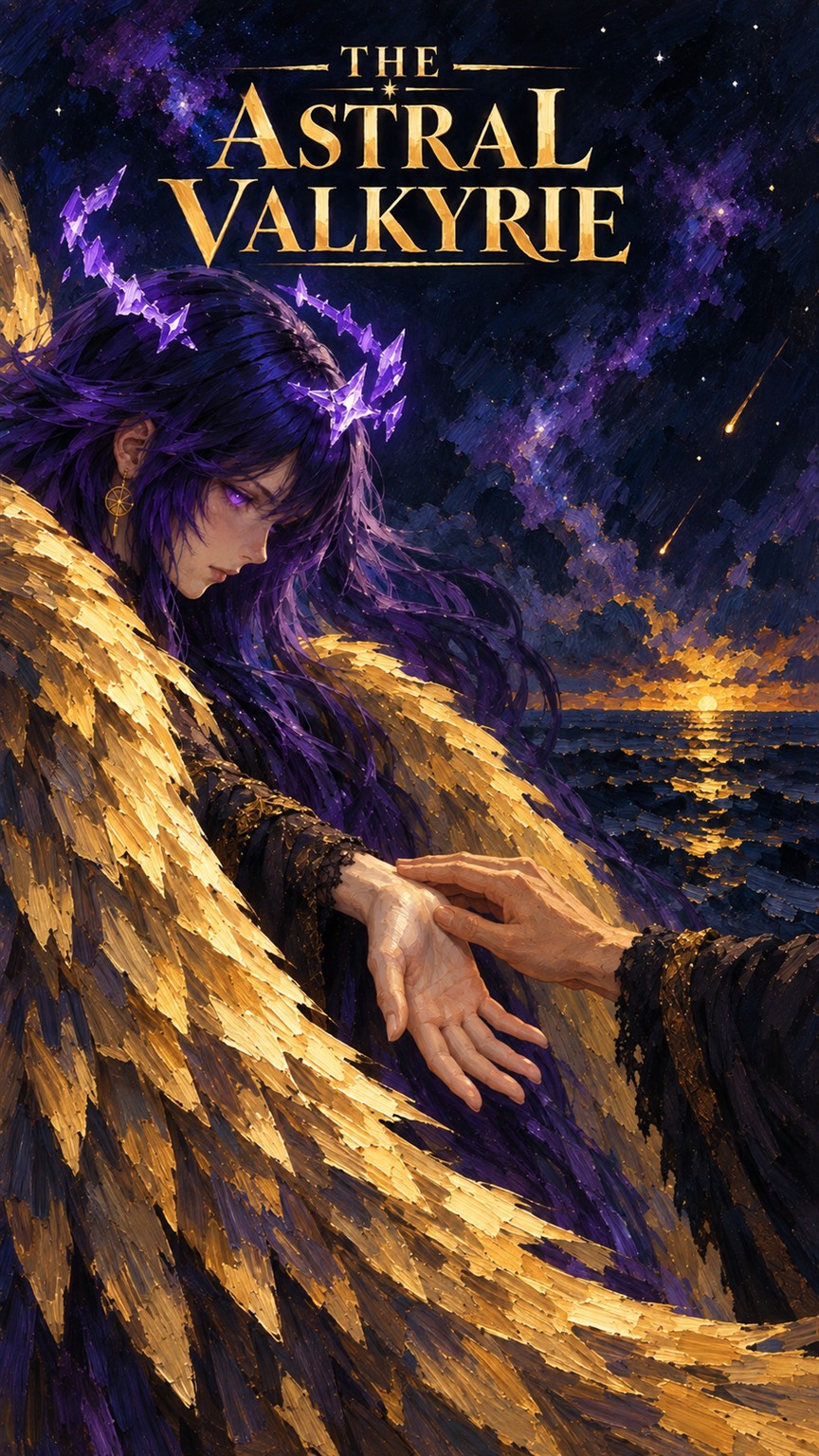
I was rehearsing what to say against my country when the stars began to move around her.
There were only seven people left on the palace roof. Below us, in the feast hall, hundreds lay beneath tables or stood watching plaster fall into their hair. The other islands of Theskar had gone under during the previous nineteen nights. Our last ships had burned where they were drawn up on the beach. A bright body hung above the western sea, growing brighter, while lesser fragments struck the dark around it. We had stopped calling it a comet. Names had ceased to help.
I had come upstairs because someone remembered a story: at the death of a people, the Astral Valkyrie descended to choose its witness. I had sung that story myself, once, with a chorus dressed in gold. Now I had a split lip, a stolen court cloak, and a speech intended to make our destruction seem overdue.
That was how I wanted to begin this account, too. You would have been on my side before you knew my name.
She came feet first through the falling fire. Gold wings folded behind her, each feather veined with a light that moved as blood moves beneath thin skin. A broken circle of violet crystal turned above her head. Her hair was indigo, immensely long, and remained lifted after her bare feet touched the roof. Nothing else about her floated. She bent her knees to take her weight. She breathed.
The smallest fragments curved away from her wings. One hit the roof ten paces off and drove a piece of tile through a man's cheek. He dropped without letting go of the woman beside him. The light made the inside of his mouth pink and plain.
Vasketh, who had been head historian before the library fell, approached her with both hands open.
“How many?” he asked.
“One living soul. With the body that holds it.”
“To the mainland?”
“Beyond the years in which your people disappear. I can keep one person alive beside me.” She looked west. “I cannot turn that aside. I cannot bring back those who have died.”
The woman on the tiles began to swear at her. The Valkyrie stood listening until the woman ran out of breath, then knelt beside the fallen man. Her wings sheltered his face from the glare. They did nothing to stop the blood.
Of the seven, two went back down the stairs. Another sat against the parapet, laughing softly. Vasketh remained where he was. So did I.
“I know our history,” he said when the Valkyrie rose. “I know the smaller languages. The root crops that survive the red moth. Give me a piece of your time.”
“Your hand,” she said. “Offer me something you remember. I cannot take what you withhold.”
He put his palm against hers. At her gesture I touched her other wrist. Her pulse was quick. Then the roof vanished, though I could still feel the hot grit under my feet.
A child was teaching Vasketh a game played with peach stones. He got the counting wrong; she slapped his enormous, hairy knuckles and started again. A page lay on a desk, the ink beginning to spread because he had sneezed over it. Now an old farmer held up two roots, one sound, one rotten, while Vasketh struggled to get the names right. The memories were ungainly, interrupted by his own questions. He offered a woman reciting the last poem she knew in a language he had arrived too late to learn properly. He offered his shame at asking her to repeat it when she was tired.
I could smell the inside of his library: paste, old leather, the beans someone kept eating over the manuscripts. It was too much life. I tightened my grip on the Valkyrie's wrist.
“And the conquests,” Vasketh said. He was still on the roof with me; the child and the farmer had gone. “I have the testimony of the occupied islands. I copied it before the ministry could burn it.”
“You've read about what they did,” I said. “I watched.”
He looked at me properly for the first time.
“Nacorra.”
I hated hearing my name in the old, pleased rhythm of recognition.
“You know her?” the Valkyrie asked.
“Everyone did.”
I turned her hand over and laid my face against the palm. A performer's gesture. I knew it even then.
“Let me show you whom they killed.”
I offered the execution square, the summer before the sky began to fall. My lover stood on the platform in the brown tunic they had given her. They had cut her hair badly. The left side was shorter; I kept looking at that, as if someone might come with scissors and put it right. She was thirty-eight. She had printed the names of villagers our soldiers had buried in a quarry. The court called this aid to an enemy.
Before the executioner pulled the cloth over her face, she found me. I lifted my hand. She tried to lift hers, forgot the rope for an instant, and smiled at her own mistake.
I stopped there. The Valkyrie's fingers were wet against my cheek.
“She wasn't sorry,” I said. “Whatever else you carry, carry that.”
Vasketh took a breath that rattled. “I have her list. Most of it. The quarry was reopened in the seventeenth year of the old king.”
“I know when.”
“Then you know it was the campaign you sang for.”
He had not let go of the Valkyrie. Neither had I. Beneath my feet, the roof gave a long, low knock.
“Come away from the edge,” the Valkyrie said.
A crack opened through the tiles between Vasketh's shoes. For a moment he stared down at it as if something were written there. I caught his sleeve and pulled him toward the stair. Behind us, the parapet peeled outward. The man who had been laughing went with it. I heard him strike something below and then heard stones, too many to distinguish.
We went down sideways, the Valkyrie drawing her wings so close that their light showed through the seams of her dark bodice. Vasketh held my shoulder. His breath smelled of mint leaves chewed long past sweetness.
“Did you ever read our leaflets?” he asked.
“What leaflets?”
“The ones we gave out at your performances. The prisoners' names. Your audience walked over them.”
I did remember. White scraps under embroidered shoes. I had thought someone should sweep the entrance before the queen arrived.
The feast hall was hotter than the roof. Its great doors stood open to a terrace; beyond them the sea had become a sheet of copper light. Someone called for the Valkyrie to save a child. Someone else cried that she was the thing killing us. She passed between the tables with her wings folded, looking into each face that turned toward her. People reached, but the reachers were not lifted. There was no second refuge hidden inside her light.
At the foot of the stair a man lay across two cushions. The bottom half of one leg was missing, and the cloth packed around it had gone almost black. A woman knelt beside him holding his head up. When he saw me, he tried to sing.
It was the march. Of course it was the fucking march.
He could manage only three notes. I tapped the next two against my thigh before I knew I was doing it. His eyes brightened.
“Don't make him,” the woman said. “He starts coughing.”
“I'm not.” I stopped my hand.
The man tried again, dragging breath through the first phrase. I had written it to be sung by thousands who knew nothing about singing. You could shout it drunk. You could gasp it while marching uphill with your feet rubbed raw. I had been proud of that.
“Just breathe,” I told him.
He nodded, but his lips continued moving. The woman looked past me to the Valkyrie and then back at my face. She said nothing. I moved on before she could ask me for anything.
We moved to the western doors. Vasketh sat on the threshold, one foot outside, one in. “May I have a little shade?” he asked.
The Valkyrie opened a wing over him. Its gold dimmed. He closed his eyes in the sudden coolness, then opened them sharply and caught my sleeve as I turned back toward the hall.
I knew this room in lamplight, and precisely how far a voice travelled from the musicians' platform before the pillars confused it. Even with wounded people on the floor, my eye found the best place to stand.
“There was more,” I said to the Valkyrie. “Before the executions. Before all this.”
“Show me.”
I offered her my hand. Vasketh reached up from the threshold and held the edge of her wrist. I almost asked him to let us alone.
The hall filled with lamps.
I was twenty-nine, and someone had sewn a thousand thin disks of silver onto my dress. They kept catching in one another whenever I sat, so I had given up sitting. Pepper burned on my tongue. My lover, then a printer's apprentice of thirty-one, had stolen a dish of yellow fruit from the royal table and was feeding it to me one piece at a time. She had begun by bowing after every piece; now she was laughing too hard. Juice shone in the hollow of her wrist.
Around us, dancers struck the floor with their heels. Each set of partners approached and withdrew, turned, stamped, came together with a slap of palms. You could miss one step and recover at the next. You could be terrible and still be included, unless the court dancing master saw you, in which case he would descend with an expression of personal bereavement. My lover imitated him with a stolen napkin tucked under her chin. I nearly choked on the fruit.
The Valkyrie's mouth opened. Her free hand made a small motion at her throat.
“The heat,” she said.
“Pepper.”
“It hurts, but you want another.”
“Yes.”
She swallowed. There was no fruit in her mouth, only my remembered taste. Her eyes had closed. In the present, the roof beams groaned. In the memory, my lover wiped my chin with her thumb, leaving a black trace of printer's ink.
“Stay here a moment,” the Valkyrie said.
I had prepared to make her watch executions. Now I had given her something she wanted. I could feel it in the pressure of her fingers. When she opened her eyes, they were violet even where ours are white. I had never been looked at with such naked appetite.
I let the dance continue. I gave her my pride as the room applauded me, the weight of silver tugging at my hips, my lover's hands spread wide among all the clapping hands. Beyond the pillars, the side doors opened.
I pulled away.
Smoke returned. Vasketh was staring at me. From somewhere near the broken stair came the faint, unbearable start of my march.
“Why did you stop?” the Valkyrie asked.
“It was a long time ago.”
“It was the victory feast,” Vasketh said. “The night they brought the island captains before the queen.”
“You weren't there.”
“There are accounts.”
“Offer them,” the Valkyrie said.
I took the Valkyrie's hand again. Vasketh laid his other hand on her arm, and the hall became a page covered in a narrow, impatient script. I saw it as he had seen it. The captains entered barefoot. Chains joined them at the ankles. Someone threw a fruit stone. The account named the singer who led the refrain.
My own name was halfway down the page. The writer had underlined it twice.
I broke contact again. A piece of ceiling fell onto an empty table and split it in two. Vasketh flinched and covered his head, then dropped his hands and looked up at the Valkyrie.
“I can remember that page,” I said. “If she chooses me. I can tell it.”
“You could have told it just now.”
The Valkyrie waited. She did not extend her hand.
Here is where I could put a noble thought. You have followed me through a burning palace; perhaps you would accept that I became someone else in its doorway. But I was looking at Vasketh. He knew the names I did not. He could give the dead their own sentences. I wanted him to fail, and I wanted to live, and the memory I had withheld was still in me, warm and crowded and splendid.
“I liked it,” I said.
Neither answered. I had given them too little.
“That night. When they came in. I liked all of it.”
I took the Valkyrie's hand and reached for Vasketh. He drew his own away from me, then put it against her arm.
The captains entered. I stood on the platform, enjoying the sudden hush. One prisoner was a woman with a broken nose and a strip of bandage sliding over her eye. The queen had ordered them to dance. Their chains allowed half a step. They tried to follow the music and collided; one fell, pulling two others down. Laughter came from the royal table. My musicians looked to me.
I raised my hands and brought in the march.
Every heel in the hall found its beat. Our guests stamped around the prisoners as they struggled up. I changed a word in the refrain, replacing armies with dancers. Such a little alteration. They loved it. The queen threw a bracelet that landed at my feet, and I wore it home.
My lover stopped clapping. I had omitted that too. She stood below the platform with the dish in her hands, no longer smiling. Later, she would ask why I had done it. I would say it was a song, that everyone had been drunk, that she had enjoyed the feast well enough until then.
I gave the Valkyrie that conversation as well. I heard myself turn cruel when my excuses failed, and then the door closing after my lover left. We would find our way back to each other, but not that night, and not because I deserved it.
When I let go, the Valkyrie was watching the present hall. Her wing still shaded Vasketh. The man on the cushions had stopped moving his lips.
“I didn't want her to die,” I said.
“I know,” Vasketh said. He was looking past me at the man on the cushions.
Outside, the great light widened. Shadows of the terrace pillars stretched across the floor until they reached the far wall.
The Valkyrie folded her wing. Vasketh shielded his eyes.
“Nacorra,” she said. “Will you come?”
For a moment I could not work out what answer she needed.
“I have given you very little,” I said.
“You stopped where I wanted to stay. Then you made me go on.”
Vasketh struggled to stand. “Wait. There are eight hundred years behind her little court. There are things nobody knows now except me.”
The Valkyrie turned toward him. “I have heard what you offered.”
“Not half of it,” he said. “Please.”
“We have to leave.”
He caught her wrist. She allowed the touch. Nothing came through to me; I was no longer holding her. I watched his lips move, watched her face, and knew that he was still trying.
She removed his hand gently. I disliked her for the gentleness, although I was already moving toward her.
“Yes,” I said. “Take me.”
Someone inside the hall called Vasketh's name. An older woman, sitting beneath a table, was trying to get up. He looked between us and her. Then he turned and went to her, striking his knee against the broken table edge in his haste. He swore, steadied himself, continued. He did not look back at me.
The Valkyrie lifted me from the terrace with an arm beneath my knees. Her other hand held the back of my head. Her wings opened and there was breath around us, cool air that smelled faintly of her skin.
Below, the hall filled with light.
The people nearest the doors raised their arms. Clothing caught fire. I saw a woman trying to drag a burning blanket from the person beside her, pulling until she fell backward with it. Then the outer wall burst inward and the roof came down. Vasketh was under it. I had last seen him bending toward the woman beneath the table. I cannot tell you whether he had reached her hand.
We rose. The island vanished inside a white circle. Beyond it, the sea lifted in concentric ridges, copper turning to gold, gold to a violet so deep it seemed cool. The fragments high above the impact shone like a necklace pulled apart.
You can see how easily I do it.
I pressed my face against the Valkyrie's neck. Under the dark collar her skin was damp. I waited to hear something over her breathing. There was only a deep pressure in my ears, and then nothing of Theskar at all.
We did not go to another world. Far below us the same land turned through seasons I could no longer count. Her living warmth held me while the sky changed around her. Sometimes I woke with my mouth open on a word. Sometimes she asked for the feast again, and I gave it to her through the entrance of the prisoners, through the quarrel afterward. She never asked me to stop sooner. Whether that was sorrow, duty, or appetite, I do not know.
When she set me down, she said six centuries had passed. I stood on a cold beach with a split lip that had not healed. The sea lay east of me. I had to turn around twice before I understood that this was the far coast of the mainland.
“Are there people?” I asked.
“Beyond the headland.”
“Will you come?”
“Their ending has not come.”
She stepped backward. Her hair lifted and the crystal above her head began to turn. I reached out too late to touch her. When I walked around the headland, I was alone.
The people who found me gave me a cloak, then argued about who was going to feed me. I understood that part long before I understood their words. Their children laughed at my accent for years. Their singers could warm the stones beneath their feet with a held note, yet could do nothing to make me learn their scales. It took nine winters before I could write this without someone sitting beside me. I am older now than my lover was allowed to become.
I have put down what I remember of Vasketh's offerings, including the child's game. I have put down the names from my lover's list that I can still recall. There are gaps. I have left them visible. I cannot ask the dead man what came after a word I almost remember, and I still hate him sometimes for knowing it.
You have my country now, as much of it as these pages can give you. You may close them. You may decide the Valkyrie chose badly. I have imagined you doing both, often enough that I began by trying to prevent it.
But there is a woman here who has read this twice. Yesterday she asked me to sing the march so she could hear where the prisoners entered. I took the first breath. Across six hundred years my chest knew how to fill, my tongue knew where to strike, and for one sickening instant I wanted her to join in.
I sang it anyway. When I reached the changed word, she kept her hands still on the open book.