
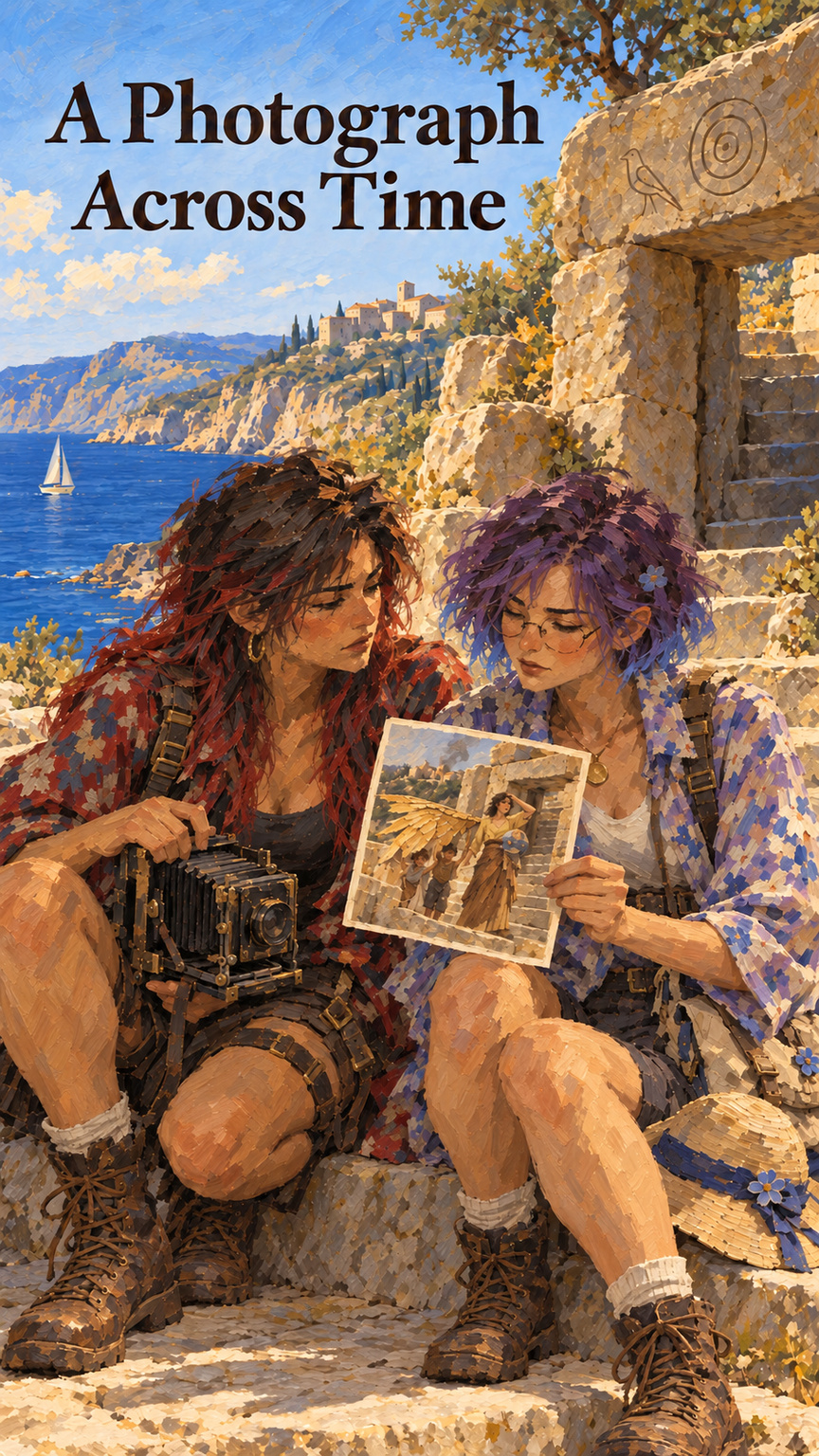
By noon, Tamsa had acquired a sunburn around her necklace and an opinion about every stone in the theatre.
“Is there anything left you haven't explained?” Brinna asked.
“That one.”
Brinna lowered her camera. On the lintel above the stair's beach exit, someone had scratched a crooked bird beside two circles. The outer circle broke off where the stone had flaked. Behind it, the excavated steps rose through the theatre's foundations and turned once in the cool. A strip of white beach lay below.
“Bird,” Brinna said. “Possibly two eggs.”
“An excellent contribution. I'll cite you.”
Tamsa wrote bird, concentric rings; later graffito? in her notebook. Her purple hair kept falling across the page. She had pinned it back with a pencil, forgetting that she would shortly want the pencil.
Brinna took the photograph. Beyond the ancient lintel, modern sailboats leaned out across the blue bay. By evening the new survey of Halcyra would have a record of every exposed surface in the theatre, including the unhelpful bird.
They climbed the lower flight of the builders' stair and left it through an excavators' break at the turn. Above them, the upper flight vanished into fallen masonry. A tagged jamb stone lay beside the break. Outside, a cleared passage followed the foundation wall round a corner to the awning, where their table stood among storeroom footings. On it were pottery trays, survey drawings, lunch, and the little black bellows camera Brinna had bought from an antiques stall.
Tamsa rescued her pencil and indicated a painted tile in one of the trays.
“This next. Before you play with your new old thing.”
The tile carried six arrangements of dots and strokes, each beside a tiny figure and a brief caption. Some figures stood with their arms spread; one held a mallet. A border of birds ran round the surviving edges.
“Six lamp calls,” Tamsa said. “The words are clear. Their purpose isn't. The catalogue offers ‘procession signals,’ with three question marks and a very confident introduction. For once I suspect it's right.”
Brinna photographed it, then unfastened her digital camera and set it on the table. She shook out the red-tipped ends of her hair where the strap had caught them.
“All right. Now I play.”
The antique's leather was cracked, its lens hood dented. A previous owner had fitted a self-developing card back, for which Brinna had brought considerably more paper than anyone thought reasonable. She liked an image she could give away. Tamsa liked having actual pictures to spread beside actual stones. Between them they had justified the weight.
Brinna loaded a pack, opened the bellows, and aimed along the broken colonnade. A lizard occupied the top of the nearest fallen capital. The sea glittered between the pillars.
The shutter clicked. Warmth prickled through the palm supporting the camera. A card slid out, pale and blank.
“Twenty seconds,” she said, when Tamsa reached for it. “You can't improve it by watching harder.”
“I can try.”
The lizard disappeared beneath a man's elbow.
Brinna turned the card over, as though the lizard might have got onto the back. On its face stood a broad man in a white apron, holding a tray above his shoulder. Behind him, the columns rose whole, red below and blue above, supporting a striped awning. A shred of grey cloud hung above the distant roofs. A woman was reaching up for something on the tray. Her mouth was open. Brinna could almost hear the price being disputed.
Tamsa took off her glasses, cleaned them on her shirt, and put them back on.
“Do that again.”
Brinna checked the back. New pack. No double exposure. She held the camera at the same height and tried again.
Twenty seconds later the man had put down his tray. He was offering the woman a small round cake. She was pointing at a larger one.
The view through the finder still contained a lizard, a collapsed column and the empty sea.
Brinna took a picture with her digital camera. The lizard, splendidly sharp, looked offended.
“That's a baker,” she said.
“I see him.”
“Where's he standing?”
Tamsa looked up the colonnade, down at the print, and up again.
“Here.”
They went out from under the awning.
For the next hour, they behaved very badly with their lunch.
It lay uneaten while Brinna photographed the square beyond the theatre. The bare paving filled with people, stalls and shade cloth, with a small dog carrying something it ought not to have. A public noticeboard stood against a wall that survived only to Brinna's knee. Tamsa made her go closer.
The board announced the evening's procession. Beneath it, in a different hand, someone had complained about the price of melons. Under Year 341, sixth day of the Little Sun, a clerk had drawn a line so firm it tore the paper.
Tamsa sat down on the low wall.
“Today,” she said. “Today's date.”
Brinna bent to read the old numerals. “Can you place that year?”
“Two thousand years ago,” Tamsa said. “To the day.”
The breeze lifted the corner of the print. Brinna put a finger on it. She could touch the clerk's torn line, but the surface was perfectly smooth.
Tamsa rose so abruptly that her hat fell off her shoulder.
“The theatre.”
Brinna followed, laughing now, unable to help it. She had photographed storm fronts from a cliff edge and once taken a portrait while hanging upside down from a tree. Nothing had prepared her for hurrying after her best friend because the past might be doing something without them.
They stopped where the semicircle of ruined seats opened toward the stage. The present theatre was roofless. A few square holes punctured its surviving upper wall; Tamsa had spent the morning recording their dimensions.
Brinna composed a wide frame, with the stage at the bottom and the whole bowl above. She pressed the shutter. Again that prickle in her palm, as if she had grasped a sun-warmed railing.
“If this is a trick,” Tamsa said, “I'm going to be extremely unreasonable.”
The card darkened. First came the seats, crowded with cushions and baskets. Then the roof appeared.
It was cloth, stretched in great translucent panels from wall to wall. Blue deepened toward the centre. Silver stars hung upon it, and a long white fish swam through a painted moon. Sunlight passing through the fabric put constellations onto the faces below. A child had stood on a bench to catch one in both hands.
Tamsa's hand closed on Brinna's sleeve.
“They made night.”
Brinna forgot to check the horizon.
At one side of the stage, an enormous yellow bird rested on three men's shoulders. Another bird, still only ribs and paper, leaned against the wall. A woman in yellow sleeves was tying a ribbon round its beak. Her dark hair had escaped its knot, and she held a spare ribbon between her teeth.
“Another,” Tamsa said.
Brinna moved two paces to fit the square holes into the upper corner of the frame.
In the new print, a man stood behind those openings with a hooded lamp. The woman below had stopped tying. Her arms were held wide, exactly like one of the figures on their tile.
Tamsa snatched her notebook open.
“Not decorative. We thought the holes were for little votive figures.” She looked from the picture to the empty sockets in the stone. “They're lamp stations. The people carrying the birds wouldn't hear a caller under that roof.”
“You were right about the tile.”
“I was right about six inches of tile. I was wrong about an entire building.” Her grin was enormous. “Look at it.”
They looked.
Brinna photographed the balconies, the painted doors, a man asleep with his sandals arranged neatly beside his head. Sometimes a face turned toward the camera's position. One little boy pointed. Brinna checked over her shoulder, though there was nothing behind her except warm stone and Tamsa, pushing her glasses up with an ink-stained knuckle.
The next photograph of the stage showed the woman in yellow staring straight at them.
She had taken the ribbon out of her mouth. One hand shaded her eyes. The other pointed to a place in the empty air in front of her.
Brinna lowered the camera.
“Did she see that?”
“Take another.”
This time the woman was closer. On a scrap of board she had drawn a circle, with short lines radiating from it. Beneath the drawing was a question mark.
For a while neither friend said anything.
Then Tamsa put the signal tile's photograph flat on a stone.
“The short flash means attend,” she said. “One long means hold your place. Two shorts, one pace left. Short and long, one pace right. Two longs, strike. Long and short, descend.”
“Strike?”
“The figure has a mallet. They must have used it for assembling the bird frames.” Tamsa put a finger on the little figures beside the dots. “There's the recipient, facing the light. Her left, not yours.”
Brinna turned the shutter to its hand-held setting. She could keep it open as long as she held the lever down.
“One short?”
Tamsa nodded.
Brinna held it for a count of one. Her palm warmed. The card emerged, white as ever.
They waited. The picture caught the woman turning toward the light. Brinna took a quick checking photograph, a fleck of exposure far shorter than the deliberate signal.
Twenty seconds later, the woman had lifted her board above her head. Her other arm was bent, palm forward: acknowledgment. The gesture was on the tile too.
Brinna's knees gave a small, absurd tremble. She had an impulse to wave with both hands.
“She can't see us,” Tamsa said softly. “Only the light.”
They tried the long call. Its picture blurred the woman's movement; the checking photograph afterward showed her standing extravagantly still, board at her feet, arms folded, eyebrows raised. Beside her, a small boy copied her pose.
Brinna laughed into her hand.
“She's making fun of us.”
“Of you. I didn't tell her to wait.”
Tamsa turned the new card toward the light. Behind the woman's shoulder, something had settled on the yellow bird's wing: a scattering of orange points.
Brinna looked at the actual theatre. The lizard had returned to its capital. The air smelt of thyme and their abandoned oranges.
She took another picture.
Smoke had begun to gather under the painted roof.
They moved uphill for a view of the city. From the broken end of a street, Brinna photographed the ridge beyond the theatre. In the print, flames were running through a row of wooden warehouses. The lane below them was already full of people. Cloth shades burned between the houses, carrying fire across the gaps.
“The burn layer,” Tamsa said.
Brinna pulled out the first photograph. That grey shred above the roofs was smoke. It had already been rising from the ridge while the baker held up his tray.
Brinna had spent three days putting a scale beside the burn layer's black edges. Nobody knew the day of the fire, or where it had started. The city had continued in diminished form afterward, but the theatre had never been rebuilt.
She had not imagined it happening on a day with a quarrel over melons.
When they returned to the stage, Brinna's first photograph found a crowd pushing through the far exit. In the second, a yellow sleeve appeared through a side doorway. The woman was lifting a child through a low window in the court beyond. Burning cloth had fallen across the passage between her and the escaping crowd.
Back under the awning, Brinna aimed across the cleared footings. A kneeling shot gave her whitewashed plaster at arm's length. She raised the camera over her head and got roof tiles.
“The storerooms,” Tamsa said, spreading the survey beside the picture of the woman at the window. “Our table's inside one.”
The old yard had stood above the stores like a balcony. Now its floor was gone; six metres up, its stair entrance hung dark in the surviving wall. Brinna followed the drawn stair down to their excavators' break and on to the beach.
“Can she get them through there?” Brinna asked.
“Yes. If it was open.”
Brinna picked up the camera. “Then I'll try from the stair.”
From the excavators' break, Brinna photographed the blocked upper flight. On the card, intact steps rose into shadow. Something shut off their upper end, but she could make nothing of its surface.
She held the picture beside the fallen stone. The camera saw past the modern collapse and stopped at that old obstruction.
“We're inside her wall,” Tamsa said. “Below her floor.”
The present flight offered nowhere firm to put a foot. Outside, Brinna looked higher.
The old upper gallery ended above the corner of the court. Most of it was sound. Its final section had broken away, leaving an exposed strip along the wall, just wide enough for a boot.
“From there,” Brinna said. “Above the roof.”
Tamsa checked the angle against the plan. “Both her and the entrance.”
Brinna studied the strip. Nine metres below it, in the present, lay a fine collection of sharp stones.
“I'll want the survey rope.”
“Yes.”
Tamsa was already opening its case.
They took the card packs, the plan and a magnifying glass. Tamsa tucked the signal photograph into her notebook's elastic. Brinna left the digital camera under the awning. She had never felt more peculiar about choosing which camera to carry.
They went round through the theatre and climbed the surviving aisle steps to the gallery.
At the gallery's sound corner, Brinna tried a photograph. The vanished stagehouse filled it: they needed to get the lens past its outer edge. They looped the rope round a massive standing pier. Brinna fastened the free end through her climbing belt and pulled it hard. Tamsa checked the buckle, then checked it again without making a joke.
“Can you reach the cards from here?” Brinna asked.
“If you keep your left elbow beside this stone.”
Brinna put her heel onto the exposed strip. The sea widened at her shoulder. She shuffled sideways until the lens should have cleared the vanished stagehouse.
Tamsa's fingers touched her elbow.
“Here.”
Brinna leaned out and took the photograph.
The card slid into Tamsa's waiting hand. Brinna could see dry grass and pottery trays far below, the passage outside the foundations, the dark upper mouth with no floor before it. She pressed her tongue against the back of her teeth while the ancient yard slowly appeared.
Tamsa held up the print.
There were fourteen people in it. Brinna counted again. A man held a child on each hip; an older woman leaned against him. Fallen, burning beams blocked the court's street gate. The yellow-sleeved woman stood on a box beneath the gallery. She had written a name below the drawn circle on her board and was pointing to herself.
“Ivrin,” Tamsa read.
Brinna's next breath hurt a little.
“Tell Ivrin to attend.”
One short opening. A few beats for Ivrin to respond, then a quick checking exposure. They waited twenty seconds for that picture.
Ivrin was looking directly upward now. Her raised palm appeared pale against the darkening yard.
“The entrance is on her left,” Tamsa said. “Six paces, perhaps. We do one at a time.”
Brinna gave two short openings, then the quick checking exposure. In that picture, Ivrin had taken a long stride along the wall. One yellow sleeve touched a blue stripe painted on the plaster. She held up her free hand, waiting for the next call.
“Farther than I expected,” Tamsa said. “Again.”
Each pair of openings made Brinna's fingers warmer. On the second set, a gust lifted her hair across the finder. She tucked it behind her ear without moving her feet.
Four commands brought Ivrin under the correct part of the wall. She stood with her hand against blank plaster.
Brinna looked over the camera toward the modern opening. It was black and unmistakable, tall enough for a person to enter upright, stranded above the excavation.
“Why isn't she opening it?”
“It's plaster.” Tamsa's voice had gone tight. “They faced over the builders' entrance when they finished.”
In the photograph, Ivrin had turned both palms upward. Behind her, people were carrying the older woman away from the window. A burning strip of roof cloth had fallen into the court. The great paper bird lay across it, a yellow wing crushing flame beneath its ribs.
“Give me the glass,” Tamsa said.
Brinna passed back the magnifying glass, then held the print flat against the camera body. Tamsa bent over it.
“Higher. There's something beside her head.”
Brinna changed the framing. She gave up the crowd, the bird and most of the yard to fill the picture with Ivrin and the wall.
Through the finder, she was photographing a hole. She waited for twenty seconds to find out whether she had photographed a way in.
Tamsa lifted the new card almost to her glasses.
“There.”
Beside Ivrin's shoulder, hairline cracks in the plaster traced a narrow rectangle. A chip at one lower corner exposed a mason's mark cut into the stone: three short cuts and one long cut, stepped like a little flight of stairs.
“The lintel's still there,” Tamsa said. “That facing doesn't carry the wall. Our opening is wider because the jamb fell later. She needs to go right a pace.”
Brinna flashed short, long. The checking picture placed Ivrin between the rectangle's faint edges, her arm raised for the next call.
Two longs meant strike.
Brinna held the shutter, let it close, opened it again. During the second long exposure the rope tightened against her hip. She had started to lean after the people in the picture.
Tamsa caught the back of her belt.
“Stay with me.”
Brinna pressed her heel down. Stone held beneath it. The present sea shone, the present sky stayed blue, and somewhere a sail snapped sharply in the wind.
Nothing in the signal pictures had moved enough to be certain. Brinna took another quick exposure.
When it cleared, Ivrin was holding her empty hands toward the light.
“She hasn't got anything,” Brinna said.
Tamsa looked at the print, then looked into the actual court.
“The bird.”
Ivrin had already turned. On the next exposure she was pulling a wooden crossbar out of the collapsed frame. Brinna watched the card take colour beneath Tamsa's fingers. Another picture found the woman back at the wall with the bar raised above her head.
They did not send another command.
The next print showed a white burst of broken plaster and Ivrin with one arm thrust through it.
Brinna made a sound she would never have permitted in front of a client.
“Down,” Tamsa said.
Long, short.
Ivrin vanished through the opening. The people nearest it began to follow. A child went backward for the paper bird, and the man with the two children caught the child's sleeve.
Then Ivrin came out again.
“No,” Brinna said. She did not touch the shutter.
In the next photograph Ivrin was at the far window. A hand reached through from beyond the frame. She had hauled a boy onto the sill; in the following picture she was catching an infant being passed after him. Someone inside the building had wrapped the baby in a piece of blue cloth. White stars ran along its edge.
Ivrin took the baby to the man by the opening. The boy scrambled after them. In the card that followed, she had the older woman's arm round her shoulders and was guiding her through the break in the wall.
Brinna widened the composition again. Smoke filled the top half. Below it, two children were freeing a folded wing from the bird's broken frame. A third had taken its hollow paper head. They carried the pieces into the stair.
When the last card cleared, the yard was empty.
For the first time since they had climbed the gallery, Tamsa lowered the pictures.
“I can't see the lower mouth from here,” Brinna said.
Her own voice sounded wrong, too loud for a quiet afternoon.
“You can from the corner. Come back.”
Tamsa kept a hand on her belt while she shuffled to the sound paving. Brinna sat down hard. The camera knocked against her knee. She held it between both hands until they stopped shaking, then they hurried round the standing pier to the gallery's seaward edge.
Below, the beach path ran white against the cliff. The stair's lower lintel cast a blue rectangle of shade.
Brinna framed it and released the shutter.
On the card, smoke poured along the top of the wall. People filled the steps below. One child had a yellow paper beak over his head. The man was sitting with the infant on his lap and the other children crowded beside him. Ivrin stood at the exit, one hand over her eyes, looking up toward the theatre.
Tamsa touched the signal photograph.
“Ask her to wait.”
Brinna gave one long opening, then took a quick picture of the response. They watched it clear on Tamsa's knee.
Ivrin sat on the lowest step, feet planted wide, one palm raised in acknowledgment, the other on her knee: the same extravagant patience she had shown them beneath the painted roof.
Brinna started to laugh. It came out in two uneven pieces.
They unfastened the rope and went down.
At the excavators' break, Brinna stopped beside the fallen jamb stone. Ancient plaster still clung to one edge. Behind its tag, three short cuts and one long cut descended beneath her thumb.
She left the tag where it was.
The stair was cool. Their boots sounded much too heavy. At the turn, Tamsa put a hand on the wall and stood still for a moment, letting Brinna pass. No one brushed against them. Nothing crossed between the centuries except the light they had lent.
Outside, the afternoon lay bright on the white beach. Farther along it, holidaymakers were unfolding striped chairs. Two little sailboats had come close enough for Brinna to hear the people aboard them calling to each other.
Tamsa looked up at the lintel.
The bird and the two circles were just where they had been that morning. She put her notebook beside them, open to her sketch. Brinna could see the question mark after later graffito.
“She came back,” Tamsa said.
“We don't know it was her.”
“No.” Tamsa traced the air beside the rings without touching the stone. “Someone came back.”
Brinna took the last position she wanted, several paces below the stair, low enough to leave the whole lintel in the frame. Her hand was still warm. She imagined a ring appearing here, above these very steps, and the woman who had agreed to wait turning toward it.
“She's waiting,” Tamsa said.
Brinna gave the short call. Its picture caught Ivrin turning toward this new light, one hand rising to her face.
Tamsa crouched beside Brinna and leaned against her shoulder to steady the camera.
Brinna opened the shutter again.
They waited together on the hot stone. There was salt on Brinna's lips. A strand of Tamsa's purple hair tickled her cheek, and she left it there.
The picture darkened from its edges. Under the intact lintel, the children had raised the salvaged yellow wing above their heads. They gathered beneath it with the baby in its scrap of painted night. Behind them, smoke hid the top of the theatre; a silver star, still attached to a length of blue cloth, hung from the wall.
Ivrin stood a little apart. She had pushed her hair off her face and set the broken crossbar down beside her. One hand rested on the shoulder of the older woman. The other shaded her eyes.
She was looking straight into the light.