
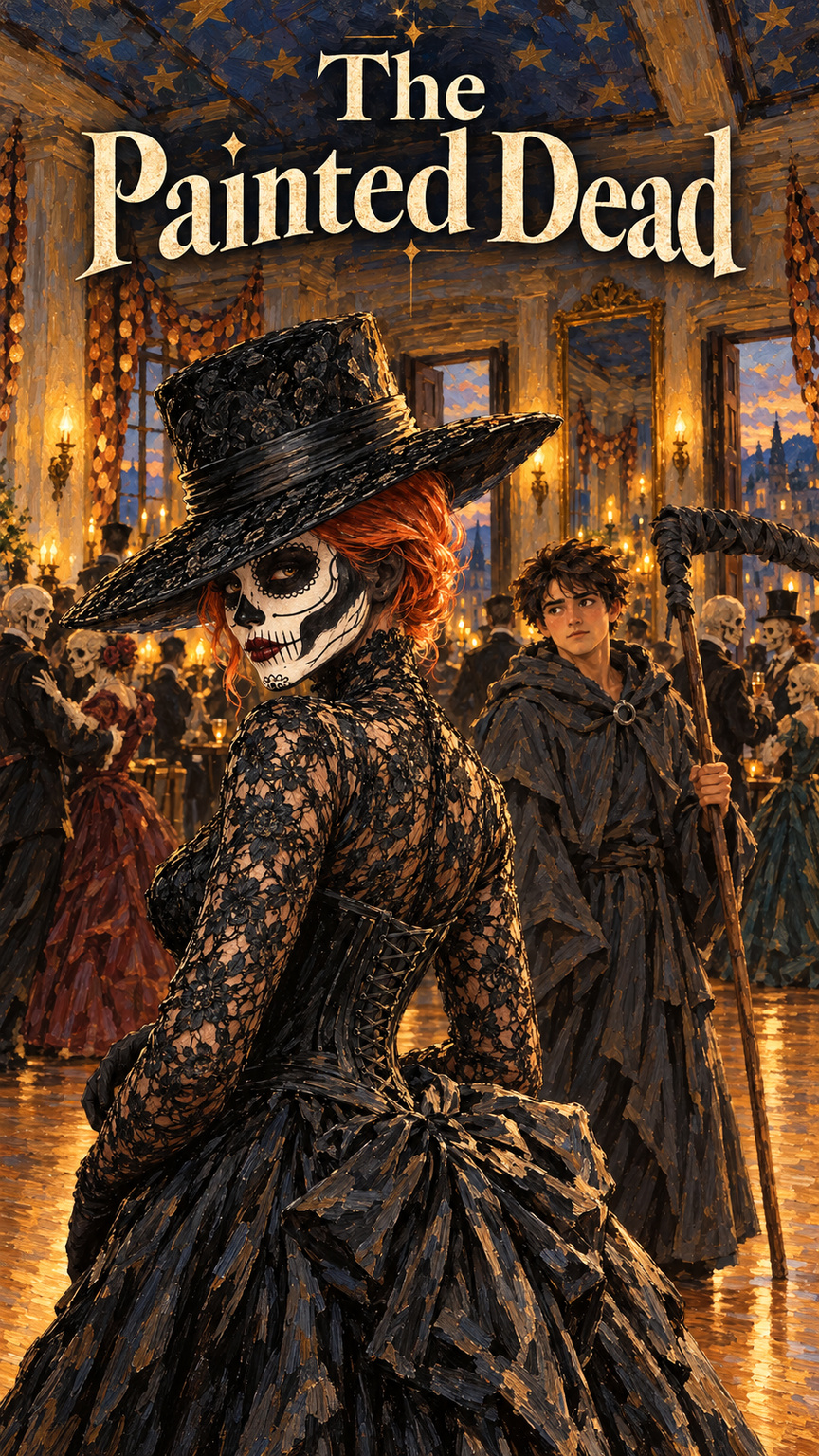
The King of Seven Orchards could conquer anything except a three-step turn.
“You are marching,” Belisane told him.
“I am keeping time.”
“You are advancing on the violins.”
He glanced towards the musicians, whose leader raised her bow in warning. Three hundred years ago he had offered her a duchy to play faster. She had asked whether he owned one that still existed.
Belisane took his hand from the small of her back and placed it higher. Her dress was black lace over black silk, its fitted bodice laced down the back above a great gathered bow; its maker, dead a hundred and twelve years, was watching from beside a pillar. If the king trod on the hem again, Belisane would hear about it until the next century.
“One, two, turn.”
“There was always a fourth.”
“That was the charge.”
They moved beneath the painted stars of the ballroom. Around them, jaws flashed with gold teeth. A woman had fixed tiny white flowers in the hollows beside her eyes; another wore a wax nose she had bought in the upper city, slightly crooked, and was daring anyone to mention it. The dead painted their bone faces with landscapes, ancestral patterns, expensive imitations of the flesh they had lost. The king wore his plain. Above its permanent grin he had drawn, for the occasion, two severe black eyebrows.
Belisane's skull had taken her forty minutes that evening. She had put little scallops around the eyes, white petals beneath the painted teeth, and a narrow black stroke along each cheek. Her red hair was pinned beneath a broad black hat. Through three hundred years of fashions she had kept the hat, though not the same one. A brim gave the paint its shadows.
A living couple stood near the doors with their dead father between them, arguing about which road to take home. In the street outside, the supper sellers were calling to both sorts of customer. Everyone could see the dead. Everyone knew the three roads into the Low City. In spring, children went down them to show their new height to grandparents whose faces no longer changed.
Belisane had been coming here long before the roads were paved.
“There,” she said. “You managed it.”
“I have managed it before.”
“In the year of the blue sleeves.”
“You remember what I wore?”
“They caught fire.”
The king laughed, and the sound beneath the bare bone was the same foolish bark she had known when someone on the surface could still name his country. He turned her through a circle that nearly worked.
At the edge of the dancers stood a young man with a scythe.
Its silver blade had been wrapped in dark cloth. His own face, round and serious, was bare beneath a hood too large for him. His hands kept finding and releasing the shaft, as though he were checking that it had not wandered off. Reapers were living people. A dead hand could sharpen the blade or cut an ordinary rope with it. Waking the other edge required life.
Belisane knew every Reaper who worked the Low City. She did not know this one. Her painted skull had always been enough for the others. Reapers did not take the dead twice.
The king followed her glance.
“New appointment. He brought the old carpet seller down yesterday. Sat with her while her daughters came to meet her.”
“That was kind.”
“Come and be kind to him. He's been standing there for an hour.”
The king led her over before she could refuse without attracting notice.
“Tereth,” the young man said when introduced. He bowed too deeply. “I was told I might find musicians here.”
“Several,” said Belisane. “We have been trying to discourage them.”
The violinist made an unmistakable gesture with her bow.
Tereth smiled. He looked less solemn at once.
“Belisane taught me this dance,” the king told him. “Three hundred years ago, and she has yet to make up her mind about the steps.”
“Three hundred?”
“In the spring. She wore white then. Looked like a bride who had escaped the wedding.”
“I wore white once,” Belisane said. “You have made such a business of it that I cannot do it again.”
The next dance began. Tereth shifted aside to let a pair of women pass. One of them caught his loose hood with a raised bracelet. The fastening sprang; the hood slid off his shoulder, and Belisane caught it before the king could put a heel through it.
Its silver clasp swung against her cheek.
She felt the small sting. She held the hood out, clasp tucked safely inside, and Tereth reached to take it. His fingers closed around her wrist instead.
Her glove had slipped below the cuff of her lace sleeve.
He was looking at the thin red line through the white paint. Beneath his fingers her pulse struck once, twice.
Belisane drew her hand back.
“A malicious piece of silver,” she said.
The king took the offending hood. Tereth did not look at him. The red line on her cheek was already closing.
From outside came a long, descending note.
“The procession,” Belisane said. “I promised to meet them.”
She put a hand briefly on the king's arm, then went out through the dancers. People made room, lifted fingers in greeting, asked if she would be back. She answered each of them. She did not run.
Behind her, Tereth said something too quietly to hear.
The music continued.
The last living speaker from the Copper Coast had died that afternoon.
She was coming down the middle road in her best yellow coat, bewildered by the crowd waiting for her. The first thing she did was hold out her hands to a man at the front. He left his place beneath the funeral canopy and went to her. Their foreheads met, bone against bone.
They had been married sixty-one years. For the last nine she had eaten supper alone.
Belisane stopped at the foot of the road.
The canopy was red, sewn with copper discs and weighted at its corners with four little bells. She had seen it before. Its people brought it out whenever another of their dwindling number came down. Tonight there would be nobody left above to carry it again.
When the new arrival saw Belisane, she drew back from her husband.
“You came.”
Belisane answered in the woman's language. She had learned it from a sharp-tempered milliner who used to refuse customers in it.
The woman laughed. Then she covered her mouth, discovering the shape that was no longer there.
Belisane waited. The woman's husband kept his arm around her.
At last the woman said, in the common tongue, “I thought I'd forgotten how to speak it.”
“There are plenty of people here to correct you.”
“Do they still?”
“Mercilessly.”
The bells moved. The bearers lifted the canopy, and the procession turned towards the square below the ballroom. No coffin traveled under the cloth. The woman in yellow walked there with her husband; in her hands she carried the key to a house whose new owners would never know what the marks above the door had meant.
This was the ninth funeral of a country Belisane had attended. Once she had helped carry a bowl of blackened grain. Once the mourners had brought the last bird that knew the old warning cry. It had outlived the last human speaker aboveground and bitten everybody. She remembered the woman who carried it laughing through her tears, trying to make it sing.
Tonight there was a key.
The song began badly. The man at the front chose a pitch too high for the women, and three groups entered on different words. Belisane sang the second line loudly enough to give them somewhere to meet. Around her the voices settled. Above ground the language had died in an old woman's room. Here it filled the square.
Tereth waited beside a shuttered stall until the verse ended.
“May I speak with you?”
She could see the ballroom doors beyond him. The King of Seven Orchards had come out with the musicians. He carried her small evening bag, which she had left beneath her chair.
Belisane stepped into the space between the stall and a stone pillar. She kept the procession in sight.
“You saw living skin,” she said. “You felt a pulse. You may believe both.”
“I do.”
“Then let me go.”
He unwound the dark cloth from his blade.
She caught his sleeve. “Put that away.”
The naked silver showed her something she could not see in an ordinary mirror: a thin gold pressure beneath her breastbone. The old binding tightened in answer. Tereth looked from the blade to her chest, and his face changed from suspicion to distress.
“How long has that been holding you?”
“Longer than you have been alive.”
“Three hundred years?”
“That is how long I have lived here.”
“I saw a man held eleven years after his body should have died. My teacher freed him. He had forgotten how to ask.”
Belisane's hand tightened on the sleeve.
“I have not forgotten.”
“You needn't be afraid of whoever tied it. He cannot follow a soul once I've taken it.”
She saw, a moment too late, that he was making a promise rather than asking a question.
“He can follow this one.”
The Reaper turned the blade.
The square went a very long way away.
Belisane could still feel the young man's sleeve between her fingers. She could see each stitch of it. Beyond it the singing had become the sound of a company marching in another country.
Gold came out of her chest without making a wound. It rose towards the silver in two bright loops, one doubling back into her body, the other stretching through the stone pillar and away. Where they crossed, a small, intricate knot turned in the air.
Tereth stopped breathing.
The scythe had opened what he thought was a single tether. Through it they both saw a room with open windows and a soldier lying on a table. Belisane was at his head. She wore no paint. His mother stood at his feet with a funeral cloth bundled in her arms.
The soldier's soul had gone just far enough to stop hurting.
Belisane remembered that distance. Drawing a soul back across it had once seemed the most beautiful thing she could do.
She watched her younger hands close. The man on the table gasped. His mother cried out, and the officers at the door began arguing about which regiment would get him.
The man's eyes found Belisane.
“No,” he said.
The windows disappeared. Now she stood before a seated figure in gold. His face was young, his fingers heavy with rings. Between her chest and his lay the same knot.
“I won't do it again,” she heard herself say.
The man in gold leaned forward.
“Then we shall keep them ready for you.”
The view shuddered: beds in a long room, shoes in pairs beneath them. Azravan had held these soldiers just short of death for weeks. Every morning he asked whether Belisane was ready to restore them to his army. A woman at the far end tried to lift her head; when she saw Belisane, she turned her face away.
Then a hand, Belisane's own, spreading white paint across a mirror's reflection. The first skull had been a poor one. She had wept while painting it, and the black lines had run.
Tereth's scythe trembled. The knot rose another inch, drawing both loops with it.
Belisane felt herself coming loose.
She had recalled souls from battlefields, from fever rooms, from the silence after a long fall. She knew the way inward. This time the body waiting for her was her own.
She called herself back.
Her heels struck the stones. The air entered her lungs with a noise that startled the nearest singers. Her loop snapped taut against the silver, and the other one jerked towards her from beyond the pillar.
Something answered the pull.
“Restorer.”
The voice came from inside the gold. He had called her that so often that she had almost forgotten the name she was born with. Belisane was a name she had chosen down here.
Tereth turned towards it. “Who's there?”
“Let go of her.”
She kept her hand over her breastbone, holding herself inward. She could feel the distant man take hold of the other end. For three hundred years he had had no more than the knowledge that she lived. Now somebody had pulled their hidden tie into the open, and there was a road along it.
“I told you,” she said.
Tereth lowered the shaft an inch. Both loops moved.
“Don't cut,” she said. “You have two of us.”
He held still. The square was quiet now.
“You brought them back,” he said. He had seen the soldier. He was looking at her hands.
“I did.”
“He made you.”
“At first I called it saving them.”
The gold brightened. Through the pillar she could see a stair with polished steps. A foot in a gold slipper appeared at the top of it.
Tereth looked into her face. Half a painted tooth had rubbed away beside her mouth. The living lip beneath was shaking.
“You aren't dying,” he said.
“No.”
“I thought—”
“I know what you thought. Hold still.”
He did.
“Belisane,” said the King of Seven Orchards.
He was standing at the mouth of the narrow space, her evening bag dangling from one finger. He looked at the gold coming out of her, then at the lost paint. She had known him for three hundred years and had never watched him understand something so slowly.
“I'm alive,” she said.
His gaze returned to hers.
“So I see.”
“The man coming down that stair wants to take me back.”
The king set her bag carefully on the stall.
“Where shall we stand?”
She had prepared explanations for this discovery. In sleepless hours she had composed a hundred apologies, each more graceful than the last. None of them contained an answer to that question.
Beyond the pillar, Azravan put both hands against the sides of the opening. Stone creaked.
“Get them away from there,” she said.
The king went to the procession. He spoke to the bearers, pointed with his whole arm, moved two people who had not understood. The woman in yellow took her husband's hand and backed towards the musicians.
“I can close it,” Tereth said. Sweat had gathered along his upper lip. “If I leave the blade, the claim will fail. We could go.”
Belisane looked past him at the square: the canopy, the ballroom doors, the violinist holding her bow against her chest. Above the windows hung the long strings of copper discs she had helped put up that morning.
The king in gold had seen it now. He would know which road to search, whose doors to open. She could leave her dressmaker, the music, the obstinate old dancer. She could paint a different skull in another city and let him come looking through this one.
A chip of stone fell from the pillar.
For the first time she could see both ends of the tie that had held her since the day she agreed never to grow old. It had been a gift then. Azravan had stood beside her at a boy's bedside and said that together they could put an end to loss.
She had gone willingly into his palace. She had escaped it in a line of his dead.
She turned back to the young man.
“Keep it open.”
He looked into the bright passage. “He'll come through.”
“I need him here. First I break the spell that keeps us alive. Then I take his soul.”
Tereth looked at the silver blade. “You mean to kill him.”
“Yes. He'll be here, among the dead. He won't be able to cast, or bind me again.”
“The blade is holding both of you.”
“I can hold myself here. You felt me do it.”
“I don't know whether—”
The figure on the stair struck the stone again. This time the pillar split from capital to base. Through the gap Belisane could see his young, untroubled face.
“There is time to drop it,” she told Tereth. “I cannot make you stay.”
His fingers shifted on the shaft. For a moment she thought he was letting go.
Instead he moved his upper hand down, leaving room for hers.
“Tell me where.”
She put her hand above his.
“Here. Let me turn it. Keep your weight against the lower end.”
He braced the heel of the scythe against the stones. The blade stayed bright. Through the wood she felt the rough, unpracticed force of his living will, nothing like the cold assurance with which he had first touched her soul.
Azravan stepped into the square.
The second gold loop followed him out of the pillar. Its far end vanished beneath the clothes at his breastbone; nearer the scythe, it still crossed the light coming from Belisane's chest.
He wore gold as though there were no other metal. Golden cloth, golden rings, a narrow crown with no jewel to disturb it. He had not aged. Neither had she. The same spell had seen to both of them.
He looked at the painted teeth beside her mouth.
“Is this what you did with my gift?”
For years she had imagined the sentence she would say if she ever saw him again. She could not remember it now.
“Yes,” she said.
His gaze traveled over the square. Perhaps he was looking for her guards. Perhaps he was simply counting the dead.
“I have spent three centuries looking for you.”
“You asked after a living woman.”
“I asked in every country.”
“You never thought to ask whether the dead were enjoying themselves.”
His eyes returned to the knot above the scythe.
“Let it fall, boy.”
Tereth said nothing. Belisane could feel his hands trembling below hers.
“She has shown you something,” Azravan said. “She always was good at choosing the worst moment. Did she show you the children she saved? The people who embraced her?”
The mother with the funeral cloth was still in Belisane's mind. Her cry when the soldier woke. His one exhausted word.
“I saw enough,” Tereth said.
“You saw a fragment of a life you cannot comprehend.”
Tereth glanced at Belisane, then lowered his shoulder more firmly against the shaft.
“It's hers.”
Azravan lifted his right hand.
The force struck the scythe first. The heel scraped a white furrow across the stones. Tereth fell to one knee but kept his grip; Belisane went sideways into the stall. The blade tilted. Gold climbed from her chest and pulled so hard that for an instant she saw her own body from above.
She called herself inward again. The stones, the pressure of silk at her waist, the ache in her shoulder returned. Her loop drew close to her. The other remained taut between the blade and Azravan's chest, changing its angle with each step he took. She needed it clear of her own.
Azravan came towards them, right hand rising again.
The King of Seven Orchards stepped into his way.
“You are interrupting a funeral.”
Azravan pushed him aside without touching him. The old king struck the stone pillar shoulder first and slid down it. His painted eyebrows remained absurdly stern.
“Leave them,” Belisane said. “It's me you want.”
“It has always been you I wanted.”
He said it without tenderness, as he might have spoken of a missing province. His hand opened towards the knot.
Behind him the woman in yellow spoke sharply in the language of the Copper Coast. The canopy bearers looked at her. She repeated herself, louder, and pointed.
“Down!” Belisane called to them in the same language.
They brought the canopy down over his raised arm.
Copper bells struck his shoulder. The cloth was heavier than it looked: generations of funerals sewn into it, disc by disc. Two bearers threw their weight onto its fallen corners. Azravan turned, furious, dragging them a step. A white glare burned through the cloth above his wrist.
“You cannot keep her,” he said to the square.
The woman in yellow caught the fallen fourth corner.
“Nobody's keeping her,” she said.
The King of Seven Orchards got up. His left arm hung awkwardly, but he could still use his right. He caught the back of Azravan's robe, close against the neck, and set one foot behind the sorcerer's heel.
“One,” he said.
Belisane knew that voice. His shoulder would turn on the second count; on the third he would pull. The fourth was the extra step she had spent three hundred years trying to take out of him.
She shifted her grip above Tereth's hands.
“Two.”
The king turned his shoulder. The canopy bearers held their corners tight.
“Three.”
He pulled. Azravan staggered to Belisane's left, dragging the canopy with him. The gold from his chest swung left too, clear of the light leading into hers.
Belisane held herself inward. Her own loop folded close against her chest, leaving his alone above the blade.
She waited for the fourth step.
“Now,” she told Tereth.
He bore down on the lower shaft. The old king stepped clear. Belisane turned the scythe through the space he had left, and its other edge caught Azravan's loop alone.
The knot opened.
She felt a small release beneath her breastbone, like a hand unclenching after so long that she had forgotten it was a hand.
The spell no longer stood between either of them and death. Her own soul stayed within her. Across from her, Azravan was still alive, but mortal.
Azravan looked down at himself.
“Restorer.”
She turned the blade towards him and fed it her living power. This time she drew his soul out.
He tried to step away from it. He could move only as fast as a man beneath a heavy cloth.
The light passed through him.
When it had gone, his face was bone.
For a moment nobody moved. Then the little white glare above his wrist went out, and the scorched canopy settled over his hand.
Azravan stared at his fingers. He lifted them towards Belisane. Nothing came.
A dead man could still command an army, if anyone chose to follow him. He could persuade, threaten, hate, remember. He could not cast a spell.
Belisane lowered the scythe.
“You can recall me,” he said.
“Yes.”
He waited.
She had only to close her free hand and make the inward call. She left it open.
She turned to the bearers. “Are you hurt?”
The woman in yellow was holding up the scorched corner. Her husband took it from her, examined the damage, and said something that made her laugh once, shakily.
The King of Seven Orchards helped three of the bearers wind the cloth around Azravan's arms. Across the square, people were coming out of doorways. Two were wearing uniforms Belisane had seen in the long room of beds.
They recognized him. One said his name. Others took it up.
His gold crown had fallen near the stall. Nobody fetched it.
They finished the funeral before the music began again.
The bearers used an old curtain from the ballroom for the damaged corner of the canopy. The woman in yellow hung her house key from its center. It turned among the copper discs while her people sang around her.
Belisane joined the last verse. She could still make the difficult sound in the third line, the one the milliner had made her practice until both of them were helpless with laughter. She had thought of herself as someone hiding when she learned it. Now she could see the years in which she had simply been there.
Afterward Tereth found her on the ballroom steps. His hood was folded over his arm. There was a bruise coming up beside his mouth.
He held the scythe across his palms.
“You said you were alive,” he told her.
“Yes.”
“I heard you.”
She waited.
“I thought I knew what you meant better than you did.”
Inside the ballroom, somebody tested a violin string. The old king was protesting that his shoulder would be perfectly well in time for the next dance.
“What you saw,” Tereth said. “The man on the table. Is he here?”
“I don't know.”
He looked surprised, then ashamed of the surprise.
“I didn't bring everyone back,” she said. “And I didn't meet everyone afterward.”
“If I find him—”
“Ask him whether he wants to see me.”
Tereth nodded. This time he did not promise more than that.
Belisane touched the place beneath her breastbone. Nothing tightened in answer. For three hundred years even the simplest breath had pulled against a presence at the other end. Its absence was so unfamiliar that she kept checking.
“What happens now?” he asked.
“I grow older, I suppose.”
“All at once?”
She looked at her hands. They were scratched and shaking and the same age they had been that morning.
“I hope to do it gradually.”
“When it's time—” He stopped.
She smiled, and the painted teeth around her mouth shifted with it.
“When it is time,” she agreed.
He took the dark cloth from his pocket and wrapped the blade. When he was done, he offered her his arm for the steps. She accepted it.
At the ballroom door the dressmaker seized her, inspected the torn lace, and went off in search of a needle. The violinist wanted to know whether it was true that the King of Seven Orchards had finally found a use for his fourth step.
“One use,” Belisane said. “We mustn't encourage him.”
Then she saw herself in the long mirror between the doors.
The painted skull was in ruins. White lay in the creases beside her nose; black had smeared across one cheek. Beneath it was the face Azravan had known, which nobody in this room had ever seen whole.
She took her bag from the king and went to a side table. Her little mirror was unbroken. So were the pots of white and black, the brushes wrapped in silk, the small bottle of oil.
She tipped the oil onto a cloth.
It took longer to remove three hundred years than it ought to have taken. She worked the paint from the corners of her eyes, from the hollow beneath her lip, from the small place beside her ear she always missed. Her hair came loose from its pins. She took off the broad hat and laid it beside the pots.
The face in the mirror looked strange to her. Its cheeks were warm. Its mouth could not remain composed.
The King of Seven Orchards stood beside the table, his left arm supported in a sling made from a very expensive sash.
“You have freckles,” he said.
She touched the bridge of her nose.
“I had forgotten.”
He regarded her with the concentration she had once seen him give a newly recovered map of his vanished country. Then he offered his good hand.
“I can manage the turn.”
She looked at the sling.
“We shall see.”
They went onto the floor. Around them were the gold teeth, the painted flowers, the crooked wax nose. The new woman in yellow sat between two friends who were telling her a story; at the far door Tereth stood with his covered blade, listening to someone.
Belisane laid her hand in the king's and let the music reach them.
“One,” she said. “Two.”
He turned her on the third step. With her living face uncovered, she laughed so loudly that the violinist missed a note.