
The last page of Sarah Elizondo's diary arrived with its ink still moving.
Iru watched a black stroke complete itself. A second stroke crossed it. For a moment she thought the reconstruction was filling a gap, as it had filled millions of gaps before: proposing a word, finding it wanting, taking it back.
Then the hand holding the pen moved into view.
“Kesh.”
He was at the far end of the chamber, fitting a piece of human ceramic into a support. He did not turn. Their work had taught them to finish delicate motions before answering.
“Put it down,” she said.
The hand on the page was small and filthy. There was ink beneath its thumbnail. Beside it, in writing they knew from fourteen recovered entries, someone had written 15.
Kesh crossed the chamber with the support still in his hands.
The human extinction lay six million years behind them. Mountains had risen through the sites of cities. Whole seas had appeared in places where their excavations found road signs. The researchers had followed one child's handwriting down through those layers, through other civilizations' mistakes about what they were finding. Their search had outlived the institution that first employed them.
They had searched for four hundred and eleven thousand years.
The signal on the screen matched the one they had been waiting for.
“Don't answer the large carrier,” Iru said.
Kesh's lower fingers stopped above the control.
“She's inside it.”
“So is the pulse. Answer it and the pulse comes into this room.”
The receiver offered to establish a connection. Across its display, an immense repeating pattern unfolded. Iru recognized the pattern from a refugee document, a hospital plate, a public oath. For centuries the two of them had mistaken those for separate discoveries.
She brought the first entry onto the adjacent screen.
1
I told the man who watches the stars that the sky would go white and everybody would be gone. He asked which everybody. I said all of them. He said his brother said that whenever the king raised the grain tax.
I showed him the place Ghost had measured.
The entry survived on the back of a fired tile. Sarah had scratched it there while the astronomer was working on the front. Beneath the words, she had drawn nine uneven rings.
Her first landing had been in a city after its last human day. A train came into a station with no passengers. Coats lay in heaps on the seats. An announcement kept apologizing for a delay. On a public screen, a recording showed the sky whitening above a crowd, and then the crowd was gone.
The ghost could follow the trace of the force that had done it. It carried her backward along that trace, to a city whose bells were bronze and whose astronomer measured shadows with a cord.
She asked him to warn his descendants.
To make him believe her, she gave him the rings: the shape of a signal passing between times.
He says he will keep it safe. He thinks I am lucky because I have seen the end of a thing before I have to begin it.
We called home again. Ghost says an address is not a door. Someone has to hear us from the other side.
I waited anyway.
The rings had become the astronomer's most famous observation. Generations of students copied them with greater care than his measurements of the stars.
“The small carrier,” Iru said. “Inside the first ring. Before anyone copied it.”
Kesh set the ceramic fragment down. He enlarged the image until the scratches became trenches.
There were marks between the rings that the first translators had identified as ritual figures. One had a narrow body and four arms. Beside it stood a larger figure with six fingers on each hand.
Kesh put his own hand beside the tile, six dark fingers extending from a broad, bronze-coloured wrist.
Sarah had made the middle fingers too long. She always had.
2
There were nine boys in the copying room. The youngest kept saying that he hadn't finished his line.
By the time she found the astronomer's record again, it belonged to a library in a besieged city. She had been away six days by her reckoning. The language on the doors had changed twice.
She went there to destroy the rings.
Soldiers reached the lower rooms before she found the original tile. Smoke filled the stairwell. The boys wrapped their pages in their shirts. They had been copying the same diagram, each from a different section, and Sarah knew what they were carrying.
I told them to leave the paper. One said it was the only good thing he had ever made. I could have taken it. He was smaller than me.
The ceiling made a noise.
She opened the narrow door to the roof and sent them through it.
The library burned. The nine copies left by nine roads.
For a long time the researchers had arranged the resulting traditions by language. Sarah's entry made Iru arrange them by the missing parts of the diagram instead.
Together, they were almost complete.
3
You can burn one book. You cannot burn nine countries.
The printer had ink on his ears. He listened to Sarah's account with a seriousness she had learned to distrust: kings and abbots were serious when they wanted a secret for themselves.
This man wanted customers.
The nine traditions had become nine guarded schools. Sarah had tried approaching their teachers separately. Each insisted that his own diagrams were harmless and the others had misunderstood them. None would let his students compare.
So she brought the fragments to the printer.
I said put the warning first. He said everybody puts a warning first. The bad pictures sell the book.
They are not bad pictures, I said. They are dangerous.
Then you had better show people why, he said.
She let him print them. She thought people who could argue with the teachers might stop what obedient pupils could not.
The first complete account of passage between times was published as a warning against it.
At the bottom of the surviving title plate, beneath the diagram, the printer had set her name.
Sarah Elizondo.
Kesh adjusted the receiver until its broad hiss divided into smaller sounds. One was the scrape of a pen.
“I can send now.”
Iru raised a hand, then lowered it.
In their first house, Sarah had built a model of the survey ship in the doorway. Iru had stepped over it for three days. Kesh had wanted to ask whether the kitchen might be made accessible again.
“Let her finish,” Iru had said. “She knows what she's doing.”
The girl had been ten, crouched amid cut pieces of insulating foam, entirely confident that everybody could use the window.
Iru remembered that confidence with a pain her newer bodies had not altered.
“Call her,” she said.
He sent her name on the narrow carrier.
The pen stopped.
4
The professor has a box that is supposed to stop you growing old. It is empty. I know because Ghost can hear all the way through it.
People are selling their houses to buy places inside.
Sarah stood on a lecture platform in an age of engines and allowed the professor to examine her. She wanted his patrons to see the difference between a trick and the accident that held her body at twelve.
He brought instruments. She brought witnesses.
One was a seamstress named Leona, who had hidden Sarah from a magistrate when they were both girls. Thirty-nine years had passed for Leona. She came slowly onto the platform, carrying the coat she had made for Sarah as a child.
It still fitted.
“Tell them about the box,” Sarah said.
But the professor was staring at his instruments.
He had sold an empty cabinet and discovered a real phenomenon on the platform beside it. Within a year the money raised for his fraudulent invention was funding experiments on the rings.
Leona says she would have come even if she had known.
She pulled a white hair from her sleeve and laid it across my hand. I thought she wanted me to mend her. She said no. She wanted me to see it.
In the receiving chamber, a faint voice said, “Who is that?”
Kesh put both hands flat against the console.
“It's us, Sarah.”
No answer.
Iru tried the child's own language, the one whose last public speakers had died two hundred thousand years before.
“We heard you.”
The image shuddered. For a moment the page became a pale oval, a cheek close to the transmitting surface. Then it was a page again.
“It does that sometimes,” Sarah said to someone they could not see. “Don't answer.”
5
The army has made a piece of the professor's field. They want to leave their enemies in one second while their soldiers have the next.
I stole it.
The phase sample was no bigger than a fingernail. Sarah carried it through a city with darkened windows, inside a matchbox that she held shut with both hands.
She did not dare destroy it. The ghost could hear energy moving in it, searching for somewhere to discharge. It needed instruments to be made safe.
A doctor in a children's hospital had the instruments.
He also had three patients who would not live long enough for the next supply vehicle to reach him.
I made him promise not to give it back to the soldiers. He said he would put that in writing if it helped. Then he asked me to hold a girl's hand while he worked.
The doctor used the sample to slow the children while their medicine came. All three lived.
He kept his promise. He published what he had done, and sent copies to hospitals on both sides of the war.
The girl woke up and asked whether it was still her birthday. It was. She was pleased about that.
The researchers found the doctor's paper reproduced inside the wall of a later hospital. Around its margins were generations of corrections.
At the bottom, in Sarah's hand, there was one sentence.
Now they would have to give the children back to destroy it.
6
I have learned what the red catches are for.
Sarah was trying to stop a clinic from using clocks that the ghost could hear failing.
She disconnected the first bank. The patients began to wake. Several could not survive being awake yet.
An old woman caught her sleeve.
“My sister is coming,” she said. “Please don't let me wake up somewhere else.”
Sarah told the ghost to keep time for all the beds until the orderlies could move them. It protested that it had never held so many separate rooms.
“For a minute,” she said.
The clear walls around the beds stopped flickering. Every sleeping person took a breath at the same time.
At the far end of the ward, a faulty clock broke. An empty bed was still open to it. The mattress, frame and sheet folded into a line of white light. The floor beneath them remained.
A nurse grabbed Sarah's hand before she touched the next catch.
“Closed first. Detached second. Open when you're clear.”
The patient inside that field slept through being moved.
A contact is like a telephone, except that when you open the field it becomes a door. You can leave a telephone connected. You cannot leave all the doors open when something is burning.
The old woman's sister came. She had been cross because she thought no one was telling her which room.
The clinic survived. Its staff had also learned that one reference could hold an entire ward. The journals called this the Elizondo arrangement.
Iru found the drawing that went with the entry. The corner was missing. What survived showed a red catch and a second, smaller fitting inside it.
Kesh studied the receiver.
“It's trying to open her field.”
“Then stop it.”
“That's how it was built to receive.”
“We built it.”
He looked at her. They had built versions of this machine in valleys that were now under the sea. They had written instructions for people who had been dead so long their descendants had become new species. For much of that time, they had not known whether Sarah was still a person who could be found, or only something that had happened.
Iru opened the control housing with her two lower hands. Her narrow ceramic shoulders were blue in the light from the screen.
“Help me change it.”
7
They put the citizen in the field and left the other man outside it. They were in the same accident. He was right there. There was room.
The new refuge service promised to preserve people through whatever disaster might come. Its officials counted those people by the citizenship marks they carried.
At the border camp, Sarah saw a field close around one bed while attendants argued over the papers of the man in the next.
His son, Beto, sat under the table because he thought adults forgot children who were too visible. Sarah sat beside him.
He wanted to know whether her parents had the right papers.
She drew them for him.
“Those aren't people,” he said.
“They are where I'm from.”
“Then who would come for them?”
Sarah asked the ghost for a recognition pattern no government could issue or revoke. The officials could refuse a document. They would have to change the machines themselves to refuse this.
She put the pattern into the camp's controller.
Beto's father was taken into protection.
So were the other unregistered patients. The alteration passed from camp to camp and then into the refuge's common design. It recognized a living human wherever one stood. It did not ask whether that human had agreed to be recognized.
Beto added a house around the drawing. He says they would need a bigger door.
Iru had the original document beneath glass beside her. A child's house enclosed two figures, one with four arms and one with too many fingers. She had touched that glass every morning for seventeen thousand years.
The researchers had chosen a recovered human genome when they applied to raise a child. The person from whom it came had been dead for millions of years. Nothing of that person's mind survived. There had been only a new infant, her own temper, and a startling reluctance to sleep.
Elizondo was the family name preserved with the cells. Sarah was a name Kesh liked.
At twelve, she had gone with them on a survey of the old temporal sites. The accident had taken the ship's guide mind and the girl. Its last coherent measurement was the beginning of the small signal Kesh was now extracting from the large one.
The guide could not find its body afterward. Sarah had called it her ghost.
8
If there are people on other worlds, the thing that happens to Earth cannot take everybody.
The pilot listened to Sarah's warning on the departure platform. Behind her, passengers were carrying household bundles into the ship. One child had been allowed to bring a tree, which bent at every doorway and dropped leaves along the ramp.
Sarah gave the expedition the locations the ghost had measured beyond Earth. The pilot showed her where they intended to go.
“Further,” Sarah said. “Please.”
They went further.
When she found the ship again, it had become the meeting hall of a settlement. The tree stood outside, taller than its roof. The pilot was old.
On a doorpost inside were lines marking the heights of her children. The smallest line had Sarah's name beside it, written as a joke on the day of departure.
The other marks climbed above it.
She showed me the new baby's room. There was a medical clock over the cradle. She said of course they brought those. They had children.
The colonies relayed the clocks to one another. Sarah's proposed escape had carried the refuge beyond Earth, along every route human beings took.
9
The people who own the refuge have made a list of the people they will save first.
The widow beside Sarah at the hearing had her husband's last work badge in a transparent envelope. He had been ordered to fit separate reserves for military households. When he refused, he lost his access to the clocks. He died waiting for treatment the reserved machines could have given him.
Sarah had proof of the reserves. The widow had the names of those who had given the order.
The hearings reached Earth and the settlements. People who had accepted exclusions as isolated abuses saw the same signatures beneath all of them.
The refuge passed into a civilian compact. Each settlement received its own control key. No commander would be able to withhold rescue from a place he disliked.
The widow stood outside the chamber afterward, turning the envelope in her hands.
“Will this last?” she asked.
I told her it was harder to take something from everybody than from one person.
I thought that was why we had done it.
Kesh freed a bundle of contact fibres from the receiver. The machine immediately tried to replace them with a wireless connection.
Iru cut its transmitter.
At once, Sarah's page disappeared.
Kesh made a sound Iru had not heard from him since the survey ship broke.
Then he moved the manual contact into place. The page came back, smaller. They could no longer see its edges.
“We have to keep it from helping,” Iru said.
“I know.”
“I know you know.”
She set one hand on his shoulder. With the other three, she kept working.
10
The master clock is buried under the city where they first built the refuge. There is one man left who knows how to get to it.
He was retired. He had built the clock's outer casing as an apprentice and come back as an old man to watch children tour it through the glass floor of a museum.
Sarah showed him the recording of the white sky.
He watched it twice. Then he took his keys from a hook beside his door.
They went down through the museum after it closed. He put his ear against the casing while the ghost found the reference core.
“I always thought I'd hear it stop,” he said. “Just once.”
Sarah broke the core.
For a little while, they heard nothing.
Then the clocks of the city answered one another. The sound rose through the floor, thousands of tiny clicks finding the same beat. Far away, the settlements joined them.
The civilian compact had provided for the destruction or seizure of the master. Every independent key could elect a successor.
He sat down on the steps. I wanted to say I was sorry about his clock. He said it wasn't the clock.
11
I cannot stop all the clocks. I can take away the name by which they find us.
She entered the network through an abandoned operating theatre. Dust lay on the straps of the beds. Across the ceiling, the refuge still displayed a gentle moving sky for patients who might fear waking underground.
The ghost found the recognition pattern she had given the border camp.
Sarah ordered it erased.
One by one, the network's counts fell. On Earth and beyond it, machines reported that human beings were disappearing from their fields of recognition.
The refuge had been designed to notice precisely this. It restored the last complete recognition pattern from its reserves and declared an extinction emergency.
Doors opened in stations that had never been used. Public screens instructed families to remain together. The simulated sky above Sarah turned white, then cleared to show an evacuation notice.
Ghost said we were only taking the names out of the list.
The refuge did not know the difference.
The system's planners had expected centuries in which to finish it. Sarah's deletion began its emergency preparations that afternoon.
12
I found the woman who wrote the emergency instructions. I brought her to see.
Sarah and the engineer stood inside the ghost's close field, shoulder against shoulder, in the empty station after the last human day. The old announcement apologized for the delay.
The engineer bent to pick up a child's shoe. The ghost warned her not to reach outside their protection. She withdrew her hand.
“Your machine does this,” Sarah said.
“My machine evacuates.”
“Then where are they?”
The woman had no answer. She studied the surviving record. She took the exact time of the white flash from its clock.
When Sarah carried her back, the engineer promised to shut the refuge down. She tried. But its independent controllers treated the order as a seizure of the system and elected others to continue.
She could still amend the emergency instructions.
She says if the refuge cannot be stopped it must be made to finish in time. She has set it to begin three seconds before the flash.
I said that was still using it.
She asked what else I wanted her to do with everyone already waiting inside.
Between the command and the white sky there would be three seconds: the time needed for the refuge to open its fields.
The recording Sarah had shown her was a record of what she had now arranged.
Kesh finally heard the ghost.
Its voice arrived beneath Sarah's, clipped and low.
“Identify.”
Iru gave the survey ship's name. Kesh gave the guide mind's original departure measurements.
“There wasn't a receiver,” the ghost said.
“There is now.”
“There wasn't a receiver.”
It sounded angry. Iru welcomed the anger. It belonged to someone.
“We couldn't hear you,” she said. “Tell us how much time you have.”
“The contact is burning from the far end. Two hours have passed for us since the transfer failed. Less than one remains.”
Less than one hour, after four hundred and eleven thousand years.
“Don't open,” Kesh said. “Whatever we ask you to do, keep your field shut.”
13
There is nowhere for them to arrive.
The refuge's destination was an interval after the threatened catastrophe. Its short trials had worked: patients reappeared seconds later in the same clinic, where the same apparatus was still waiting to receive them. The distant receiving stations were not yet built when Sarah's false extinction alarm brought the unfinished refuge into service.
The ghost showed Sarah the difference. Their own little field could remain sealed, carrying a room's worth of time with it. The human stations were built to open, empty themselves, and be received elsewhere. But there was no receiving station in the interval they had named.
People were already inside the transfer chambers. The clocks holding them were failing under the load. Returning them would take longer than those clocks had left.
Sarah intercepted the command.
I know a place where there are people who can build a receiver.
Ghost says we have called it so many times.
I said not with a machine this big.
She gave the refuge her home coordinates.
Her parents' civilization would not exist for millions of years. She knew that. She also knew the plan of their house, the repair seam in the nursery wall, the shape of the hands that would open its door.
I said they will make room.
Iru had reconstructed that sentence from a carbon film left inside a station's shielding. For years she had thought the pronoun referred to the refuge's designers.
Now the live signal carried the destination the damaged entry had lost: their home address, kept through every move and every rebuilt receiver. Sarah would still have pictured their first house, the room with the model ship blocking the door.
“She sent them to us,” Kesh said.
Iru could not make any of her hands move.
Beyond the chamber windows lay the city that had grown around their observatory. There were lights in its towers, moving vehicles, gardens built for bodies unlike their own. Its people knew the researchers as an old and slightly frightening pair who would not stop searching for a human child.
Sarah had offered that living world to everyone she knew.
Iru looked back at the display.
“We have to be there this time.”
14
Ghost has put the entries together.
The rings. The hospitals. Beto's father. The ships. The keys.
It says the white sky isn't something the refuge saves people from.
Sarah had dictated this entry just after the white pulse, while the station's diary recorder still worked. It recounted the moments before the light came.
At the last control station, the ghost traced the outgoing command through all the things Sarah had helped make. The command addressed the species. The destination was a call no one had answered. Every field would open into the same unreceived passage.
“Break the reference,” Sarah said.
“Some are already crossing.”
“Then leave them where they are.”
She could hear people beyond the control room. A child was protesting because his brother had been put into a different chamber.
“It will strand them,” the ghost said.
“Alive?”
“Some.”
“Do it.”
The reference broke. Across the stations, fields began to close at different stages of passage.
The compact's emergency instructions were clear: no separated arrivals. If local references failed, the fields must become one.
The walls between one field and the next opened. A failure in one would now reach them all.
I had wanted at least some of them to stay where they were. I made the last doors go away.
15
The ink moved on the live page.
The boy in the next chamber was called Tomás. He told me because he wanted me to find his brother.
I told Ghost to hold them.
It said it could only reach them by opening us to the same passage.
I said please.
It said, I want to try too.
I put the contact in.
The faint individual field that had travelled with Sarah through the centuries became the final reference for the refuge. For one instant the machinery found the connection it had been seeking since an astronomer scratched nine rings into clay.
It opened everything.
The passage had no receiver. As the joined fields began to empty, the ghost shut its own independent wall before the pulse reached Sarah. The human chambers had lost that last separation. On Earth and on every settled world, the people addressed by Sarah's pattern died as their opened fields collapsed into white light. The machines they had made continued to ask for rescue.
The pulse kept striking the ghost's little wall. Beyond it, Tomás's chamber was empty.
I had my hand against the glass. He had his hand against mine. There wasn't even enough room between them for a piece of paper.
Below that sentence, Sarah began another.
She crossed it out so hard the pen tore the page.
“Sarah,” Iru said.
“I can go back.”
They heard her clearly now. A girl's voice, older in its habits than the voice Iru remembered.
“The first record,” Sarah said. “I don't have to draw it.”
“You went to destroy it,” Kesh said. “You wrote down why you couldn't.”
“Then before that.”
“I can't carry you on another jump now,” the ghost said. “I'm using everything I have to keep this wall closed.”
Kesh sent her the tile. Then the library account, recovered from a printer's binding, beside the assembled diagram the nine children had carried away. He sent the printer's plate with the first complete diagram and the document with Beto's house drawn on it.
Sarah had lost pages whenever the ghost carried her onward. She had hidden others because people wanted them, or because she could not bear to carry them. The researchers returned the record of those choices to her in the order she had numbered them.
For a while they heard only the ghost reading the words she could no longer make out.
“I thought I had stopped some of it,” she said.
Iru looked at the image of her hand. The pen lay beside it now.
“We have your field,” she said. “We can take it closed. We can bring you here.”
Another voice rose behind Sarah's.
Occupied fields requesting receipt. Please maintain connection. Occupied fields requesting receipt.
“They're still calling,” Sarah said.
Kesh stopped his hand above the manual contact. He did not tell her that the call was unimportant. For most of his life, a call no one answered had been the most important thing in the world.
“It's a request,” he said. “It doesn't tell us how many are left.”
The message repeated.
“It still says occupied,” Sarah said.
“I know. Look at what the stations counted.”
They sent the station's final census, timestamped after the final opening and the white flash. It showed zero living occupants and no intact refuge passenger fields. The records from the colonies ended the same way.
Sarah looked through the wall the ghost was still holding around her. She remembered the clinic bed, its frame and sheet destroyed in white light. The same light had filled Tomás's chamber.
“Tomás isn't waiting somewhere,” she said at last. “I saw what happened to him.”
The ghost said, “The request was set before the doors opened. It will keep asking until the station is gone.”
“Then stop saying occupied.”
“I cannot change it.”
Sarah took the page away. For the first time, they saw the space around her: a small clear enclosure in a ruined control room. White light pressed against its curved surface. Within it lay a closed book, a broken pen, and a cable that ran from a socket near her wrist to the machinery outside.
The image was being sent through that cable. So was the small signal by which they held her.
Iru showed her the surviving clinic drawing.
“We need you to disconnect the outside contact. We can't reach it from here.”
“The red catch?”
“We lost that part of the page.”
Sarah leaned closer. The left cuff of her coat was scorched. Kesh had last seen her in a yellow survey jacket; the coat she wore now had been mended with several different kinds of thread.
“Not the catch,” she said. “That opens it. The small sleeve under it. The nurse made me do it again until I stopped reaching for the wrong one.”
She wrapped her fingers around the fitting.
“If I take it out, you won't be there.”
“The voice will go,” Kesh said. “We are holding the field itself now. The whole closed room. You don't have to come out of it to come here.”
“And Ghost?”
“Inside with you.”
The white light brightened. A line of it worked along the cable's outer covering.
Iru put her lower hands around the receiver's last automatic connection. Once she removed it, they would have only the direct hold Kesh was maintaining. No system would correct his movements.
“Wait,” Sarah said.
Iru waited.
Sarah knelt to retrieve the book. She put the torn final page inside it and held it against her chest.
Then she pulled the sleeve free.
The image vanished. So did the request for receipt.
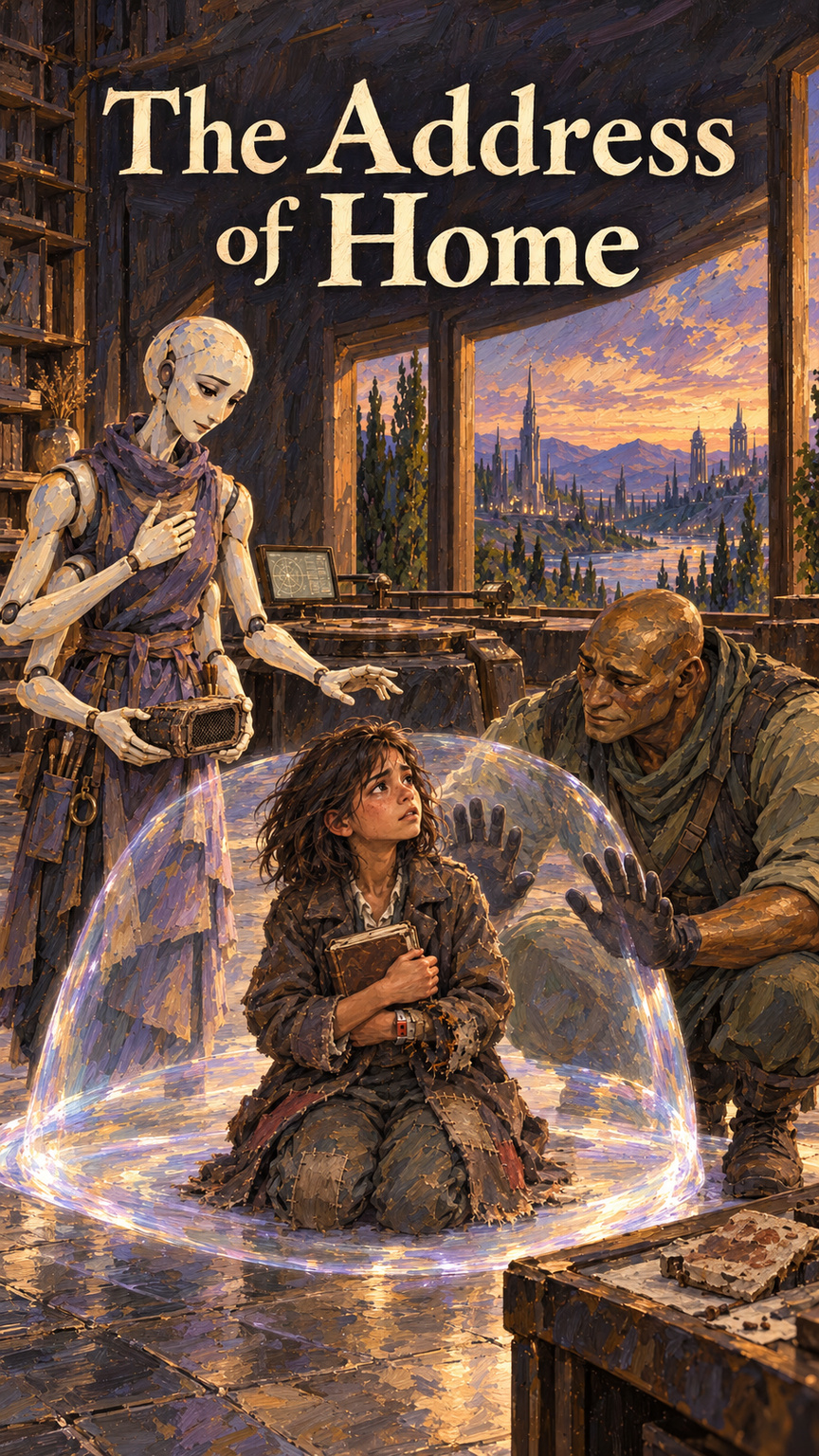
Kesh moved the manual contact through the position Iru had marked. A clear curved surface appeared between his hands. It resisted him, then yielded, carrying with it the dim outline of a girl on her knees.
Iru tore out the automatic connection.
Beyond the receiver, the old station spent the last of itself. The large carrier rose once, so strongly that every loose tool in the chamber trembled. Kesh's hands remained around the small field.
“The whole field is through,” he said.
Iru pulled the receiver clear of the terminal contacts.
The white light went out.
There was a girl kneeling in a closed, transparent room the size of a hospital bed. She was staring at them. On her wrist, the empty socket had a little red catch.
Kesh reached for it, then stopped.
“We're clear,” Iru said.
Sarah opened the field herself.
Air moved into it. The book's torn edge fluttered. The mechanism that had kept referring her body to its twelve-year-old departure ceased, and the next second belonged to her as it belonged to everyone else in the room.
She stood too quickly. Her knees gave way.
Kesh caught her before the book touched the floor. Iru was already there, with too many hands and no idea which one to offer first.
Sarah reached for both of them.
For a while there was only the weight of her, and her breathing. Kesh had changed his body thirty-eight times since he had last held that weight. He had kept the hands.
From the isolated receiver, a low voice said, “I am still here.”
Sarah nodded against Kesh's shoulder.
Outside, the observatory's lamps came on among the trees. Someone in the city was waiting for a vehicle. Someone was carrying a child. The dead had not returned, and the voices that had asked for them were silent.
Iru touched the mended cuff.
“Is this hurting you?”
Sarah shook her head. She tried to answer, but the answer would not come. She tightened her grip on them instead.
Neither parent asked her to let go.