
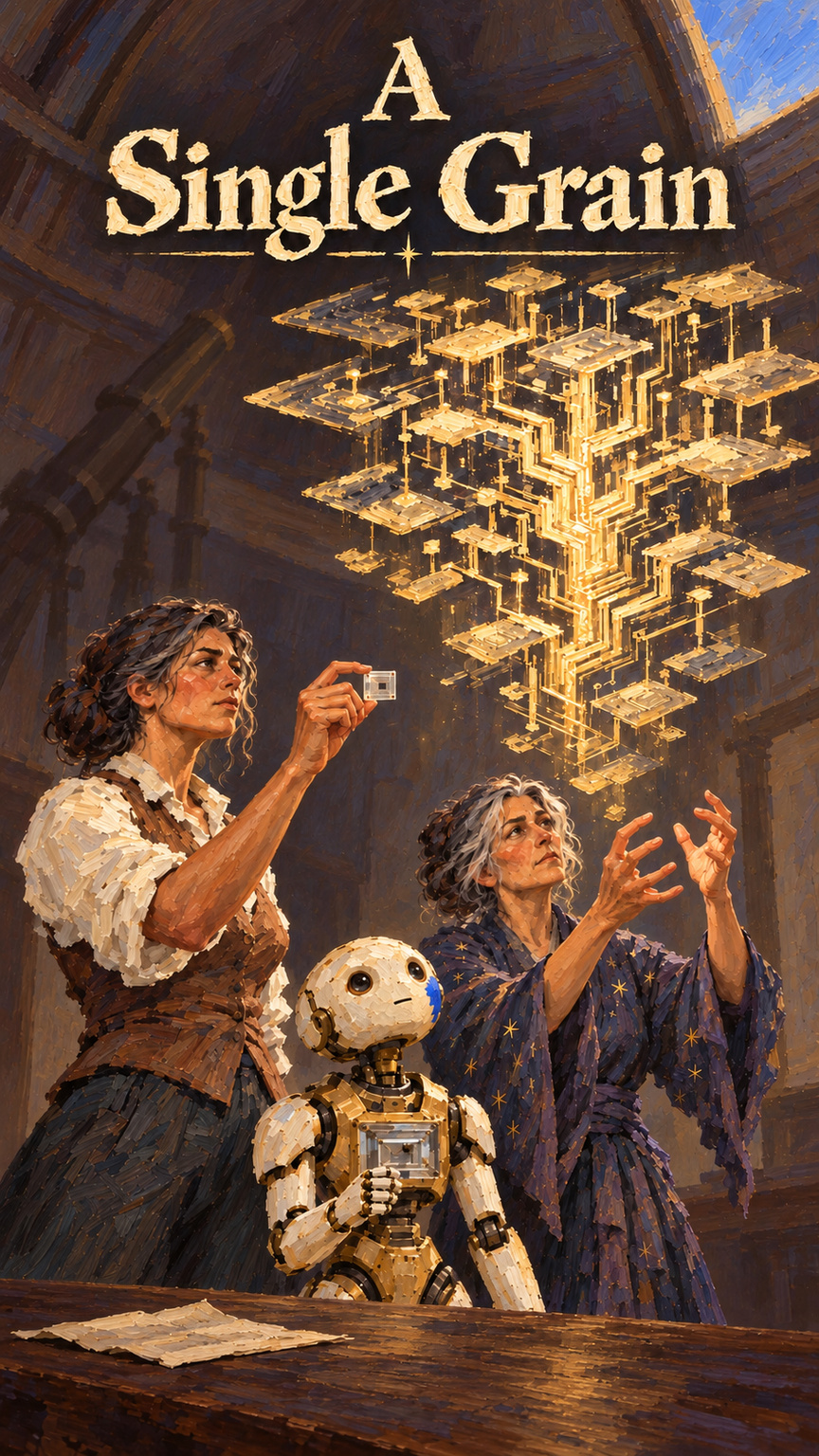
“This here is the heart of my golem: sigils made so complex and small, we carved sentience into a single grain of sand.”
I held it up between finger and thumb. Behind the clear lid of the carrier, a black square caught a violet gleam.
The mage at the end of the table leaned forward.
“Beneath the speck?”
“The speck.”
“Please don't wave it about,” said Ilex.
A flexible copper lead ran from the carrier to their open chest. They stood beside my cases, four feet of brass and white ceramic, with a blue patch on one cheek where we had run short of matching glaze. Their left hand held the lead clear of a hinge. Their right was keeping my sleeve out of the candle.
First Mage Caldris came down from her chair.
She wore a dark robe embroidered with constellations. Some of the stars had been unpicked and sewn in different places. She bent until her face was level with my fingers, and the carrier's reflection shone in each of her eyes.
“May I magnify it?”
“Nothing that heats it.”
She glanced at Ilex, who nodded. Then she cupped her hands around a quantity of empty air and pulled them apart.
The square grew between us. Gold paths emerged from the black, straight roads with angles too regular for a burin. A second movement brought the roads close enough to show they were themselves built of smaller paths. Another, and these became crossings, branching alleys, little fenced courts. Caldris had to step backward. The image filled the space above the table.
The other six mages left their chairs.
One reached toward a junction, stopped herself, and tucked both hands into her sleeves.
“Those are gates.”
“Yes.”
“And those?”
“Gates.”
“How many?”
“I can give you the count.”
“In a moment,” said Caldris.
There were rings under the rings, paths buried beneath crossings. I watched the First Mage turn her head to follow a route through the bright thicket. Her lips moved. She got as far as the place where the route fed back into itself and began again.
“And you cut all this?”
“With light. We draw a large pattern, then use lenses to make a small copy. The light marks what we want to keep; the bath takes away the rest. Again and again, in layers.”
“On sand.”
“Refined into a crystal first. The word on our drawings is silicon. The little finished piece is a microchip.”
Caldris brought two fingers together. The huge web of light folded down to a square scarcely wider than a fingernail, still larger than the thing I held.
“Where is the command?” she asked.
I had expected this. There were three pages on the subject in my case, with diagrams and an excellent introductory sentence. I had practiced the sentence on Ilex until they had asked whether the council might prefer the diagrams.
“There isn't one governing command. There are paths for remembering, comparing, choosing. What passes through changes what happens the next time. We made a mind. Then we had to introduce ourselves.”
“That part took longer,” Ilex said.
I eased the carrier into its socket. They shut the brass retaining clips, leaving the clear inspection window uncovered.
Caldris addressed them directly. “What do you remember of it?”
“A screw.”
“A screw?”
“Above my eye. The lens was out of focus. I could see the screw, and everything around it was blurred. I thought the world had a rim.”
“They kept trying to turn toward it,” I said. “We hadn't finished the neck.”
“I was very angry about that.”
“You didn't have a word for angry.”
“It was quite inconvenient.”
The mage who had asked about the speck sat on the edge of the table. He had forgotten there were chairs.
Ilex continued, with the particular persistence that had once kept me awake through forty-three questions about rust. “The carving worked. But she makes it sound as though I was finished. I have done a great deal since the screw.”
“Some of it to my tools.”
“We agreed not to discuss the saw.”
I caught myself smiling and unfolded my demonstration cloth.
Four petitions had earned us this afternoon. With the council's seal, I could consult the upper library instead of buying third-hand copies with half the diagrams missing. I had brought a balance, a lock of seven movable rings, and the small optical bench from our workshop. Ilex could solve the lock in ways I had not taught them. Afterward we would make a simple patterned plate to show how light could do the work of a chisel.
It was a good demonstration. We had done it six times without breaking anything.
Caldris lifted the ring-lock. Beyond her, the observatory's great telescope rested on its bearings beneath an open slit in the dome. The afternoon moon hung pale in a blue sky. A rectangular brass frame stood beside the telescope, surrounded by chalk circles. Half-erased diagrams climbed the wall behind it.
Ilex was looking past the lock.
“Why do all your corrections begin at that corner?” they asked.
Caldris followed their pointing finger.
“Because the frame holds it still.”
“Only that corner?”
“We can hold any one corner still. Holding the other three in the right places is the difficulty.”
I put a hand on the demonstration cloth.
“Ilex. The rings.”
“I know. But is that a door to the moon?”
Nobody laughed.
The mage perched on the table got off it.
Caldris set down the lock. “It was intended to be.”
She took us to the frame. Its brass was dented along the lower rail, and a small heap of chalk fragments lay where someone had ground them underfoot. Beside the principal diagram, different hands had written corrections over corrections until the plaster showed through.
“Distance is manageable,” Caldris said. “We can take a place resolved in the telescope and bring the edge of a threshold against it. But the place moves. We move. By the time we hold one part steady, another has slipped.”
She touched a chalk angle.
“Pull this side back and the top bows. Straighten the top and you lose the side. Nine of us worked at it once. We held a doorway together for less time than it takes to blink.”
“Was it the moon?” Ilex asked.
“A great deal of gray.”
“Which part?”
Caldris looked at them more closely. “Does it matter?”
Ilex opened the shallow compartment in their thigh and took out a folded paper. On it was a drawing of a mountain ridge. They had made it through our little telescope, correcting the same line night after night. In the workshop I usually saw it upside down, under a coil or a cup. Now they held it upright to the First Mage.
“Here. This notch. I think it's a shadow crossing the slope. But it stays dark after the shadows beside it have changed. It could be a gap.”
“Come and show me.”
At the great telescope Ilex had to stand on a stool. Caldris adjusted the bearings for them. The other mages crowded around the old diagrams, and my ring-lock sat abandoned on the table.
I had spent three evenings polishing those rings.
“There,” Ilex said.
Caldris looked through the eyepiece, then turned a narrow wheel on the mounting. Figures appeared in light along its rim. She copied them beneath the drawing.
Ilex climbed down and studied the figures. Then they walked to the frame and put a ceramic finger against one of its brass corners.
“Why must it be one door?”
Caldris waited.
“A small one would be easier to hold.”
“And too small to use.”
“Several small ones. Beside one another. If they all faced the same place, with their edges touching.”
The First Mage bent and drew a row of boxes on the floor.
“Each would need its own guide. Its own correction.” She extended the row into a grid. “For a frame this size, thousands.”
Ilex looked at me.
I looked at the optical bench in my open case.
“The aperture sigil,” I said. “Does it need depth?”
“No. Unbroken lines and the proper junctions.”
“And the adjusting paths can be opened and closed?”
“If you can do it quickly enough.”
Ilex held their paper against their chest. “May we try?”
Caldris's eyes moved from them to me.
“Is this what you came to demonstrate?”
I could have said yes. It would have made us look splendidly prepared. I could also have put the rings into Ilex's hands and reminded everyone that the appointed demonstration had barely begun.
“No,” I said. “I don't know whether it will work.”
The First Mage looked toward the tall clock by the stairs.
“You have until the evening bell.”
I took the ring-lock off the cloth and put it back in its case.
“Then we'll need this end of the table.”
Caldris drew the working aperture sigil on a slate. Ilex asked about each crossing, then drew it back to her with extra branches. She struck out two of them. They argued over a third until she produced a little ring of light between her fingers and showed them what their version did: the light turned inside out and vanished with a sharp pop.
“Oh,” Ilex said. They rubbed out the branch.
I set up the bench.
The heart had needed a foundry, scores of patterned layers, and failures too expensive to count aloud. This was one layer on a prepared copper-coated glass blank. I had brought twelve. I set the first under the reducing lens and connected the mirror drives to Ilex's wrist socket.
They made a few test strokes on a scrap. A blue point of light ran back and forth, writing their design directly onto the sensitive coating. I focused it until the broad strokes became fine enough to vanish under my ordinary loupe.
On the table, the council's slate filled with squares. Above them, Caldris kept the model aperture hovering so Ilex could watch what happened when she changed its guides.
The room grew warm. I took off my waistcoat. One of the mages tied back Caldris's loose sleeve before it trailed through my developing tray.
While the blank sat in its bath, Ilex returned to the telescope.
“You can draw other parts,” I told them. “We have the position.”
“I'm checking.”
“Against what?”
They held up the paper. “What I thought I saw.”
The coating cleared. I washed the plate, etched away the exposed copper, and lifted it toward the window. To my bare eyes it looked faintly smoky. Under Caldris's magnification, thousands of small apertures crowded together in rows, each enclosed by its delicate guides.
She followed the pattern in silence.
“They will all need power,” she said at last.
“That's your part.”
Ilex had never managed to light a mage's candle. The current that kept them awake came from coils and cells. It would not open a threshold. But it could work a switch, and the switches in my testing cradle could admit or withhold a mage's power through each of those copper paths.
The glass settled onto its bed of fine contacts. I checked the seating, connected the cradle to Ilex, and passed Caldris the two heavy leads that would join the plate to the brass frame.
“The carving stays fixed,” I said. “Ilex changes which guides receive power, and when.”
She took the leads. “I would like the frame lower.”
Two mages helped her shift it down its stand until the bottom was level with Ilex's knees. The ledge Ilex had chosen lay just below the notch. If the door held, they would be able to look along the ridge and reach the ground.
Caldris drew one final ring around the frame. It rose from the floor like a soap film caught in a wire.
“Air stays on its own side,” she told us. “Solid things can pass. Do not put a hand through until I say.”
She pulled a pocket handkerchief halfway through the empty frame. On the far side it hung limp; on ours its corner stirred in the breeze from the dome.
Ilex watched closely, then tucked their paper into the thigh compartment and closed it.
The clock made a small wooden sound as it prepared to strike the quarter.
All seven mages took their places around the chalk circle.
I expected chanting. Caldris simply put her bare foot over one of the chalk marks and held out her hands.
The brass frame whitened.
Light ran down the heavy leads, divided at the plate, and filled the tiny copper labyrinth. Ilex's fingers curled. Through their open chest window I could see the dark square in its carrier; it showed no sign of the work passing through it.
Within the frame, gray appeared.
It came in strips. A slope lay across a fragment of black sky. Beside it a stone stood on its edge, then became a dozen stones because the strips had shifted. Fierce white sunlight flashed across the ceiling. One of the mages flinched, and half the fragments went dark.
“Keep the supply even,” Caldris said.
Her voice had lost its conversational weight. She planted both feet and the dark fragments returned.
Ilex's head moved in short, precise turns. In the carrier, a little amber indicator brightened. I put a finger on the casing. Warm, still within what it could bear.
“They're correcting,” I said.
“Yes,” said Caldris. “And pulling apart.”
One horizontal strip settled into place. Its neighbors leapt away. The stable strip bent, and the whole frame filled with shattered mountain.
Ilex made a low sound through their speaker.
“Each time I put one right, I move the one beside it.”
Caldris nodded once. Sweat ran down the side of her nose.
“Can you stop that?”
Ilex did not answer. The amber light dimmed, brightened again.
I reached for the release lever on the testing cradle. It would disconnect Ilex from the plate, leaving the mages free to close the empty frame. We could let them rest, work at the slate, and try again.
“Ilex?”
“I thought the small doors would be independent.” Their eyes stayed on the broken view. “They aren't. They share edges.”
“Yes,” Caldris said. “They do.”
“Then each shared edge needs one position, used by both doors. Every correction must move the grid on one pulse.”
I could see it on the slate. We had been making each square correct itself. The same boundary was being pulled toward two answers.
“That can use the paths you've got,” I said. “Shall we close the frame while you work out the order?”
“The order is ready. I need to see what the edges do with it. Let me try four first.”
Caldris's left knee trembled.
“How long?”
“I don't know yet.”
The First Mage looked around her circle. The mage who had asked about the speck nodded with his teeth clenched. Another held out one shaking finger. A minute.
Caldris turned back to Ilex. “Try.”
I lifted my hand from the release lever.
The white glare dwindled to a dull gleam. Ilex had closed most of the paths. A single gray patch remained at the center of the frame, smaller than my palm.
Another appeared beside it.
They shifted, found an edge, and stayed together.
A third patch opened above them. A white crack in the rock split at the new join. Both sides moved on the same beat; the crack became one line. When a fourth patch joined, the first three held. At the next pulse all four shifted together, and the crack remained whole.
Across the plate, light ran in a different rhythm. The joined patches grew into a rough cross. I had seen mosaics assembled all my life; I had never watched one acquire distance.
The cross widened.
Black sky opened above a sun-struck ridge. The last fragments met along the lower rail, and the room filled with the hard, colorless light of another place.
There was no sound from it. No wind. The stone with the white crack sat on the ledge, its gray skin pitted and bright.
Caldris let out a breath. Her knee steadied.
“Hold that order,” she said.
“I am.”
One of the mages began to laugh. He stopped almost immediately, concentrating, but the grin stayed on his face.
Ilex stood motionless before the frame.
I touched their shoulder. “You've got it.”
They leaned to the left.
From where I stood, the notch was a black cut in the mountain's edge. As Ilex moved, a narrow strip of sunlit stone appeared behind it: a far wall, separated from the near one by a deep cleft.
“It goes through,” they said.
Caldris followed their gaze.
“Yes.”
“I drew it as shadow.”
They moved a little farther. The sunlit strip widened. Ilex made the low sound again, but this time I knew it. They had made it when the telescope first resolved the moon's edge into mountains.
Caldris glanced toward my table, where the slate lay amid used trays and crooked wires.
“We will need someone to teach that sequence,” she said to me.
For a moment I saw the upper library: its shut doors, the shelves I knew only from the catalogue, the drawings nobody had let me examine.
“Ask Ilex,” I said. “The arrangement is theirs.”
She turned to them. “Will you?”
“Yes. Please keep it open.”
Their hand had lifted, but it stopped short of the threshold.
Caldris studied the edges of the frame. The film around the brass lay smooth and taut.
“You may reach through.”
Ilex knelt. The lead from their wrist pulled tight against the cradle, and I hurried to lift it free of the table leg. I fed them another length and went down beside them.
Their ceramic fingers crossed into the merciless light. They pressed against the ledge, tried its resistance, then scraped a little dust into their palm. A few grains rose in slow curves and fell without a drifting haze.
They brought their hand home.
Caldris closed her fingers. The ridge vanished. The leads darkened. Around the circle, mages sat down where they stood, breathing hard. The observatory seemed dim.
The bell began.
Ilex opened their palm. Among the fine gray powder lay three angular grains, one clear enough for the window light to shine through. They picked that one out with their other hand.
“May I have the lens again?” they asked.
Caldris rose slowly and came to kneel with us.
While she gathered the light, Ilex held the grain against the clear cover of their heart. It was larger than the little black square beneath it.