
Pellin flew them straight into a cloud because he was sixteen and had been trusted with a blue coat.
“Which way?” he asked.
“Out.”
“You're the navigator.”
Cold fluff closed over the skiff. Cirel could see her brother's hands on the tiller and nothing beyond them. Somewhere in the whiteness, something enormous sneezed.
“Left,” she said.
“Certain?”
She wasn't. She was thirteen. It was her first morning aboard a proper ship, and Pellin had already told three people that she could find her way anywhere.
Then a gap opened below the skiff. In the polished belly of the raincloud beneath them, Larkglass shone upside down. There were its houses, hanging under the great reef's roots; there were the bridges between them, and the little yellow square of the quilt Mum had put out their kitchen window.
“Left. Unless you'd rather hit our house.”
Pellin swung the tiller. They burst into sunlight with a fringe of cloud clinging to his curls. Cirel plucked some off and put it down his collar.
“Navigator dismissed.”
“You'll have to steer home by yourself.”
He flicked her ear, then passed her the parcel from under his seat. Mum had packed two plum buns. Pellin's was larger, but he broke off its best, stickiest corner and gave it to her before she could steal it.
Above the reef, the expedition ships were unfurling their sails. A thread of whale-breath ran from the brass flask beneath Pellin's seat into the skiff's mast. The little sail swelled. They rose past gardens growing out of stone, past a woman shooing winged snails off her washing, toward the blue-and-gold hull of Pellin's ship.
“Ours won't be this small,” Cirel said.
“Ours will be exactly as small as we can afford.”
“It needs a chartroom.”
“A chart drawer.”
“And when we discover an island, I name it.”
“The captain names it.”
“Pellin's Monumental Nose.”
He tried to snatch back the bun. She stuffed the rest in her mouth, and for a minute neither of them could speak.
When they docked, he brushed crumbs off her borrowed grey coat. Its sleeves were too long; he rolled them twice. His own cuffs were blue, with a navigator's silver stitch at each wrist. She wanted those stitches so badly she could feel them.
“Stay behind the net-line,” he said. “That's the only thing the captain asked.”
“I know.”
“I said you would.”
“I know.”
He checked her last button and let her go.
On the next ship, three sailors were carrying a barbed iron head toward a gun. Cirel stopped to watch them lower it into place.
“For the great ones,” Pellin said. “They pull ordinary nets apart.”
The mooring irons held those whales while the crews filled their breath-flasks. Working a great whale could take weeks. By the time it was released, the migration passage would have closed. One grey whale had been circling Larkglass's outer roots since before Cirel was born; she used to feed it apples from a bridge. At this flowering it would finally be able to go home.
They sailed at noon, following the voice of the wind-bell.
The bell lived in a wooden frame above the quarterdeck. It had a bronze shell, gauzy wings, and six hooked feet. Two black eyes blinked on either side of its rim. When the captain touched the frame, it rang, and the other ships answered with smaller bells. When it sang, the whole fleet altered course.
Cirel had fed it a plum crumb. It had taken the crumb, bitten her finger, and rung a note she chose to interpret as thanks.
Ahead, the flowering reef stood up from the sky like a mountain uprooted and turned slowly in a giant's hand. Golden buds hung from its underside. Within three days they would open into a passage to the whales' far country, then close for nineteen years.
Nineteen years was why every breath-hunter in Larkglass had come.
“I'll be thirty-five next time,” Pellin said, joining her at the rail.
She looked at him. Thirty-five. His face simply refused to do it.
“You'll need a bigger coat.”
“So will you.”
She would be thirty-two. It seemed an age belonging to people who wrote letters to complain about things. She turned back to the sky before it could attach itself to her.
By afternoon, there were whales.
They appeared first as shadows moving in clouds. Then one rolled into the sun, pearl-white and longer than the street where Cirel lived. Light shone through its belly. Inside, little shapes turned like fish in a lantern.
“That one's young,” Pellin said.
Cirel forgot to be cross with him.
The hunters let out their nets.
She had watched this from Larkglass all her life: the silver spreading, the patient ships, the full breath-flasks brought home beneath the hulls. Close up, the nets made a sound like teeth chattering. Their mesh drew breath from a whale until it was quiet enough to be worked alongside a ship.
An adult could afford what they took.
The calf that blundered into their net was scarcely bigger than a house.
It hit the silver mesh nose-first. The net tightened; the calf turned, and its tail struck a hauling line. Water burst from its flank.
“Slack!” someone shouted. “It's a young one!”
The wind caught the net against the hull. Its winding drum jammed.
Cirel was over the painted net-line before she remembered promising. The calf's eye was level with the deck. It had a dark-blue patch above it, the shape of a thumbprint. The patch was running down its face.
She reached through the rail.
Her hand sank into cold, trembling skin. Beneath it, the calf was becoming rain.
Gran had called the refusal a family gift. It came early, late, or not at all. Once between one dawn and the next, she used to say, you could put your foot down about something. Think of what was going to happen, then say the words.
Cirel had believed that story absolutely when she was six. Recently she had been less sure. Gran also claimed to have married a prince before Grandad, which everyone said was untrue.
The calf opened its mouth. Its cry sounded like Orro, drawn out until there was almost no voice left.
Cirel thought of it coming apart beneath her hand.
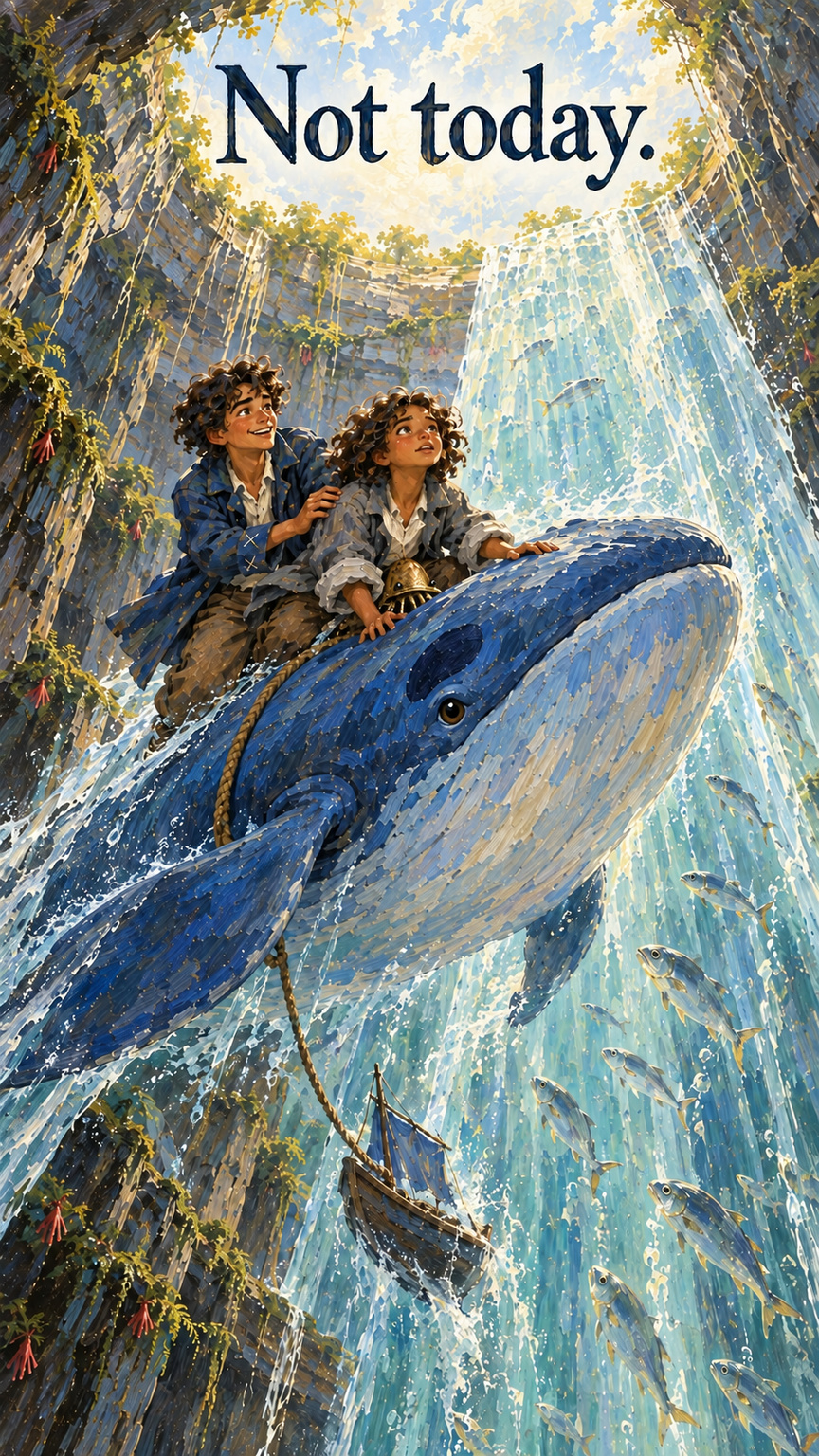
“Not today.”
The rain kept falling. The calf stopped becoming it.
Blue skin grew firm under her palm. The eye cleared. A flipper struck the hull with the force of a dropped house.
The wooden arm above the net cracked.
The draining mesh tore away from the calf's belly and streamed loose beneath it. Its next breath shook the deck.
For a dazzling second Cirel was standing on a whale, going up. Netting streamed around her. Sailors tumbled into the safety webs beneath the deck. A broken spar swung toward Pellin.
The calf twisted. It took the spar across its broad back and knocked it away from him.
Then its heave tipped Cirel into a web too.
She lay among three furious sailors, laughing so hard she couldn't apologize. Nothing hurt. The whale was blue and whole. She had done it. Gran had been right about this, which meant the prince might also be true.
Above her, the calf skimmed past the bell-frame. The wind-bell's carrying strap had come loose in the wreckage. A bronze glint vanished behind the calf's head.
When it banked away, the bell was clinging to its back.
“Wait!” Cirel shouted.
She thought of the bell reaching the bank of cloud ahead.
“Not today!”
The calf went on.
“Not today.”
It grew smaller against the clouds.
The answering bells had already begun to sound uncertain. One ship turned after the calf. Another followed a wrong note into mist. Their neat formation loosened into scattered sails.
Cirel clambered out of the web. She stood staring, her mouth still shaped around the words.
Once between one dawn and the next.
She had known that part. She had simply never imagined being finished so soon.
The captain came down with a torn sleeve and a sailor's blood on her hands. The sailor himself was beside her, holding a cloth to his nose.
“You were to stay behind the line.”
“It was coming apart.”
“I saw.”
“I stopped it.”
“And reached into a working net.”
Pellin arrived, pale beneath his brown skin. “She stopped the spar hitting me.”
“I'm glad of it,” the captain said. She looked at Cirel. “Your trial is over. You'll go home when we return.”
There was no shouting. Cirel had prepared herself to shout back, and now she couldn't find anywhere to put it.
“But I could—”
The captain was already calling for a lookout. Without their bell they would have to find the fleet by sight.
That evening Pellin brought Cirel supper. She had folded her too-long sleeves over her hands.
“I thought she'd let me stay,” she said. “After.”
“So did I.”
He sat on the deck beside her. She wanted him to say something unfair so that she could be angry with him instead.
“Orro,” she said at last.
“What?”
“That's what it called itself.”
“You don't know that.”
“You don't know it didn't.”
He gave her his apple.
By morning, she had worked out how to put everything right.
Pellin caught her untying the skiff.
“No,” he said.
“I'm only going to get the bell.”
“That is a very large only.”
“Orro went toward the hollow reef. We saw it. If I bring the bell back—”
“You can't steal a skiff to apologize for causing trouble on a ship.”
The last knot came loose under her fingers.
He jumped in before they drifted out of reach, landed on her foot, and seized the tiller.
“Ow.”
“Good.”
She let him turn the bow. She had been a little worried about finding the right reef.
The hollow one had a waterfall through its middle. They followed the falling water upward to a mouth in the stone, where fernlike growths brushed the skiff's sail. Inside, daylight fell in one white shaft. The waterfall struck a pool and went on down through the reef's lower opening, trailing its long silver tail into empty sky.
Orro floated beside the pool, almost touching it. Its skin had darkened to blue velvet. The thumbprint above its eye was no longer running.
The wind-bell was asleep in the hollow behind its breathing-hole.
“See?” Cirel whispered. “We can get it without even waking him.”
She made the three-note call the captain used.
The bell woke. Its wings blurred, and it flew to her outstretched hand. It had warm little feet. She rubbed a finger along its rim, and it hummed against her skin.
Pellin brought the skiff alongside the pool. Cirel took the carrying tether from her pocket.
The bell caught it in two feet.
“Helpful,” she murmured.
It tugged the tether out of her fingers, carried it over the water, and dropped it.
They watched the strap sink.
Then the bell flew back to Orro.
“Oh,” Cirel said.
She called again. The bell looked at her from the whale's back. One wing lifted. It made a pleasant little note, but did not come.
Orro hadn't stolen it.
She had brought the captain's call and the carrying strap and a pocketful of crumbs. She had known exactly what would happen. The bell would sit in its frame, the ships would find one another, the captain would reconsider.
The bell picked a shred of net from Orro's skin and threw it into the pool after the strap.
Cirel put the crumbs down on the edge of the skiff.
“It likes us,” she said.
Pellin was quiet for a moment.
“Yes.”
“It still won't come.”
“I saw.”
A shadow crossed the reef's mouth.
Outside, a hunter's boat turned broadside. A silver net opened behind it, covering the lower exit. Someone on the boat recognized Pellin's blue coat and waved for them to come out.
Cirel looked at the bell. It had flattened its wings along its body.
“We can't take them out that way,” she said.
Pellin glanced at the hunter, then at her. “Up, then.”
He let more breath into the sail. The skiff rose toward the shaft, its bow dripping.
Wind struck it from above. The sail collapsed against the mast, and they fell a boat-length before Pellin caught the turn. Overhead the sheer walls ran up into spray. There were roots to cling to, if they could reach them, and nothing wide enough to land on.
Orro tried next. It beat its flippers into the downward rush, climbed a few yards, and was driven back against the pool.
The hunter's boat edged closer. Its crew began hauling the net into the reef.
Cirel could stop the net coming in. Then they would all be here until dawn, and the hunters would have time to bring another boat. She could picture that clearly enough now.
She looked up the white shaft. So much water, all moving the wrong way.
“Can you swim?” she asked Orro.
Pellin stared at her.
“It's a whale.”
“It flies. I thought I'd ask.”
Orro dipped its nose into the pool. The bell clambered higher on its back.
Cirel thought of the waterfall falling.
“Not today.”
The roar stopped.
Her ears rang in the enormous quiet. Above them hung a column of clear water, wrinkled where it had been tumbling. Silver fish slid through it. One opened and closed its mouth beside Cirel's face.
She touched the column. Her finger went in. Water curled around it and stayed.
Orro pushed its nose into the still water.
“On,” Pellin said. “Quick.”
He threw the skiff's mooring rope around the shallow notch behind Orro's flipper. Cirel climbed onto the calf's back, Pellin behind her, and the bell tucked itself between their knees.
Orro swam upward.
Water rushed cool over Cirel's boots. She leaned out to keep her face in the air, clinging to the ridge above the breathing-hole. Behind them the empty skiff climbed bow-first, scattering a string of bubbles. Through the column she could see Pellin's face distorted into something long and solemn.
“Your nose,” she gasped.
“Don't.”
He was laughing too.
They climbed past blind white roots and fish with lamps in their tails. Little creatures like red gloves clung to the rock and waved each finger as they passed. Near the top, the sun shone through Orro's flippers, laying blue shadows across their sleeves. Pellin caught her hand as the calf shouldered through the last lip of rock.
They broke out into a bowl of sunlight on the reef's crown.
Orro hauled the skiff free. Water poured out of it in sheets. Pellin lay on his back in the wet grass with his boots higher than his head, laughing in a way she hadn't heard since he left home for his apprenticeship.
Cirel wanted to leave the waterfall hanging forever.
Then she saw the sails.
The normal spray had wrapped the hollow reef in mist. Now the shaft shone clean through it, a glass finger pointing into the sky. Their own ship was turning toward the impossible brightness. Beyond it, two more sails emerged from cloud. A skiff left their ship's side and turned toward the crown.
Cirel felt the words rise behind her teeth. She wanted the ships to stop coming. Then she shut her mouth. She had spent today's refusal on the waterfall.
Pellin followed her gaze. He got up without laughing.
“Help me with the sail.”
They dragged the skiff to the edge. Its canvas hung sodden from the mast. Orro nosed it, snorted, and blew a long warm breath into the cloth.
The sail lifted. The skiff tugged forward.
Pellin's hand had gone toward the collecting flask. He left it closed.
“Well,” he said to the calf. “Thank you.”
They sailed, and Orro went with them.
That night they hid beneath a shelf of flowering stone. Cirel slept in the skiff's bow while Pellin kept watch. Once she woke to find the bell walking over her forehead, inspecting her curls for crumbs.
The stars were thick beyond the reef. Somewhere in the dark Orro was calling and waiting for an answer.
“Do you think she'll ever let me have the berth?” Cirel whispered.
“I don't know.”
“If we explain about the bell.”
Pellin looked down at her. “Cirel. We stole a skiff.”
“Borrowed.”
“We are still borrowing it quite a long way away.”
She rubbed her face against her sleeve. The captain might listen. Mum would certainly listen, although afterward there would be a terrible amount of talking.
“We'll go back after we find his mother.”
“Yes,” Pellin said. “We will.”
She slept again with that settled.
At dawn, the waterfall fell.
They were far enough away to see the white plume before they heard it. The sound rolled among the reefs like something enormous waking up. Mist spread around the hollow mountain and hid the path they had taken.
Cirel watched until it was an ordinary waterfall again, ordinary except that yesterday she had swum up it on a whale.
Then Orro heard its mother.
The answer came through the skiff's boards. Cirel felt it in her heels. Orro rolled so abruptly that the bell fell off, caught itself with a furious clang, and pursued the calf toward the flowering reef.
Its golden buds had opened into a ring bigger than Larkglass. Beyond it was another sky. Sunset burned at the ring's far edges although morning lay over the ships below. Enormous whales were passing through, their silhouettes full of little swimming lights.
One had waited.
She was pearl-white, with grey freckles scattered across her back. A notch in the edge of her broad flipper could have held the skiff. When Orro called, she turned so quickly that clouds poured from her shoulders.
Cirel had thought the calf was large. Beside its mother it was a plum beside a bun.
Orro pressed against her mouth. The mother nudged it over, examined its blue flank, and made a deep, indignant noise at the remnants of net still caught around its tail.
Three other calves circled beyond the passage, beside a dark whale. Each time Orro's mother called, they answered and turned back toward her.
“She's going to tell him off,” Cirel said.
Pellin smiled, then looked toward the hunters.
The fleet had gathered under the ring. Nets swung between ships. The great harpoon-ship was coming up from below, its iron gun still pointed away from the whales.
“We've got to go,” he said.
A weighted line flew from a nearer boat.
It caught Orro across a flipper. The mother turned between the calf and the boat, and the line lashed around the ridge beneath her jaw. Its end broke free of the hunter's reel. The loose length snapped in the wind, but the knot had drawn tight: calf and mother were bound together, Orro's flipper twisted against her skin.
Pellin swore. It was a word Cirel had never heard him say in front of Mum.
“Bring me alongside,” she said.
“I'll cut it. You take the tiller.”
The mother was already entering the passage. Beyond its rim, the far sky deepened to purple. A long gold petal began folding inward.
“You can make the turn faster,” Cirel said. “I can keep it open.”
He looked at her.
“If it closes. I haven't used it today. I'll stop the closing, and you come through and get me.”
She saw him measure the ring, the skiff, the distance to the whale's head. He knew how quickly his boat could turn. He had made her practice it before the fleet sailed.
“Then hold it,” he said. “Don't wait till I'm halfway.”
He gave her his knife.
Cirel climbed from the skiff onto the mother's flipper. It was warm, and less slippery than she expected. The skin had fine ridges; she could get her fingers into them. Orro was trying to pull free, making the loop tighter.
The bell landed on her shoulder and hooked a foot into her collar.
“Stop,” she told Orro. “I am helping. You're being horrible about it.”
The calf rolled an eye toward her. She got her knee under the line and began sawing.
The mother passed through the ring.
For a moment Cirel could see two countries together: the pale morning behind her, Pellin's blue sail, the ships; ahead, a copper dusk filled with slowly moving lights. The whale's body carried her farther into it. The line was thicker than it had looked from the skiff. The knife was sharp, but her hands were shaking.
“Cirel!”
Pellin had brought the skiff around. He was on the homeward side of the passage, facing her, ready to come through.
The petals were closing. He had time to reach her if she held them. Time to scoop her off the whale, shout at her, turn, and sail back to Mum. He did not have time unless she held them.
“Now!” he called.
She looked at the gold edges moving together and thought of their closing.
Behind Pellin, the harpoon-ship rose into view.
The gun swung.
Cirel had seen that iron head on the deck before they sailed. Three men had carried it between them. It was aimed at the soft place behind the mother's flipper.
The mother saw it too. She turned her body across Orro, sheltering the calf. The last rope loop held its flipper against her jaw; she could not roll away without twisting it further.
On the ship, the recovery winch began to turn. Chain lifted from the deck.
If Cirel kept the passage open, Pellin could fetch her. The hunters would have time to draw the mother back through it too. Weeks of filling flasks would follow. The flower would be closed long before they pulled the iron free.
Cirel thought of the grey whale circling the roots of Larkglass. She could see this white one there instead, in the wrong sky for nineteen years. Beyond the passage, the three calves kept calling.
Pellin's sail trembled on the edge of the turn.
“I can hold it,” she called. She needed to tell him that. She could do exactly what she had promised.
Orro heaved against the rope. It was trying to get in front of its mother.
Like the broken spar, Cirel thought. Like Pellin beneath it.
The gun fired.
She wanted the kitchen window with the yellow quilt. She wanted the rest of her trial and a ship with a chartroom and the argument about what to name the first island. Pellin was right there. She could see the silver stitches at his wrist.
The iron head came through the opening.
Cirel thought of it entering the whale.
“Not today.”
The point stopped a hand's breadth from the pearl-white skin.
Behind it, the chain fell in a long, useless curve. The iron head shuddered, straining against the place it could not cross. Cirel heard the ship's winch shriek.
Then her knife went through the last rope fibers.
Orro tore free. The mother rolled it against her flank and surged away from the passage, carrying Cirel with her.
Across the shrinking gold, Pellin stared at the arrested harpoon.
He looked back at Cirel.
She saw him understand. His mouth opened. The skiff began to turn toward her anyway.
Cirel threw up her hand, palm flat: turn back. The signal he had taught her.
“Tell Mum I'm alive!”
She had to shout it twice.
Pellin pulled hard on the tiller. The skiff turned home, its sail nearly brushing the closing petal.
On the harpoon-ship, men were hauling another iron head toward the gun. It was still on their shoulders when the opening narrowed below the width of a boat.
Cirel could see only Pellin's face now. She tried to keep it, the way it was at sixteen. He was crying. She had not expected that, and it made her raise her hand again as though she could reach him.
Gold closed over the last piece of blue sky.
The shriek of the winch stopped with it.
For a moment she stood with the knife held out and waited for something else to happen.
Nothing did.
The mother carried them into the dusk.
Clouds gathered around her flippers. At first Cirel thought she was entering mist. Then the mist took corners. A roof lifted out of it, and another, and a stairway unrolled down the curve of the whale's shoulder.
All around them, the migrating whales were opening their cities.
Houses of folded cloud shook themselves wide. The little lights in the whales' bellies rose into the windows. One lengthened into a woman, yawning and gripping the sill while her feet took shape.
Lanterns rose on stems. Rope bridges drifted between the nearest whales, caught and fastened by people leaning from bright balconies. Children ran along a white terrace above a breathing-hole. When the whale beneath it exhaled, every child jumped, and the breath lifted them laughing into the air.
The bell flew from Cirel's shoulder. Other bells came to meet it. For a while the sky rang with so many notes that she couldn't tell which was its voice.
She sat down where she was.
Orro pushed its nose against her knees. She put a hand on the thumbprint above its eye. The skin was warm. It was alive. Its mother was alive, and around them a whole city was unfolding into places she had never imagined.
She began to cry.
When the bell returned, it tugged her sleeve. She shook her head. It waited, then tugged again more gently.
It led her down the new stairway to a balcony where a woman with white braids was setting out lanterns. The woman saw the knife still in Cirel's hand and held out an empty bowl.
“You can put that down.”
Cirel did. Her fingers hurt when they opened.
“Can the whales go back before the next flowering?” she asked.
The woman's hands paused over the lanterns.
“Did someone stay behind?”
“My brother. Can they?”
“No. They can't make the reef flower.”
“But they might know another way.”
The woman shook her head.
Cirel hated her for a moment. It was unfair, and she knew it was unfair, which didn't help.
The woman brought her water and a blanket. She pointed out a room Cirel could use and left the balcony door open. Nobody asked her to be pleased.
During the night, Orro slept beside the balcony, its eye level with the rail. Whenever Cirel woke, it was there. Sometimes that helped. Sometimes she wanted to push it away, and then she was ashamed and put her forehead against it instead.
At dawn she had another refusal.
The passage had already closed. She could not stop something that had happened yesterday.
She stood wrapped in the blanket while the rising sun lit the country ahead. Forests grew in great rings through the sky, their roots full of nesting stars. A waterfall arched from one drifting island to another without spilling a drop between them. Beyond it, an island with a long, ridiculous promontory was coming slowly out of the morning cloud.
“Pellin,” she began.
The bell shifted on the rail. Orro opened one eye.
Cirel looked at the empty place beside her. Then she pointed out the island to the calf.
“That one,” she said, her voice breaking. “We were going to call that one Pellin's Monumental Nose.”
Orro followed her finger. It looked back at her, plainly waiting for more.
It was a very stupid name. She cried while she tried to explain it.