
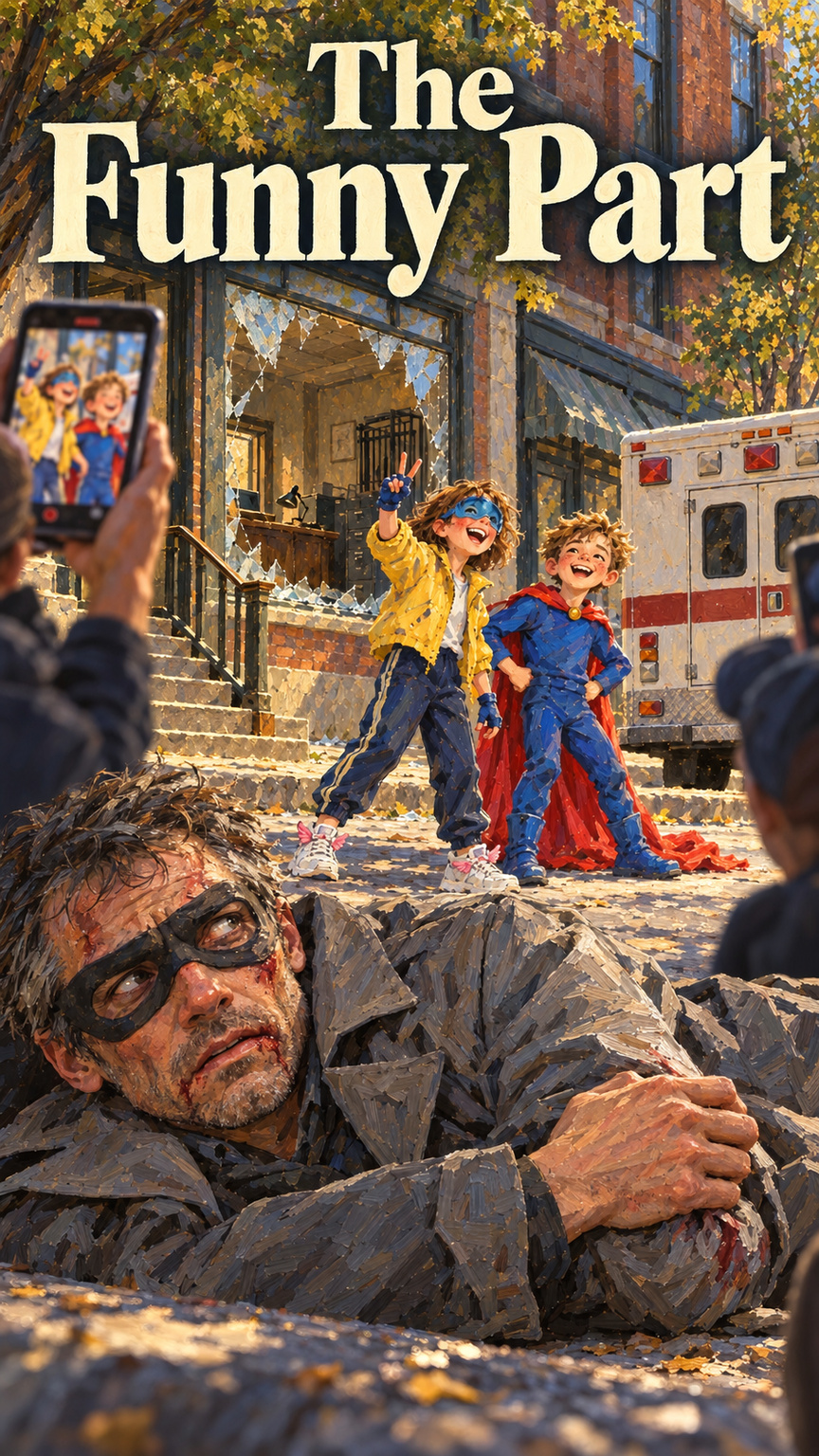
Nellis put the money on my bad hand.
He had to help me turn it over first. The fingers stayed spread, with the last two bent backward at their middle joints. He settled the envelope in the palm as if he were feeding a horse.
“Half now,” he said. “Half when the door's open.”
We sat in the coach station café. Someone had turned the chairs up on every table but ours, and the woman behind the counter was counting her till. The northbound coach was due at one. Nellis had bought a ticket for the midnight service back east. He laid it beside my tea.
“You could get that hand done,” he said. “Jaw, too. I asked.”
I could feel the envelope against the heel of my hand. Higher up, nothing. I moved it onto the table with my right hand and looked inside.
He had asked. That was the surgeon's price.
I picked up the return ticket. The midnight coach would get me there before the clinic opened.
“You heard why I left.”
“I heard you were through with work. Then I heard you were opening lockers at the dog track for twenty a time. I'd have paid you more for telling me you were hungry.”
“That job's in my old town.”
“You're going through the back of a countinghouse. There's no patrol on that road after eleven. Nobody's asking you to fight.”
“I left town because I'm terrified of kid heroes.”
He laughed. A small, surprised laugh, finished almost before he saw my face.
“Len.”
“They have no idea how to hold back. No empathy. They'll beat you to an inch of your life and make a little joke, and everyone laughs like you aren't dying on the pavement.”
Nellis looked toward the woman at the till. I had been louder than I meant to be. Since the injury I couldn't always tell what a word was going to do until it came out.
“I saw the clip,” he said.
“Did you.”
“A while ago.”
“How long was it?”
He didn't know.
“Twenty-three seconds,” I said. “I've watched it, too.”
I put the return ticket down between us. It was less than a thumb's length from my good hand.
Hob and I went into the payroll office just before lunch.
He wore his red shell, the one that made him look like a walking safe. It wasn't powered. Hob had shoulders enough to carry it, and he'd rather pay for a plate of steel than trust somebody who said their expensive fabric stopped bullets. He was forty-six and had been shot in expensive fabric twice.
I wore a half mask, a gray coat, and a belt with too many things on it. People knew the belt. A picture of it had appeared in a Sunday supplement under the headline TEN THINGS LATCH CAN OPEN.
They'd included a woman's bra. I'd never done that. They hadn't included the door of the flat we'd emptied while its tenant was at her mother's funeral. I had done that.
The payroll clerk was a woman with a pale strip on her finger where she'd taken off a ring. Hob blocked the stairs. I showed her the pistol without pointing it at her and told her she would be all right if she sat very still.
She sat very still.
People sometimes hear that part and want to know whether the pistol was loaded. It was. She couldn't have known either way, but it was.
I opened the cash cage. Metal fastenings release when I touch them and want them open. That's the whole trick. Skin to metal, one catch at a time. I can't make a lock fly across a room or turn a gun into flowers. When something has been welded shut, I need a saw like anybody else.
I was kneeling at the second drawer when a small girl appeared on the clerk's desk.
There was no sound of her coming in. One moment the desk held a stapler, a lamp, and a cup of pens. The next it held those things and a pair of white trainers with pink wings attached to the laces.
“Oh, gross,” she said. “Old villains.”
She was twelve. There were posters about her birthday all over town; the cake had been as tall as she was. Skip. She wore a blue visor, a yellow jacket, and little blue gloves with the fingertips cut off. One thumbnail had chipped green polish.
“Hob,” I said. “We're done.”
He stepped away from the stairs. He'd seen who was outside.
Wallop came up slowly, because he couldn't skip between places and hadn't worked out what to do with the last six inches of his cape. He trod on it at the top step. The clasp pulled against his throat and he made an irritated little cough.
Eleven years old. Red cape, blue suit, freckles. His right front tooth was growing over the left one.
I'd seen him stop a runaway tram with both hands.
“Hands where we can see them,” Skip said.
I touched the buckle on my belt. The whole thing dropped: pistol, tool roll, smoke tins, bag. I put my empty hands up.
“Giving up,” I said. “Both of us.”
Wallop saw the tins roll and shouted, “Gadget!”
Hob got one hand out. It was an old habit. You don't hit a customer who panics; you stop him reaching into his coat and explain the arrangement again. Hob meant to hold the boy away from him.
Wallop punched him through the window.
The window was behind the clerk's desk. Hob went over her head with part of the frame around him. She ducked so hard she struck her mouth on the desk edge. The boy laughed once, in surprise at the noise he'd made.
I remember the clerk looking up. Blood was on her lower lip. She was looking at me, because I was the person who had promised she would be all right.
Then Skip was behind me.
She took my left wrist and disappeared with it.
There was no interval in which to be carried. We were in the office; we were outside; my boots were on the pavement and her hand was somewhere above and behind my head. The arm had to join those positions. Something tore inside my shoulder.
I made a sound I'd never heard myself make before.
“Got him!” she called.
Hob lay by the curb. His shell had dented across the chest. He was trying to undo its side catch with his right hand, but the left half of the casing had folded over it.
Wallop jumped down from the broken window. He landed with both feet on Hob.
The sound was mostly metal. I was thankful for that until I saw what came through the split beneath Hob's arm.
Skip let go of my wrist. I fell forward, and Wallop caught me under the chin with his fist.
It didn't feel like being punched. The bottom of my face went away. My teeth struck each other and some came loose; there was a hot, loose weight inside my mouth that I couldn't put back where it belonged. When I tried to take a breath, blood went down instead of air.
I landed on my left knee. The kneecap broke against the curb.
After that I stayed down.
People were coming out of the shops. Someone held the payroll clerk at the office door and wrapped a jacket around her. She was shaking. There was a little boy in the crowd wearing a red cape like Wallop's, except his was made of the slippery stuff flags are made from.
“He surrendered,” I tried to say.
I meant Hob. I also meant me. The words wouldn't separate.
Skip crouched beside me. She didn't seem angry. Sweat had made a pale line through the dust on her forehead, and she was breathing hard. She looked pleased in the tired, attentive way you look when you have done something difficult and are waiting to be told how it went.
I pointed at my mouth.
“He's trying something,” she said.
Wallop put his boot on my left forearm.
I stopped pointing.
“See?” he said.
Hob was making a thin noise. I couldn't see his face through the opening in his shell. It was angled toward the road, and the front plate had gone down far enough to hold his chin there. His right hand kept finding the folded edge, then slipping.
I tried to say ambulance.
Wallop bent to hear me.
“What?”
I tried again. There was a tooth under my tongue. It moved when I breathed. I pushed it forward with my tongue, hoping that would help, and spat it onto his boot.
“Ew!”
He jerked his foot sideways.
The bone in my forearm came through the skin. I saw a white end turn against the gray pavement, saw grit adhere to the wet red around it. The sleeve was tight above the break and empty below it. My fingers lay a little way off, attached to me in a manner I couldn't understand.
I screamed with my mouth full. That brought more people to the shop doors.
Skip said, “Wallop. Watch.”
She took my left hand. She lifted it by the fingers, turning the wrist so the palm faced out. The rest of the arm followed in separate movements.
“Guess Latch could use a hand!”
They laughed.
Not every person made the same sound. There was a woman's sharp laugh near my head, and a man who repeated a hand to somebody beside him. Somebody clapped. Wallop doubled over, delighted. He had blood on his boot, and he rubbed it against the back of his other leg while he laughed.
I had stopped making noise. That happens. It doesn't mean anything has improved.
Skip dropped my hand.
She let it fall the full distance.
Nellis pushed his tea away.
“I didn't know about the arm,” he said.
“It's in the clip.”
“You can't see it properly.”
“No.”
The woman behind the counter came over with the key to the café shutter. She looked at the envelope and then at me.
“Five minutes,” she said.
Nellis nodded. He pulled the envelope a little farther from the edge of the table, away from a ring of spilled tea.
“They ought to have stopped,” he said.
I waited for him to finish.
“Once you were down.”
“Yes.”
It was an ordinary thing to say. I found I had nothing to add to it.
I told him about the ambulance and the man with the phone.
An ambulance came up the street. I heard it before I saw it, and for a few moments the sound took the place of pain. There was something coming that knew what bodies were.
It stopped in the road with its rear step level with Hob. Through the low gap beneath the step I could see sunlit road on the far side, and a black shoe with a strip of yellow at the heel.
A medic came around the back carrying a bag.
“Stay there,” Skip told her.
“I need to get to them.”
“We're not finished.”
The medic took another step. Skip was suddenly in front of her, so close their faces nearly touched. The woman drew back.
“Just stay out of the shot,” Skip said. “One second.”
She was gone again. The medic stood with the bag at her knee. Then she backed around the ambulance. I watched the yellow strip on her shoe move through the light underneath it.
I wanted to hate her. I also wanted very badly to be where she was.
A man in the crowd held up his phone and backed toward the payroll office. Several people crowded onto the steps behind him. Others stood beside us with their phones raised toward the children's faces.
“Do it again,” he called. “I missed the start.”
Skip turned toward him. Wallop adjusted his cape. They were talking about where to stand. The medic started around the ambulance again. Wallop held an arm across her path without looking away from the phone. She backed out of sight.
Hob's good hand scraped the pavement and touched my coat.
I knew what he wanted. There was nothing else he could want from me.
I rolled onto my right side. Pieces moved in my mouth. The pavement tilted and came level again, and Hob's fingers were still on my coat. I reached under the curled metal at his flank.
The side catch had a brass pin. I'd fitted it myself. He'd asked for two, in case one broke. I'd told him two would make it harder to get him out in a hurry.
I couldn't reach it.
I pulled myself closer with my right elbow. My left arm dragged. I had to stop then, with my forehead on the pavement and my mouth hanging open so I could breathe around what was in it.
“Ready?” the man with the phone asked.
Hob moved his hand from my coat to the road. He pushed. The shell lifted perhaps as much as the thickness of a coin. I got my right forefinger underneath and found the pin.
The fastening opened.
One side of the shell dropped flat with a clang.
Wallop's blue boot turned toward us.
I stayed where I was. Blood filled the low side of my mouth and slipped toward my throat. I needed to spit. I couldn't make myself do it with the boot facing me.
“Keep looking this way,” the man said.
Wallop turned back.
Hob came out of the shell a piece at a time. His left arm stayed against his stomach. He used his right hand and his knees, creeping toward the dark beneath the ambulance. One of his boots caught in the lining. He left it there.
Someone at the edge of the crowd stepped aside to let Hob's foot pass. Their phone stayed pointed at the children. There was room enough for him below the rear step. I saw his stockinged foot scrape over the road and vanish.
Then it was only me.
I got my right hand under the edge of my coat and held my broken arm against my chest. That left me my right elbow and one useful foot. I pushed with them. The first time I moved almost nowhere. The second time my face went down onto the road and I had to lift it again.
Above me, Skip was explaining that she needed her friend to stop giggling or she would laugh, too.
The ambulance's rear step touched the top of my head. I pushed until I was under it.
There was a bar above me and a thick pipe beside my cheek. It was hot. Beyond them the light on the far side looked no nearer. The shoe with the yellow stripe was gone.
I remember deciding that I had been wrong about the ambulance. A vehicle wasn't a place. It could leave. It could roll over me. The woman might have gone to the front to drive away and I had put myself underneath it.
I let go of my arm and reached for the light.
That is the last part I know.
The medic told me later that she saw my hand come out and got down on the road. Hob was already on the far side. She and her partner pulled me through.
I asked her whether the children had tried to stop them.
“They were doing photographs,” she said.
That was all she said about it.
They put a tube in my throat at the hospital. When I woke, my left arm was in a cage of rods, my knee was held straight, and there was a pad beneath my jaw that a nurse changed whenever it soaked through. She told me not to try to talk. For once I was able to follow an instruction without hurting myself.
Hob lost his left arm below the elbow. He visited when they let him out of his ward, with a guard behind him and a blanket folded over the place where his hand should have been. He had brought a packet of cards. We hadn't thought about how to shuffle them.
We sat there for a while with the packet between us.
At the hearing, the payroll clerk had a small scar on her lip. She described what I'd said and how she'd believed I would shoot her. I hadn't remembered saying I'd shoot her, but I believed her. There was plenty of that morning I couldn't get back.
The court sent me to prison. When the sentence was done, I took a coach west. Hob still had a year to do. I wrote to him from the coach station because I didn't have an address yet.
The clip was nearly two years old by then.
You have probably seen it. The version that went everywhere starts with me screaming, just after Wallop turns his foot. Then the camera finds Skip. She lifts my hand. You can see my face at the bottom of the frame, but only if you look there instead of at her. She says the line. Wallop laughs so hard his cape slips off one shoulder.
The little boy in the matching cape jumps up and down. His father has to pull him back from the curb.
That's the end.
Someone sent Hob a birthday card with the joke on it. He gave it to his lawyer. I don't know what the lawyer did with it.
The woman at the café turned off half the lights.
Nellis looked at my arm. He had known me before I needed a brace to walk. We'd once run together across a warehouse roof carrying twenty thousand in bearer notes and a bag of oranges because I hadn't eaten that day. He'd complained about the oranges for a year.
“Wallop's thirteen now,” he said. “They'll be training him properly.”
I waited.
“It wouldn't be the same.”
The envelope was still there. In the hospital a surgeon had shown me the joint he wanted to put in my hand. Three small pieces on a blue cloth. He'd let me pick one up. I had been surprised how light it was, how little material it took to represent the possibility of closing my fingers.
I looked at the return ticket.
Nellis leaned forward.
“Listen. What you said about them turning around. That's useful.”
I looked at him then.
“They want an audience. We give them one. They're on one side of town, we go in on the other. Nothing fancy. You're in and out.”
He was talking faster. He'd found the part he understood.
“You wouldn't even have to see them. And after this you get the operations and you're finished. You can go wherever you want.”
I put my right hand on the table and stood. The brace caught against the chair leg. I had to sit again and pull the chair out farther.
Nellis kept still. He was being considerate. I did it the second time.
“Len,” he said.
I got my stick under my right hand. The envelope lay beside the ticket, both perfectly dry.
Outside the café the departures board made a clicking sound. I had enough to go north to the end of the line. I knew the name of the place there. That was all I knew about it.
At the ticket window I rested my dead hand on the counter and used it to hold my coins while I counted them out. The clerk slid them away without touching my fingers.
“Single?”
“Single.”
The coach was waiting at bay four. I had to take the steps sideways. My brace wouldn't bend enough otherwise.
The driver watched me in his mirror. I could hear the engine, and a woman near the back closing the catches on a bag. I was slow. I knew I was slow.
He waited until I was sitting down.