
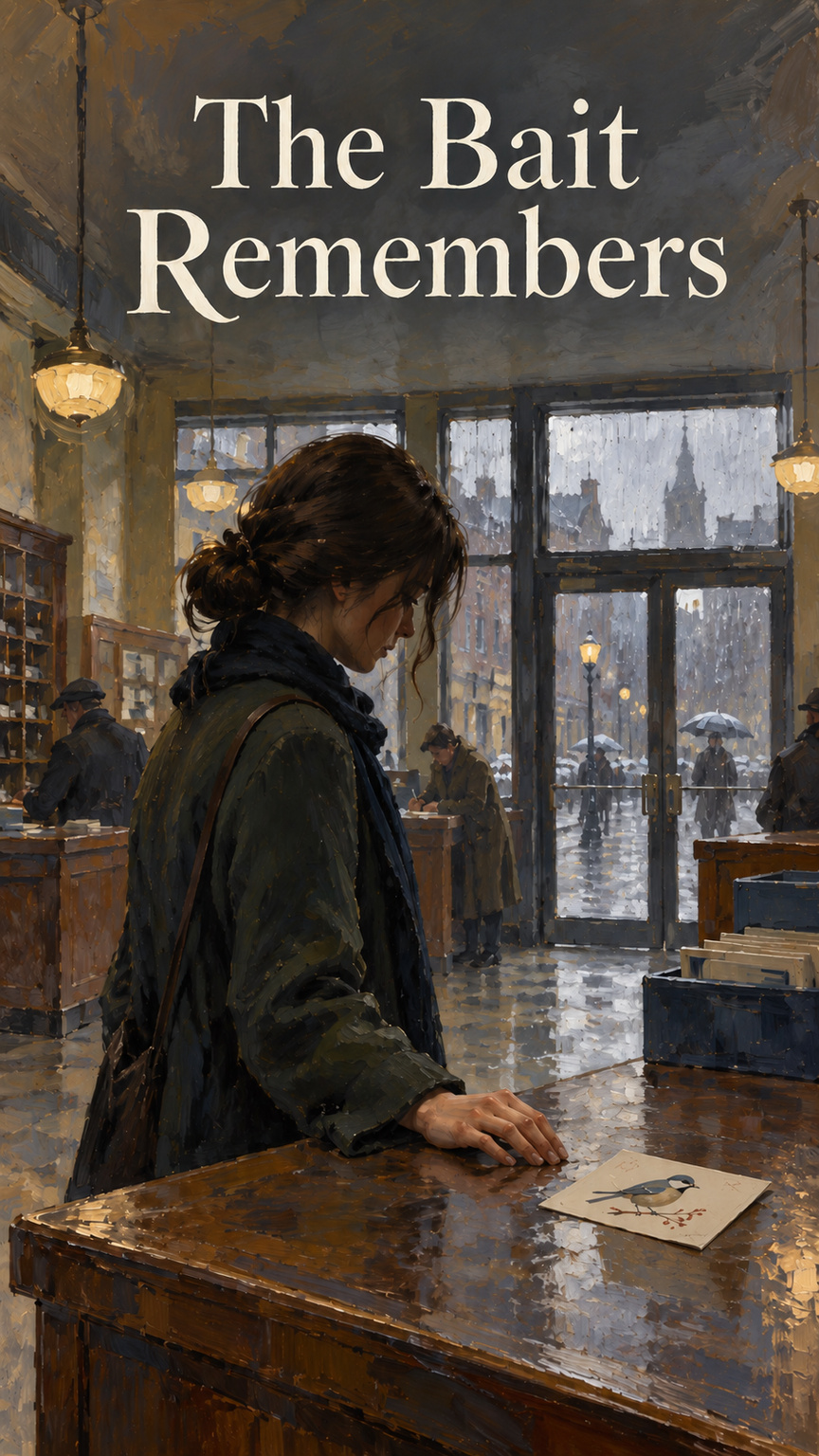
I had three coins, an unstamped birthday card, and an assignment to stand in a post office until someone looked inside my head.
The card was for my sister. Innes did not know about it. He had searched my coat before we left, but the card fit behind the tongue of my shoe. In the post office I bent to retie the lace and moved it to my sleeve. I had written the address from memory. Orla might not live above the bakery anymore. For three years I had been permitted to know almost nothing about her, and it seemed better to risk a returned card than to let another birthday pass without one.
Innes stood three places behind me in the queue. His coat was damp at the shoulders. People trying to keep their parcels dry had crowded toward the counter. Across the open floor, the writing desks stood between us and the street door. He had chosen the hour because the queue would hold me still and give him a view of everyone else.
“Blue forms,” he said when my gaze drifted toward my sleeve. “Keep your eyes on the blue forms.”
He meant the stack on the counter, an ordinary place to rest my gaze. I looked at them. A man ahead of me was arguing about the cost of sending a parcel to his son. The clerk took his complaint seriously enough to weigh the box a second time. Beside the writing desks, a little girl in a raincoat drew a circle around each stamp on a sheet while her father addressed envelopes.
Across the floor, the street door shut hard. For an instant I smelled the old room.
Not the post office's wet wool and ink, but wallpaper warmed too long by a bulb with no shade. I knew where the memory would go. The narrow bed. The line of light under the door. Then the scrape of a key in the lock.
My thumbnail found the center of my palm. Four-one-six, I thought. Four-one-six. The wallpaper went away. I could see the clerk's blue forms again, and Innes nodded almost imperceptibly.
He had taught me the thumb-and-number drill in a room very different from this one. The key's scrape was the cut. Thumb into palm, number in the mind, as soon as it came. At first I had refused because I thought he was trying to make me forget. He wasn't. He needed me to remember exactly as far as the key, over and over, and never go through the door.
Before I knew him, the memory sometimes ran on. The door opened. There was the corridor, the morning street, and the bus I rode without a ticket because I could not make my hands find my money. Then I came back to whatever room I was actually in. Going all the way through had never made it easier. I had learned to fear the end of it as much as the beginning.
Now the route out belonged to Innes. If somebody reading me followed the memory, my jump to the number at the scrape left them at the locked door. With no later moment of mine to follow, they heard the key scrape again. Their body stood unanswering while Innes looked for it.
I had watched him take two. The first was a man who had been picking names out of a doctor's waiting room. The second was a woman who said afterward that she had only wanted to know why I was frightened. I had not seen what was done with either of them. The woman had looked at me as Innes led her away, confused by the fact that I was walking while she could hardly stand.
“Next,” called the clerk. The man with the parcel lifted it off the scale. There were two people between me and the counter.
Orla used to put cards on the mantel weeks before her birthday. She liked seeing her name written in other people's hands. I had taken a plain postcard with a small printed bird on the front. On the back, I had managed: Happy birthday. I am alive. Love, Ada. I had tried longer versions, but each one began to sound like an account I was giving Innes. I hoped the coins would buy a stamp.
Someone behind the writing desks made a small, angry sound. A woman holding a padded envelope had turned toward a man in a gray scarf.
“I wasn't talking to you,” she said.
“I'm sorry.” He backed away from her at once. Nothing distinguished him from the other customers. He was younger than Innes, older than me, perhaps thirty, with rain darkening the ends of his scarf. “I thought someone needed help.”
The woman gripped her envelope under her arm. “Ask them, then.”
He looked across the queue. I felt something brush the outside of a thought, so slight that I might have mistaken it for dread if I had not spent three years learning the difference.
The plea he had heard was mine. It had escaped while I was remembering the old room. I had not formed the words on purpose; they came out of the same place as the smell of wallpaper. Please don't leave me there. Innes counted on a thought like that carrying. A psychic might hear it without choosing to. Finding its owner among strangers required another choice.
The man in the scarf looked at the father by the stamp sheets, then at the woman with the envelope again. He was searching. She moved away from him, and he let her go, but his eyes kept moving down the line.
I could have raised my hand. I could have told him aloud that I was the person in trouble. Innes would have heard. Perhaps the man would have stopped looking inside other people. Perhaps he would have looked into me more closely. I had been placed in this room to make those possibilities hard to tell apart.
I took the card from my sleeve instead. I meant to keep it from bending. The man glanced at the movement.
For a moment the birthday message was no longer mine alone. I felt him see the little bird, Orla's name and address, the three short sentences that I had protected with my shoe and sleeve. I held the card against my chest. The contact went deeper anyway.
“No,” I said.
I was in the old room. The bulb made a yellow patch high on the wall. There were nine flowers on the wallpaper to the left of the bed if I counted the torn one. I had counted them for days because there was so little else to do.
From somewhere that was both inside and outside me, the man said, I'm sorry. I can leave.
He meant to. The key was scraping in the lock, and he was still with me.
My thumbnail went into my palm. Four-one-six. The bulb vanished. I was under the post office lamps again, holding the card so hard that the bird had folded in two.
Someone said, “Is she all right?” Another person answered that I was next in line. Innes came closer; I knew his shoes on tile. He had to find the reader among the people waiting and writing and weighing parcels. His gaze stopped on the man in the scarf, standing at a desk with his pen poised above an envelope. He might have been trying to remember an address. Innes watched for a beat, then left the queue and started across the floor.
I can't get out, he said from the old room. The key scraped in his voice.
It was an astonishing thing for him to ask of me. He had entered without permission, seen Orla's name and address, and touched the memory I had spent years trying to survive. His apology could not put those things back. Yet Innes was crossing the floor, and the man could not even lift his pen.
I could still feel the key at the edge of my attention. I let it pull me back. I was in the wallpaper room again, with the man close behind me and the key scraping for the second time. My thumb moved toward my palm. I held my hand open around the folded card.
Don't leave me here, he said.
The plea had been mine before it was his. I wanted to go. I could have done the drill again, but it would leave him at the same locked door, and Innes would reach the writing desk. My hand stayed open. In the post office, the card slipped against my wrist; Innes could see I was not doing what he had taught me.
The key turned.
I had spent years stopping the memory before that small, ordinary sound became anything else. Now the door swung toward me. No new truth waited behind it. The woman who had kept me there was in the corridor, holding my shoes by their laces. She told me I could go. She had said those words exactly that way then, as though she were letting me out of a shop after closing.
I remembered reaching for the shoes and flinching when she let them drop. I remembered the cold floor through my socks. The man in the scarf stayed close enough in my mind that I felt him stagger with each of those steps. I wanted to tell him to keep up, but speech belonged to the room and the woman might have heard me.
At the outer door there had been daylight, thin and gray. I had stood on the step for so long that the woman shut the door against my back. The pavement was wet. A bus came and I climbed aboard, because it stopped and opened its door, and for once a door opening meant I could leave.
In the post office, the blue forms swam into focus. The card had folded across the bird. I was breathing through my mouth. The clerk was handing change to the last person ahead of me. I could hear the stamp sheet rustle where the little girl was touching it.
The man in the gray scarf was at the writing desk, one hand braced on its edge. He met my eyes. He understood that I had left him there for a little while, and that I had come back for him. Both were true. Innes was halfway across the floor, threading between customers.
Innes saw me looking. His gaze went to the writing desks, then back to my open hand. I had stopped the drill. He knew it.
The man took a step away from the desk, still near the street door.
“Don't,” I called across the open floor. My voice worked this time. “Go.”
“You asked for help,” he called back. The father looked up.
“I didn't ask you to read her.” I nodded toward the woman with the envelope. She was watching him, her parcel still tight against her side. “Or me.”
He looked at her, and for a second I thought he would go over and apologize again. Then he turned toward the street door. Innes moved past the father. The counter was free. I went to it and put the card down, the bird showing. My hand was shaking enough that the three coins fell out separately.
“One stamp,” I said. Innes turned and crossed back toward me. The clerk, a woman with a gray pencil tucked above one ear, looked from me to the coins. Across the floor, the man in the scarf reached the street door. He had to hold its frame for a moment before he could walk properly, but he went.
Innes closed his hand around my wrist and put his other hand over the card before the clerk could take it. He smiled at her. “She isn't well. I'll look after that.”
The clerk left the stamp tray where it was. “Does she want to send it?” she asked me.
I could have told her what I was. She might not have believed it. Innes might have moved us outside before I finished. What I needed from her was smaller and within her power.
“Yes,” I said.
For the first time since we entered, Innes had to look like a man taking a birthday card away from another adult in front of witnesses. He let go of my wrist, then lifted his hand from the card. The clerk counted my coins and turned the card over to read the address. She smoothed the bent corner with her thumb and pressed a stamp beside Orla's name.
“Collection at five,” she said. She put it through the slot behind her.
Innes watched where it fell. He might know someone who could find it in the sack. He would certainly decide what to do with me. My legs were weak, and the old room had not gone far; the street door shutting again could still send me toward it. I kept my hands open on the counter until I was ready to move.
The clerk gave me my receipt for the stamp. It recorded the price and the time of day. I folded it carefully and put it in my pocket.