
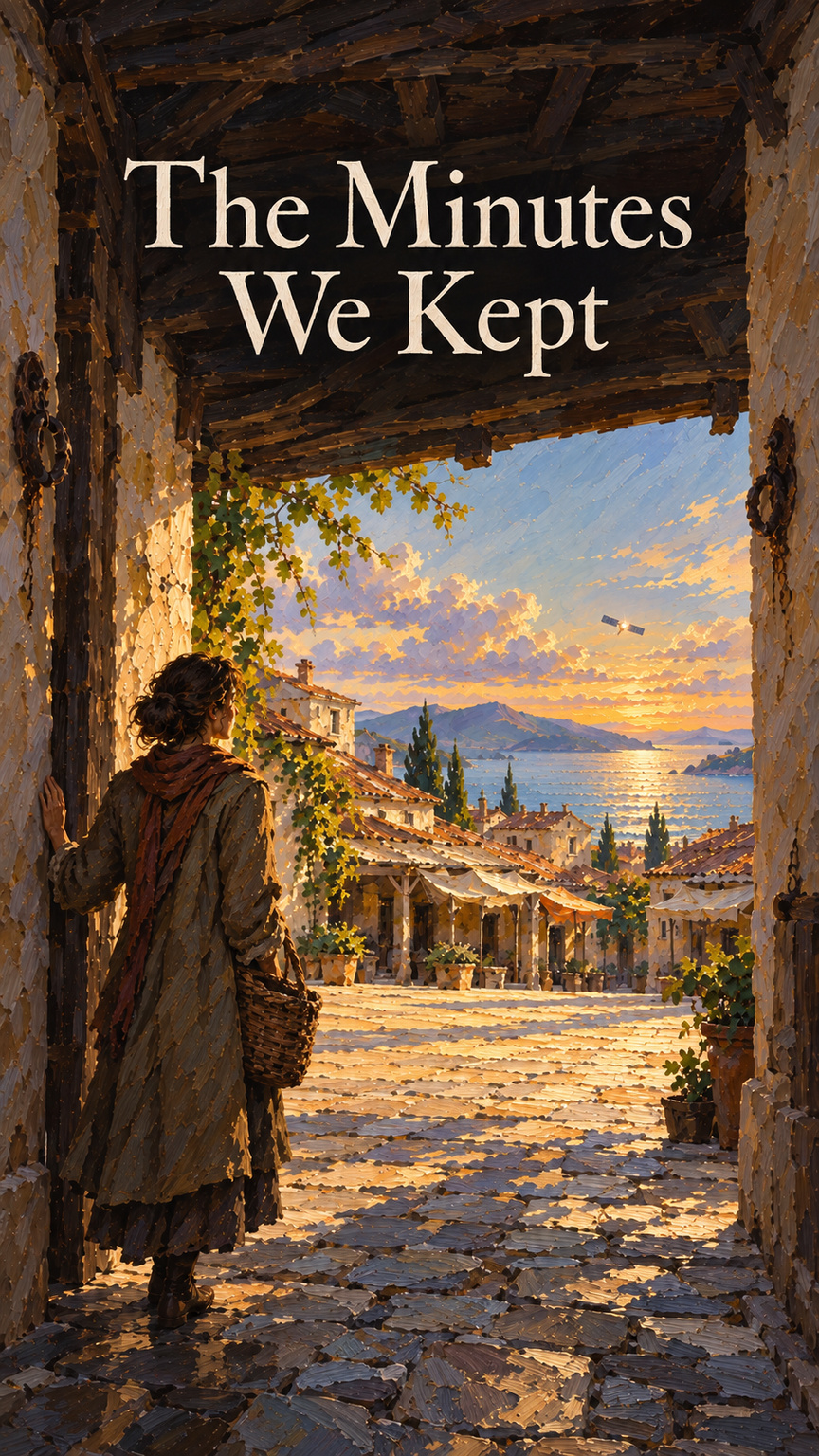
At fourteen minutes past five, Maren put her hand on the door to the square.
Sera had been watching the minute hand on the clock above the covered market. Yesterday, at that hour, she had gone out under a blue sky with a basket of bread. She had returned with an empty basket, and three people had touched the hem of her coat.
They called the ancient satellite the Eyes of God. By Sera's count, it was still above the sea.
“Wait,” Sera said.
Maren, Sera's wife, looked back. In her other hand she held the message brought from the far side, a square of paper creased until it would fit beneath her thumb. Come before dark. I want to see you. Her father had written it himself. The letters slanted left because the Eye had taken his right hand seven years ago. Evening light had already turned the opposite arcade copper.
“He asked for me,” she said.
“I'll go. I'll tell him you're coming.”
“He asked for me.”
There was no answer to that. Between the two covered streets lay forty paces of open stone. A canvas roof had once crossed it; the beam that killed two carriers and took Maren's father's hand had left the canvas rings melted into the walls. Nobody had put up another. From either side, the square looked short enough to cross while holding a breath.
Maren pulled the door inward. Sera put her palm against it. The effort was so slight that Maren could have pushed past her.
“Not until five eighteen,” Sera said.
Maren's fingers tightened around the note. “You were out at this hour yesterday.”
Sera had counted on her not noticing. People watched her in the square and called her faithful or vain, depending on what they believed God wanted. She had grown used to their eyes. She had not expected Maren, who shared her table and knew when she came home with aching feet, to watch the clock too.
“Yesterday,” Sera said, “it had gone.”
Maren's gaze lifted toward the gap beyond the roofs. You could not see the Eye from here. The town had been built to deny it a straight look into every room: streets roofed in tile and tin, windows facing other windows, children taught to walk beside walls. A person could grow old here without feeling rain on their face. Sera walked the square once or twice a day, and people spoke of it for hours.
“How do you know?” Maren asked.
Sera moved her hand from the door. She had a few minutes to give an answer she had withheld for years.
She took Maren into the disused counting room beside the market. Its outer wall faced the sea. Near the ceiling, a hole no wider than a nail faced the Eye's path. They stood well to one side of it, behind solid stone. Whatever looked through the hole would see only plaster.
Sera had covered the inner wall with small charcoal marks. Each showed where the glint had vanished from the plaster, a little farther along each day. Beside each she had written a date and an hour.
Maren read the nearest three. “Yesterday, five thirteen. The day before, five nine. Before that, five five.”
“When it went under the horizon,” Sera said. “Four minutes later each day this week.”
“You made these?”
Sera nodded. On clear afternoons the Eye caught the sun as it traveled west. Its bright point came through the nail hole and moved across the wall. The first time Sera saw it vanish, she waited an entire hour before she opened the square door. Then she began counting. By the end of that season she could plan a crossing instead of guessing at one, and knew not to trust a cloudy day.
Below the older times she had written today: five seventeen? She set her pocket watch, kept to the market clock, on the sill beneath it. She had intended to come here alone, wait for the light to go, and cross as she always did.
Maren stared at the writing. “You watch it.”
“Yes.”
“You know when it can't see you.”
“Yes.”
The market bell chimed the quarter hour. Maren had defended Sera to her father, who called the crossings an invitation to judgment. She had left his house and come to live with Sera. The truth had grown harder to say each year.
Maren had waited through all of that silence. Her father was waiting now.
“It's an old satellite,” Sera said. “Something people made and left above us. It goes around the world. It has an eye and a weapon. I found a drawing of it in a book that survived in the north cellar, round as a fist with two dark wings. The book couldn't tell me what makes it fire. I could watch where it was.”
Maren looked at her. “You think the book tells you whether there's a God?”
“No.”
“Neither do I.”
On the wall a red pin of light appeared. It passed yesterday's mark and kept moving. Sera felt her body answer before her mind did: shoulders drawing in, breath shortened. The Eye had passed over this room hundreds of times. Stone still held. Fear did not become smaller through repetition.
“At sixteen, it will reach that black fleck,” Sera said, pointing farther along the wall. “At seventeen, the light will be gone. Watch.”
“If you could show me this, why didn't you?”
Sera wanted to say she had been protecting Maren's faith. That might even have been true on some of the days. It was not the answer to the question.
“Your father called my crossings pride. You called them faith. I was afraid you would leave if I said I was only counting.”
Maren folded the note once more. It was already small enough.
“I didn't stay because you were fearless,” she said. “I stayed because I thought you would tell me when to be afraid.”
The red point made its slow climb across the white plaster. Sera remembered the day the beam came down: not the column of light, which she had seen only after she was safely beneath the arcade, but Maren pressing both hands over her father's empty sleeve so he would not look at it. He had tried to cross for flour. He had waited for a cloud to cover the Eye, thinking that meant the Eye could not see him. Only after that day had Sera found the old book and begun counting. In the years since, she had walked out beneath clear skies, and he had called that pride. She had never gone to his door with her marks.
When Sera's watch reached five sixteen, the light touched the black fleck.
Maren saw it. Her face did not clear. Sera had given her a fact at the cost of every occasion when that fact should have been given freely.
“It will go now?” Maren asked.
“Past the edge of the sea. I'll wait another few breaths to be sure.”
Maren took a piece of charcoal from the sill. Beneath Sera's line, she wrote tomorrow?
“Don't just add four,” Sera said. “See where it comes through the hole. On cloudy days you can't.”
“Then we wait on cloudy days.”
“Yes,” Sera said.
The point of light moved beyond the black fleck. Sera's watch reached five seventeen, and the light winked out. Sera took another piece of charcoal and marked the place where it had vanished. On the other side of the wall, the blue sky stayed blue. Whatever the Eye had been built to judge, its absence made no sign in the world except this small extinguished dot.
They waited until the watch reached five eighteen. Maren went to the door. Sera followed as far as the threshold.
“I can come with you,” she said.
“You can come when I ask.”
Maren stepped into the square. She did not run. At the place where the old canvas rings had melted, she stopped and looked upward. Sera could not tell whether she was checking the sky or offering it a prayer. Then Maren crossed the remaining stones and entered the opposite shelter, carrying her father's note in one hand and the charcoal in the other.
Behind Sera, a woman in the market whispered that Maren had learned to test her faith too.
“She waited for it to set,” Sera said.
Across the square, Maren's father opened his door. Sera could see only his empty sleeve and the space he made for her. Maren stepped inside, still carrying the charcoal.
Sera led the woman into the counting room and showed her the last mark. She could tell her where to stand tomorrow, if the sky was clear.