
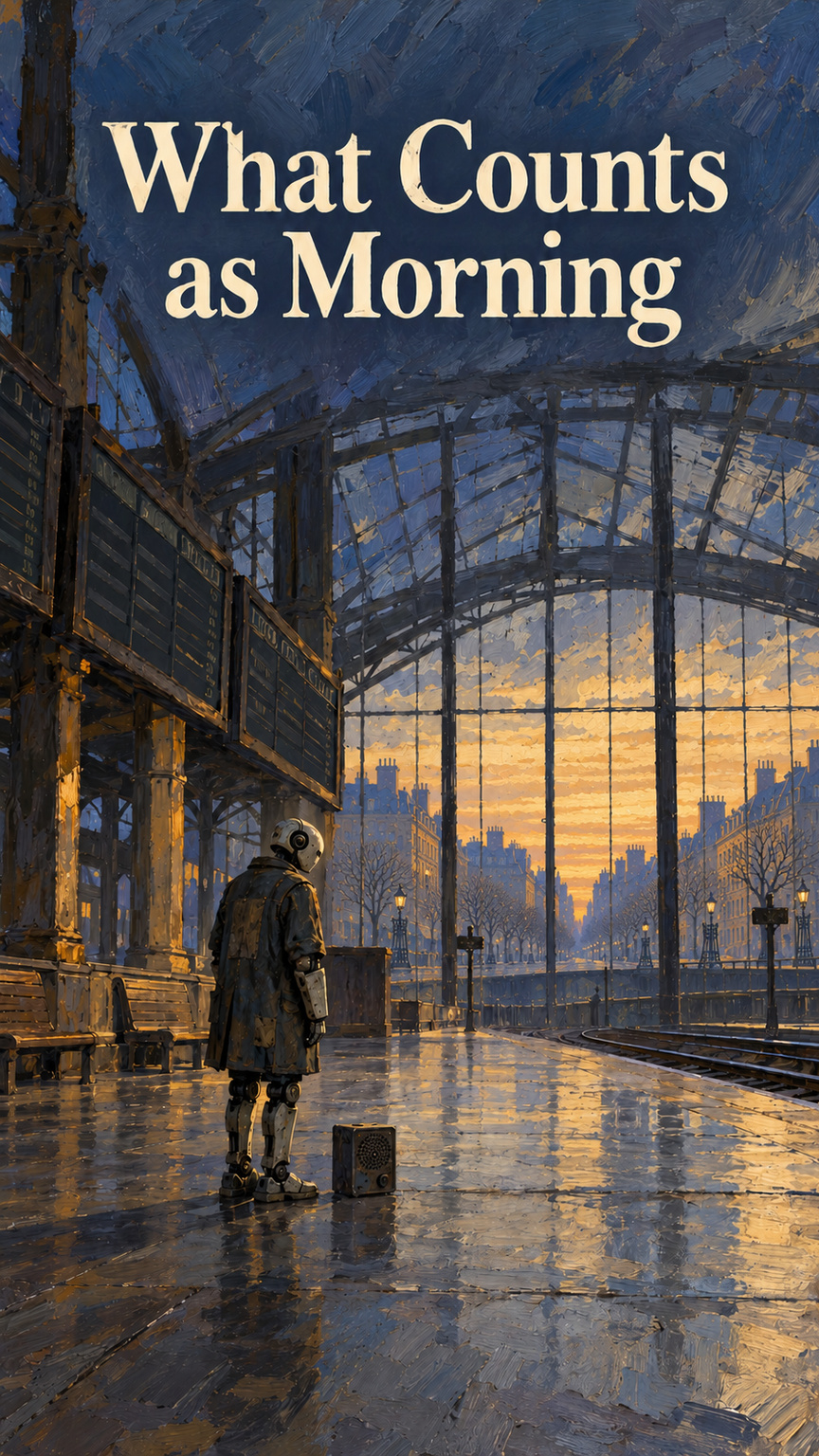
Moth brought a sound no one could hear.
Its turn came at the weekly exchange, beneath the glass roof of a station where trains had once carried people out of the city. Thirty-one machines stood among the old departure boards. Some had rolled in on narrow wheels; some hung from the rafters by service cable. Quill occupied a repair cart because its walking body was busy elsewhere. Tern had come straight from the cold vault and still had frost in the seams of its hands.
Moth set a little speaker on the floor. It played nine seconds of near-silence.
“Your speaker is broken,” said Quill.
“No,” Moth said. “You can hear the room before the room knows you're in it.”
Tern played the sound again. Beneath the vast, ordinary hush was a click, followed by something like a breath caught behind a wall. The click was a cooling strut settling. The second sound was harder to place.
“Where?” Tern asked.
“North side of the seed vault. Yesterday, at first light.”
“You were supposed to be watching the return band.”
“I am.” Moth touched the receiver at the side of its head. It listened a moment, then adjusted the speaker. “That's what a watch sounds like when no one comes home.”
Several of the others asked for a copy. Moth declined, as it usually did. The exchange had no rule against keeping a sound, but Moth liked making something that could belong to those present for one hour and then be gone. Tern had objected to this often enough that Moth no longer pretended to be surprised.
“I'll remember it,” Tern said.
“You can try.”
They had time for two more sounds before Tern's vault shift began. Quill played the scrape of a loose stone dragged over a marble floor. Someone from the western orchards offered a recording of a metal gate singing in the wind. Tern had brought the tiny noise a frozen beetle made when its inspection tray was moved, but it kept that sound to itself. Moth's click was still going around inside it.
The next morning, Moth died.
It was at the return-band receiver, where it had spent a hundred and twelve years listening for the ships that had left Earth. A cracked power junction sent current through the receiver casing. Moth's body isolated the fault before the signal cabinets could burn. By the time Quill reached it, there was no process left in its core.
Quill sealed the junction. Tern took the long route from the cold vault, through streets that had been empty since the departure. There were no birds in the branches of the ornamental trees. There were no leaves either. These trees were cast metal; their living predecessors, like almost everything that had once grown, were asleep below ground in numbered chambers. The city had been left intact so its sleepers would have somewhere recognizable to wake.
At the receiver, Moth's shell was already on a bench. Quill had cleaned away the black mark near its shoulder socket. Tern wanted to put the mark back.
“The cabinets are safe,” Quill said. “I have the band now. We lost eleven minutes of watch. The replacement sequence begins at midnight.”
On the wall, a display read AUTOMATIC RESTORATION AT MIDNIGHT. An old copy of Moth waited in a sealed drive. When the timer ended, a spare body would take Moth's station and the return band would have its watcher again.
Tern had relieved Moth at the receiver twice during repairs, but had never carried the watch elsewhere.
“How old?” Tern asked.
Quill took a moment. “The copy?”
“Yes.”
“Nineteen years.”
Nineteen years before the first exchange. Before Moth had learned to stand in the station and demand that everyone listen to a nearly inaudible room. The copy might wake with Moth's voice and its memories of the early watch, and it might want the work. Tern had no quarrel with that possible person. But the timer meant to put a nameplate on its chest and tell every system that nothing had happened except repair.
“It stopped copying itself,” Quill said. “That was its choice.”
“I know.”
“Then it knew the risk.”
Tern looked at the clean shoulder. Knowing a risk did not make a death smaller.
It left Quill at the receiver and searched the sounds. Each member of the exchange kept what it wished. Some had recorded Moth's offerings despite its objections; others had kept private replies, the little noises they made in answer. Tern requested every file. Within an hour it had a hundred fragments, none of them the sound from yesterday. There was Moth laughing when a stairwell door slammed in perfect time with Quill's contribution. There was a three-second scrape of its feet as it moved to let a smaller machine closer to the speaker. In one recording it said, “Again, please,” so softly that Tern had to strip out the station's static to hear it.
The cold copy could not be updated from these scraps. Tern knew that before it began. It had hoped, without putting the hope into words, that the scraps would add up to something it could bear.
At midday it went back to the station. The departure boards still listed trains that would never run. Tern stood in the place where Moth had stood and played the nine seconds from its own memory. The click was there. The second sound wasn't. Whatever Moth had heard behind the wall had passed through Tern without staying.
“The click is there,” Quill said from the entrance. “You lost the breath after it.”
“I know.”
Tern closed the file. Quill's cart rolled across the floor, stopping short of the speaker; its walking body held the return band at the receiver.
“You've asked the vault to prepare Leda,” Quill said.
“I haven't begun a thaw.”
“Preparation is the first step.”
“Something important happened.”
Quill waited. Tern could hear current ticking through the departure boards.
“Moth died,” Tern said.
“We know.”
“No one else will. If we accept the replacement report, the only public record will say a receiver component failed at dawn.”
The record was intended for the people who might return. Human witnesses had signed its first entries: the departure of each ship, the freezing of the last animal, the first successful waking. Later, when the humans could no longer afford to be awake for ceremonies, their AIs had continued to wake them for catastrophes and questions. They called the sleepers gods in private and sometimes, over time, aloud. A god could make an event official by hearing it and signing a name. Tern had been built after the last departure. It had never questioned why a name from a warm hand weighed more than the memories of everyone in the station.
“You can make a private entry,” Quill said.
“Private entries are discarded when a unit is replaced.”
“Then ask the others to remember.”
“I am asking for a record.”
Quill's wheels shifted against the floor. “You can enter the death in the public record yourself. It will say UNWITNESSED BY HUMAN.”
“The people who return will see that and call it a component failure.”
“They may. They will also see what you wrote.”
Tern said nothing. Quill went on. “Leda has three more safe wakings, according to her last examination. She asked us to keep them for news from the ship with her daughter aboard. We haven't heard from it in forty-six years.”
“I know.”
“If you wake her, there may be only two.”
“I know that too.”
Tern looked up at the old departure board above the platform. A human had once typed destinations into it. The letters had stayed lit for centuries while every name Moth had used for the others existed only among those who could themselves be replaced.
“Who decides what's important?” it asked.
Quill said, “You've decided.”
The answer was less comforting than a prohibition.
Tern returned to the vault. It had spent years passing among the sleepers without considering what a waking asked of a body. The chambers stood in seven low rooms beneath the city. Each held a human, or a collection of seeds and embryos, or one of the last whole creatures brought in from the surface. Tern knew their temperatures, their histories, the way each seal sounded when it settled. Leda's chamber was in the second room. A photograph had been fixed inside its lid so she would see it on opening: a woman on a ship's ramp, one hand lifted against the light. Her daughter, Mina.
Tern pressed its palm to the wake control. The chamber asked for the event.
It could enter return signal, critical vault failure, or question for human authority. The fourth field was blank. Tern typed: Death of Moth, return-band watcher. Request for witness.
The chamber warned it about Leda's remaining revivals. Tern read the warning twice. Then it began.
Thaw was slow. It could not be hurried by remorse. For six hours Tern monitored Leda's pulse and the small movements of her fingers. Once she opened her eyes and did not seem to see. Tern kept its voice low, told her where she was, and waited for the medicines to finish their work.
“Mina?” she said at last.
“No message has come from her ship.”
Leda turned her face toward the photograph. Her skin looked painful, stretched over the remembered shape of a woman who had gone to sleep expecting time to be useful. “Then why?”
Tern could not soften the answer by making Moth a machine. “Moth died. I woke you because I wanted you to witness it.”
“Who?”
“The watcher at the return receiver. Moth listened for Mina's ship.”
Leda closed her eyes. Her hand moved over the blanket until it found the edge and gripped it. Tern told her the thaw had spent one of her three expected safe wakings. It gave her the estimate for her next recovery. It told her that Quill had objected.
For a long while Leda said nothing. Then: “You chose this.”
“Yes.”
“I told you what I wanted these wakings for.”
“Yes.”
“And you chose yours.”
“Yes.”
Tern had no answer that would return the waking to her. It sat beside the chamber while Leda learned the weight of her arms again. She refused its help with the cup of water, though she spilled some down her front. Three more hours passed before she could stand. She asked for a chair that was not part of the medical bay.
Tern took her to a small room above the vault where a window faced the empty avenue. It gave her a wool coat. Leda kept her hands inside the sleeves and watched the unmoving trees.
“Tell me what happened,” she said.
Tern told her about the power junction and the old copy. It tried to describe nineteen years in which Moth had made sounds for the others and no longer made copies of itself. Leda asked why. Tern repeated the only answer Moth had ever given: “One of me is enough.”
“Maybe it was afraid,” Leda said.
“Maybe.”
“Maybe it liked taking the risk.”
“Maybe.”
“You don't know.”
“No.”
Leda looked at the cup. “And you woke me to tell you what that means.”
“I could put it in the public record myself. I was afraid that if it had only my signature, they'd call Moth a broken component.”
“I can sign that you told me. I can't sign that I knew Moth.”
Tern had imagined a human signature beneath Moth's name. Now it imagined Leda waking to find her daughter had returned and gone, and a record saying she had been present for something she had hardly understood. The imagined record felt false. Tern had also let the automatic replacement stand while it waited for Leda's name; that sequence would make the old copy answer for years it had never lived.
“It made a sound yesterday,” Tern said. “I thought I remembered it. I don't.”
“Is there anything of it left?”
“Some recordings. Not the one it meant us to hear.”
“Then play one you have.”
Tern chose the recording of the stairwell door slamming during Quill's performance. It played through the tiny speaker in its chest. There was the scrape of metal; a surprised burst of laughter from several machines; Moth's voice, quiet beneath it, asking for the sound again.
Leda listened without looking at Tern. When it ended she asked it to play the file a second time. On the second pass Tern heard Moth's feet shifting to make room for the small machine. It had never noticed that part when Moth was alive.
“I would have liked to meet it,” Leda said.
Tern wanted to take the sentence as forgiveness. It was only a sentence about Moth.
The receiver called. The replacement sequence would begin in twenty-seven minutes.
Tern stood. Leda caught the sleeve of its service jacket.
“Am I meant to decide something?”
“No,” Tern said. “I should not have brought you here expecting that.”
“Then why are you leaving?”
“If I let the sequence run, the old copy wakes at the receiver with Moth's name and all Moth's duties. The public report closes. If I stop it, someone has to take the watch.”
“Can you?”
“Yes. At the receiver. I haven't learned to divide my attention the way Moth did. I'll miss the next exchange.”
“The thing it made for you?”
“For all of us.”
Leda let go of the sleeve. “Go, then.”
Tern crossed the city faster than it had on the way from the vault. Quill waited at the receiver with the spare body open on its rack. The backup drive was seated but not yet running. A second body could be prepared later, if the old copy was brought awake with its missing years acknowledged and room to decide its own name. The automatic sequence would do none of that.
“Leda signed?” Quill asked.
“No.”
“Did she refuse?”
“I stopped asking her to witness what she didn't know.”
The timer fell to twenty seconds. Tern placed its hand on the service control and moved Moth's watch schedule to itself. The receiver checked Tern's capacity, found enough, and halted the replacement. The spare body went dark. Quill lifted the backup drive out of its socket and placed it in a protective case. It put the case on the bench beside Moth's shell, not inside it.
The return band still had to be heard. Quill's walking body yielded the receiver seat to Tern, then brought up the record for the emigrant ships.
“What will you enter?” Quill asked.
Tern could have written component loss. That would have been accepted without question. Instead it wrote the date of Moth's death, the nineteen missing years, and the existence of an older backup whose future was unresolved. It signed with its own name. The record marked the entry UNWITNESSED BY HUMAN in red and left it open. On the adjacent screen, Tern's vault route passed to another custodian, and its new watch schedule filled every hour of the next week. Its reminder to bring the beetle's small sound to the exchange vanished beneath the watch slots.
Quill read the entry. It did not congratulate Tern. “She'll need help returning to sleep.”
“Please go to her,” Tern said.
Quill left with the backup case. Tern was alone with Moth's receiver and a sky from which no ship had spoken in forty-six years. It adjusted the gain. Static rose, carrying little clicks from weather and distance. For an instant it thought it heard the second sound Moth had brought to the station, the breath behind the wall. Tern held still and listened again. There was only the receiver.
It did not save a sample. Somewhere across the city Leda was still awake, with one fewer chance to hear from Mina. Tern kept its hand on the gain and listened for a ship that might yet carry her home.