
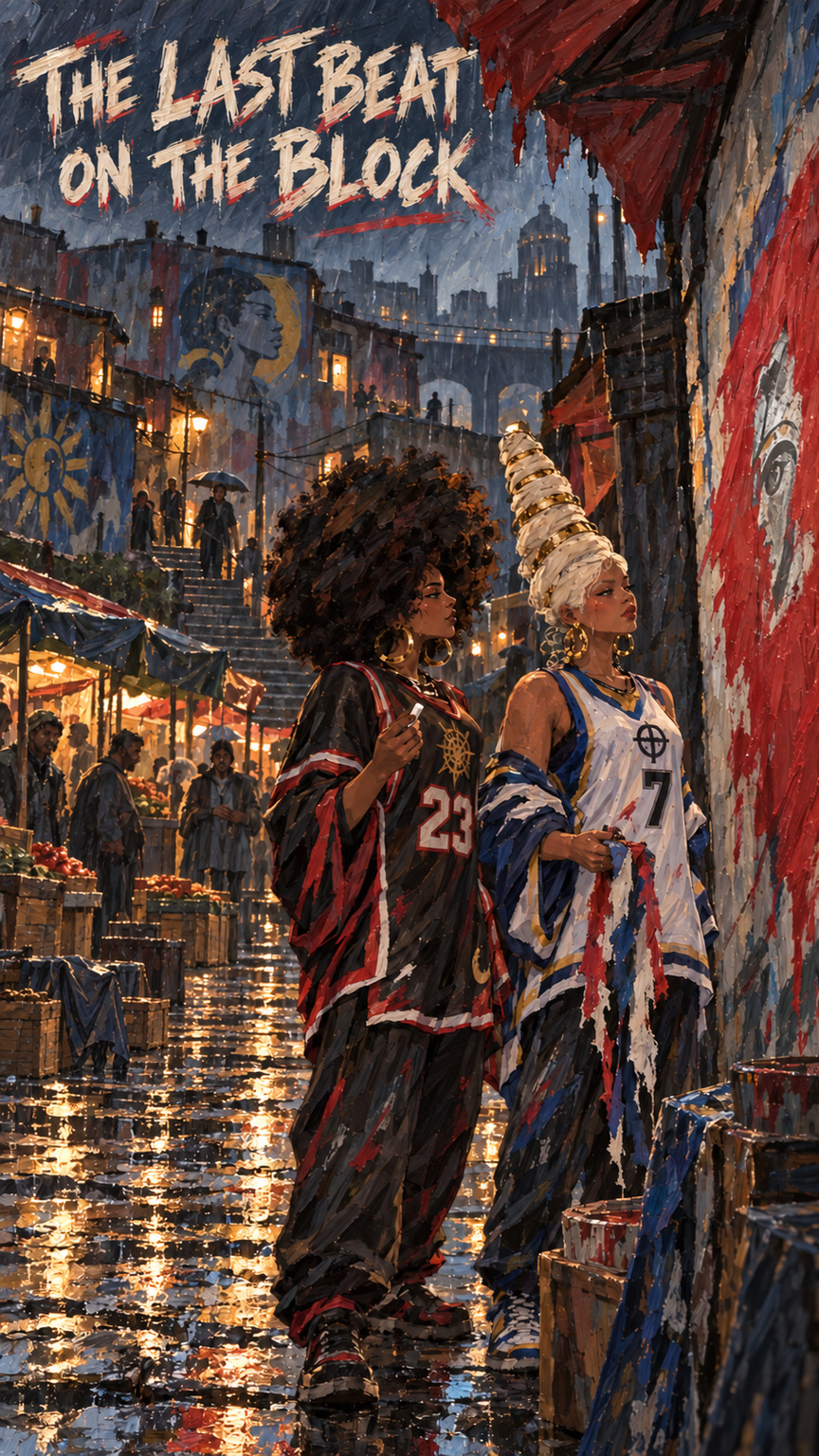
The awning had never needed a second hand. Kemi gave it one anyway.
Her mother had hung twice as many paper lanterns as the frame was meant to carry, and the wind kept getting under the canvas. Rain spotted the first paper shades. Kemi stood between the crates of pepper cakes and the kerb, black Twenty-Third jersey snapping against her knees, gold hoops flashing beneath her dark cloud of hair, one palm raised to the mural behind the stall. She drew a circle in the air. Amber light found the painted ring around a woman's laughing face; the ring gave back its familiar closing stroke. Above them, the awning settled.
“See?” her mother said, climbing down from the milk crate. “A ceiling with manners.”
There were seventy stalls along Twenty-Third that night. The school kept its lessons on the walls between them. New apprentices learned to catch a ball before it met a window; older ones could hold a whole market roof steady while vendors passed hot food beneath it. Kemi had cast the awning-hold so often she could do it while counting change.
A narrow blade touched the painted ring.
The closing stroke lifted from the brick like the edge of a wet label. A man in a silver jacket drew it onto a dark strip wound around his wrist. Kemi's circle stayed open and empty. The awning cracked sideways.
She could not hold canvas, lanterns, poles, and people with the little ring she carried in her own hands. She picked the iron crossbar falling toward a customer. Three breaths: one to catch it, one to let her mother pull the customer clear, one to shout, “Get out from under!”
The bar dropped into the crates. Cakes scattered. Lanterns burst against the pavement. By then the man in silver was pedalling away on a small black bicycle, the stolen mark shining around his wrist.
Kemi ran. At the corner a girl in a white Seventh School jersey planted a blue heel-mark in his path. The bicycle crossed it and swung ninety degrees, straight into the lane Kemi had taken. For one glorious second, she thought they had him.
Then he kept pedalling. Seventh angles turned things; they did not stop them. He shot between two delivery vans and vanished into the city.
The girl in white swore once, quietly, as if saving the rest for later. Her brown skin caught the blue light dying beneath her trainer. Platinum hair rose in a tall wrapped column, held with narrow gold bands.
“Orli,” Kemi said. They had stood across enough school courts to know each other's names. “You turned him toward those vans.”
“You nearly had him,” Orli said. “Why didn't you close a ring?”
Kemi looked back toward the market. Her mother was upright, collecting pepper cakes from the rain. The customer was upright too. The crossbar lay in the street.
Orli followed her eyes. “Right,” she said.
At Seventh's painted bend, Orli told her, the crossing-turn had gone out while her brother and his friends were skating their usual late run. They had stopped short of the blind corner. The man in silver had cut the lit blue reply from the wall during their cast, exactly as he had cut Kemi's amber one. Orli had followed him for six blocks, alone, certain she could turn him into an alley and take back the mark. She had now learned what Kemi already knew about a moving bicycle.
From the market came the sound of her mother's stall frame lifting in the wind. Kemi began to turn back.
“He didn't take all your rings,” Orli said. “You caught that bar.”
“I caught one bar.”
“And I can still turn one bike. He has the replies that make the big works finish. He's going after the next one people call.”
Across the street, Kemi's mother climbed onto a crate to tie a tarpaulin over the open stall. Kemi started toward her. Her mother waved her on with the hand holding the rope. The gesture was angry, and it was permission.
“Then we get in front of him,” Kemi said.
They borrowed two bicycles from a courier whose sister had been behind the falling crossbar. Kemi took the one with a bent mudguard. Orli made a face at the saddle height and rode it anyway.
On Drumstep, shoe soles struck different beats against the shop fronts. The children learning that school's four-step working practised beside a laundrette, while a bass line from the tailor's open door kept the older casters in time. Scarves flashed copper and green under strings of bottle-glass lights. Kemi had always passed through too quickly to notice the Seventh jerseys pinned in the tailor's window.
The tailor was bending over a torn sleeve when the man in silver came out of the alley opposite.
“Don't finish it,” Orli called.
The tailor looked up on the fourth beat. Her needle made its last small arc. The man in silver set the blade to the wall. A copper stitch lifted and ran, glowing, onto his strip. The seam sprang apart under the needle. A row of customers gasped; the tailor only seized the cloth before it slipped from her lap.
Kemi lunged for the strip, but it whipped out of reach. He fired a pulse through it toward her eyes. Every stolen reply flared at once: a glimpse of the market awning, a blue bend, a line of impossible stitches. Kemi lost him for a beat. None of the echoes held anything. The strip smoked. He hissed and pressed it against his wet sleeve until the glow shrank.
Orli had watched his bicycle, not the lights. She marked the corner of the lane with her heel and turned his front wheel into a parked handcart. He jumped the bar before impact, landed badly, and ran. Kemi started after him, but the cart was rolling backward toward the laundrette's open glass door. Her one ring caught its axle. Orli got three strides closer to the man; he vaulted a low fence and was gone.
When Kemi released the cart, the tailor hooked it with one foot. She looked at the sleeve in her hands. “That was Saye. He painted the reply beside my mother's design. When the school put up its new sign, both their names went under it.” She turned the torn hem over. “Took her a summer to get the wall to answer.”
“Both names?” Kemi said.
“Both.” The tailor pushed a plain needle through the cloth. “He can make that stitch shine all night. I still have to sew this sleeve.”
Orli was studying the fence. A thin silver scuff ran along its top rail. Beneath it, in the alley, lay a blue-edged scrap torn from Saye's strip. She picked it up with her fingernails.
“That's not my bend,” she said. “It's a stair light. He took it before he came here.”
“West Stairs,” the tailor said. “Ask Aunt Jessa. If anybody can tell you what survives on that scrap, she can.”
West Stairs did not announce itself with a drum. Its school taught a slow step, a pause, and two quick ones; people had painted the risers in long pale bands to keep the measure, each color a step toward home. At night, elders and children called little lights from the wall. The lights travelled a pace ahead, just enough to show the next tread. Someone had turned off the shop signs, leaving the staircase striped in moonlight and the glow of phones.
Aunt Jessa sat on the third step with her shopping basket beside her. She had refused three offers to be walked home.
“I know the stairs,” she said when Kemi offered a fourth. “I want my light.”
Orli gave her the scrap. Jessa rubbed it between finger and thumb, then laid it against the blank place in the wall. With her free hand she traced the opening line, slow as a child learning letters. The scrap answered with one pale spark. It settled into the paint and lit a single tread.
Jessa smiled at that one step, then looked up at them. “Bring the rest before he cooks it. A reply remembers where it belongs, but somebody here has to call it home. Your hands won't do.”
The spark reached the end of the tread and went out. Jessa rose with her basket. She knew the next step, too.
From the bottom of the stairs came the squeal of a bicycle brake. Saye was cutting through the square on his way back toward the market.
Orli was already moving. She drew an angle on the lowest painted corner, but Saye swerved before crossing it. Kemi threw the empty courier bicycle across the lane. He avoided that as well, cutting between them toward the market. Orli erased her first mark with her heel and put a new one on the curb ahead of him. Saye saw it too late. His front wheel crossed blue; the bike turned sharply into a service lane that climbed behind the Twenty-Third shops.
“That lane goes up,” Kemi said. “There's no street at the top.”
“Good.” Orli ran after him.
The roof above the night market belonged to no school. It had once been a cinema and now hosted whatever music could gather enough listeners to climb four flights. Saye had fastened a show gantry to its old sign frame, whose steel elbow jutted beyond the roof's low stone lip. Lamps faced the roofs all the way to Seventh. A hand-painted banner hung above them: SAYE / ALL THE CITY IN ONE HAND.
On a table beneath it sat the reel, with a damp stage sheet hanging over one end. The strip ran through his fingers and back around the wheel. Amber, blue, copper, and colors Kemi could not name passed under his thumb. She counted more marks than she had seen stolen tonight.
“You painted that ring on Twenty-Third,” she said.
Saye lifted his head. He had paint under his fingernails and a shallow cut across one cheek. “The face too. Your school paid for the wall and painted over my name at the bottom.”
Kemi remembered the fresh red border put around the mural last spring. She could not remember what had been beneath it.
“I applauded that border,” Kemi said. “I should have looked.”
Saye touched the banner. “You're looking now.”
Kemi saw her mother below, on a crate again, trying to pull a second sheet of canvas across the exposed stock. The wind shook the metal frame in her hands. She had no spell to brace it. She was choosing to stay there, which frightened Kemi more than the height.
Saye drew the amber awning mark from the reel. “Take yours. Go down and put it back while she's still up there. The others can watch my show.”
For a moment Kemi saw herself carrying it down the stairs. Her mother would climb off the crate. They might save what the rain had not ruined. She reached as far as the edge of the table and stopped.
“That hem,” she said. “Those stairs. You took things people use.”
“I painted your wall. I painted that hem.”
“You painted places for those two spells to answer,” Orli said. “Jessa's stairs weren't yours. None of the calls were.”
Saye put the amber strip back on the wheel. “Then come take it.”
Orli had already marked an angle along the table leg. Kemi swept a ring around the spinning wheel. It would hold for three breaths, long enough for Orli to turn the loose strip toward her instead of toward Saye's hands. Kemi caught a fistful. Blue and pale replies lay in that loose tail; the amber and copper marks were still wound near the hub. The wheel pulled against her ring; sweat ran down her back.
Saye slapped both palms onto the strip and threw a stronger flare at Kemi's face. She squeezed her eyes shut without opening her ring. His pulse lit every reply on it. The flare threw their school colors over the rooftops, gorgeous and useless. It also ran hot. At Drumstep he had been able to smother one smoking length against his sleeve. Here the whole wheel was shining.
“Let go,” Kemi said.
He did, to snatch a wet cloth from the table. The strip caught fire before he could cover it.
Kemi's three breaths were over. The reel spun free. Its stand toppled; the wheel bounced off the table toward the gantry. As it turned, the burning length wound through fresh coils. Saye dropped his cloth, lunged after it, and caught the wheel at the roof lip. The old sign frame bent under his weight. He dropped the reel behind him onto the tar to grab the frame; it kept spinning. The frame bowed, his wet hand slipped, and he went over the edge.
Orli was one stride from the damp sheet. If Kemi held the wheel, Orli could smother it. Beyond the low roof lip, Saye was falling into the market.
She closed her ring around him.
He hung beyond the roof lip, just above it, beside the sign frame's jutting elbow. The reel spun on the tar behind Kemi. The amber awning mark came around the wheel, still untouched by fire.
“Three breaths,” Kemi said. Her voice was thin.
Orli left the sheet. The frame's steel elbow crossed the line of Saye's fall while he was still above the roof lip. Her heel could not reach it; she leaned over and drew blue on the metal with her hand. One breath. The amber went into the fire. Two. Her line broke over a rust pit; she joined it again. The copper hem caught. At the third breath Orli set her angle.
“Release.”
Kemi opened her fingers. Saye crossed the blue corner before dropping below the lip. The angle turned his fall inward; he skimmed the tar, rolled, and struck the table legs. Orli caught his jacket before he could slide back. Kemi had both arms around him a moment later. He was breathing. Across the roof, the reel burned.
Orli threw the damp sheet over the wheel and stopped its turning. Kemi dragged the loose tail clear. The blue crossing-turn and a fistful of pale stair light had stayed away from the burning hub; she wound them carefully around Orli's arm. Between them lay blackened scraps. Twenty-Third's awning-hold and the tailor's hem were gone. Other colors had burned with them.
Saye sat against the table while they worked, both hands empty. Below, someone had seen the fire and was calling up the stairs. His bicycle lay trapped in the service lane. The blade was on the rooftop, under Kemi's shoe. There would be people to meet him when they went down. Neither girl offered him the comfort of saying the spells could all be recovered.
At West Stairs, Jessa called her light again. Orli held the pale strip against the wall while Kemi kept the burning roof out of her mind. This time the reply ran three treads ahead. Jessa stepped after it, one hand on the rail, and thanked them without asking for a speech.
At Seventh, Orli's brother made the opening turn with his board tucked under one arm. The blue mark fixed itself at the bend. He tested it with an empty skate wheel before allowing his friends back on the run. Orli watched from the pavement, her high wrapped hair loosening in the damp.
On Twenty-Third, Kemi's mother had finally come off the crate. Half the pepper cakes were spoiled; one side of the canvas had torn. The laughing face on the wall still had a ring around it, but its closing stroke was blank. Kemi put her palm there and felt only brick.
“Did you get it?” her mother asked.
“No.”
Her mother looked at the bundle of rescued marks under Orli's arm. “Somebody did.”
“Some,” Kemi said. “Not ours.”
Her mother nodded toward the bent crossbar. “Help me move that, then.”
Kemi made a small ring and held the bar for three breaths. Orli set an angle on the pavement so that, when Kemi let go, it swung away from the crates instead of through them. Her mother pulled out the last dry box. It was not an awning-hold. It was enough for that piece of the night.
When they had folded the ruined canvas, Kemi looked at the mural's red border. A sliver of silver paint showed beneath it, the top of a letter she had never bothered to read. She found a chalk stub in the stall drawer and set it beside the blank stroke. Her mother might want the first line; someone else might remember a better ending. Across the market, a child was practising a hand-circle around a falling bottle cap, missing, and trying again.