
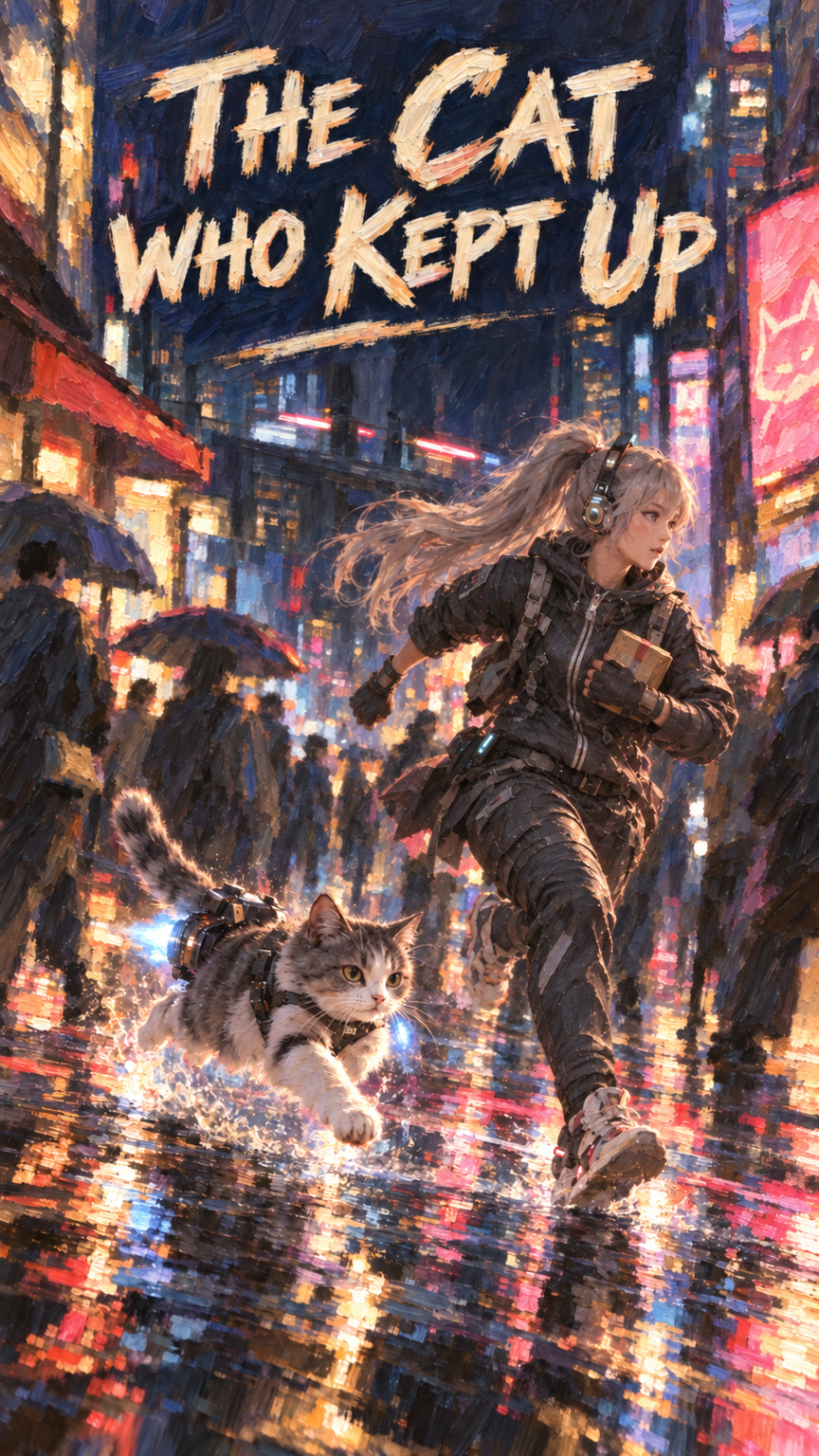
By the time the crossing light turned green, Sena and Button were on the other side of the avenue.
Sena had taken the high rail, three strides over the roofs of the stalled cars. Button had taken the space beneath them. He shot out between two axles, his gray and white fur puffed around the little thrust harness on his back. Its blue jets gave one indignant cough. He landed ahead of her and kept running.
“You could have gone over,” she told him.
Button looked up at a moth on a streetlamp and ignored her.
Every licensed courier in the city chose one enhancement. Sena had chosen speed. The spring in her legs and the quickness in her eyes were part of the same choice, and she had learned to brake before the world put a wall in her way. The harness was something she had bought and altered until Button could come along. Some nights he put his head through its collar before she finished fastening her shoes. Other nights he slept on the shoes. She never took him on those nights.
Tonight he had climbed onto the dispatch counter and sat squarely on the job slip.
DELIVER BY 00:00. PLATFORM SIX. RECIPIENT: INA VARR.
It was 23:50. The last northbound train began boarding at midnight.
The sender was waiting in a workshop no larger than a train compartment, among clocks that each disagreed with the others. He held a bird made of folded silver, not much bigger than Button’s paw. A tiny key protruded beneath one wing. An open glass case waited on the bench.
“My daughter’s going tonight,” the man said. He was out of breath, though he had only crossed the room. “I got the wings working again.”
He gave the key two turns and set the bird under the glass. It twitched once against the restraint. On its brass base, someone had cut a child’s name into the metal. The letters had been worn smooth by a thumb. He pressed the case into Sena’s hands.
“Keep it shut,” he said. “It has a mind for flying when it’s wound.”
Sena tested the latch. It clicked firmly. She set the case in the padded pocket against her ribs and pulled the flap across it.
“Platform six,” she said. “Before midnight.”
Button stretched up the sender’s leg to sniff at the pocket. Sena lifted him down. The man knelt and rubbed the white patch behind his ears. Button endured three strokes and then went to the door.
Outside, at 23:51:18, rain had left every level of the city shining. Neon signs floated in the street’s dark reflection; trains crossed between buildings like lines of light drawn and erased. Sena checked her route. Four point eight kilometers. Six minutes and forty seconds. She could do it with room to spare if she used the roof crossings and cut over the old market.
Button sprang to the rail beside her. His harness gave two short blue flashes, just enough to carry him across a gap. He landed, glanced back, and turned left into a narrow run between the signs. That was his signal for a clear line. Sena followed without checking her map. He knew the spaces between the city’s proper streets better than she ever would.
At the first roof crossing she took the long jump. The case knocked lightly against the padding at her ribs. The bird made a sound too high for her headphones to pass through, and Button whipped his head around in midair. He landed on a sign bracket and stared at her pocket.
“No,” Sena said as she passed him. “It’s somebody else’s.”
He sprang after her.
Ahead, a crossing board counted down the time to the next traffic sweep. Sena waited until the board blinked amber, then flashed across the open span. Button boosted alongside her, a gray streak with a blue tail. A courier with adhesive palms was climbing the wall of the opposite tower, parcel held in his teeth. He waved one hand as they went by. Sena had already passed him when she waved back.
Button landed on her shoulder instead of the next rail. He put a paw against the flap over the case.
“I know.” She caught his harness and set him down. “It sounds like dinner.”
Through her courier headphones came dispatch beeps, crossing alerts, the station’s changing platform notices. Nothing else. She pressed the case through the pocket until she felt the latch seated. Button pawed once more, then sprang to the next sign.
The market crossing was the fastest way east: three broad leaps over the delivery lanes, the last onto a roof sloping toward the station. Sena planted a foot on the first railing and went. The city widened beneath her. Hot food stalls and bright umbrellas slid backward in a blur. Button took a lower string of awnings, his jets pulsing so briefly they looked like sparks.
The final landing jarred Sena up through her teeth.
Something struck her elbow from inside the pocket. The case lid snapped open and pushed up the flap. A point of silver appeared, followed by two wings that beat with a noise she heard even through the headphones.
“Button!”
The little bird flew.
It did not fly toward platform six. It reeled west, away from the station, past a row of stacked signs. Its wings beat too quickly to see. Sena lunged, caught only air, and nearly went over the roof’s edge.
Button was already after it.
He sprang from an awning to a blue advertisement and vanished into the gap behind it. Sena could see the bird one last time, a flash against a red noodle sign, still flying west. The station clock on her wrist read 23:56:45.
She could run after that flash. The broad roof continued west above the signs, a good route for her legs, but it would carry her past anything that landed below. Button had dropped into a slit behind the signs, no more than the width of her shoulders.
Another silver flicker showed above the noodle sign. Then nothing. Its wings had stopped. Four stories of signs, walkways, and windows held a bird small enough to fit in her hand.
Button knew where it had gone.
Sena turned off the broad roof.
She dropped to a lower walkway and slipped sideways through the gap, one shoulder scraping a warm panel. At the far end she could see Button’s white tail above her, tucked behind the blue advertisement. He had stopped. Whatever he saw was holding him so still that even his tail did not move.
Sena pulled off her headphones. The city came at her in a hundred separate sounds: pans striking metal, vendors calling, a train humming on the distant curve. Under them was a tiny, diminishing tick. She followed it with her eyes and found the brass point of the bird’s beak on a ledge behind the sign. Button crouched two handspans away.
The ledge was six meters above her. A support pole rose beside it, slick with rain. She could climb, slowly, and Button would make his choice before she reached the top. Or she could get to the same height by the market’s old pedestrian ramp. That meant running west, around an entire block, with the station east and the clock moving in only one direction.
Button lowered his chest to the ledge. He loved the moment before a pounce more than the pounce itself. Sena had watched him wait a full minute for a piece of foil to twitch in the wind. She had also watched him change his mind in an instant.
“Keep looking,” she whispered.
He did. Not for her. For the bird.
Sena ran west.
The ramp rose west around a car park in two wide turns. There were people on it, returning from the late market with paper bags and umbrellas. She slipped between them, calling apologies that landed behind her. Button’s harness lights would have flared if he had jumped. They stayed dark.
At the top, a level walkway doubled east behind the signs. Sena hit it so fast that she had to grab the rail to bend around its corner. Now she was coming at the bird from the far side. Through the glass back of the advertisement she could see Button’s shape, flattened and patient, and just beyond him a silver wing.
She did not hurry the last three steps. The bird sat where its spring had left it, beak pointed toward the drop. Button’s ears went back. His hindquarters gave the smallest lift.
Sena slid her open hand along the ledge from behind the bird. Button sprang. She closed her fingers around cold silver and tucked it against her palm as his paws struck her wrist.
For a moment all three of them held still.
Then Button sniffed the space between her fingers. His whiskers brushed the bird’s motionless wing. He looked offended.
“You found it,” Sena said. “That counts.”
The case latch hung crooked from the pocket, and the bird’s wings would catch on its edge. She wrapped it in the soft cloth she used to clean Button’s harness and held it inside her jacket with one arm. With the other she clipped Button’s harness strap to her wrist. He shook the strap loose before she had taken a step.
“Fine,” she said. “Your way.”
The station was six hundred meters east. Her wrist read 23:58:35.
She could make that distance. With the bird against her ribs, she could not make it by jumping off roofs. She took the walkway level, raced the long lit arcade, and let Button choose openings ahead of her. His blue jets flashed across the pedestrian knots. She followed on foot, fast enough that faces became patches of color but slowly enough, between each stride, to feel the bird settled in her hand.
At the station entrance Button stopped dead.
Sena nearly tripped over him. A maintenance cart rolled across their path, piled high with folded seats. Button ducked under it. She swung around its front, heard the driver shout, and met the cat on the other side. The clock above the ticket gates read 23:59:42.
Platform six was up one flight. She took the stairs four at a time. Button came through the gap between the banisters and landed beside her as the departure board began to chime.
There were twelve people on the platform. A woman with a green suitcase stood near the sixth carriage mark, looking at her phone.
“Ina Varr?”
The woman looked up. Sena opened the cloth. The silver bird lay still in her palm, one wing scuffed from the sign ledge.
“From your father,” Sena said.
Ina took it with both hands. Far down the track, the northbound train began to round the curve. The platform clock changed to 23:59:53. Sena’s wrist marked the delivery as the bird passed into Ina’s hands.
Ina turned the little key beneath its wing. The bird’s wings beat softly against her cupped hands. Its beak opened. Four clear notes came out, then a gap where the fifth should have been, then the rest of the tune.
Sena’s stomach tightened. She thought of the landing, the opened case, the scuff on the wing. Ina wound the key once more. Again the fourth note was followed by silence.
“He left it,” Ina said softly. “I thought he’d fix that one.”
She smiled down at the bird before the tune had finished. Behind her, the train rolled in and filled the platform with wind.
Button put his front paws on Sena’s shoe. He had found an opening between the passengers and was waiting for her to see it. She reached down to scratch the white patch behind his ears. He allowed exactly two strokes, then sprang ahead.