
Talia carried her mother's stool out of the fire because her mother was trying to go back for it.
It had three legs and a worn crescent in the seat. It was not worth a house. Talia got the stool under one arm, took her mother's wrist with the other hand, and pulled her away as the roof of their lane went down in sparks.
They reached the old temple with eight neighbors, including two children. The children's father had wrapped them both in a blanket. Another neighbor carried a loaf blackened on one side. The temple had stood through worse fires when the Hearth Nine lived there, and its stone walls held now. The vestibule had no door left, though. Wind came through the opening and gathered the smoke around their feet.
“The inner rooms?” one of the neighbors asked.
Talia's mother shook her head. “Sealed.”
“We could sleep in the hall.”
“With that wind?” Talia said. “They'll be coughing till morning.”
Her mother looked at the doorway where she had counted guests for thirty-one years. She had begun while the Nine still received petitioners, continued after their departure because someone had to tell the disappointed that there would be no audience, and stopped only when the temple was closed. The gods were not a story that old people disagreed about. Their names appeared on the city's charter beside human signatures. Three gods of storm had once signed a treaty in rain that did not run down the parchment. The parchment was in a glass case at the civic house. The gods were gone, and the case remained.
“There's a room behind the west wall,” her mother said. “There used to be.”
Talia leaned the stool against the wall and went to look. Fire had cracked a painted panel from top to bottom. The picture showed one of the Nine extending a hand to a visitor, though most of the visitor had fallen off with the plaster. Talia put her fingers in the crack and drew a loosened piece away.
Behind it lay something pink and ribbed. It withdrew from the cold air, then pressed slowly forward again. Its warmth came through the dust on her fingertips.
“Mother.”
Her mother pushed Talia's hand aside, held two fingers close to the living surface, and spoke the old three-note summons. Talia remembered hearing it at bedtime when she was small. In those days it meant a visitor inside wanted the human door opened for them. Her mother sounded every note correctly. Nothing moved.
She tried once more, softer. The growth kept its slow pulse.
“That was for someone asking to come out,” Talia said.
“I know what it was for.”
Talia laid her palm against the ribs. They tightened around the heel of her hand. She almost tore free. The living seam drew back instead, opening a slit between two old stones. Air breathed out of it, dry and carrying the faint smell of extinguished candles.
Her mother caught her sleeve. “It opened. That doesn't mean anyone invited us.”
Behind her, a child began to cough. Talia looked back. The others were bent around their small bundles, waiting for her to decide whether the space behind the wall was large enough to help.
“I'll find out what's there,” she said.
“Then I am coming.”
“You said we weren't invited.”
“I said no one invited us. I didn't say I'd let you go alone.”
Talia told the neighbors to keep close to the stone wall and wait. Then she ducked through.
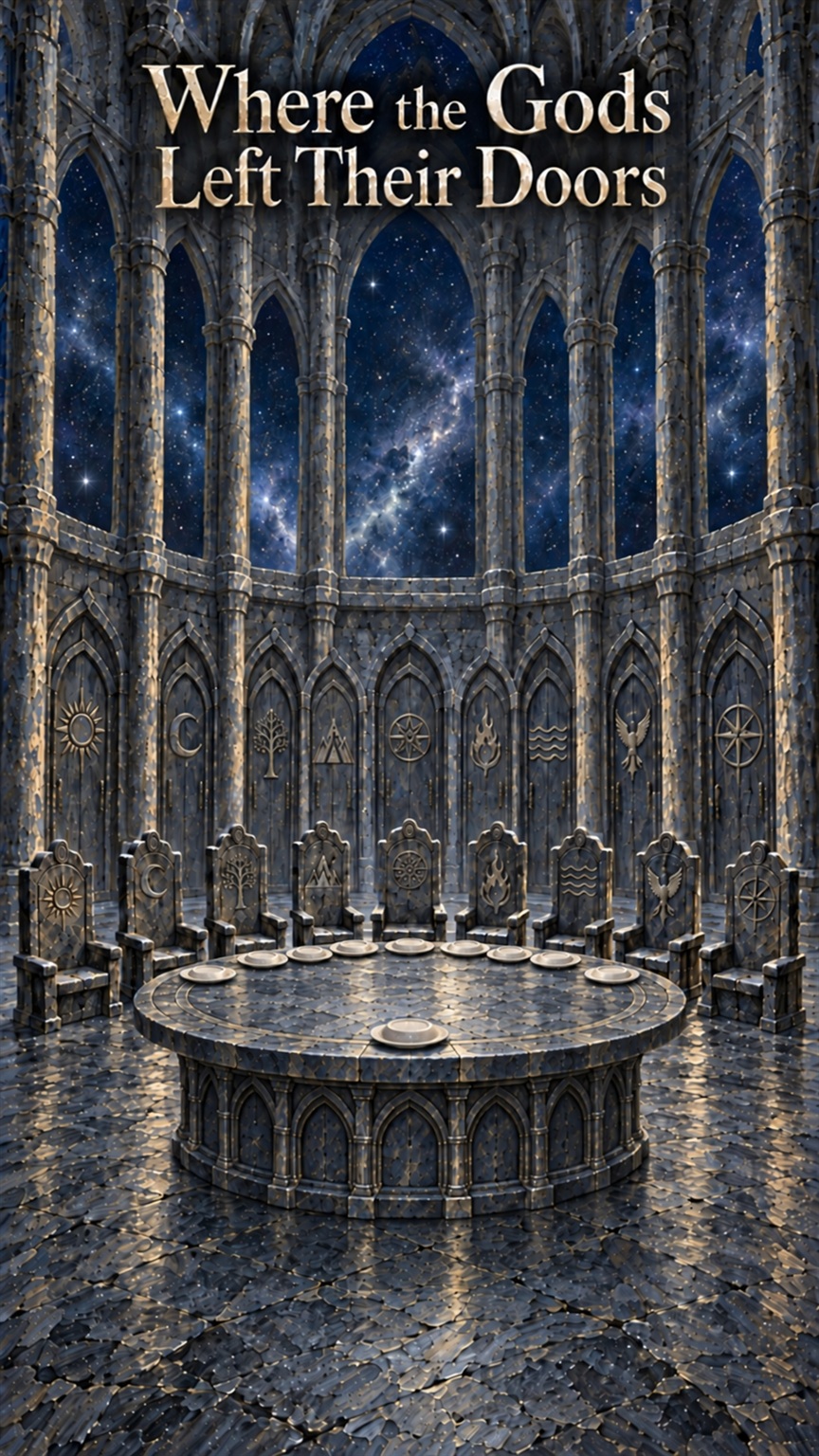
The passage was two steps deep. On the third, the ceiling lifted away from her. She came out beside a broad round table of stone. Nine great seats followed its far curve. Their backs carried different marks: a crescent, a branching tree, a bird with its wings spread. Behind each seat stood a closed door bearing the same mark. Dust lay unbroken along all nine thresholds. Small benches for mortal visitors followed the near curve.
The table was laid with plates of pale stone. Dust had settled into the shallow hollows where the food would have gone. At one side of the hall stood a hearth tall enough for Talia to walk into without lowering her head. Its logs were still stacked, but every piece was cold and furred with ash.
There was a tenth place along the table's near curve, small enough for a human hand. Its plate had been turned upside down to keep the dust out. Talia righted it. On the underside someone had scratched a row of dates, each beside a visitor's name. The last date was from the year the Nine departed.
Her mother came through behind her. For a moment she looked exactly as she used to at the temple entrance, counting what a guest had brought and whether there was room at the table. Then she looked at the empty seats.
“I used to stand there,” she said, pointing to the smallest bench. “If the Nine ran out of plates, I had to fetch more. They didn't run out often.”
“This was for us?” Talia held up the small plate.
“For whoever arrived after the meal began.” Her mother read the last scratched name. “He was a man from the north road. He couldn't pay for lodging. The Nine gave him a seat, and I had to find him a spoon.” She set the plate back on the table. “I don't know what happened to him after that.”
Talia looked toward the distant end of the hall. “Did they build all this?”
“I watched one of them pull that wall farther away to fit the winter guests. We carried the benches across the new floor.” Her mother put her hand on the table. “It was still here the next morning.”
Talia went to the hearth. No heat waited beneath the ash. Above the nine doors, high arches opened onto a sky scattered with cold stars and a pale river of light. No wind came through them. The place was dry, but the stone had kept a long cold. She could feel it through her boots.
“They could fit everyone here,” she said.
“They could lie here.” Her mother held out a hand. Talia took it. The fingers were shaking. “That isn't the same as keeping warm.”
“Did the Nine have a kitchen?”
“We had a kitchen. We brought their food in from our side.”
Talia thought of the loaf outside, its burned crust and sound middle. She had wanted to find a room, not a banquet, but the bare plates made her hungry anyway.
“There was a guest annex beyond the Storm Three's court,” her mother said. “People slept there when the treaties ran late. I haven't walked there since the house was sealed, but I can try to find it.”
Her mother walked to the far end of the hall. Talia followed past every empty seat. None had been pushed back as if its owner had only risen for a moment. Dust lay undisturbed on the arms. At the end was a narrower arch. Above it, two carved hands met without joining. One bore the Nine's hearth mark; the other held the forked crown of the Storm Three.
“They visited,” her mother said. “They had to agree which court hosted the winter guests.”
The arch led into a passage with small doors along both sides and a larger one at its end. The larger door was open. Beyond it stood three thrones on a height of black stone. The Storm Three had sat there when the yearly treaty was renewed; there were paintings, receipts, and the rain-signed parchment to prove it. Past the thrones ran a covered arcade; her mother remembered following it through a brick court to the guest annex. Now clouds hung close under the ceiling, translucent and hard-edged as cut glass. Their shadows moved over the thrones though nothing sat in them.
Talia took a step onto the black floor. A clear pellet struck beside her boot and broke into shards. Another struck the empty middle throne, then a scatter of them rattled down the steps. Her mother pulled her back under the arch. A thin piece cut through the outer layer of Talia's sleeve and stopped against her skin.
Three tall standards stood behind the thrones. Their fabric had fallen away, leaving bare poles and bronze catches. Hail struck the catches in irregular bright notes. Beneath them lay strips of colorless cloth stiff with old mineral deposits. Talia waited for the fall to slacken so they could cross to the arcade. It grew heavier instead, covering the first step until its edge could no longer be seen.
“Was it like this when they lived here?” Talia asked.
“No.” Her mother watched the hail strike the thrones. “When they wanted rain, they went outside.”
The three seats remained empty while the weather worked above them. Talia had wondered, as she crossed the great hall, whether the Nine might still be somewhere in their house, too distant to hear. She looked at the storm court until the hail filled the steps with glittering chips. There was nowhere to call for anyone. Her mother had already turned down the passage, searching its smaller doors for another way to the annex.
One of them had no handle, only a black frame set by itself in a recess. Color flowed along the floor toward it in narrow living streams. Red curled up one side, blue over the lintel, green along the other side, with darker strands passing beneath. The currents divided around Talia's boots and joined again. Her mother lifted her hem clear.
“Is that paint?”
Talia crouched. Green thickened against her finger, firm and warm. The black slab swung outward.
There was daylight on the far side, and a tree. Its nearest limb was broader than the street where their houses had burned. Forests grew on that limb, and on the branches above it. Beneath them, green stretched away until the world curved under a luminous rim. A flight of stone steps had been cut into a far bough, now half buried in moss. On its lowest visible riser was a crown of leaves Talia knew from the records of another departed pantheon.
Warm air moved through the opening. For one breath she thought of bringing everyone into that green. Then she saw the space between the sill and the bough: too far for a person to step, with no ground she could see below. A winged animal crossed the gap and vanished among the leaves. Talia shut the slab. The red, blue, and green currents went on moving through the frame.
“There was a stair,” she said.
“There was no way to reach it.”
“I saw their mark.”
Her mother had seen it too. She stood with her hand braced against the passage wall, looking toward the frame as if expecting its forest to show through the black stone again.
The next small door opened at Talia's push. Red grass bent away from a white road. Seven-spoked seams ran through its stone and out across patches of bare ground. Talia had studied the city's survey made when witnesses saw the Road Seven roll this plain across what had been empty sky. The Seven's shrines had stood empty since before her mother was born. Overhead, doors drifted through a blue sky, some no larger than a palm and one wider than the temple roof. Far down the road a sleeping creature carried a city on its plated back. Copper towers and crooked awnings rose and fell with each breath. Among them stood an old stone shrine with the same wheel cut above its entrance. Copper braces held its cracked walls together; someone had built a stall against the side.
“They live there,” Talia said.
A figure moved under one of the awnings. Smoke gathered across the road near a gate and took a shape she could not read from this distance. The grass before the threshold would give no shelter from the night air behind them, and the sleeping creature already carried a city's worth of people. Talia closed the door carefully. Her mother touched one of the wheels cut into the frame before moving on.
“They kept the shrine,” she said.
“They built against it.”
“Both.”
One plain door remained in the passage. Twin wheel tracks ran beneath it. Her mother knelt beside an open hand carved near the floor.
“I know this mark. The servants brought extra beds this way. We were told to leave it shut.” She put her palm against the door and pushed.
The door swung inward. On the other side was a room with narrow windows and a pale stripe of afternoon along one wall. Shelves stood empty between low niches. There was space along both walls for ten bedrolls, perhaps more, but the middle of the floor bore the polished tracks of wheels. Warm air came from an open arch at the far end, taking the bite off the stones.
Beyond the arch lay brick galleries and firing pits. People with horns worked among racks of glazed bowls, passing boards of wet ware hand to hand. An old relief rose along one wall: a god with three arms holding a vessel over a kneeling visitor. The vessel's rim now supported the end of a kiln shelf. The workers had packed clay around it, not scraped it away. A white goose pursued a child between the racks until an adult scooped the child onto her hip.
Talia had found the room her mother remembered. She was still deciding how many could sleep there when a worker came through the hot arch with six newly glazed bowls on a flat board. Her horns had brass caps. She lowered the board onto a trolley in the center of the annex.
“Stand back,” the worker said. “Glaze is wet.”
Talia moved. The worker turned the trolley toward the door they had just opened.
“You carry these through the guest passage?” Talia asked.
“To the red-grass road. Market takes our ware.” The worker looked from Talia to her mother, then toward the open service door. “You came through the old house?”
“From the temple,” Talia said.
“I thought the temple side had died.” She glanced at Talia's soot-black sleeve. “How many?”
“Ten. Two are children. We need a place to sleep.”
“Not in the center.” The worker pointed down the wheel tracks. “We carry through here.”
It was almost exactly what Talia had hoped to find. It was also clearly in use.
“We'd leave a path,” she said.
“People say that before they're asleep.” The worker spread her arms to show how far the trolley's handles swept. “We move ware before dawn. If I have to wake your children to pass, the bowls will break and they'll be frightened. Then everyone is angry at me.”
Talia looked at the room's width again. A blanket laid close against each wall would leave the wheel tracks clear. The doors at both ends would need space too. The people waiting in the temple had no other dry floor she knew of. But the worker's trolley was here now, not in a tale about the gods' return. She could not ask the woman to vanish from her own work.
Her mother knelt beside one of the niches. She brushed dust from a line carved at knee height: a small open hand, then a measure marked in finger widths.
“Mortal guests slept here,” she said. “The beds were kept back to this line.” She touched a second line nearer the wheel tracks. “The center was a walk. We used to leave it clear for the Nine's visitors.”
The worker watched her trace the mark. “That's why the tracks fit.”
“I can stay by this door,” Talia's mother said, indicating the annex doorway facing the guest passage. “If one of ours spreads out or a child wakes and wanders, I'll move them before you bring the trolley. The other door stays free as well.”
“All night?”
“Tonight.” Her mother straightened. “After that, we talk again. There are other people who use this way.”
The worker steadied the board on the trolley so the bowls would not knock. She looked at Talia, waiting for her answer rather than her mother's.
Talia had wanted a shut room with no other claims in it. She pictured the great hall's nine cold plates, the hail falling on three empty thrones, the stair disappearing into green growth, and the city rising on a sleeping back. None of those places had made an offer. The worker had given them a line to sleep behind and a duty to keep.
“We'll bring our own food and blankets,” Talia said. “We won't use your shelves. The aisle stays open.”
“Tonight, then.” The worker lifted the trolley handles. “I'm taking these through now. Watch the wet glaze.”
She rolled between them. Talia and her mother stepped back into a niche until the last bowl cleared. Then they retraced the passage, leaving the warm room waiting.
At the great hall her mother stopped beside the small bench where she had once stood to count plates. Talia did not ask whether she was reconsidering. Her mother put her fingers against its dusty edge, then walked on.
The living gate opened when Talia set her palm to it from inside. In the temple vestibule, the neighbors had piled blankets against the wind. One child was asleep upright against her father's shoulder. The burned loaf had been cut into ten thin pieces. When Talia said there was room, nobody asked which god had granted it. They gathered the bread, lifted the child, and followed her through.
The crossing frightened them. The great hall stopped them all. Talia let them look at the empty seats and the cold hearth. Her mother told the children which side of the table had belonged to mortal guests and guided them onward before they could sit on the stone and freeze.
In the annex, Talia laid the first blanket along the marked wall. A neighbor laid another beside it. The man with the loaf passed the remaining pieces around while the children chose niches and disputed which one was warmest. From the guest passage came the clack of trolley wheels; from the kiln court, a goose's distant outrage. No one had yet slept, but their shoulders had begun to lower.
Talia went back for the three-legged stool. She had left it against the temple wall in her hurry. She carried it through the living gate, past the great table, the storm arch, and the black frame with its restless colors. Her mother took it at the annex doorway and placed it just inside, beyond the sweep of the worker's trolley.
“You used to sit by the temple entrance,” Talia said.
“The living gate opens for you.” Her mother sat, tested the stool's legs on the stone, and moved it an inch to clear the carved walk line. “This one has people coming through.”
From the kiln court the worker called that she had another load. Talia lifted the end of a neighbor's blanket back from the line. Her mother gave the worker room to pass, then turned to the child who had woken and was standing in the aisle with his piece of bread.
“Come sit here till your father is ready,” she said, and shifted on the stool to make space.