
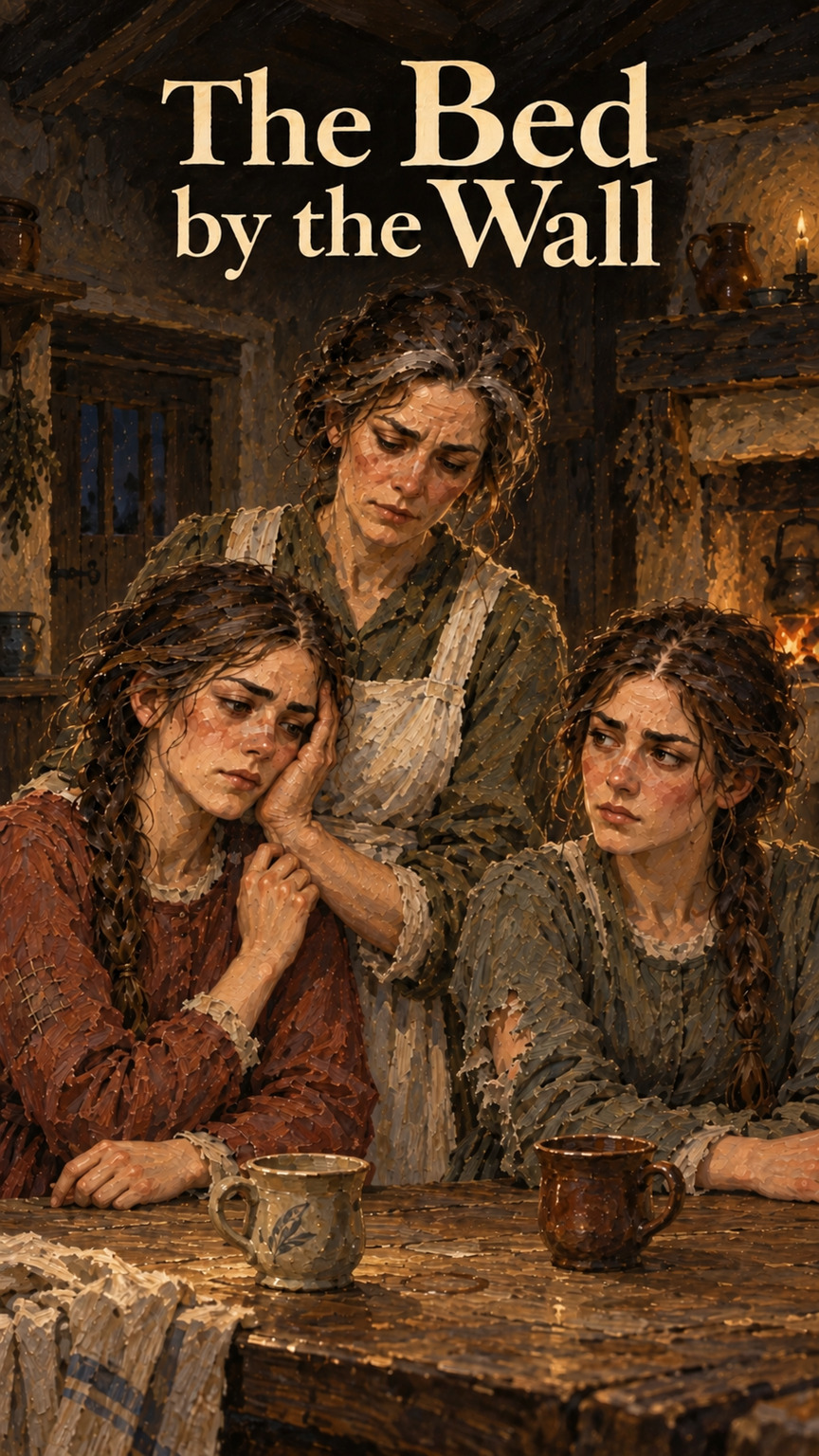
Carys waited until I had both hands in the dough to ask for the orchard ladder.
“What have you put up a tree?”
“Nothing. I need you to help me carry it.”
It was nearly dark. The bread should have been in the oven an hour earlier, and the ladder belonged to our neighbour, who had lent it to me until tomorrow. I told her that whatever it was could stay up there until morning.
She laid a folded paper on the floury table. Her hand remained over it.
“And we need to make up the little bed.”
I looked at her then. Sixteen years had given me a fair knowledge of the things she could say easily. She could confess to breaking a plate while the pieces were still falling. This had taken her all afternoon. I had heard her coming to the kitchen door and going away again.
“Who's coming?”
She moved her hand.
The paper had been folded and unfolded until its corners were soft. A bird was drawn along one edge, its head turned back into its feathers. Under it, in cramped writing, someone had written:
They have taken the tall chest downstairs. I got the last nail out of the frame. I can get my shoulders through. Tonight, while they load. You will have to bring her. Please bring her.
It was signed Briony.
“Who's her?” I said.
“You.”
Carys pulled a bundle from inside her dress. More papers, tied with blue thread. One had a little pressed leaf caught in the knot.
“There's a girl in the house above the old quarry.”
I waited.
“They took her from the plum trees. When she was four.”
My hands were beginning to ache with the dough drying between my fingers. Carys had been four when she wandered out of the orchard. Her father found her sleeping underneath the hedge after we had spent half the afternoon calling. He brought her home with a thorn in her stocking and cried while I pulled it out.
“They made me look like her,” she said. “They left me in her place.”
I looked from the papers to her face. The small dent in her upper lip. The dark brows that nearly met when she was cross. She had my mother's eyes, and her father's habit of turning her whole body when someone spoke from behind her.
“Don't,” I said.
She held the bundle against herself.
“The thread seller carries things for them. He came to find me three summers ago. He said I was growing just like the girl they'd taken. I made him tell me what he meant.”
The thread seller had eaten bread in this kitchen. He wore his hat indoors and never let me pour his tea.
“He took a letter for me. She wrote back.”
“Three summers?”
Carys nodded.
I drew my hands from the bowl. Dough stretched and broke. She fetched the jug from the shelf, as she always did when my hands were dirty, but I went past her to the washstand.
“Why didn't you tell me?”
“I was going to.”
“When?”
She had an answer ready. I watched her decide against it.
“I don't know.”
Outside, a cart went by. We both listened until its wheels had passed.
“They're leaving tonight,” she said. “On the summer road. When the moon goes down, it goes too. She says they'll take her if she's still there.”
I knew about the road. Once, before Carys was born, her father and I had watched the fairy coaches pass across a field without bending the grass. He put out our lantern and kept his hand over my mouth until the last had gone. In the morning there was no road in the field, only the sheep walking where it had been.
I wiped my hands on my apron.
“Show me where.”
Carys did not move at once.
“Afterward,” she began.
I could not help her with afterward. I went upstairs and pulled the little bed out from under hers.
It was a low truckle bed with one foot shorter than the others. I wedged a scrap of leather underneath and put it beside the wall. Carys slept best with one knee drawn up against the plaster. I found a sheet and the spare blanket. Then I went out for the ladder.
*
We carried it between us along the lane, Carys in front. Whenever she turned to check on me, the end dipped and knocked my shin.
“Watch where you're going,” I said the third time.
She faced forward.
There were years folded in the bundle against her ribs. Three summers in which I had asked what she wanted for supper, whether she needed new stockings, why she was so quiet. During those same years another girl had been waiting above the quarry. My anger could find no useful shape. It settled on the back of the neck I knew, on the small hairs escaping from her plait.
“Was there no way before tonight?”
“We tried things.”
“What things?”
“She got into a coach once. They found her before it left. I went up to the house in spring, but they knew me. They thought it was funny. They made us stand together.”
I stopped walking. The ladder pulled against my hands.
“You went there?”
“I didn't tell them about the letters.”
“That isn't what I asked.”
She stood with her back to me. In the gathering dark, I could still see the white parting in her hair.
“I didn't think you'd want me when you knew.”
I ought to have answered her. I had answered smaller fears in worse places: beside her father's bed, in the lane after a dog knocked her down. But I was thinking of a child trying to hide in a coach.
“Lift your end,” I said.
We crossed the quarry track. The house stood on the shelf of land above it, where in winter there was only broken stone and a stand of elder. Tonight its chimneys rose past the trees. Lamplight moved behind windows too closely set, and a coach waited at the front with its shafts pointing uphill.
“If they come after us?” I whispered.
“They have until moonset. If they miss the road, they stay here a year.”
“Then they can stay.”
“She says they won't.”
She led me around the back. A narrow window stood open above a sloping roof of loose slates. Below it were stacked chairs, a rolled carpet, a stone figure with a sack over its head. We put the foot of the ladder among them and raised it slowly. One rail grated against the wall. Carys caught it before it struck the window.
A face appeared in the opening.
For an instant I turned to see how Carys had got up there. She was beside me, with both hands on a rung.
The girl above us pushed her plait out through the window first. It fell over the sill. Then she put an arm through, feeling for the ladder.
“Lower,” Carys whispered. “Your hand. Lower.”
I wanted to climb to her. But the foot was on uneven ground, and when Carys put her weight against the left rail, the right began to lift. I planted my boot on it and held on.
The girl had a flat wooden case wedged under one arm. She got her head and one shoulder outside. Her dress caught on a projecting nail. She backed an inch, tugged, and the case slipped from her arm into the room.
We heard it hit the floor.
“No,” she said.
She tried to draw her arm back. From the front of the house came a shout, followed by the sharp complaint of a door being dragged over stone.
“Leave it,” Carys said.
“It's all of them.”
“Get your foot out.”
The girl looked down at us. At me. I had imagined, on the walk, that I would know her when I saw her. I knew every feature. I could not read the way she held them.
“The ladder's slipping,” I said. “Please.”
She pulled the caught cloth until it tore. A knee came through. She lay across the sill, then lowered herself until her foot found a rung. Her bare heel pressed my fingers when she came down.
Carys took her wrist at the bottom. The girl shook her off.
“I can walk.”
A light came into the upper room. Someone called a name I had just seen written on paper.
We left the ladder against the wall.
*
At home I put the bar across the door and fastened the shutters. I had never tested either against anything that wanted to get in. Carys stood beside the hearth with the other girl. Now and then one glanced at the other and looked quickly away.
The moon was still above the orchard. I drew the kitchen curtain.
“Sit down,” I said. “Both of you.”
The bread had risen too far. It sagged when I put it in the oven. I needed something hot, so I cut yesterday's loaf and set milk to warm.
“I'll wash your feet.”
The girl looked down at them. A thin line of blood had dried above her heel.
“I can do it.”
“There's a cut.”
“I know.”
I put the basin in front of her. She waited until I stepped away before lowering her feet into it.
Carys reached for the brown cup on the shelf. I took it from her and set it on the table in front of the girl. Her father had made it, badly, with a thumbmark too deep in the handle.
“Do you remember this?” I asked.
The girl shook her head.
“You used to put buttons in it.”
“That's my cup,” Carys said.
I heard the ugliness I expected in the words and looked up sharply. She was holding an empty hand out toward the shelf. It was her cup. She drank from it every morning.
“I'll get another,” she said, and did.
The girl left the milk untouched. When I asked, she said she didn't like it warm. I almost told her that she did. Instead I poured it back into the pan and brought cold milk. Carys had begun rubbing a spot of dried mud off her dress. It was my old dress, altered twice, with the mending under the arm done in her own uneven stitches.
“What was in the case?” I asked.
“Drawings.”
“Yours?”
She nodded. “Birds. What I could see from the top pane. I put the names underneath when I knew them.”
“She drew a kite with the fork wrong,” Carys said. “I told her.”
“It wasn't a kite.”
“You said it was.”
“I said that's what they called it.”
Carys bent again over the mud on her skirt.
“Can I see the bird I sent you?” the girl asked.
Carys pushed the loose letter across the table. The girl smoothed it on her knee and bent over it for a while. Then she folded it with the drawing inside and put it into the pocket of her skirt.
I found a clean cloth and a needle. The girl allowed me to set them on the table. When I looked at her hand, there was black ink in the crease beside her thumbnail. Carys had that dent in her lip, those brows, that same nail bitten short. Twelve years ago a child had been carried away and I had not missed a single breakfast with her face.
“Carys,” I said.
Both girls looked up.
I could not finish.
“Briony,” the girl said.
“Did they give you that name?”
“It's what I called myself.”
Behind the shutters something brushed the wall. Carys was on her feet before I had got round the table. We listened. A small scratching moved along the sill, then stopped. I kept my hand on the shutter fastening. I had gone to the quarry thinking only of the girl who was there. Now I could picture either of them being lifted through a window.
“A branch,” I said, too loudly.
We sat down again. The bread smelled scorched. I took it out and put it on the hearth without cutting it.
Briony had dried her feet. She held the cloth in her lap.
“Carys told me about Father.”
I nodded.
“She said it was in the autumn.”
“Six years ago.”
“I know.” She picked at a thread on the cloth. “Was he awake?”
“Most of the time. At first.”
“He kept wanting us to open the window,” Carys said. “Even when it was raining. He said the room smelled—”
“Let me tell her.”
She shut her mouth. I was grateful for the silence. There was so little I could give Briony that she had not had to get through someone else.
“He wasn't frightened,” I said. That was not wholly true. “We stayed with him.”
Briony looked at the cup, then at me.
“Did he ask where I was?”
The kitchen became very quiet. The fire had burned down to a glow around the underside of the loaf.
“He didn't know,” I said.
She was looking directly at me now. I had to go on.
“Neither of us knew.”
“So he thought I was here.”
I nodded.
“When he died?”
“He had your hand.”
“My hand,” Carys said.
Her voice had scarcely any sound in it. I turned and put my palm against the side of her head. She leaned into it before she could stop herself. I felt the familiar weight, the warmth under her hair. Then she pulled away.
Briony was watching us.
I put my hand on the table. There was a damp ring where I had set the milk.
“He would have—”
“Don't,” Briony said.
I closed my mouth.
She folded the cloth carefully along its wet creases. Carys stood up and went to the stairs. Neither asked me to come.
*
I stayed in the kitchen until the moon had gone behind the orchard and the light under the curtain had thinned. Far off, wheels rattled over something harder than earth. They went on for a long time.
The sound passed. Later an owl called from the quarry.
I took a candle upstairs.
Both beds were empty. For a moment I could not move. Then I saw Carys sitting on the floor between them, still dressed. Briony stood by the window, examining the latch.
“Don't open that,” I said.
“I wasn't going to.”
“The road's gone.” Carys had been looking through the gap in the shutters. “It's just the field again.”
I set the candle on the chest of drawers. There was not much space. Carys's boots stood under her chair; her books were stacked on the window ledge. I had put Briony's bed against the wall where there was room for it, and its blanket was already rumpled at the foot.
“Is it all right?” I asked.
Briony looked at the bed.
“I don't want to sleep there.”
“It isn't damp. I aired the blanket last week.”
She rubbed her forearm. The dress had torn almost to the elbow.
“I don't like being against a wall.”
“You could have mine,” Carys said.
“Yours is against a wall.”
“The head is.”
“I can see that.”
I bent to straighten the blanket. “We can turn it.”
“There's no room,” Carys said.
“If we take the chair—”
“That's where I put my clothes.”
I stood up. Carys was looking at me, not at Briony. All evening I had been taking things from her hands.
“The chair stays,” I said to her.
I turned to Briony. “I could make up a place downstairs. Or you could come in with me.”
She gave a small, immediate shake of her head. Then she looked away, as if she had been rude to someone in a shop.
I had kept her first shoes. They were wrapped in a piece of linen in the bottom drawer of my chest. I had thought of them while carrying the ladder: I would show her the shoes, the little blue coat, the height marks on the door. I had not understood how much of what I could show her belonged to Carys.
“You don't have to decide now,” I said.
“I have to sleep somewhere.”
There was no answer to that which did not begin the whole thing again. I left the candle and went downstairs.
I washed the bowls. Carys usually dried them while I washed, but I set them on a cloth tonight. The other letters were still on the table. I gathered them without untying the thread and laid them on the stair. They were not mine to read through.
Above me a bed scraped over the floorboards.
“Mind the books,” Carys said.
Something knocked against the wall.
“You said mind them after I hit them.”
“You can see them.”
I went to the foot of the stairs. The scraping stopped. There was a pause, then Carys said, more quietly, “It won't go straight.”
“Then leave it crooked.”
I sat on the bottom stair. After a while the door opened above me. Briony came to the landing. She had the candle, and I was afraid I would call her by the wrong name again.
“Have you got a pillow that isn't feathers?”
I had one stuffed with carded wool in my own room. I fetched it, slipping the cleanest case over it, and carried it up. Briony waited in the doorway. Behind her, the little bed stood at an angle, with a passage just wide enough to squeeze through on either side. Carys was kneeling beside a spill of books. Her chair was still in its place.
I waited for her to look up, but she kept putting the books in order.
I held out the pillow. Briony took it against her chest.
“The books under the stairs,” I said. “You can take any of those too.”
She looked down at the pillow. “Not tonight.”
“All right.”
She stepped back. I moved my fingers clear of the door, and she closed it gently.