
The cup stayed where it ought to have smashed, four inches above the kitchen tiles.
I had knocked it off the table with my elbow. I shut my hand and said, “Stay!” as if it had done something naughty, and there it was, hanging with its big yellow handle sticking up. A drop of tea fell out of it and landed on my foot.
“Mum,” I said. “Look.”
She was looking. So was Dad. Mum had stopped squeezing the dishcloth, and water was running down her arm.
Enna put her fingers over her mouth. She made a small noise behind them.
“I did that,” I said.
Dad came round the table very slowly. “Have you done it before?”
“No.” I opened my hand to show him. “There's nothing.”
The cup stayed where it was.
Mum spread the dishcloth underneath it. She asked if I could let it down.
I didn't know. I pointed my open hand at it and said, “All right. You can go.”
It dropped onto the cloth with a clunk. Mum picked it up and checked the handle. Dad asked me to tell him exactly what I had said, from the beginning.
Enna was still smiling.
All that Thursday evening she kept smiling, even when she thought nobody could see. Once, while Mum and Dad were talking in the kitchen with the door shut, she gave a little chuckle and shook her head.
I went to bed waiting for somebody to be pleased with me.
By breakfast, Dad was calling everything I said “interesting.” He had never found my opinions about porridge interesting before. Mum asked me not to experiment until they had talked to somebody who knew about these things. When I reached for the marmalade, Dad passed it to me so quickly that the lid fell off.
Enna chuckled into her sleeve.
“What?” I asked her.
“Nothing.”
“You keep doing that.”
Her smile tried to get bigger. She pressed her lips together.
I put the marmalade down. I was ten, and I knew when people were laughing at me.
“It was a whole cup,” I said.
“I know.”
“I could do something bigger.”
“Let's leave bigger for a bit,” Mum said, and Enna laughed again. This time Mum looked at her.
My sister was eighteen. She had been eighteen since spring, and supposed to leave since summer.
She had a place at a theatre in the city, where she was going to learn to paint forests that rolled up and castles that could be carried through doors. She'd shown me the letter until the folds went white. There would be a room above a bakery. The theatre had sent her a list of things to bring, including stout shoes and clothes that could get paint on them. Enna said she had been training for that part all her life.
On the morning she was first meant to go, she couldn't get through the garden gate.
She could open it. She could put a hand through the bars. But when she tried to walk out, her next step wouldn't happen. She stood with one foot lifted, looking cross, then frightened. Dad took her bag and told her to try again without it.
She had tried facing backwards, with her eyes shut, and over the back wall. She'd thrown her bag onto the road and gone upstairs to see if she could make herself forget it was there. She remembered within a minute and came down crying.
The woman who came to look at her said somebody had set a hold. She felt round Enna's shoulders and along the garden wall with her eyes half closed. At the gate she drew her hands back.
“I can tell you it's there,” she said. “I can't tell you who made it. Only its maker can let it go.”
After she left, Mum said that a person's first spell could happen without them knowing. Dad said it was a very big change, moving to the city. Perhaps Enna wasn't quite ready.
Enna said she was ready.
They talked about it a lot that summer. Sometimes I heard Mum say, very gently, “You can admit it, darling.”
I told my friends Enna would go when she was ready.
Meanwhile, we had the theatre in my bedroom. Enna had made it out of a grocer's box, with a curtain on a knitting needle. She painted the scenery and worked the curtain. I did the puppets and nearly all the voices, because she said mine were much worse. My knight had a foil helmet. His horse was a sock with buttons for eyes.
“Where is your noble steed?” she would ask, in a queen's voice.
“In the wash!” I would squeak.
It was not the best joke in the play, but she always laughed.
There had been plenty of plays that summer. Sometimes she said she was tired, or wanted to paint her own things, and I would hang about outside her door making the knight clear his throat.
After breakfast on Friday I carried the yellow cup upstairs. Enna's door was open. Her bag lay on the bed, packed again. It was always packed near the end of a month, when another letter came from the theatre. This time they had said they could hold her place until Saturday.
She was sorting paintbrushes. Each handle had a little rag tied round it to keep the bristles from rubbing.
“I can do it again,” I said.
She looked up at once.
“Can you?”
I put the cup on her desk. “I could try on you.”
The smile left her mouth, but stayed somewhere in her face.
“What do you mean?”
“You can't get unstuck. I made the cup get unstuck.”
Enna sat down on the edge of the bed. She looked at the cup for so long that I thought she'd say it was different, or too dangerous, or wait till Mum had spoken to somebody.
Instead she said, “Get your shoes.”
At the gate I set the cup on the flat top of the post. Then I knocked it sideways, shut my fist, and told it to stay. It hung with its yellow handle pointing at Enna.
She was looking at my hand.
“Do that again.”
“I have to let it go first.”
“No. What you said.”
“Stay.”
She caught her breath. For a moment I thought she was going to laugh again.
“You had my sleeve,” she said.
“What?”
“The morning I was leaving. You wouldn't let go of my sleeve.”
I remembered. Her bag had been beside the gate. Mum was looking for the tickets, and Enna had bent down to say goodbye. I had got a fistful of her shirt and pulled her back towards the house.
Stay home till I'm big. Then I can come too.
The cup hung between us.
“You think I did it?”
“I think you might have.”
“I only said something.”
“So did you yesterday.”
I wanted to hit the cup. I wanted to throw it all the way down the road.
“Why didn't you tell me?”
“I didn't know.” She rubbed her face. “Last night I thought, perhaps. And then I thought, don't be stupid, you'll only be disappointed again.”
“You've been laughing.”
“Yes.”
“At me.”
“No.” Her voice came out too loud. She looked past me at the house, then lowered it. “I started to think they were right. That I didn't really want to go. You don't know how many times I've stood here trying to want it properly.”
She made that small noise again. “And then you went and stopped a cup. It might not have been me at all.”
“You could have asked me last night.”
“I could have.” She swallowed. “I wanted to see you do it again.”
“Mum said you weren't ready.”
“I know what Mum said.”
Enna looked so angry that I stepped back. The cup was still hanging over the gravel. I opened my hand towards it.
“You can go.”
It fell. Enna caught it against her stomach and set it on the post.
“Could you try?” she asked.
I stared at her shoes. They were the stout ones from the list, with white paint on the toes. She had worn them all summer.
I didn't want her to go. I wanted the cup back in the kitchen, and breakfast to start again, and Enna to say something rude about my porridge.
I held my open hand towards her.
“You can leave home,” I said. “You don't have to stay.”
She put one foot through the gate.
Then the other.
She stood on the road with her arms a little way out from her sides. She looked down at herself. A cart rattled past, and she moved aside for it, two quick steps that made her look astonished.
She turned towards the corner.
“Wait!” I cried, and my hand shut.
Enna stopped with one heel off the ground.
Her arms jerked. She tried to put her foot down. I could see the muscles moving above the edge of her shoe, but the heel stayed up.
She turned her head towards me.
“Open your hand.”
I did.
“Let me go.”
“You can go.”
Her foot came down hard. She stood with her back to me for a moment, then walked to the corner. I waited beside the gate, afraid to call after her.
She came back along the road. She could do that now. She stopped just outside.
“Are you leaving?” I asked.
“Tomorrow. My train is tomorrow.”
“I thought—”
“I'm going to finish packing. And I'm sleeping in my bed.” Her voice shook. “I don't want to be scared to come home.”
I moved away from the gate.
She walked past me carrying the cup.
Dad was at the back door. He had seen her on the road. When she reached him, he put a hand out, then let it fall.
“You told us,” he said.
“Every time.”
“Yes.” He looked at the cup in her hands. “We should have listened.”
She gave it to him and went upstairs.
I stayed in the garden until Mum came out. I thought she would tell me off. She sat on the step beside me instead. There was dirt on the knee of her good trousers.
“I said she could go,” I told her. “I did.”
“I saw.”
“Then I made her stop again.”
Mum looked at my hand. “Did you mean to stop her?”
I tried to explain about the corner, and how Enna had turned without telling me how far she was going. It sounded worse when I said it. I stopped.
“We need help with this,” Mum said. “The woman who came to see Enna is coming back tomorrow afternoon. Dad and I will be with you. Until then, no trying spells on people.”
I nodded.
Mum picked some dirt off her knee. “And I was wrong to keep saying your sister wasn't ready. She wanted to go.”
Mum stayed on the step with me.
After supper Enna came into my room for the scissors. She had a parcel to tie up. I was sitting behind the little theatre with the knight on my hand.
“Could we do one?” I asked.
“Not tonight.”
I rattled the knight's helmet. “Just the short one.”
She looked at him, and then at me.
“I have things to do.”
I let the puppet fall. She took the scissors.
For a while I sat behind the curtain, which had a little hole where Enna had pushed the needle through too hard. I could see the corner of my pillow through it. I thought about going to her door with the horse, but I stayed where I was.
I tried the play by myself.
The knight asked for his horse in the queen's voice. I had to stop and change voices. Then I couldn't pull the scenery across because the horse was on one hand and the knight was on the other. I put down the horse. The knight fell backwards into a forest, and the curtain came off its needle.
From Enna's room came the sound of paper being folded. Mum asked if she wanted another blanket for the journey. Enna said yes, please.
I took the puppets off my hands.
Behind the theatre were the pieces Enna had cut out but never painted. There was a mountain with three peaks. I had asked for it in spring, for a play where the knight had to climb all three and kept finding he'd dropped something at the bottom.
I fetched my paintbox. The mountain wouldn't fit in Enna's bag, so I drew a smaller one on the back of an old cereal box and tore it out. My middle peak came out crooked. I tried to match the purple she used for distant things, but my blue was nearly gone, and it turned out very red.
I painted snow on the peaks. Some of the red came through and made the snow pink.
Enna brought the scissors back while I was making a little stand for it.
“What's that for?”
“Your room. Above the bakery.”
She knelt beside me. There was a bit of string caught in her hair.
“Those are extremely warm-looking mountains.”
“The snow went wrong.”
“I can see why it's melting.”
I pressed the glued edges together. She waited while I did it.
“I'm sorry,” I said.
She sat down properly on the floor.
“I know.”
“I didn't know I could do it in summer.”
“I know that, too.”
I looked at the mountain. I had left fingerprints in the snow.
“But this morning,” she said, and stopped.
“I know.”
We sat there a little longer. Then she stood the mountain on my desk to dry and went back to her packing.
In the morning, she wrapped it in a clean handkerchief. She put it between two books in her bag.
Mum was going with her to the station. Dad carried the parcel as far as the gate. Enna carried her bag. She stopped beside me and bent down. I put my arms round her neck, loosely, because I was thinking about the shirt sleeve.
She hugged me hard.
“You can squeeze,” she said into my hair.
So I did.
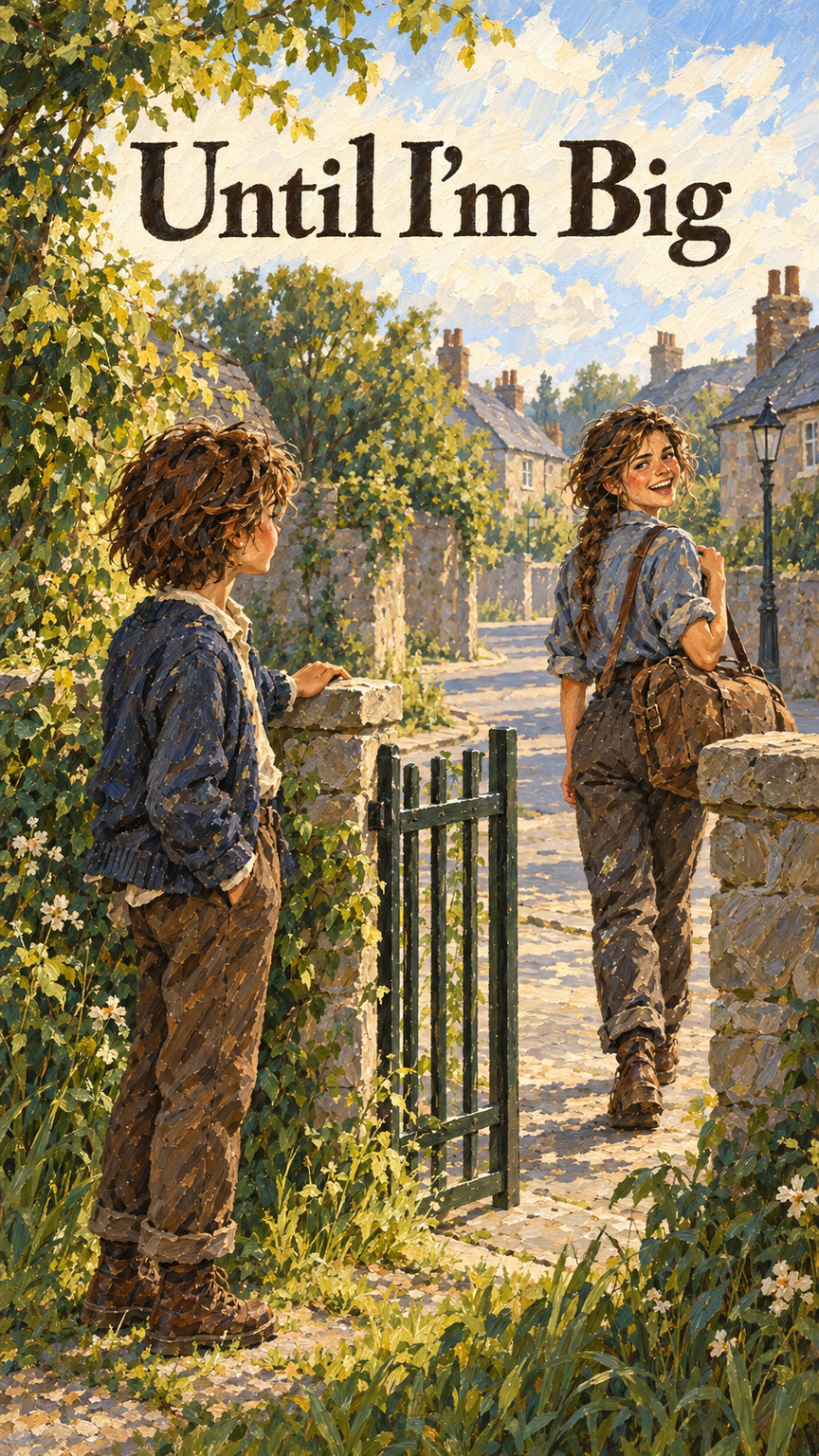
Then she straightened up and went through the gate. Mum followed. Dad handed over the parcel, and they started down the road.
I put my hand flat on the gatepost. The yellow cup wasn't there anymore. It was in the kitchen, with all the others.
Enna was almost at the corner when I took a breath to call.
“Where is your noble steed?”
She turned. There were people on the road, but she put her free hand on her hip and answered in the knight's dreadful squeak.
“In the wash!”
I laughed. So did she. Then Mum said something to her and she turned the corner, still laughing.
Dad put his hand on my shoulder. I stood there with him until the gate swung shut.