
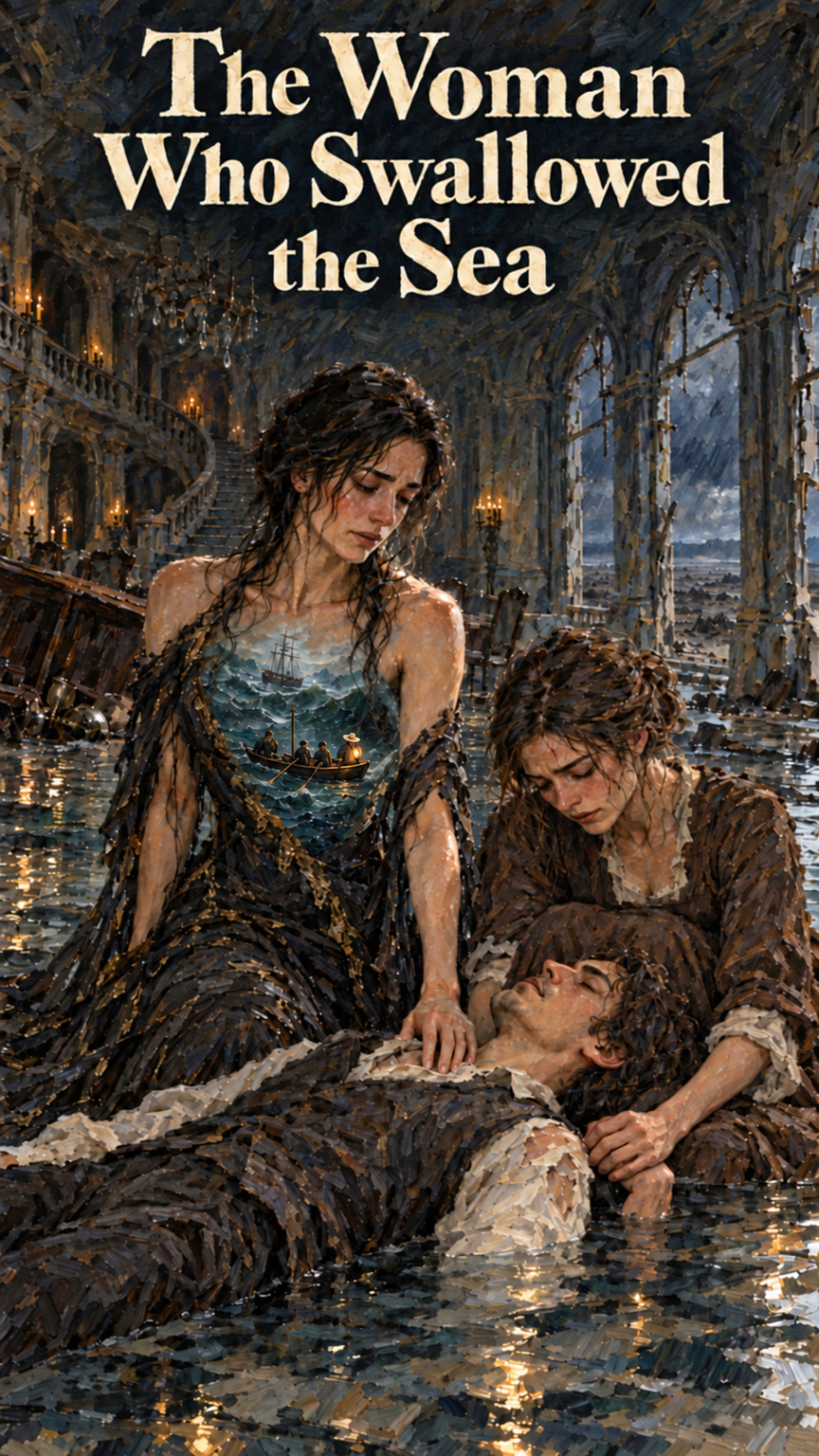
At the supper before she swallowed the sea, Belise asked her husband to stay for a pear.
Jowan had one arm in his coat. Beyond the long windows, the water was black; now and then a white line appeared on it, stayed a moment, and went out. He wanted to go down and see how his boat was riding. Belise wanted him at the table. He had been away for eleven weeks, and everyone had spoken to him except her.
“One pear,” she said.
He looked at the silver dish. “Two.”
He hung his coat on the back of her chair and sat down again. There were still a dozen guests, though the candles had burned nearly to their holders. His sister Utta was telling someone about the goose that had bitten her through a sack. Belise reached for a knife, but Jowan took it first. He always peeled her fruit. He also always took too much flesh off with the skin.
“You leave nothing for me.”
“I'm doing the work.” He ate a strip of peel. “This is my half.”
She took a slice from under his knife. He let her have it, then laid the next strip across the bare skin of her wrist. She flicked it back at him. It stuck to his cheek, and he left it there until she laughed. Across the table Utta looked up, saw him, and rolled her eyes.
Belise was still chewing when the first wave struck the windows.
The candles bent inland. Glass burst through the room. The long table moved sideways, carrying the candles, the pears, and a man's hand still resting on his plate. Then the sea was between them all. Belise came up beneath a chair and heard Jowan calling her name somewhere beyond it.
People found the stair. She saw pale sleeves reaching down from the gallery; she saw Utta clutch a baluster and turn back. Belise worked her way along the wall, catching carved leaves and stone mouths in her fingers. Another wave came through the broken windows. Jowan's voice stopped.
She searched by touching. The water lifted her dress and wound it round her legs. Once she reached for a hand that was her own reflection; once she found a dead candle and held it as if it could show her anything. Utta came down the last steps and caught her by the shoulder.
“There.”
Jowan lay under the overturned table. Its heavy edge had settled across his back, holding him face down. His right arm extended into the room. Belise caught his sleeve and pulled. The sleeve tore at the shoulder. He stayed where he was.
She ducked beneath the water to reach him. When she surfaced, the sea filled her mouth. She swallowed it.
The water fell the breadth of a finger against the wall.
Belise looked at the line it had left. She could still taste pear beneath the salt. She bent her face and drank again. This swallow kept coming. It drew the water off the stair, off the carved mouths, off the gilded feet of the chairs. Her throat worked and worked, and the sea went through it.
Utta had hold of her hair. Belise shook her off. Somewhere outside, a ship's bell sounded once, much too close. A point of yellow light swept towards her across the water. Behind it, someone clung to a short mast. Both vanished beneath her chin.
There was a boat attached to that light. She had seen the person aboard it. But now Jowan's sleeve lay on the surface, and she could reach the place where it joined his shoulder. She could bring his face up and hear his voice again. She opened her mouth.
The sea came in through every window. It crossed the hall in a low, dark wall and narrowed as it reached her. A chair turned, struck the table, and stayed. Little silver fish slid over the marble. The water took them up and brought them to her. Beneath the windows the shore appeared: first the house steps, then the rocks, then a great plain of ridged mud stretching towards the far mountains.
She drank until the sound of it stopped.
The hall was ankle-deep. From the broken windows came rain and the smell of the exposed sea floor. Utta crouched beside the table, bracing both hands under its edge.
“Help me.”
Belise put her shoulder beside hers. Together they rolled the table away from him. As she strained, a wave struck the inside of her breastbone.
She let the table fall on its other side. Utta swore. Together they took Jowan by the arms and drew him out across the marble. Belise's gold seams split at the waist. She felt the cloth give and paid no attention.
Utta tried to make him breathe. Belise held his face between her hands. His eyelids had always been a little darker than the rest of him, even in sleep; she rubbed one with her thumb, as though the color were something she could remove. Water ran out of his hair, down her wrists. Utta worked until her own breathing grew ragged. Then she sat back on her heels.
“Again,” Belise said.
Thunder sounded under her ribs.
Utta looked at her. Belise took a breath to say it again, and the loose black cloth lifted from her chest. Beneath the wet skin, between the torn gold seams, a sea broke white against the curve of a wave. Farther in, another wave rose. A three-masted ship leaned under stripped rigging, miles away inside her. Nearer, a small boat showed a yellow light.
Belise put a palm over it. She met her own skin. The light shone through the spaces between her fingers.
Four people were aboard the little boat. A woman sat at the tiller in a broad pale hat. Two were pulling oars; the fourth clung to the short mast. The sail hung loose, streaming water. As Belise breathed out, it filled so suddenly that the person at the mast fell to his knees.
She held her breath. The sail sagged. Both oars kept moving.
Utta reached for Jowan's hand.
Belise had it already. She pulled it into her lap and shook her head. She wanted to turn him towards her, wanted to lay his cheek against the place where his cheek had gone every night he was home. But when she bent, the little sea sloped. The boat's light dipped out of sight.
She sat upright. It reappeared.
Utta remained crouched on the other side of him, one empty hand on her knee.
“You could give me room,” she said.
Belise looked down at Jowan instead. His thumb had a white ridge across the nail. A lid had fallen on it in the summer, and he had complained for three days whenever she asked him to open anything. She rubbed the ridge. It was almost grown out.
Something knocked against the back of her teeth. She gagged and spat. An oyster shell, small as a seed on her tongue, opened to its ordinary size as it passed her lips. It struck the marble and spun. Brine ran down her chin.
The boat's light was coming higher. The woman at the tiller had turned towards the pale reach of her throat. Belise opened her mouth. A little water spilled over her lower lip and became a great splash on the floor. Utta scrambled back, dragging Jowan's other arm with her.
Belise shut her mouth. The water stopped.
Beyond the windows, the old sea lay empty under the rain. She could return it there. The terrace projected over the shore; she had stood at its rail a thousand times and watched for Jowan's sail. She set her free palm on the floor and began to rise. Jowan's arm lifted with her. She settled back down and drew his hand into her lap.
The boat had reached the upper curve of her breast. If she could get it out first, if she could open her mouth just enough, perhaps Utta could catch its people. Then she could stay beside him.
Belise leaned backwards to bring the water up.
It rose inside her like a floor tipping. The boat ran sideways. One oar thrashed in its rowlock; the person at the mast lost his hold and went over the bow. She saw him hit the water, saw the space where he had been.
She jerked upright. The wave fell away. The boat's bow turned down and inward, against the current she had made.
No, she wanted to say. Up here. This way.
She pressed her lips together. The two rowers bent their backs, pulling away from her throat. The lamp swung at the stern. Below them, a head appeared between two waves and disappeared again.
Belise kept one hand round Jowan's fingers. With the other she gripped the edge of her torn dress. She could feel a sound gathering behind her closed mouth. She tried to breathe a little at a time. The boat rolled; its sail hung uselessly. The woman in the pale hat took the lamp off its hook and held it out over the side.
Utta leaned close enough that Belise could feel her breath.
“I see him.”
The head was farther off than Belise had thought. The boat turned again. It was going away from her, into the dark water under her heart.
She looked at Jowan. He was beside her, and for the first time she could not bend down to him. She could not make the little boat come back. Its people had their backs to the way out.
The sound escaped her.
It was small in the ruined hall, scarcely louder than a hiccup. Inside her it raised a black swell that hid the lamp, the boat, the swimmer. Belise covered her mouth with both hands. Jowan's hand slid from her lap and struck the floor.
Utta caught it before the next wash of water reached it. She pulled it against her own chest.
The lamp came up on the far side of the swell. The boat rose beneath it, bow high, then dropped. A rower had an arm in the water. Someone hauled at the back of his coat. When the boat turned broadside, Belise saw the fourth person draped over its edge, his legs still trailing. The others dragged him in. For a while all four lay or crouched low in the boat. The lamp rested on the stern bench, shining on their wet knees.
Belise's breath came badly. Their sail stirred. One of them reached up and pulled it down.
She waited.
At last the woman in the pale hat stood and took up the light. The rowers set their oars in the water. This time they turned towards her throat.
Belise put out a hand for Jowan. Utta held his hand closer.
“You had him at home before he went,” she said. “I had this afternoon.”
Belise almost spoke. Utta's face was wet, and there was no way to tell which water was which. She had the same wide mouth as her brother. Belise had never liked the resemblance; at every family dinner there had seemed to be a part of him looking back from the wrong end of the table.
She turned her open hand upwards. After a moment, she lowered it beside Jowan's shoulder instead of reaching for the hand Utta held. She lifted his head a little, offering its weight.
Utta looked at her, then slid her free arm beneath him. She settled him against her knees. Belise took her hand away.
Above them, a man called from the gallery. Utta looked up.
“Come down,” she said. “We need to carry him.”
Two guests came as far as the last dry step. The first stopped at the moving light beneath Belise's skin. The other touched his shoulder, and they came on. Utta dragged the tablecloth off the wreckage and spread it alongside Jowan. She told Belise where to put her hands. They rolled him onto it together. When Belise bent, the boat slid towards her shoulder; she stopped, waited, and bent more slowly. Utta watched her with her jaw set. They worked without speaking until he lay on the cloth.
The guests lifted its far corners. Utta took the others. Belise rose beside them and caught Jowan's foot where it had slipped out. For three steps she went with him. At the stair, a woman from above came down to take the corner nearest Utta.
Belise let go of his foot. They carried him up to the gallery. She followed him with her eyes until the curve of the stair hid his face.
Then she turned towards the windows.
The boat kept moving. She could see the other ship behind it, sails being gathered by people too far away to distinguish. Farther still, more lights marked the swallowed sea. Every step sent a long disturbance through them. She learned to set her feet down softly. A fish brushed the inside of her throat and went down again.
On the terrace the rain was cold enough to hurt. Wind struck her torn dress and drove it against the stone rail. It was the same wind that had broken the windows. Out on the bare sea floor, scattered fish gleamed among the rocks. Something large moved in a hollow, beating its tail.
She knelt at the edge. Through the gap beneath the rail she could put her face above open air, above the steps and the shore and the place where there ought to have been water. In the hall behind her, Utta shouted to someone to get farther up the stair.
Belise opened her mouth. The first rush knocked her chin against the stone. She choked and shut her mouth, driving a wave back inside. The boat reared; a rower let go of a caught oar.
She clung to the rail. Her jaw ached; salt burned the corners of her mouth. Every breath scraped.
The lamp was still burning. The woman kept the light clear of the water while a rower brought the bow round with the remaining oar.
Belise moved her chin beyond the stone and opened her mouth. This time she kept it open.
Water poured out. She could not draw breath through it. Her shoulders heaved. The stream broadened beyond her lips, fell past the terrace, and spread white across the shore. It lifted the fish and ran into the hollows. The sound filled the empty basin, striking the far cliffs and returning.
She gagged. More came. She had to let her body shake.
The boat rose towards her tongue, its lamp bright enough now to show the pale hat's frayed brim. Belise could see the recovered sailor huddled beneath a coat. The woman at the tiller looked towards the opening. She lifted the lamp.
Belise felt the keel cross her lower lip.
Beyond her mouth, the boat lengthened away from her. Its bow plunged down into the returning sea; its mast rose taller than the terrace. The stern swept past, the lamp suddenly a full-sized lantern close enough to touch. The woman leaned over the tiller, her straw hat soaked. She was looking ahead, shouting to the man with the oar.
The boat fell clear. It struck the water hard, took a wave over its bow, and came up. The woman hauled the tiller towards her. Belise saw her open mouth, heard one word lost in the roar. The recovered sailor raised his head from the coat. Belise kept him in sight as the boat turned out across the sea, until his face was too small to distinguish.
Water kept coming. Shoals broke silver through it. The great ship's bowsprit grew out over the dark, followed by its black hull and the bundled weight of its sails. More distant lights scattered into their proper distances. Belise knelt with her hands locked round the rail while the sea returned through her, wave after wave. It filled the space between the mountains. It struck the house steps and came up them. Behind her, chairs knocked together in the hall.
When she could breathe, she breathed. When the water came again, she let it.
At last her empty stomach clenched. Nothing came out but a thread of salt water. She stayed where she was until her arms would hold her weight, then crawled back through the window.
The hall was flooded again. The table lay on its side beneath a shattered chandelier. A pear bumped softly against one of its legs. Belise caught the banister and climbed.
Utta sat on the gallery with Jowan's head in her lap. Someone had brought a blanket, but his feet extended beyond it. One was bare. They had lost a shoe in carrying him.
Belise knelt beside that foot and covered it. Her throat closed when she tried to swallow. She waited for it to open, but it would not.
“There's water,” Utta said, pointing to a glass beside her. Then she looked at Belise and pushed it away.
Belise moved closer. She put her hand beneath Jowan's shoulder, where the cloth was bunched and pulling his head sideways. Utta let her lift him. Together they settled him more comfortably, Utta still holding his hand, Belise supporting the back of his neck.
From beyond the broken windows came the ship's bell. This time it was far away.