
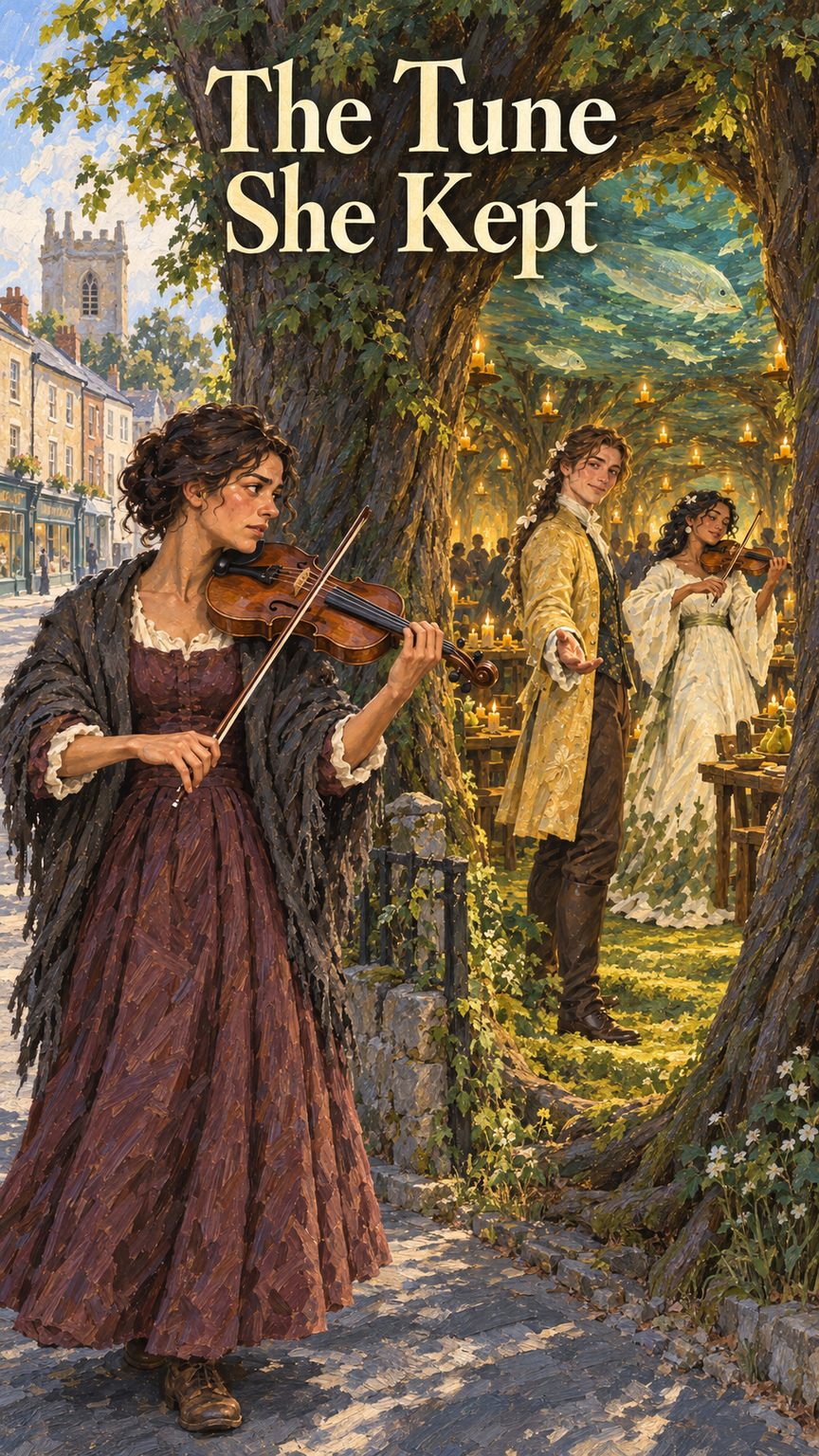
The bride at the first wedding had split her skirt. I played while her sister sewed it, and the guests stamped so hard that the pewter cups moved towards the edge of the table. By eleven my shoulder ached. Someone gave me a parcel of cake for Agnes, and someone else asked whether I couldn't play something they knew.
I played it. There are worse ways to earn a shilling.
Agnes was sleeping at my sister's, across the lane from our house. Before I left she had asked me to wake her when I came back.
“Even if it's dark?”
“I'll know more about the wedding if it's dark.”
She was seven. She believed late hours improved a story. I had promised her the full account: the bride's dress, what they ate, whether the groom cried. He had. I was looking forward to telling her that.
In the copse behind the church I heard a fiddle.
It was playing a tune I knew, although I had never heard it before. I stood on the path with my own instrument under my arm and listened to the phrase come round. The player left a little gap each time, where I expected a turn. I supplied it under my breath.
On the third repetition, someone supplied it back.
Between two trunks stood a man in a yellow coat. His hair was braided with small white moths that opened and shut their wings. Behind him I could see a long room where there should have been more trees.
“You've come with your fiddle,” he said.
“I've come past with it.”
“That would explain why you're standing outside.”
He moved aside. The smell of pears reached me, warm pears in butter, and underneath it something like the rain on our lane after a hot day. I could see the other fiddler now. She had six fingers on her bow hand. When she turned her head, her earrings went on turning.
“What wedding is this?” I asked.
“Ours.”
“You and the fiddler?”
The man looked delighted. “Yes.”
I knew what the opening was. My mother had told me enough stories. They disagreed about almost everything except the wisdom of keeping to the path.
“I can't stay,” I said.
“Then you mustn't.”
The fiddler left the gap again. This time I lifted my bow.
I meant to play the turn from where I stood. But a dancer passed through the doorway, offered me a hand, and I took it to steady myself over the root.
Inside, the floor gave a little under my shoe. It was covered with living moss, trimmed so close that the dancers' heels made no mark. The ceiling was the underside of a lake. Fish moved above the candles. Once, a large pale belly blotted out half the room, and the wedding guests looked up as casually as I would look at a cart passing the window.
The six-fingered woman drew me beside her. Her shoulder was warm through her sleeve. We played the strange tune together, and when we came to the place I had filled in, she gave me the whole phrase to myself.
Nobody asked for something else.
I played the tune twice, then a reel, then the little air I had made for Agnes when she was a baby. It had become the song we sang over her stockings, to persuade the heel to turn the right way.
Three white pears on the parson's tree,
One for the rook and one for me—
“Who gets the third?” the bride asked.
“It changes.”
“Good,” she said, and put a finger to her own highest string.
The tune opened. There were ways through it I had never found, little doors in the space between one note and another. I followed her into them. She followed me into a low phrase that had always sounded foolish on my own. The man in yellow danced with a woman whose skirt was made of overlapping leaves, and the leaves turned red as they whirled.
Later I ate the pears. Later still I danced. A small gentleman with a beard down to his knees tucked it into his belt before taking my hand. I laughed so much that he asked whether he was doing it incorrectly.
“No,” I said. “No, please do it again.”
I had been a widow for three years. I loved my sister; I loved the warm place Agnes made in my bed. I had not known how much I wanted a hand at my waist that asked nothing further of me.
When the beard came untucked, we had to stop.
There was more music. I remember a woman catching a falling candle between her bare palms, the flame looking out through her fingers. I remember the bride leaning against her husband's shoulder while I played. There were little bones of some delicious creature beside my plate. I do not remember getting tired.
The man in yellow offered me another pear, and I thought of the cake in my pocket.
“I must go,” I said.
“Already?”
“I've promised my daughter a story.”
The bride lowered her bow. “Then tell her a good one.”
One of my strings had begun to fray. She took it off and replaced it with a bright strand pulled from her sleeve. It hummed before I touched it.
“Play this under those trees when you want us,” she said. “We shall hear.”
I thanked her. I thanked them all. On my way out the little gentleman tried to kiss my hand, but his beard caught on a chair and he had to bow from some distance.
I was still smiling when I stepped over the root.
The path had gone.
There was a hard black surface under my feet, with white marks painted on it. Something blue, taller than I was, came towards me. Behind its windows a seated woman was eating an apple. A horn sounded. I jumped backwards, fell against the tree, and watched the woman slide past, still chewing.
For a while I did not move. The copse had shrunk to six trees behind a low fence. Beyond it stood houses, three storeys high, all down what had been the meadow. A woman walked past. When I asked where the lane was, she pointed, then looked at me again.
“Are you with the festival?”
I asked for my sister's house. She did not know my sister. I asked for the Bell house, beside the wheelwright's. She did not know a wheelwright.
The church was there. Its tower had a pale patch where the ivy ought to have been. On a board outside were the words SUNDAY 17 MAY 2026.
I read them, then read them again. Below was an invitation to a sale of plants.
I stopped a man carrying a bag of bread.
“That year is wrong.”
He looked at the board. “No, that's today.”
I told him the year was eighteen hundred and twenty-six. He held his bag against his chest and asked whether I had somebody he could call.
“My sister.”
“Have you got her number?”
I could give him her name. I could give him her husband's name and the names of their children. When I had finished, he was looking past me for help.
I left before he found it.
Our house had been white, with a brown door that needed lifting to shut. The lane where it stood was lined with shops. I went into a passage between two of them, where I thought our garden might have been, and found a locked gate. I rattled it until a man opened a window above me and told me to stop.
I nearly asked him whether he had seen my little girl.
Instead I went back to the street.
There were fiddles in a window. Three of them hung by their necks against dark cloth. I stood looking until the woman inside came and opened the door.
“We don't open till ten,” she said. “Can I help?”
She was about my sister's age, in blue trousers and a green shirt. A pair of spectacles hung from a cord against her chest. When she saw what I was carrying, she looked at it rather than at my clothes.
“Is that what you've brought in?”
I nodded because I could not think of a better answer.
Her name was Penny. She put my fiddle on a cloth and peered into it with a light. I watched her hands. They were capable hands, with a split beside one thumbnail. I found I could bear to look at them.
“Where did you get it?”
“My father.”
“And before that?”
“I don't know.”
She looked up. “Are you thinking of selling?”
I took it off the cloth.
“All right,” she said. “You don't have to. Would you like some water?”
I drank it in little sips, though my mouth was dry. Penny sat on a stool. She asked where I had come from, and I told her. Not all of it, at first. The wedding, the copse, the year on the church board. I could hear the rest waiting behind what I said.
“You mean you thought it was eighteen twenty-six.”
“It was.”
“Yesterday?”
“Last night.”
She rubbed the split beside her nail with her thumb.
“I can't make that make sense,” she said.
“Neither can I.”
She offered to fetch someone. I said no too quickly. She stayed on the stool.
“I'm looking for Agnes Bell. She was seven. I know she won't be seven now.”
That was as far as I could say it.
Penny picked up the little bright object beside the till. Her fingers moved across it. She asked how I spelt Bell, and when I gave Agnes's birthday, she asked me to repeat the year.
“February the fourth. Eighteen nineteen.”
She wrote it down. I was grateful for that. It was something a person might do with a birthday.
“I've got a friend who does local history. Let me ask her.”
She moved away to speak to the object. While she did, I went to the door and looked towards the passage. People were buying things. A boy licked something pink from a stick. I remembered that I still had Agnes's cake, and put a hand over the pocket to keep from touching it.
Penny's friend found several Agnes Bells. One had been born in the right year, but in November. Another had the right birthday, thirty years too late. Penny read out parents' names. None of them was mine.
While she searched I took out my bow. There was enough room between the stool and the counter. I played the opening of the stocking tune, quietly, watching my hand go to the places it knew.
Penny turned towards me.
“Three White Pears?”
“Yes.”
“I play that at the Sunday sessions. Where did you learn it?”
“I made it. For Agnes.”
She looked down at the names again. Then she called her friend back.
“Try the singing collection. There was a woman from here who sang that.”
We waited. Penny stood beside me, then went to put the kettle on. I kept returning to the first line. When the answer came, I was at the place where Agnes used to stick her foot out for the second stocking.
There was a page with my daughter's name on it.
Agnes Rusk, born Bell. 1819–1907.
There were other words. Penny had enlarged them so I could see. I would not read any further.
“Is there a likeness?” I asked.
“I'll ask.”
“Was Rusk her husband?”
“I think so.”
“There weren't any Rusks here.”
“People move.”
I looked at her. She pressed her lips together.
“I'm sorry. I don't mean—”
“No. They do.”
There was no likeness that her friend knew of. But there was a recording, made in 1904, of an Agnes Rusk in this parish. Penny turned the page towards me.
“This is the woman I heard. I didn't know her maiden name.”
I gripped the edge of the counter. Penny reached towards me, then took her hand back.
“Play it,” I said.
She did something with her finger. There was a scraping, a rushing sound, and then a man's voice, very small.
“Mrs Rusk. Eighty-five years of age. The seventeenth of June.”
An old woman coughed.
“Don't put that in.”
“I'm afraid it's already—”
“Oh, get on.”
Penny gave a little surprised smile. She had been watching me and missed the first notes.
I had not.
The woman sang through her nose. She had a low voice, rough at the edges, and she took a breath in the middle of the first line. I waited for the voice I knew to come through it.
It did not.
She sang the pear song. But the second line fell where mine had risen, and there was a length of tune after the fourth line that I had never heard. She went into it without taking breath, climbing three little steps, then slipping down between them. A wheel turned behind the rushing sound. I could hear it catch at each revolution.
“No,” I said. “That's not—”
Penny stopped it.
“Do you want to stop?”
“I want to hear the beginning.”
We listened again. The old woman coughed and objected to the cough being kept. She sang. I tried to hold Agnes's seven-year-old face before me, the gap where a tooth had been. It would not attach to the sound.
“Is there another Agnes Rusk?” I asked.
“I can ask.”
“Perhaps the name was put on the wrong one.”
Penny looked at the page. “There's a note. Can I read it to you?”
I nodded.
“She said she'd learned it from her mother, a fiddler. Dinah Bell. Her mother disappeared when Mrs Rusk was a child.”
She stopped there. I knew from her eyes that there was more.
“What else?”
“The collector calls it a fairy legend.”
I put my fingers over my mouth.
Penny waited. A woman came to the locked door with a black case. Penny went to let her in, spoke to her quietly, and took the case. The woman looked at me, then away. Penny put the case behind the counter and returned to the stool.
“The rest,” I said.
“Of the note?”
“Of her.”
The voice began again. In the next verse the parson was caught stealing his own pears. I had never sung that. Agnes had thought a parson ought to be able to reach the top branch without a ladder, because of his hat.
The old woman laughed halfway through a line and started it again. Her laugh was thick and almost breathless. I remembered that my daughter laughed with her mouth so wide you could see the bread she was eating.
At the end the collector asked whether she knew the song of the woman taken under the hill.
“I know it,” she said.
There was a pause. He asked whether she would give it to him.
“No.”
“Perhaps another time.”
“You'll not get round me by coming again.”
“Very well. What about the harvest song?”
“I used to sing that with my eldest. She could hold the long note. I never could.”
The wheel caught. Agnes drew breath.
Then there was only the little shop.
“Where's the rest?”
“That's the end.”
“She was going to sing.”
“They ran out. I suppose they had to change the cylinder.”
“Then play the other one.”
Penny searched. I watched her finger move. She went to a larger machine on the desk and searched there. Once she typed my name. I saw it and felt a foolish surge of hope, as though I might be found too.
There was no other recording of Agnes Rusk in the collection. We tried the other collections Penny could find. Her friend sent a short account of a life: three children, a husband who made boots, a move to another village, a return. There was a granddaughter's name. It did not tell me whether Agnes had sung the harvest song that day.
I asked to hear her once more.
By then the shop was open. Penny had to answer questions, fetch strings, listen to a boy play a few unhappy bars on a violin too large for him. She left the recording where I could start it with my finger. I listened with the cough. I listened without it. I played the beginning over the ending, trying to hear the old woman's breathing continue.
At some point Penny put a sandwich beside me. I ate half of it. The other half dried on its little plate.
“She didn't sing the right tune,” I said when Penny came back.
“The pear tune?”
“Here.” I lifted the fiddle. I played the four lines as I had played them over the stockings. “Like that.”
Penny listened. “That's lovely.”
“That's how it goes.”
She did not answer. I played it again, slower, to make it clear.
“I heard,” she said.
I lowered the bow. I had been trying to make a mistake large enough to put the old woman back in her place: somebody else's mother, somebody who had sung the song badly and been given my child's name.
Penny looked at the time.
“I need to shut up at five. I'm playing at six, and I've still got a repair to finish.”
“Where?”
“The Crown. Round the corner.”
“Will you play it?”
“Three White Pears? Probably. The dancers like it.”
“It's a song.”
“We put it with another tune. It works.”
She began collecting things from the counter. I wanted to ask her not to. I wanted her to sit down and find someone else who had known Agnes, someone who would know whether she had cried for me on the second night, and who had told her to stop waiting.
Instead I asked, “Where can I sleep?”
Penny set down a packet of strings.
“I don't know yet,” she said. “Can you give me a minute?”
She made another call. This time I heard her say, “I know, but she's here.”
She came back and gave me a piece of paper with a name and an address on it. Her sister kept rooms over a café. She could give me one for three nights.
“I've told her I'll pay. We can work out the rest tomorrow.”
“I can pay you back.”
“All right.”
She did not say it as though she believed me or disbelieved me. She was pulling on a different coat, one with buttons missing from the cuffs.
“I'll be in here at ten tomorrow. If I'm a bit late, wait.”
I nodded. She gave me the address of the Crown as well.
I went back to the trees.
There were people sitting near them, eating from paper. I waited until they left. Then I put my fiddle under my chin and touched the bright string.
The other fiddler answered.
The room opened between the trunks. The fish were overhead. The small gentleman had freed his beard from the chair and was combing it with his fingers. I could smell the pears.
The man in yellow came to the doorway.
“You've forgotten something?”
I stayed on the black path.
“Two hundred years,” I said.
He looked at me without smiling.
“Here,” I said. “Two hundred years have gone.”
Behind him, his wife began the tune we had made together. I knew exactly where my hand should go. My fingers moved on the neck of the fiddle, without the bow.
“Can you send me to the morning I meant?”
“No,” he said.
“Did you know?”
He looked past me at the buildings.
“I knew your trees would be older.”
I wanted to strike him with the fiddle. I wanted to step past him and put my shoulder beside the bride's and play until I did not know what a year was. She had left my part open. I could hear it, waiting inside the notes she played.
“Your daughter,” he said. “Did you tell her?”
I could not answer.
He put out a hand. The sleeve of his coat was yellow silk, so fine that I could see the movement of his wrist through it. I had touched that wrist while dancing. It had been warm.
I drew my bow across the ordinary strings. The bright strand sounded with them, and for a moment the bride and I played together through the doorway.
I finished the phrase. She let it end.
Agnes's breath was still in my ears. The song had been about to start.
“Not now,” I said.
The man lowered his hand. I took the fiddle from my shoulder, and the room closed.
I stood for a while among the six trees. I did not cut the string.
At the Crown I could hear music from the street. People moved aside to let me into a room that smelt of beer and hot food. Penny was sitting at the end of a table with two other players. There were dancers at the far end, some very young, one white-haired man who took tiny steps and grinned at his partner whenever they met.
Penny saw the fiddle and shifted her chair to make room.
“Are you eating?” she asked.
“Not yet.”
She pointed to a counter. “Tell him you're with us.”
I did that. He gave me a bowl of stew and a spoon. I sat near Penny and ate while the dancers argued over the next figure.
“You can join in,” she said. “Or just listen.”
I took out the cake. It was crushed, but it had kept the smell of nutmeg. I put it on the table beside my bowl.
“Wedding cake,” I said.
Penny broke off a corner when I offered it. She chewed it thoughtfully.
“Quite good.”
“Her skirt tore. At the first wedding.”
“The first?”
“There were two.”
“You'll have to tell me.”
I could have begun with the torn skirt. I could have told her about the ceiling, or the candle in the woman's hands. I was afraid of how I would sound telling it. Happy, perhaps. I had been so happy.
The player beside Penny tapped his bow on the table. She put the last of the cake in her mouth and lifted her instrument.
They began the pear tune.
It was quick. Agnes's long addition had become a place for the dancers to turn, then turn again when they thought they had finished. The white-haired man laughed at being caught. Penny leant into the repeated notes. She was watching the dancers' feet, enjoying herself.
I came in where I thought the old tune should meet it and was wrong. Penny glanced at me, then kept going. I stopped. At the next repetition I tried the lower phrase instead.
That fitted, until the part Agnes had added. I listened with my bow poised. There was a leap in it I could not catch.
Penny played it again. I missed the leap again. She grinned at me across the table.
“Tomorrow?” she said.
I nodded and waited for the part I could play.