
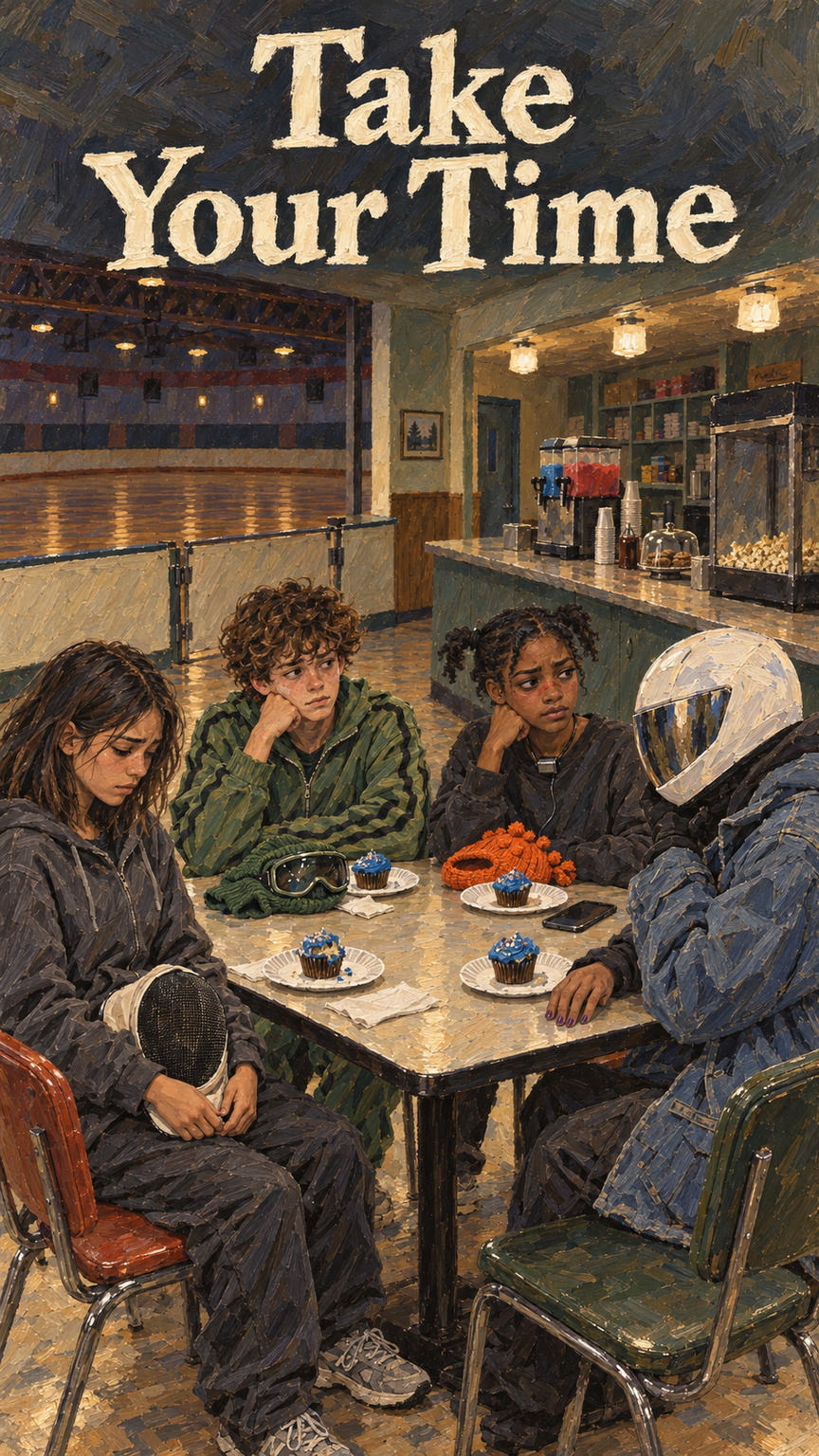
I had written our superhero names on paper plates, which made it look as if I intended to serve us.
There were four plates and four cupcakes on the table in the roller rink's snack bar. I had considered buying a fifth cupcake in case someone brought another superhero, then spent ten minutes being jealous of a person who didn't exist.
Cricket arrived first. He jumped over the barrier, landed on both feet, and held his arms up.
"Absolutely not," I said.
I put a second me beside him, pointing sternly at the gate. He walked through her, making a face. She dissolved after seven seconds, as always.
"Save it for the criminals, Afterimage. That was a normal jump."
"You went over a wall."
"It's waist-high. Cats do it."
His green ski goggles were scratched from last Saturday. He'd drawn black lines down his tracksuit with a permanent marker that had run out halfway through one leg. I wanted to ask whether he'd been back to the hospital. Instead I straightened his plate.
"Where's the owner?" he asked.
"Out. He said we could use the snack bar till eight. And no powers near the slush machine."
Three weeks ago we'd caught his falling sign. He had offered us unlimited rink access before learning that none of us could skate.
Cricket leaned over the cupcakes. "You got the terrible icing."
"You said you liked it."
"I do. It tastes like the colour blue."
He put the one with the most icing by my plate. He'd done that at the fair, too, with the last corner of a funnel cake: pretended he didn't want it so I could have it.
On Monday I had spent lunch in the library, pretending to look for a book that was in my bag. Here a boy had remembered which bit of cake I liked. I kept my hands busy with the napkins.
Sunspot came in arguing with Anchor about whether a hot dog counted as a sandwich. Anchor wore their usual white motorcycle helmet, mirrored visor down, and a denim coat with enough padding underneath to make them look like a small wardrobe. Sunspot's orange balaclava had bobbles on the forehead.
"If the bread closes, it's a sandwich," Sunspot said.
"A wallet closes."
"Please eat a wallet. Please demonstrate your point."
The voice filters Anchor had bought us made everyone sound like the same annoyed satnav. Sunspot could still put an impressive amount of contempt into a destination.
They sat down. Anchor kept their helmet on, as always. I had imagined, very specifically, the sound of that helmet being set on the table.
"Okay," I said. "So. Real names."
Sunspot pulled her balaclava off at once. Two little twists of hair sprang sideways.
"Zuri Keene. Sixteen. Hi. My ears were cooking."
She laid the balaclava beside her cupcake and looked around expectantly.
"You're meant to wait," I said.
"For what? You said real names."
"I thought we'd discuss it first."
"We've been discussing it in the chat for four days."
She rubbed her ears, then took out her phone.
"Name, normal number, someone to call. A photo so I can show somebody who I'm talking about. Doesn't have to be a nice photo."
"I can only do nice ones," Cricket said.
Zuri pointed at his goggles. "You weren't doing nice ones when they put you in the ambulance."
He stopped fiddling with the icing wrapper.
At the fair he'd caught a little boy who'd climbed onto the roof of a stalled ride. Getting up there had been easy for Cricket. Coming down with another person had not. The boy was fine. Cricket had sat on the ground asking whether we'd caught the boy while the paramedic shone a light in his eyes.
Zuri had stayed beside him until the ambulance left. I had been helping the boy find his dad. Anchor had held a buckled railing still while people climbed past.
"I texted," Cricket said.
"On Monday."
"I was asleep a lot."
"I know that now."
Zuri's phone was still pointing at him. She lowered it.
"I asked who to call and you said Cricket. You kept saying it. I had to go home and just wait for a cartoon insect to come online."
"Sorry."
"I don't want you to be sorry. I just can't do that again."
Anchor lifted one gloved finger.
"Not a photo," they said.
Zuri blinked. "What?"
"Of me. And not my name."
I had expected a bit of reluctance. I had brought cupcakes for reluctance. This sounded like a door being locked.
"It stays with us," I said.
"Still no."
"We trusted you with our lives."
Cricket looked down at his plate. Zuri looked at me.
"I was there," Anchor said.
"I know. That's why I don't get it."
"Being there doesn't mean you get everything."
"It's your face."
Anchor touched the bottom of their visor.
I waited for them to lift it. They didn't.
On the table between us, the plate said ANCHOR in silver marker. I'd drawn a silver border round every plate. This one was thicker where I'd tried to straighten it.
"Are we only going to see each other when something's on fire?" I asked.
"Something is on fire," Cricket said.
Zuri jerked her hand away from her cupcake. A tiny curl of smoke rose from the edge of the paper case.
"I'm annoyed," she said.
"We got that."
She blew on it. Cricket pushed a spare napkin towards her, then looked at Anchor.
"I want to," he said. "Do the names. I want someone to call my aunt if I can't. And I'd like to hang out when I'm not wearing this thing."
He pinched the ski mask under his goggles.
"I get spots. You can have that information free."
He unplugged the filter at his throat. When he spoke again his voice was higher and much less indestructible.
"Len Dacre."
He lifted his goggles and peeled off the mask. Brown curls stuck to his forehead. There was a pale patch on his cheek where the plaster had been.
I knew his face from school. I knew it from a video, too: Len standing on the little stage in the music room, one hand lifted, his voice breaking on a high note. The clip ended there. It didn't include whatever he'd done next.
I'd sent it to our year chat in February. Somebody else had added a squeaking-door sound. For a week people had made that sound when he went past.
He'd messaged me: Can you delete it please.
I'd written: It's already everywhere.
Len wiped his forehead with his sleeve and smiled at me.
"Don't say it."
I couldn't have said anything.
"The hair. I know. Helmet next time."
He was still smiling. I could tell him the curls looked fine. We could finish the cupcakes. On Monday I could pass him outside the music rooms and he wouldn't know the girl behind the fencing mask was me.
Zuri was looking at her phone. Anchor sat with their hands in their lap. Nobody was pulling at my mask.
I found the filter wire under my hood. It had caught in the zip, and for a few seconds all I could manage was an ugly little tugging movement.
"Take your time," Len said. "We can eat while you're dismantling yourself."
I disconnected it. I pushed back the hood and lifted the mask.
Cool air touched the sweat around my mouth.
"Romy Calder," I said.
Len's smile went away before I finished my surname.
Zuri glanced between us.
"You two know each other?"
"School," Len said.
He picked up the green ski mask, turned it over, and put it down again. I had never seen his bare hands before. There was icing on one thumb.
"Can we go over there?" he asked me.
He meant the far end of the counter, by the dark popcorn cabinet. I nodded. Zuri turned her chair towards the rink. Anchor followed her gaze, though there was nothing to look at except the empty floor.
Len went first. I stood too far away, then too close. He moved a pace back.
"Was it funny?" he asked quietly.
I looked at the popcorn trapped in the bottom of the cabinet. It was old enough to have its own dust.
"At the time."
"Right."
"I sent it. I shouldn't have. And when you asked me to delete it, I should have done it."
He pulled a loose thread from his mask. It stretched rather than breaking.
I almost told him that the people in the chat usually ignored me. That for about half an hour, after I sent it, they hadn't. But I could hear how it would sound standing here.
"Have you still got it up?" he asked.
I hadn't thought about the post in months.
"Probably."
He looked at me then.
I got my phone out. Finding the message took long enough that the screen dimmed twice. There were hundreds of things after it: homework, trainers for sale, somebody's dog. Then Len in the thumbnail, caught with his mouth open.
I pressed and held. I deleted my forward from the chat.
He watched. Neither of us said it would do much.
"I can tell them to stop," I said.
"They have stopped. Mostly."
"Okay."
"Don't start everyone talking about it again."
I put my phone away.
Behind us Zuri laughed once, too loudly. Anchor had apparently said something about the rink. I was grateful they were leaving us alone. Then I caught myself listening for Len to laugh.
"I didn't know you were Cricket," I said.
"Obviously."
"No. I mean."
I didn't know what I meant that wasn't worse.
Len finally broke the thread. He rolled it into a tiny ball.
"You could've just left the mask on," he said.
"I nearly did."
He nodded, once. He didn't say thank you.
"I'm not telling them," he said. "I don't want to do the whole thing."
"Okay."
He stayed by the cabinet. I went back to the table because I couldn't think how to ask if I was allowed to stay beside him.
Zuri turned around. She didn't ask what had happened. She pulled her phone close to her chest, out of its ready-to-take-a-picture position.
I sat with my mask in my lap. There was a red mark across the bridge of Zuri's nose. I hadn't noticed it before.
Anchor said, "I can give you a number. Someone who knows what I do."
Zuri looked at them.
"Will they know who I mean if I say Anchor?"
"They call me that too. They've seen my face."
"I was telling him everything was fine. At the fair. I kept saying it, and I didn't know."
Her voice had gone small at the end. She cleared her throat.
"I need somebody who'll actually come."
Anchor nodded.
Zuri looked down at her phone.
"Maybe we don't need the photos," she said.
Anchor took off a glove, revealing a hand with chipped purple nail polish, and held it out for Zuri's phone. She gave it to them. I watched them enter a number under ANCHOR CONTACT. We were going to have to trust a name we hadn't been given, and a person we hadn't met.
"I need to talk to them before Sunday," Zuri said. "If I can't, I'm not going out with you."
"Tomorrow. I'll tell them you're calling."
"Tomorrow," Zuri said.
She entered her mum's number on my phone. I put my dad's on hers. It felt strange to type DAD into a superhero's contacts, as though at any moment he might call and ask whether she'd done her geography.
Len came back for his cupcake.
"My aunt," he told Zuri. "She knows. She'll probably want yours as well."
He gave her his number, then his aunt's. He did the same for Anchor. When he reached me, he held out his hand for my phone.
I unlocked it. His old request was still in our messages. I closed that screen before passing it over.
He typed for a while and handed it back.
Cricket had been a green circle in my phone for three weeks. Now underneath was a name I already knew, and a number for someone who would come for him. I set the phone down carefully.
Len sat beside Zuri. My plate was opposite his. I tried not to look across every time he moved.
"I'm still coming Sunday," he said.
"Good," Zuri said, immediately.
"But no roofs. Aunt's orders."
Anchor raised a thumb. I nodded. Len picked the icing off his cupcake in little pieces.
At five to eight we cleared the table. I wanted to ask him about Monday, about school, whether I could say hi. Every version of the question ended with him having to make me feel better.
He took his goggles to the counter and began threading the strap back through the buckle.
I gathered the plates. There was icing stuck to the silver border of Anchor's. I left it until last.
"Sorry I pushed," I said to them.
"Yeah."
They stood to put on their glove.
My hood zip had trapped my hair. I tugged it once and stopped.
"Wait," Anchor said.
They held out a bare hand. I bent my head. The helmet knocked softly against my forehead, and they backed up, tried again, and worked the caught strands loose one at a time.
Across the room Len was laughing at something Zuri said. I kept my head still.