
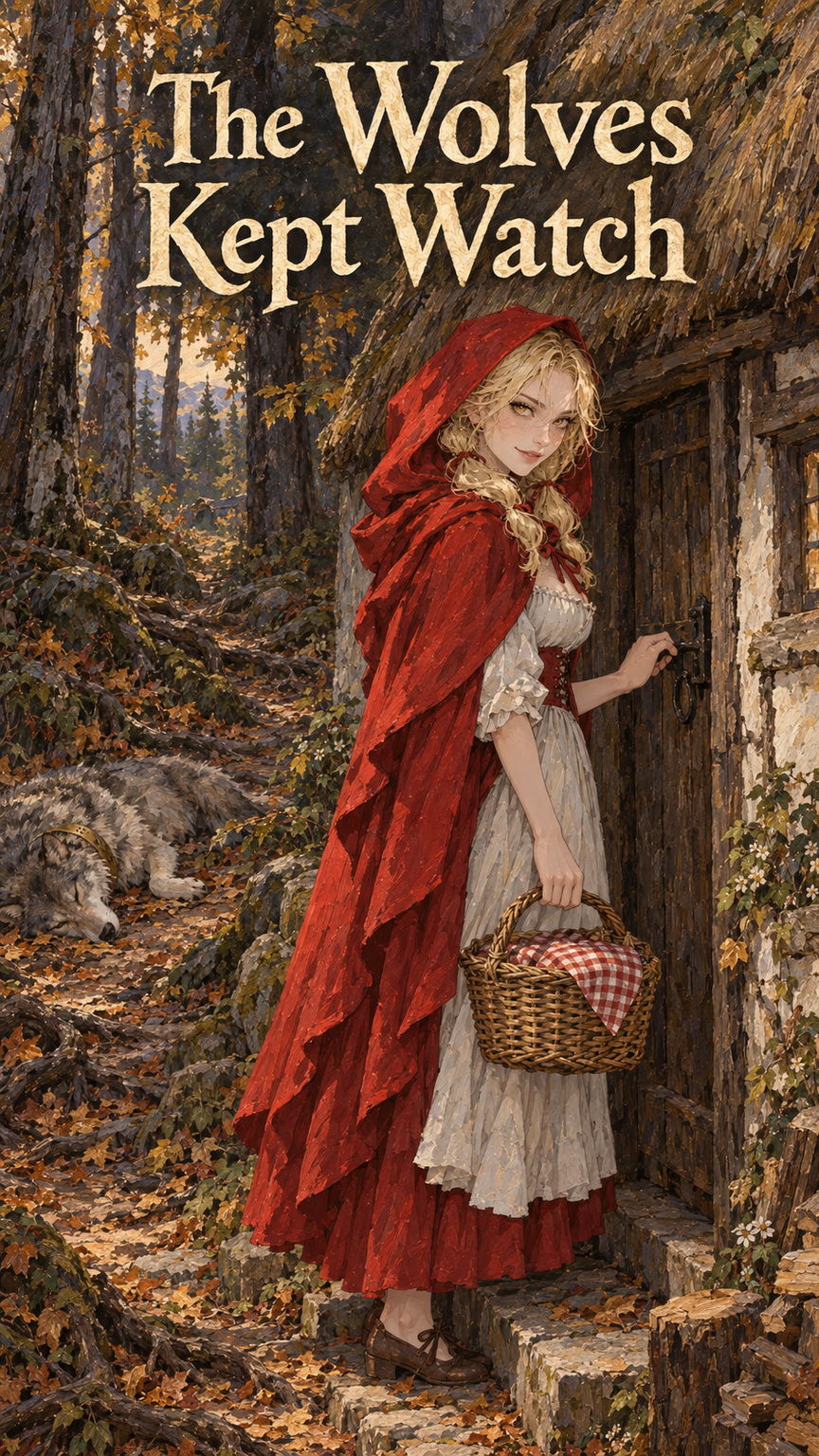
The last wolf had Red by the hem when Hollis brought the axe down.
Only the hem. Never her ankle, though it was bare above her shoe, and close enough for his teeth. The old oath allowed him a mouthful of wool. He held on to it while the blade went into his head.
Red fell when he fell. That was necessary. She let her basket roll, scattering little cakes among the roots, and put her hands over her face. Through her fingers she watched Hollis wrench the axe free.
The wolf was not dead yet. One yellow eye followed her. There was white all round his muzzle now, and a bare place behind his ear where, when she was small, she had slept with her cheek against him. His jaws worked. The red wool came out in wet strands.
He tried to get up.
Hollis struck again.
Afterward the forest was so quiet that she could hear the hunter breathing through his nose. He stood over the body with both hands on the axe. Blood ran down the shaft into the place where his wedding ring had worn a groove.
Red lowered her hands.
“Is it over?”
He looked at her, then at the wolf. “Yes.”
“You're sure?”
She knew what this cost him. She had asked six other men the same question. He set his boot against the grey chest, took a handful of fur, and lifted the head. When it dropped, he wiped his mouth with his sleeve.
“Sure.”
She went to him then. Not quickly; people liked to see you overcome the last little distance. He put the axe down to receive her.
His coat smelled of woodsmoke and the sour apples he had brought for the journey. He did not hold her by the waist. One hand went between her shoulder blades and the other cupped the back of her hood.
“There now,” he said. “You did well.”
For a moment she leaned her whole weight against him. He let her.
At twenty-three, she was rather old for the helplessness that had served her so well. Soon she would have had to find another way. It was fortunate that there had been only seven wolves.
Hollis drew back and saw the blood on her cream sleeve.
“Did he get you?”
“I don't think so.”
He turned her wrist carefully. There was no wound. The blood had come from the wolf, whose body she had fallen across. Hollis used a clean corner of his neckcloth to wipe it away.
“Meg gets in a state over blood,” he said. “Doesn't matter whose. Last week a hen caught her comb on the wire and Meg wanted to bandage the whole bird.”
Red smiled at the place where his bent head had begun to go bald.
“How old is she?”
“Six.”
“Does she look like you?”
“Poor thing.” He glanced up, pleased despite himself. “No. Her mother.”
He saw that one of Red's plaits had come loose. The little red tie was caught in a twig. He rescued it, brushed the twig out of her blonde hair, and looked at the strands with a concentration he had not given the dead wolf.
“I can do that,” she said.
“So can I. These days.”
She stood still while he divided her hair. His fingers were thick and scraped, but he did not pull. Once, finding a knot, he worked it apart with a thumbnail. Nobody had touched her hair so patiently in years.
“Meg teaches you?”
“Under protest. Says I'm a very slow pupil.”
Red laughed. It came out before she had chosen it.
Behind Hollis, the wolf's open eye was drying.
When the plait was tied, she bent to gather the cakes. Most were ruined. She put them back in the wicker basket anyway, arranging the red-and-white cloth over them.
Hollis had found the narrow brass band buried in the fur at the wolf's neck. He crouched beside it.
“A collar.”
“Her animals were all tame once.”
He touched the worn engraving. Seven small points, almost rubbed away. “This one's been here a long time.”
“Yes.”
He tried the clasp, found it would not open, and left it where it was.
The first time the captain had carried her away from the cottage, the wolf had worn that band on a man's wrist. She had been eight. Her mother had pushed her out through the kitchen door, into the captain's arms, while her father held the door shut behind them. Red remembered the captain's hands better than his face: broad hands, a split nail, the brass band bright against one brown wrist.
Later there had been no hands. The guards had chosen fur and muzzles and the hard, four-legged bodies that Grandmother could not command. They still understood everything. None could speak to Red.
When Red was twelve, the captain had scratched a crown in the dirt for her, and a little figure under it. Then he had laid his foreleg across the figure.
She had understood that, too.
Hollis picked up the axe.
“Before we go on,” Red said, “there's something else.”
He looked at the basket, then along the path. The sun was dropping behind the trees.
“You said that was the last.”
“It was.”
She lifted the cloth. Under the cakes lay a small pot of beeswax and the knife she used to cut it.
“The woman in the cottage is my grandmother. She was queen before the rising. People think she died.”
Hollis waited.
“Those were her guards. She killed my parents. They tried to stop her.”
He put the butt of the axe on the ground.
“What are you asking me?”
“To see her. And then decide.”
“You ought to have told me.”
She let her eyes fill. This was harder than ordinary crying because she had liked the braiding.
“You would have sent me back.”
“I might've.”
“I've been sent back all my life.”
He rubbed the axe handle with his thumb. She could almost see the little girl in the space between them, waiting for him to choose as a good father should.
“I have to be home tonight,” he said.
“I know.”
“I mean it. My wife knows where I've gone. Meg thinks I'm bringing her a feather.”
“There are jays by the cottage.”
He did not smile.
Red took a lump of wax and worked it between her fingers.
“She can make a human body do what she says. If you hear her and understand. Even when you don't want to.”
“And you?”
“It doesn't work on her own blood.”
“So you could go alone.”
She looked at the axe. After a moment, so did he.
“I can't kill her by myself.”
“Could you leave her there?”
“I could.”
Hollis looked back at the wolf. She thought she had lost him. Then he said, “I'll see.”
She showed him two signals: a raised palm to wait, a closed fist to strike. If he chose to strike. She was careful to say that. He tested the wax in his ears before they went on; she had to tap his sleeve to make him turn.
The knife went up her sleeve. The ruined cakes went back beneath the cloth.
At Grandmother's door she put on her sweetest smile.
The cottage was much smaller than Hollis expected. She saw that in the way he ducked under the lintel and stopped, his shoulders nearly filling the doorway.
It smelled of rabbit fat and old lavender.
The bed stood against the back wall. The table and a single chair left a narrow passage to the hearth. A chain ran from a staple in the hearthstone, under the table, to an iron cuff round Grandmother's ankle. Mother had locked it there on the day of the rising. Red could still remember the snap of its fastening, and how pleased she had been to hear that small, final sound.
Grandmother sat on the bed in a white nightdress. Her white cap had been darned with brown thread. Beneath it her face was long and heavy, with a broad, patient mouth. Her knees rose higher than the tabletop. Her shoulders would not have passed through the doorway straight on.
The guards had fed her. They were sworn to preserve royal blood, and hunger had been one more harm they could not allow. They had left rabbits, deer, once a winter-starved boar. Red had watched the captain drag it through the snow until Grandmother could reach its feet.
There were rabbit bones under the table now. Some had been broken for the marrow.
“You took your time,” Grandmother said.
Red shut the door behind Hollis.
“I brought cakes.”
Grandmother looked at the basket, then at the man. “So I see.”
Hollis had one hand on the door latch. With the other he held his axe close to his leg.
“Come here, fellow.”
He did not move.
Grandmother's eyes narrowed. She could make a man kneel with two words, strip himself with three, open his mouth and swallow whatever she gave him. Red's mother had been the only person at court who could say no to her. Until Red was born.
When Grandmother died, that voice would be Red's. Until then she could ask, and wait, and ask again. In the city beyond the wood, the councillors ate every evening at Grandmother's long table. Red knew their names.
Now Grandmother said, “Someone has been clever.”
“He's only come to look.”
“Has he?”
“I told him you were my grandmother.”
“How much of your grandmother?”
Red set the basket on the table. Her hand shook a little, which annoyed her. She wanted it quite steady for the signal.
Grandmother watched the door.
“All seven?”
Red nodded.
The old woman shut her eyes. It might have been relief. When she opened them, they were wet.
“That captain of theirs,” she said. “He used to carry you everywhere. Wouldn't put you down when you cried. Spoiled you rotten.”
“He kept me in the woods.”
“Oh, darling. So did I.”
Hollis touched Red's shoulder. He pointed beneath the bed.
She had forgotten how well he hunted. He saw what belonged and what did not.
One of the skulls lay on its side, partly hidden by the counterpane. Her father's, with the broken tooth. Grandmother had stripped him first; Red's mother had lasted longer. There were still lengths of her mother's dark hair among the bones, caught in the clasp she had worn that morning.
Red knelt and drew out the clasp. She had meant to do it tenderly. Instead she pulled too hard and a piece of scalp came with it, dry and light as paper.
Hollis took her elbow. She laid the clasp in his open palm.
“Mother,” she said, though he could not hear.
He understood her mouth.
“You were a terrible little eater,” Grandmother said. “Your mother used to make a whole performance of it. Here comes the horse. Here comes the carriage. All that trouble for a spoonful.”
Red stood. The hunter let her go and closed his hand round the clasp.
“Look at you now,” Grandmother said.
Hollis stepped into the narrow passage. He kept out of reach of the old woman's hands, judging the distance, the chain, the low ceiling. Red moved to the foot of the bed where Grandmother would have to turn her head to watch her.
“What a big girl you've become,” the queen said.
Hollis looked at Red. He could still put down the axe. She saw the choice in his face, the sick effort of making it. Then he nodded once.
Red closed her fist.
The axe came down.
Grandmother caught it.
She thrust her left hand into the blade. It split the hand from the web of the thumb through the wrist; two fingers fell on the bed. Her other hand closed round the shaft. The edge went on far enough to open the side of her neck.
Red had not believed anything could bear that pain and keep hold.
Grandmother pulled.
Hollis struck the table with his hip, hard enough to break a leg. The basket slid off. Cakes and wax went under his boots. He tried to wrench the axe backward, but the queen held it in the ruin of her hand and dragged him against her knees.
With her good hand she took his ear. Her thumbnail went into it. The wax came out red.
“Kill her.”
The words were clear. The sound she made afterward was not.
Hollis turned.
Red had the knife out before he freed the axe. She saw him try to shut his eyes. They opened again, searching for her.
“Run,” he said.
His hands rose.
She could have reached the door. She was nearer to it than he was. For one breath there was nothing between her and the path, the dead captain, all the places where she could go on being a girl with a basket.
Behind Hollis, Grandmother had her torn hand clamped to her neck. Blood pushed between the fingers. She was trying to speak.
Red went the other way.
The axe cut her face as she passed him. She felt a blow, then heat. Her mouth filled with blood. She hit the end of the bed with her hip and climbed over it, scrambling into the space between Grandmother and the wall.
Grandmother turned to catch her. The chain struck the broken table, dragging it over. She opened her mouth, but Red drove the little knife into the wound the axe had made.
The queen's good hand closed round Red's wrist.
They were face to face. Grandmother's breath smelled of lavender, as it always had. Her cap had fallen back. Beneath the thin white hair, Red saw the small pink scalp of an old woman.
Hollis came round the foot of the bed.
Red pulled her wrist free, leaving the knife. Grandmother struck her against the wall with the back of her bloody hand. Red's head hit the plaster. While she was trying to make her eyes focus, the queen reached for the knife. Red caught Grandmother's good hand on the hilt and pushed the knife deeper, her whole weight behind it.
There was no cleverness left. She hung on. Grandmother's torn hand scrabbled at her hood, pulling the cloth over her eyes. She heard Hollis climbing onto the bed. His boot drove into the mattress beside her knee.
“Please,” he said.
She did not know which of them he was asking.
Red pushed against the wrist she held. The knife moved. Grandmother's body heaved under her, and Hollis lifted the axe.
The old woman's fingers opened.
Hollis stopped with the blade above Red's head. For an instant he stayed there, arms trembling. Then he let it fall behind him.
Red was on her knees in Grandmother's lap. The queen's head rested against the wall. Her mouth had fallen open, and she looked offended.
The chain still ran across the room. Nothing had changed in it.
Hollis got off the bed and was sick by the hearth.
Red had imagined bells. Not actual bells, necessarily, but something she would feel in her bones when the old queen's last breath passed into hers.
Her face hurt. Her knees hurt. There was blood in one shoe.
She touched the cut on her cheek and her fingertip went through into her mouth.
“Hollis.”
He flinched.
She had only said his name.
“Could you help me?”
He did not answer.
Hollis pulled the other lump of wax from his ear and threw it into the ashes. He looked at the queen, then at Red, as though he expected them both to move.
“It's over,” she said. “She's dead.”
“I know.”
Red got off the bed. The floor shifted under her. She caught the bedpost, and Hollis started toward her before checking himself.
“Could you find your cloth?” she asked. “Only if you want to.”
He took it from his neck and held it out. She reached for his hand with the cloth, but he let go before their fingers met.
“Thank you.”
She pressed it against her cheek. He watched to see whether the bleeding slowed. There was still that much.
The cottage was full of ordinary noises: a fly at the window, the shrinking coals, Hollis swallowing. He found Red's mother's clasp where he had dropped it. He set it on the unbroken end of the table.
“Those bones,” he said. “You said the wolves were her guards.”
“They were.”
“What did they bring her?”
Red followed his glance beneath the table.
“Animals. Deer mostly. They wouldn't bring people.”
He looked at the ankle chain.
“They kept everyone away.”
“They couldn't let her starve. They'd sworn to keep her alive.”
“And you?”
She could hardly speak round the cloth. She lowered it. “They'd sworn the same about me. Any of her blood.”
He looked down at her shoes. She knew what he was seeing: the old wolf's mouth, her bare ankle, the teeth that had closed only on wool.
“He wasn't going to bite you.”
“He would have dragged me off again.”
“You said—”
“He would never have let me come here. None of them would.”
Hollis moved the broken table aside. He did it slowly, putting the loose leg against the hearth. He picked up his axe, wiped it on the counterpane, and wrapped the head in a piece of sacking from beside the door.
Red waited for him to turn back.
“I couldn't stay in the woods forever,” she said.
He lifted the latch.
“Hollis.”
His hand stopped, but this time it was his own stopping. He looked over his shoulder.
“Will you come back?”
“No.”
The door opened. Cold air entered, bringing the smell of crushed leaves. She could see a little blue feather caught in the briars outside. It stirred in the wind.
“Your cloth,” she said.
“Keep it.”
He stepped out. The shape of his boot remained in the rabbit grease on the floor.
Red tried to straighten her hood. Grandmother had torn one tie loose and it would not sit properly. She tried again with the hand that was not holding her cheek. The cloth slipped. Pain went through her mouth, so sharp she made a small, surprised sound.
Hollis kept walking.
“Stop.”
He had time to turn his head. One hand came up toward his ear. It stopped halfway.
Red stood in the doorway. Beyond him, the path ran back to the last wolf.
“Come here.”
He came.
She gave him the cloth.
“Clean my face.”
He bent over her. His fingers were as careful as before. He folded the cloth to find a clean place and wiped the blood from her freckles, from the corner of her mouth, from the soft skin under her eye. When it hurt, she caught his sleeve.
“What will you tell Meg?” she asked.
His lips moved. No words came.
Red held her cheek together to speak.
“When you get home, tell her the wolf ate Grandmother. Tell her you cut him open and got me out. That you were just in time. Say it to me first.”
He drew a breath.
“The wolf ate your grandmother,” he said. “I cut him open. I got you out.”
“She'll want to know if I was frightened.”
He looked at her.
“Tell her I was brave.”
“You were brave.”
Red closed her eyes while he cleaned the cut. There would be people to fetch, a journey to make, her place at the head of the long table. But she could stay here a little longer. Nobody could send her away.
The cloth grew cool against her face.
“There now,” she whispered. “Say that.”
“There now.”
She waited for his hand to cup the back of her hood.
It did not.