
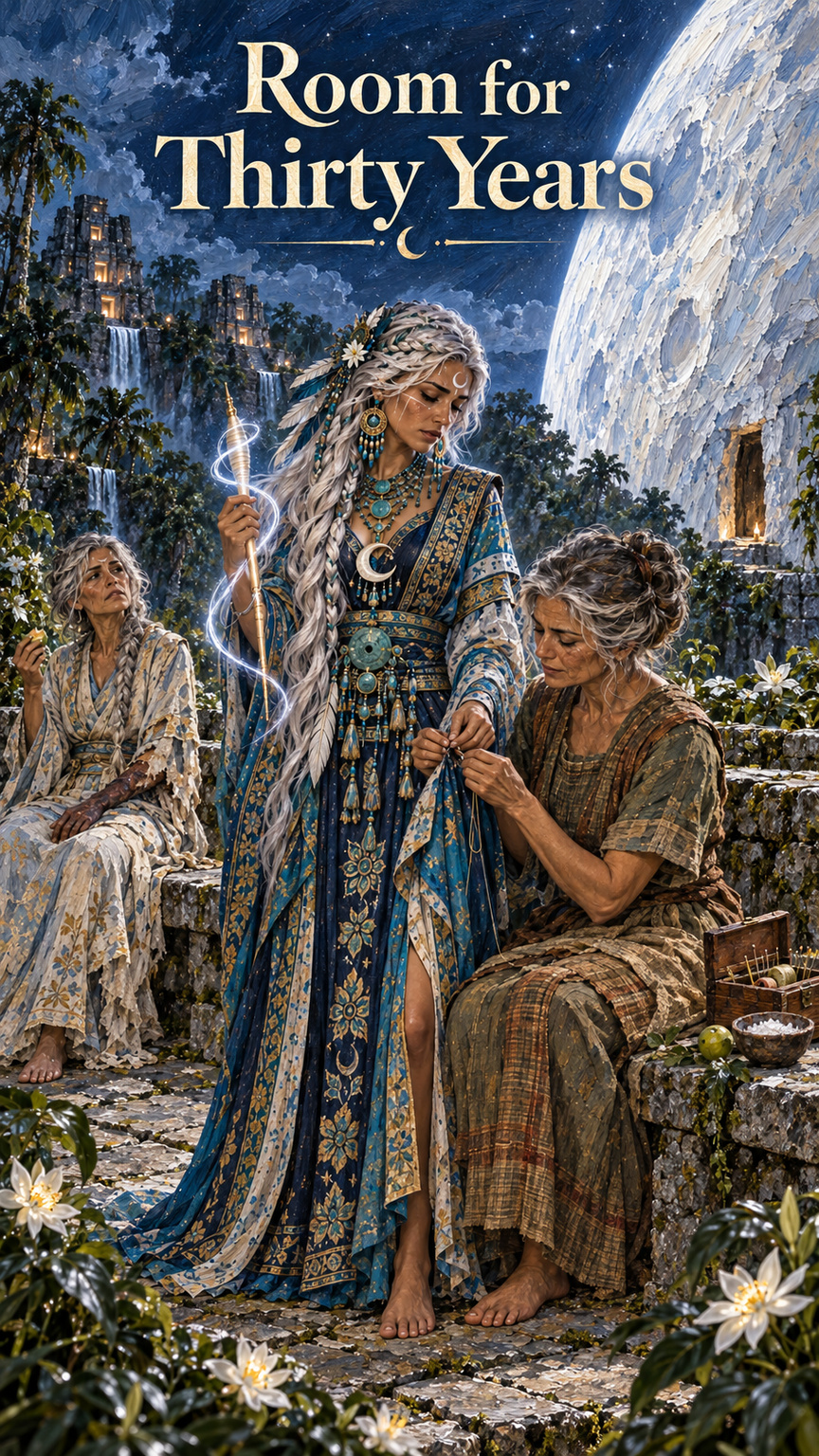
The inheritance robe had thirty years in it. Odel had folded them into the side seams and caught them down with yellow basting thread.
“Breathe out.”
Nimare breathed out. Her mother put another pin between her lips.
“You can't know I'll need all that cloth.”
Odel removed the pin. “You can't know you won't.”
At thirty-four, Nimare stood barefoot on a stool, silver hair bundled over one shoulder, while her mother fitted her for the woman she would be at sixty-four. The robe was dark blue, its borders embroidered with gold flowers. Beneath the open sleeves, teal silk lay against her sun-browned wrists. There was enough spare cloth inside it to alter the fit a dozen times before the thousandth year came round.
Her mother intended to be alive for all the alterations. Nimare had stopped arguing about this.
On the windowsill, beside a bowl of salt, lay three green plums. Odel split one with her thumbnail, dipped the cut face in salt, and gave her half.
“You said we could go when the rains ended.”
“I said I would ask.”
“You've asked. They've said yes. Now you're finding another thing to wait for.”
Nimare rolled the salted fruit beneath her tongue. Beyond the jungle were mountains where white cold lay on the ground even in daylight. They had been discussing that journey for eleven years. Her mother had made wool stockings; Nimare had laid out her lessons to finish before the dry season.
“I'm not waiting for anything,” she said.
Odel looked up at her.
“The eastward turn is still wrong.”
“Then be wrong about it on a mountain.”
Beside the sewing stool stood the ceremonial spindle, bone-pale wood tapering to a gold tip. Nimare could perform the holding pattern while walking, blindfolded, or answering questions about the nine visible ridges of the moon. She could return the light or take it into herself. Her fingers knew the movements better than they knew how to unfasten the little hooks down her own back.
Every thousand years the moon descended. Mortals touched its living light, and a prepared priestess went up to keep it burning. Nimare had wanted to go before she understood that she would have to stay. For years, the charcoal moon on her bedroom wall had been covered in fingerprints: a child reaching for the places she meant to feel from within.
There was time for mountains first. Thirty years for mountains, and for becoming tired of things she loved, and for wishing to come home from somewhere.
The salt bowl cast a second shadow.
Nimare turned toward the window. The white flowers along the sill were opening so fast that their petals struck the glass.
Above the treetops, the moon was growing.
She watched a ridge emerge from what had been a patch of grey. A whole slope moved into view. It bore a fresh black wound, ragged at the edges, across country she had drawn a hundred times.
Her mother took the pins from her mouth.
“Nimare.”
“I see it.”
“It can't be.”
The stool rocked beneath her. She caught the spindle and stepped down, the unfinished robe falling across her feet.
Odel put the remaining plums and the little salt bowl into her sewing box and followed.
They climbed through a temple turned white. Leaves showed their veins. Between the stair towers, the jungle's waterfalls shone like hanging cloth. Night flowers burst from cracks in the stone and shed petals before they were fully open.
On the upper terrace, Nimare stopped.
The moon stood beyond the parapet, close enough that its curve cut off the sky. She could see hollows inside its pale rock. The ridge with three teeth was higher than any earthly mountain she had seen; it had been a smudge beneath her childhood thumb.
A woman stood in a narrow opening at the moon's edge.
She wore a robe whose blue had faded almost white. One sleeve was burned away. Light passed through her left hand in loose, shivering strands, and the skin beneath them was darkened. She had to lift each foot with care to make it follow her.
Nimare knew the face from a thousand paintings. The paintings had not given Veya that frightened look.
“You're early,” Nimare said.
“I know.”
“Thirty years.”
Veya lowered her eyes. “Something struck the far side. I held it together as long as I could.”
The light jerked in her hand. Nimare saw the outer strand slipping beneath her smallest finger. She stepped forward, laid her free palm against the moon's cold rock, slid the spindle under the slipping strand, and turned her wrist.
“Don't pull,” Veya said.
“I'm not.”
She made the eastward turn. It had always dragged when she practiced with silk. Now the strand rolled smoothly over the spindle's taper, caught in the notch, and opened against her palm.
The ground beneath her remained stone. Another ground lay inside her hand: a long, steep slope where small rocks were moving through dust. She checked them with the slight backward pressure she had practiced for twenty-seven years. A whole fall of stones settled. The pressure came back to her, exact and alive.
Nimare laughed once, in surprise.
Then Odel's fingers were against her ribs, pulling the basted seam away from a pin that had turned inward.
“You'll have a hole in you before you begin.”
The pin slid free. Nimare could still feel where its point had been.
She completed the holding pattern. The two loops circled the spindle, one traveling upward, one returning through her fingers. As long as she made the little correcting movements, neither would tighten. She could hold this position for hours. Eventually her hand would shake; eventually she would have to sleep. The practice hold could give her time to choose, but it could not give her thirty years.
Closing the inner loop would carry her into the moon. Opening it would let the living light go, and the outer loop would return an ordinary stone moon to its path.
She had rehearsed both endings. She had expected to be old when she used either.
“May I sit?” Veya asked.
There was a stone bench a few steps from the parapet. Veya looked at it for a long time.
“You can come down first,” Nimare said.
Veya shook her head.
“The hold is steady.”
“I can feel that.”
“Then why?”
The older woman glanced back into the opening. Beyond her lay a small chamber, a worn hollow in the rock where she had rested her body while her senses traveled the moon.
“I thought I would finish there.”
“You haven't finished.”
“No.”
Nimare waited.
“Everyone is gone,” Veya said. “I knew that would happen. I knew it when I went up. It didn't seem possible that everyone could be gone and the steps would still be here.”
Odel set her box on the bench. The little clasp snapped sharply in the moonlight.
“Are those plums?” Veya asked.
Odel stared at her. “Yes.”
“I can smell them.”
The woman swallowed. Nimare felt the spindle tilt and corrected it.
“You haven't eaten?”
“I haven't needed to.” Veya's gaze stayed on the box. “It isn't the same.”
Nimare remembered all the solemn accounts of the bearer sustained by light, free from mortal hunger.
“If you step down,” Nimare said, “I can still open the loop.”
“Yes.”
“I haven't decided.”
Veya's unburned hand closed against the pale blue of her robe.
Once she came off the moon, she could not return to the place where she had spent nearly a thousand years. Nimare knew that from the lessons too. The old binding ended at the step down; there could be no taking it up again. Veya would be on earth, and Nimare might let her living light die.
“Will the trees manage?” Nimare asked.
“The flowers that open for us will close. Some will learn the ordinary night. Some won't. The trees were here before the first bearer.”
“And people?”
“People will have a darker moon.”
Veya lifted her face.
“I would have liked to bring it back whole.”
For a moment Nimare thought she would withdraw into the chamber. Instead the woman loosened her hand. The last strands slipped from her fingers into the spindle, and she lifted one bare foot toward the parapet.
“Wait. My box is in the way,” Odel said.
She moved her sewing box, came to the wall, and offered her arm. Veya took it. Her first step struck the stone hard enough to make her gasp. Odel's other hand went under her elbow.
“Don't lean there. Here.”
Veya obeyed. She sat on the bench with her feet planted wide, looking at them. The opening in the moon closed behind her, leaving Nimare's palm laid over a rough patch of white rock.
Odel wiped the bench dust from her fingers and split a plum. She held both halves out to Veya without meeting her eyes.
“Thank you,” Veya said.
Odel did not answer.
For a while there were only small sounds: Veya chewing, the waterfalls beyond the stair towers, the creak of Nimare's robe as she moved her wrist. The moon's great shadow lay across the jungle.
Odel spread the sewing box open on her lap.
“I want you to put it down.”
Nimare looked at her mother's bent head.
“I know.”
“I want you to stay.”
“You always said you were proud.”
“I am proud. Come here.”
Nimare could move as far as the spindle's light would reach. She took the three steps to the bench. Odel pulled the gold border straight and began to unpick a crooked length of basting.
“Would you be ashamed if I did?” Nimare asked.
Her mother held the small scissors still.
“I don't know,” she said. “I might be. For a little while.”
Nimare pressed her lips together.
“I had been counting on being dead,” Odel said.
“You said you'd live to finish it.”
“I said a lot of things.”
Veya looked down at the plum stone in her hand.
Odel's needle went through the silk. Nimare felt the small pull, the pressure of her mother's knuckles against her side. In her other hand, sunlight was finding a ridge on the far side of the moon. That country had never faced the earth. She could feel the difference between the brittle upper crust and the deep rock under it. Halfway down, a cleft forked beneath an overhang. With a slight turn of her ring finger she followed one branch to its end, a shallow bowl of loose stones. She wanted to know where the other one went.
Her mother licked the end of a new thread. It would not pass through the needle. She tried again.
Nimare bent and held the needle for her with her free hand.
“There.”
Odel took it back.
They had been going to sleep in the same room on their journey, because neither of them had ever slept alone in a strange place. Nimare had expected her mother to complain about the beds. She had expected to complain about her mother's complaining. She wanted those nights so sharply that her throat hurt.
The spindle rolled. She made the correction.
“Do you miss them less?” she asked Veya. “After so long?”
“I forget things. That's different.”
Odel pulled the thread through.
Nimare stood while her mother sewed. She changed her grip as she had been taught, easing the strain from one finger to another. Clouds moved across the narrow sky that remained visible above the moon. Once, Veya tried to stand and Odel put a hand on her shoulder without looking up.
The seam was straight now. There was still spare cloth folded inside it, enough for changes Nimare's body would never make.
“I want to go,” Nimare said.
Her mother drew the needle through to its full length.
“I want the mountains too,” Nimare said. “I haven't stopped.”
“I heard you.”
Nimare waited. Odel tied off the thread and put the needle in its little felt square.
“Turn around. There's one at the back.”
She took out the last pin. Then she stood and put both arms around her daughter, clumsily, avoiding the spindle.
Nimare held her with one arm. She could feel the familiar shoulder blade beneath her palm. Her mother's hair smelled of the oil she used every morning, a sharp green smell Nimare had sometimes disliked.
She took another breath of it.
“You were supposed to have thirty years,” Odel said into the embroidered collar.
“Yes.”
Neither of them moved for a long time.
When Odel stepped back, she left a damp place on the silk.
Nimare went to the parapet. There was a narrow shelf where Veya's foot had been. She put her own foot on it, holding the spindle steady.
Veya held out the other half of the plum. She had saved it in her unburned hand.
Nimare took it. The flesh was warm, marked by the older woman's thumb. Odel brought the little salt bowl and set it on the parapet. Nimare dipped the plum and bit down.
Then she passed the spindle through the inner loop and drew it closed.
The light passed under her skin. Her hand ceased to carry the long slope; the slope was hers. A thousand small falls of dust settled into places she could feel. Across three ridges, the wound pulled with a dull ache. She could feel both edges of it now. Far beyond her sight, cold lay against the moon's dark side, rough and various, waiting for her attention.
The chamber opened. She stepped inside and sat in the hollow Veya had worn smooth.
Through the opening, her mother was still close enough to touch. Nimare reached. Odel took her fingers, squeezed once, and released them before the rock began to close.
The moon lifted.
She felt the jungle passing beneath her, felt the whole unfamiliar weight of herself rise. Below, Odel picked up the sewing box. Veya tried to follow Odel and had to sit again. Her mother stood with the box under one arm, looking upward. Nimare could see her face and could not tell what she would do next.
Nimare turned toward the enormous country she had wanted all her life. Somewhere in it, in a small warm hollow, her human mouth was still full of plum.
She kept the last piece under her tongue until there was nothing left to taste.