
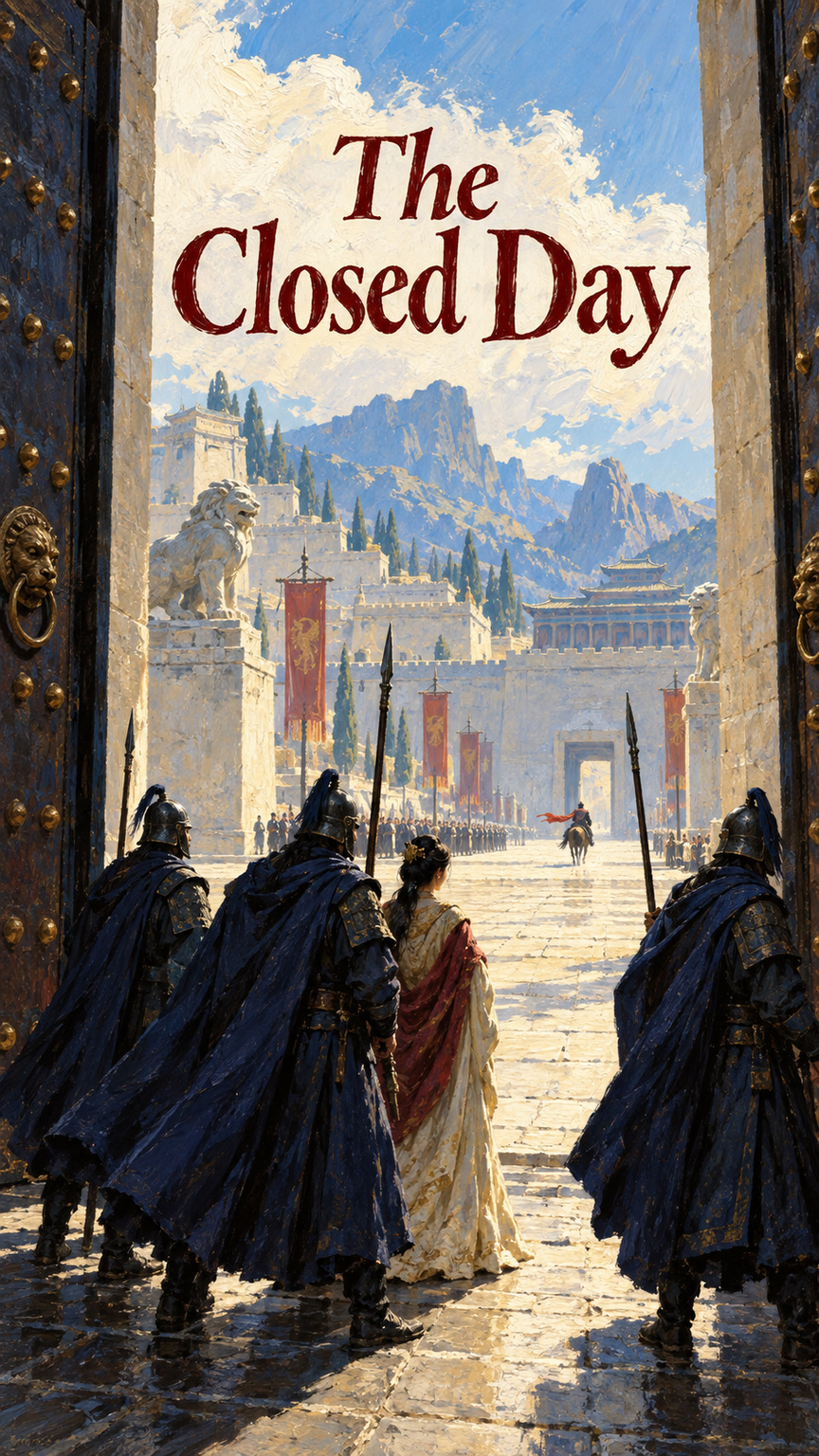
Orsen caught the knife at the Emperor's throat. The blade went through his palm and stopped against the bone.
The woman drove forward anyway. He put his weight on her, and they fell among the petitions scattered over the white floor. Around them, the Imperial Guard drew their swords and turned toward the throne.
Someone in the audience screamed. Someone else began to applaud, then stopped.
The Emperor stood beside his overturned chair. A shallow cut crossed his neck, just under the jaw. He touched it, looked at the blood on his fingers, and said, “Show me her face.”
Orsen had pulled a custody hood from his belt and covered the woman's face once she was down. She fought beneath it, breathing hard. He kept his wounded hand around her wrist and raised the other.
“A closed day, Majesty.”
The Emperor looked past the ring of swords to him. “I didn't sentence her.”
“No, Majesty. A face will give you her family.”
“Then show me.”
There were fourteen guards in the chamber. They had all trained for this. When a weapon came out, they subdued its bearer; when the Emperor spoke, they made a wall of themselves. Orsen could see which of the younger ones were still deciding whether the wall faced the correct way.
Calen stood at his left shoulder. She had helped him take the north weaving street three years ago. Her sword pointed at the dais with all the others.
“Not until she's beyond this room,” Orsen said.
The Emperor wiped his fingers on a petition and let it fall. “Take her to the inner cell. Find out who sent her. Start with her family.”
The woman went still under the hood.
The Guard's charter gave them custody of a captured attacker until sunset. They had to bring that person, alive, with a written charge to the city magistrate. Three years earlier, another attacker had made that journey safely. His cousins had not. Neither had the men who rented rooms beside his, nor the boy who delivered their bread. Orsen had signed the list because the charter protected the attacker, and the Emperor's command named everyone else. He had told himself the distinction mattered. Calen had asked why the others got no day. He had told her to read the charter. He had carried the list from door to door while the man waited in the magistrate's cell.
“The prisoner first,” Orsen said. He heard his own voice flatten into the tone he used on parade. “Pel, with me.”
Pel was the newest guard in the chamber. He lowered his sword, then glanced at the Emperor. Orsen could not blame him for looking.
“Go,” the Emperor said. “We have all day.”
Orsen kept the woman ahead of him through the side door. Pel followed. In the passage, the shouts from the chamber gave way to the small sounds of their equipment: leather shifting, Orsen's blood falling from his hand onto the tiles. The inner cell was twelve paces away. A lock and two guards would keep her alive until it was time to take her to the magistrate. Orsen had already begun counting those paces. Pel caught his hand and bound it with a strip torn from his own collar. Then the woman spoke from under the hood.
“Don't put me in there.”
“You tried to kill him.”
“I know.”
“This is where we keep you alive.”
“And where do you keep my sister?”
Orsen stopped. Pel, behind them, made the slight movement of a man who wished he had been sent elsewhere.
“He doesn't know who you are,” Orsen said.
“He will.”
He pulled the hood back from her face. She was older than he'd thought on the floor, perhaps thirty, with gray caught in the hair at her temples. She looked at his injured hand, then at his face.
“Iria Keld,” she said. “My brother was Tovin Keld.”
Orsen knew the name. Not from the execution roll, which had held thirty-two names, but from a young woman outside a weaving shed clutching a length of blue cloth. She had said her brother could not have known the attacker. He had been at his loom all morning. A younger sister had pressed a warm loaf into his hands before the guards tied them. Orsen had let him keep it, as if that were mercy. He had said the order was for a street, not for accomplices. Then he had told his men to take the young man.
Iria reached into her sleeve. Pel's sword came up. She held out a folded square of paper, stained at one edge with old rain. Orsen recognized the heading before she opened it. The notices had been posted on every door of that street: all persons of the north weaving street to be seized for examination. His mark was at the bottom of each one.
“I showed you this when you came for him,” she said. “It says all persons. He hadn't done anything.”
“I had the order.”
“That's what you said then.”
He had read the word all and taken it as permission to stop asking what any of them had done.
From the audience chamber came the Emperor's voice, asking for a clean collar. Then another voice, lower, repeated the order to find the woman's family. There would be clerks in the chamber writing the words down. There would be a rider at the gate soon after.
Orsen put the hood back over Iria's face. “Your sister. Where is she?”
“Dessa's at the west bakehouse. I told her I came to petition for Tovin's name to be cleared.”
“That won't be far enough.”
“I know.” She gripped the folded notice. “Bring me to the recorder.”
“He'll hear your name.”
“They'll find it in an hour. I want him to hear yours first.”
Orsen sent Pel to the west gate to carry a warning to Dessa. He came back out of breath. “They barred it at the alarm. The household officer won't let me through without a sealed order.”
“We can take you out under the charter now,” Orsen told Iria. “I can send him from the street.”
“I want him to hear you say what you did to Tovin.” She held up his old notice. “Let his recorder write it beside my name.”
“You won't be safe in there,” he said.
“You've told me where I'm safe.” She looked at the cell. “I'm telling you where I'm going.”
They returned to the audience chamber by the side door. The Emperor had changed his collar. He sat again, though the petitions were still scattered and nobody had resumed the audience. A court recorder sat at the narrow table beneath the windows, trying to write around a patch of blood on the day's roll.
The guard ring opened for Orsen and closed behind him. He kept Iria beside him, hood over her head. The Emperor saw the paper in her hand.
“You have the names?”
“She has a charge to make,” Orsen said.
“She had a knife to make it with.”
“She still has a charge.”
The recorder's pen hovered. The Emperor noticed. “Set it down.”
The pen stopped.
Iria pulled the hood off and dropped it among the petitions. Orsen caught at it too late. He did not cover her again.
“I am Iria Keld,” she said. Her voice was rough from the struggle but reached the back of the room. “I tried to kill you. Three years ago you ordered my brother taken because a man he did not know tried to kill you. Captain Orsen signed the order and took him.”
The Emperor's hand tightened on the arm of his chair. “Keld. A weaver's family.”
He sent a household clerk through the side door for the north street register.
Orsen felt Iria beside him, held still by the Emperor's recognition. The name had bought her a record if the recorder would write it. It had also given the Emperor a way to reach her sister.
“Write what she said,” Orsen told the recorder.
The man looked at the Emperor. He had written the Emperor's words for twenty years; Orsen had often seen him rub his cramped fingers at the end of an audience. Now his hand lay open on the page.
“Write it,” said Iria. “Write that I came here to kill him. Then write what Captain Orsen did.”
The Emperor rose. The nearest guards shifted, not toward Iria but toward him.
“That paper won't leave this room,” he said. “Recorder, tear off the page.”
The recorder took hold of the roll. His fingers shook. Orsen stepped between the table and the throne.
“Majesty. On a closed day, the attacker's account is taken before judgment.”
“You have kept her breathing. You have had your day.”
“The day has scarcely begun.”
“Tear it off,” the Emperor told the recorder.
Orsen could have argued about custom. He had been good at that three years ago. Instead he laid his uninjured hand over the recorder's and felt the man let go.
“I signed that seizure,” Orsen said. “I took Tovin Keld from his work. His sister told me he had no part in the first attack. I answered that the order did not require him to have a part.” He looked at the recorder. “Put my words beside hers.”
The pen moved. It sounded loud against the paper. Iria watched it, unsmiling.
“And this morning?” the Emperor asked.
Orsen had once stood close enough to the Emperor to fasten his armor before a campaign. He knew the small white scar over his eyebrow, the tremor that came into his left hand when he was tired. None of those familiar things made the order less plain.
“This morning I refused your command to expose her,” Orsen said. “I refuse your command to destroy her account.”
The Emperor looked at the guards. “Take his badge.”
Pel moved first. Orsen thought, for one bare instant, that the boy meant to arrest him. Pel stopped at his shoulder and unfastened the silver clasp at his throat, lifting the cloak clear of Orsen's bound hand. A captain's badge was sewn into its collar; the two came off together.
The Emperor held out a hand for it. Pel kept the cloak folded over his arm.
“Now,” the Emperor said to the others, “take the woman.”
Calen took one step toward Iria. Orsen saw the others turn to her; with him dismissed, she was the senior guard. The recorder bent over the page, blotting one line, waiting to learn whether he would have to blot the rest.
Iria placed the notice she held beside the roll. The clerk returned with a narrow register and opened it to the Keld household. The Emperor looked at a line entered in newer ink, then at her.
“Your sister works at the west bakehouse,” he said. “Did she help you?”
Iria had chosen to give her name. She could not take it back, or make the Emperor forget who had lived on that street. She looked at the recorder. “Write what he asked.”
The Emperor glanced at the pen. “You think a page will stop my men?”
“No,” she said. “I thought a knife would stop you.”
Orsen looked at Calen. “Do you remember the order?”
“Yes.”
“Do you remember who signed it?”
“Yes.” She lowered her sword. She did not look relieved. “The Guard has custody until sunset. Pel, take the roll. We're bringing her to the magistrate.”
The Emperor stepped down from the dais. Orsen stood without cloak or badge between him and Iria, his injured hand hanging uselessly at his side.
Pel went to the table. The recorder took his hand off the page, ready for it to be torn. Pel lifted the whole bound roll instead. His voice cracked as he told the recorder, “Come with us. You'll have to attest to it.”
“You can be dismissed with him,” the Emperor told Calen.
She hesitated. Orsen knew what dismissal would mean: the quarters lost, a pension gone, the cold walk through streets where a guard without a cloak was just a person who had carried out the Emperor's orders. He had imagined that walk often and had always turned back.
Calen said, “I took the street with him. My account goes on the roll too.”
The Emperor pointed at Iria. “You'll give me her. The charter won't keep her sister out of my hands.”
Iria gripped the edge of the recorder's table. She had chosen this route knowing what her name would cost, but Orsen saw her struggle to stay beside the paper instead of running toward the west bakehouse.
The Emperor called for a household runner. Orsen heard him order the west gate held against the Guard's charge. He gave a second order in a voice too low for Orsen to catch, and the runner left with two strips of sealed paper, one tied in blue cord and one in red.
Calen took Iria by the arm, firmly enough to keep custody and gently enough that Iria went with her. Orsen followed without cloak or badge. Pel held the roll against his chest, and the recorder came behind them with Iria's old notice. Two guards followed with swords out. At the passage door, Calen turned them toward the throne before they backed away.
The iron leaves of the west gate were barred again. A household officer stood in front of them with a strip of blue cord hanging from his fist. Beyond the bars, the rider with the red cord mounted his horse. The officer had let him through under seal, then lowered the bar once more. Iria saw him turn toward the bakehouse and pulled against Calen's hand.
“The Emperor ordered me to keep your prisoner inside,” the officer told Calen.
“The charter orders us to deliver her,” Calen said. “Move.”
He showed her the seal. Orsen remembered taking a posted notice to a weaving shed, certain the seal made the words beneath it right. Calen took the paper and read the gate order anyway. She handed it to Pel to take to the magistrate.
“If you pass,” the officer said, “I have to stop you.”
Calen set Iria's hand in Orsen's sound one. “I know.” Iria looked through the bars after the rider.
Calen stepped up to the bar. The officer drew his sword. The two guards behind her stepped to either side, their swords raised. Pel gave both the roll and the gate order to the recorder, then helped Calen lift. Wood scraped stone. Calen set the bar against the wall and pulled one iron leaf open. The officer looked from her to the two guards facing him. He lowered his sword and stood aside. Pel took back the roll; the recorder kept the gate order with Iria's notice.
Orsen passed beside Iria, keeping himself between her and the officer's sword. Beyond the gate, the road to the bakehouse ran left; the open court lay across the square to their right. The rider had vanished to the left. Orsen opened his hand. Iria stood between the roads, then turned right. None of them had a horse.
They reached the magistrate's table in the open court just before noon. The table stood at the edge of the square, in sight of the west gate. The magistrate did not ask Orsen for his badge. The recorder gave her the gate order, with its blue cord still attached, and placed Iria's notice beside it. Calen added her own account beneath Orsen's: she had held Iria back while he took Tovin from the weaving shed. Orsen signed with his uninjured hand, and Calen signed below him. Then the magistrate asked Iria whether she still claimed the words written there.
“I tried to kill him,” Iria said. “I claim the rest.”
The magistrate asked Pel to read the account aloud, while her clerk made a second copy under the eyes of the people waiting with their ordinary quarrels. She signed for custody. Iria would be tried; the order to take her brother was now entered beside the charge against her. Pel left one copy on the public table and carried another across the square to the city archive. He walked quickly, with no armor at his back. Calen stood beside Iria while the constables took her into custody.
The rider came back across the square on foot, leading his horse. A woman walked beside him with her wrists tied in front of her. There was flour on her sleeves. Orsen recognized the younger sister who had put bread into Tovin's hands.
Iria left the table. Two city constables stopped her at the edge of the court, close enough for Dessa to hear her call. The rider kept walking.
Dessa turned. “You said you were going to petition.”
“I lied,” Iria said.
The rider led her on toward the gate. Iria faced the magistrate. “Her name is Dessa Keld. She knew nothing about my knife. Put down that he took her.”
The magistrate told her clerk to write it. She made no order to release Dessa; the rider was already passing through the gate. Iria looked at Calen, who still wore her guard's badge.
“Follow her,” Iria said. “Tell me where they keep her.”
Calen touched the badge at her collar. Then she went after Dessa. Iria watched until Calen passed under the gate and out of sight.