
The woman buying the last portrait of the evening wanted me to make her son look less tired. He had worked a double shift and was asleep against her shoulder. If I lifted his chin, she said, and opened his eyes a little, he would look like himself again.
"I can lift his chin," I said. "If I draw his eyes open, I'll have to make them up."
She paid me anyway. While I rolled the sheet into a tube, the boy woke and asked whether his ears were really that big. His mother told him to come back tomorrow and complain to the artist. They went off laughing, with the drawn boy tucked safely under her arm.
I should have put my lamp out then. The market was still thick with people, but shoppers had become walkers; nobody wanted to sit while the evening's musicians found their places. I tied the corners of my canvas portfolio and reached for the lamp. Between two passing shoulders, something opened in the street.
My Sprite Eye, the left one, had shown me the little fires inside people since before I had words for either fire or people. On a busy night I saw them everywhere: a smudge under a vendor's collar, a pinhead of orange in a child's chest, blue embers moving past one another in the dark. When a sitter's expression eluded me, I sometimes let a spark decide the shadow beneath a mouth. At the back of my portfolio I kept sketches of the lights without their owners' faces. Close the eye, and there were only faces. Open it, and the sparks came back, visible to me through shirts and coats but never through a body standing in the way.
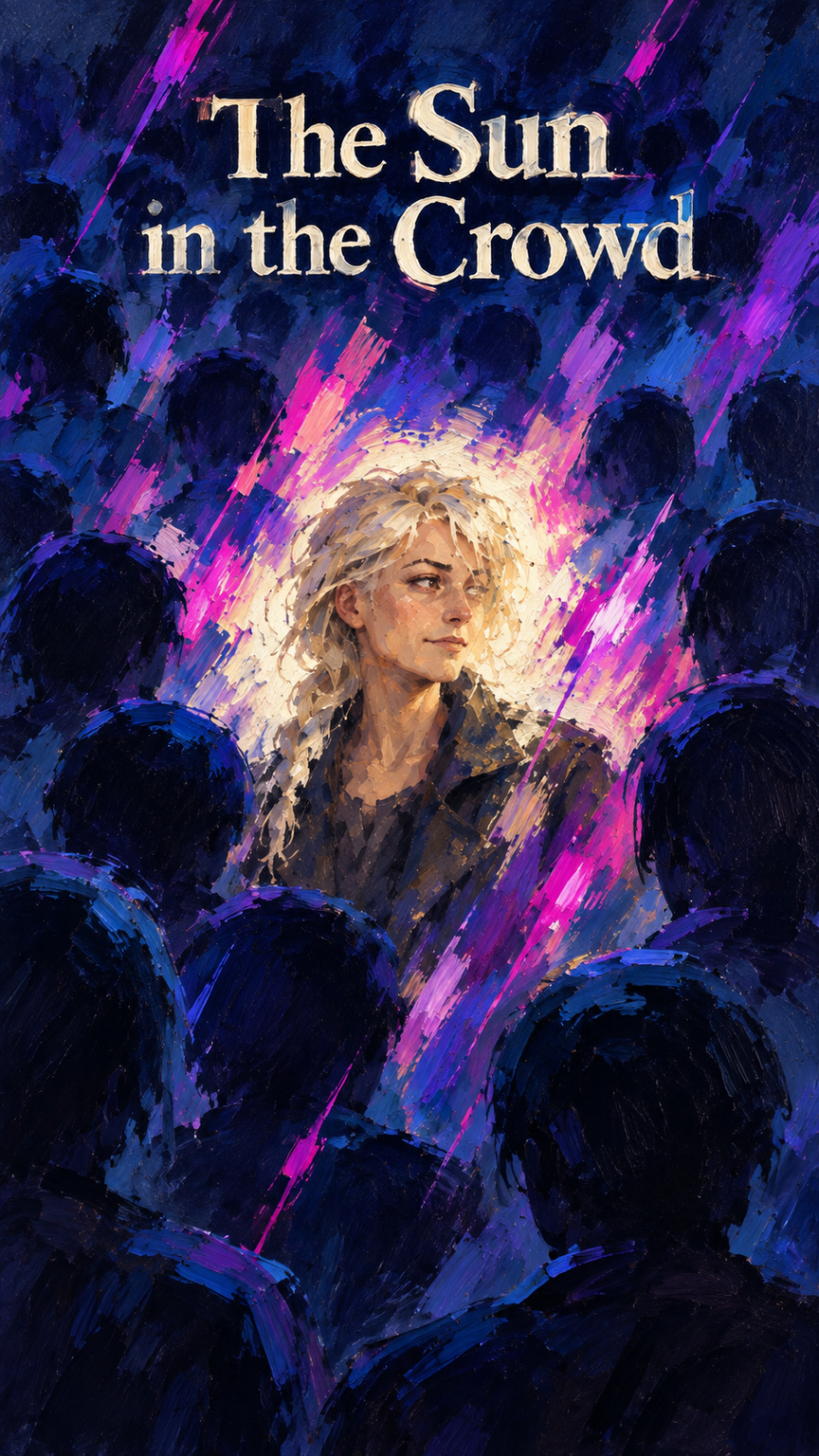
This was different. A gold-white center blazed through a gap in the tide of heads, with pink and violet at its edge. It flared as the gap widened, then disappeared behind the awning of a spice seller's cart. For an instant I thought someone had carried a lantern into the street. Then the same light reappeared farther on, keeping pace with a pale-haired woman in a dark coat.
I left my charcoal beside the unfinished stack of paper and went after her.
The street narrowed between stalls of oranges and printed cloth. I had to turn sideways to pass a man shouldering a crate. When I straightened, the woman was gone. My left eye picked her out a few strides ahead; my right saw only a sleeve, a braid of pale hair, then the back of someone's hat. I followed that moving interruption, my portfolio knocking against my hip.
At the next crossing, I lost her behind a tall family carrying paper masks. I climbed onto the rim of an empty planter for a better view. The stone was slick from crushed fruit. My foot slid; I caught the branch of a little tree, shook leaves into a vendor's trays, apologized, and jumped down. By then the light had moved toward the performance square. I ran the last few steps and found her waiting for a handcart to clear the corner.
"Excuse me," I said, more loudly than I meant to.
She turned. The left eye gave me a painful white stroke across her face. I shut it. She was older than I'd thought from behind, perhaps thirty, with one eyebrow notched near the end and a faint crease running from her nose toward her mouth on one side more than the other. The coat was plain and carefully mended at a cuff. My first surprise was that she looked so definite. The blaze had offered me no idea what sort of nose she had.
"Were you following me?" she asked.
I could have lied and said I'd recognized her from a sitting. The closed eye was twitching to open. "Yes. I'm sorry. I'm a portraitist. My stall's just back there."
"I'm late."
"Ten minutes. I can do a quick likeness."
The handcart passed. She could have gone around me with it. Instead she glanced at the portfolio and then at my empty hands. "You stopped me to sell me a portrait?"
It sounded worse aloud. "To ask. You don't have to."
"I know that." She stepped to the side so people could pass between us and the cart. "Have you got one I can see?"
I opened the portfolio at the first page, a charcoal head of a woman with a wide jaw and a knowing tilt to her mouth. The sitter had chosen the tilt. The pale-haired woman studied the paper without touching it. I turned two more pages: a stern baker, a girl holding her own ears back so I could draw them. She laughed at that one.
"She asked for that," I said.
"I believe you. Can you make me look like me?"
"That's usually the arrangement."
"Usually is a slippery word." She looked up the street. A drum was being tested in the square, a single hollow note at a time. "I'm on after the musicians. I can stay until they finish. How much for one I take with me?"
I named my ordinary price. She named a little less for so little time. I said yes, already lifting the portfolio strap over my shoulder.
"And I see it before I pay," she said.
"Of course."
"Auvet." She offered the name, then turned back toward my stall. I had neglected to offer mine.
"Mial," I said. "This way."
She walked fast enough that I had to shorten the strap and keep up. Twice she stopped to let other people squeeze past. Each time the light in my left eye seemed to stay with her, not spill into the bodies that crossed in front. I closed that eye again and watched her make room for a child carrying three wooden hoops. He didn't thank her. She didn't seem to expect it.
At the stall I pulled my folding chair from under the table and set it where the oil lamp gave a warm, steady wash across a sitter's face. Auvet sat, then moved the chair half a handspan to her left.
"I can see you better over there," I said.
"There's a draft over there."
The corner of the canvas roof breathed in and out above her. I put a folded cloth under the chair's short leg so it stopped rocking. She set a small wrapped bundle on her lap, the sort a musician might carry, and turned the mended cuff under. In the right eye she was a woman trying to hold still despite a foot already pointed toward the square. In the left she was nearly impossible to look at.
I chose the largest sheet I had. That should have warned me. For a paid street portrait, the smaller pages were easier to hold and less likely to crease on the way home. But the light around her seemed to need room. I marked the top of her head, the slope of a shoulder, the place where the blaze ran pink against the dark beyond her. My charcoal went fast. I had only a few minutes, and the first lines always made a promise I hoped the later ones would keep.
"Do I have to keep my mouth shut?" Auvet asked.
"Only if you usually do."
"Then your picture's already wrong."
I smiled without looking up. Her cheek kept disappearing inside that white center. I put it where I thought it belonged. A man came to ask whether I was still taking sitters; I told him I was closing. He leaned across my table to admire the page, blocking Auvet from me. When he moved, I drew from what I remembered. I made the shadows under her jaw darker to set off the light.
"What's that?" she asked.
"The first pass."
"May I?"
I held the sheet by its clean corners. She rose and came around the table. For a moment she didn't speak. Her thumb hovered over the paper, careful not to rub the charcoal.
"You've given me an enormous head," she said.
"It's the light. I can pull it back."
"It isn't just that." She pointed to the brow. "This eye is higher. My nose doesn't turn that way. And what am I standing in?"
The charcoal was heaviest around her face, like a curtain of smoke lit from behind. Even to my right eye, it had a kind of force. Her face, on its own, could have been anyone's. "I rushed it. Let me fix the features."
"You keep looking here." She touched the air an inch beyond her own cheek. "Then your hand moves as if my face were over there too. What are you seeing?"
I had talked about my eye to friends, never to a customer halfway through a bad sitting. "I see a little light inside every living person, with this eye." I tapped the left side of my face. "Yours is very bright. That's why I stopped you."
Her attention went from my eye to the portrait. "And this is what you saw."
"Some of it. I don't know what it means." That last part mattered enough to say before she asked. "It doesn't tell me who you are. I can't tell what you can do with it."
"But you wanted a picture of it."
"Yes."
She looked at the sheet once more. A pair of sisters going by stopped to look as well. One said the portrait was beautiful. Auvet held it against the table, out of their view, and waited until they walked on.
"You can keep this one," she said. "It isn't what I came back for."
I laid the sheet face down. "I can start again. I'll use the smaller paper, and I won't charge you if I miss it."
The drum made two notes in succession. Auvet turned her head toward the square. She had every reason to take up her bundle and go. Instead she settled into the chair again, her boots planted beneath her.
"How long?"
"Until the musicians finish, if they'll give us that long."
"Then be quick." She drew a breath, looked at me, and saw that I had reached for the charcoal without closing the left eye. "Can you stop seeing it?"
"Yes." I shut the eye. The inner fire vanished, and my view narrowed. From here I could still work. I had done it as a child whenever a crowded room became too much, though I disliked the small strain of holding the lid down. I tore a narrow strip from the edge of my rag and tied it over the eye, under my hair.
Auvet's mouth moved at one corner. "Is that comfortable?"
"Not much. I'll manage."
I steadied a fresh page on the board. The lamp picked out the shallow line beside her mouth and threw the other cheek into shadow. Auvet tipped her chin away from it.
"Back a little," I said. "Toward me."
She obeyed, then looked at the bundle on her lap as though checking it was still there. The change in her expression made her upper lip almost disappear. I put down the long angle of the nose and the plane of her forehead. Ordinary contours stayed where I saw them, so long as I kept my attention on them. My hand wanted to smooth the asymmetry at her mouth. I stopped it.
Someone tugged the back of my coat. The boy from the last portrait had come back without his mother at his side to ask if I could make his ears smaller after all. She stood at the orange stall behind him, holding the rolled paper. I told him I could make another portrait tomorrow, but I couldn't alter the one she had taken without her permission. He considered this and went back to her.
When I turned, Auvet had slipped her bundle under the chair and was watching the boy. I had missed the change of pose. "Your arm," I said. "Could you put it back?"
"Which way was it?"
I showed her with my own. She copied it, badly. We tried once more and both laughed. The small mistake eased the tightness in my fingers. I marked the bend of the sleeve as it was now and worked toward her hand.
"What do you do?"
She looked at the charcoal on my fingers. "A kind of drawing. I can't take it home afterward."
I let that sit. I didn't want to force her into showing me something she had not offered, and the question had already cost a line at her wrist. Then she held up her hand where I could see it over the board.
"Would it help to watch?"
"If you want me to."
A thread of red appeared between her finger and thumb. She pulled it through the air as if drawing silk from a spool. Blue and green followed it; under her moving fingertips the threads bent into the shape of a tiny horse, jointed legs poised without a surface beneath them. Its colors touched the table and lit my charcoal sticks. A child passing the stall cried out and reached through the horse's flank. Her hand met empty air. The horse took three steps across the air, climbed nothing, and disappeared when Auvet lowered her fingers.
The child protested. Auvet gave her a small bow. "More in the square."
She wasn't speaking to me. I had opened the covered eye without noticing, pushing the rag aside with my brow. Auvet's inner light came at me all at once, much stronger than the little horse had looked to anyone else. I couldn't say whether the two sights had any relation. I only knew that my own marks on the paper disappeared in the glare. I drew the rag back into place.
"It walked," I said.
"Only three steps." She held up the fingers she'd used, checking a charcoal smudge left when she had touched my table. "I'm still learning the legs."
I glanced at the tabletop below where the horse had walked. There was no mark on the wood. "Could you make one hold still long enough for me to copy?"
"I tried. It goes when I stop." Auvet turned her hand palm up, then let it rest on her knee. "Can you draw from that?"
"From memory, perhaps. But I need your face first."
"Then hurry."
The music in the square had become a pattern rather than a test, with a flute taking up the space between drumbeats. I moved the board so the lamp shone across the paper instead of into my right eye. Auvet leaned forward to inspect a few lines. I asked her to sit back; she did, but she reached across and indicated the end of the eyebrow with one finger.
"There. You missed the gap."
"I see it."
"You didn't the first time."
I cut the notch into the dark line. She watched, then nodded. We worked that way for the next minute. She told me the lower edge of her coat was frayed, not embroidered. I had mistaken a loose thread in the lamplight. She said the left side of her hair was shorter because she'd cut it in a hurry, and no, she did not want it evened out on paper. She could be still only until the flute reached the familiar rising phrase; then one foot started moving under the chair. I drew it as far as the page allowed.
Auvet broke the end off a charcoal stick as she tried to turn it between her fingers. "Sorry."
"That's the short piece. I use it for darks."
"You're welcome, then." She set both pieces down. "May I see?"
I held the board so she could look without standing. Her face on the page was smaller than in the first drawing. The nose turned as it did when she faced me, the eyelid on the lamp side lowered a little, the mouth almost forming a word. The coat showed its worn cuff, not the shining folds I'd invented around the first figure. I had put more care into the gap in her eyebrow than into any surrounding shadow.
She looked at it for a long time, considering the paper at several angles. "My chin is sharper than that."
"A little." I made the correction while she held the pose.
"And that mark beside my mouth goes all the way to the corner when I smile."
"You're not smiling."
"I will be, when I see the person this is for. If you can catch a little of it."
I asked her to smile so I could see it. She obliged too broadly. We both knew it, and it fell away. The line remained for a breath. I marked its course, then rubbed the end gently with a clean thumb so it belonged to the face in front of me.
"Better," she said. "What's this space?" She pointed to the blank beside her hand.
"I meant to ask." I pulled the rag clear of my left eye to look at her, not at the page. The gold-white center crowded back into view. "Do you want any of what I see in the drawing? I have chalk."
She studied the empty space. "If it's all around my head, no. The person getting this has heard me describe the show often enough, but hasn't seen it. Could you put the horse there? In my hand?"
"A small one. You made it above the table, though."
"Put my hand higher, then. It was there for a moment." She raised it to the height where the horse had walked. "I won't ask you to invent the legs. You've seen how bad mine are."
I steadied the second portrait on the board and moved her drawn arm, only a little; the old line disappeared under the heel of my hand, leaving a grey seam in the sleeve. Auvet checked it before I continued. With the right eye I could remember the horse's red spine, its blue belly, the green steps that had fallen through air. I laid three short chalk strokes over the charcoal, then added a fourth where its foreleg should have bent. In the page it rested just above her fingers. It wasn't a likeness of the bright center I saw with my left eye. It was something she had made while I watched, and she had chosen its place.
"It needs the back leg," she said.
"I only saw three."
"Fair." She took the board and angled it toward the lamp. The little shape caught the light before the rest of the drawing did. "The face is right now."
The flute stopped; applause came from the square. Auvet rose, tucking the bundle under her arm, and reached for her purse. She paid the price we'd agreed on, plus the small difference between her offer and mine. When I held the extra coin out, she closed my fingers around it.
"For the second sheet," she said.
"The first was my mistake."
"Then for the chalk."
I tucked the coin into the tin. She looked once more at the notch in the eyebrow and touched the paper below it, where no mark could smudge. Then I slipped a clean sheet over the portrait so the chalk wouldn't brush against her sleeve and rolled both pages into a tube.
"Is it dry?" she asked.
"The chalk may still come off if you rub it. Hold the tube by the ends."
She did. The applause was thinning. Auvet backed into the moving people, gave me a quick nod, and turned toward the square. I could see her pale hair for three steps. My left eye found the flare twice more between passing bodies, then a high-sided delivery cart crossed the street and hid her completely.
The first drawing lay face down where I'd left it. I picked it up by the corners. The paper still held my thumbprint at the edge of the great bright head. I put it under the board before the night air could lift it away. From the square came the sharp slap of a drum, then a ripple of voices answering something I couldn't see.