
“No weapons allowed in this establishment, ma'am.”
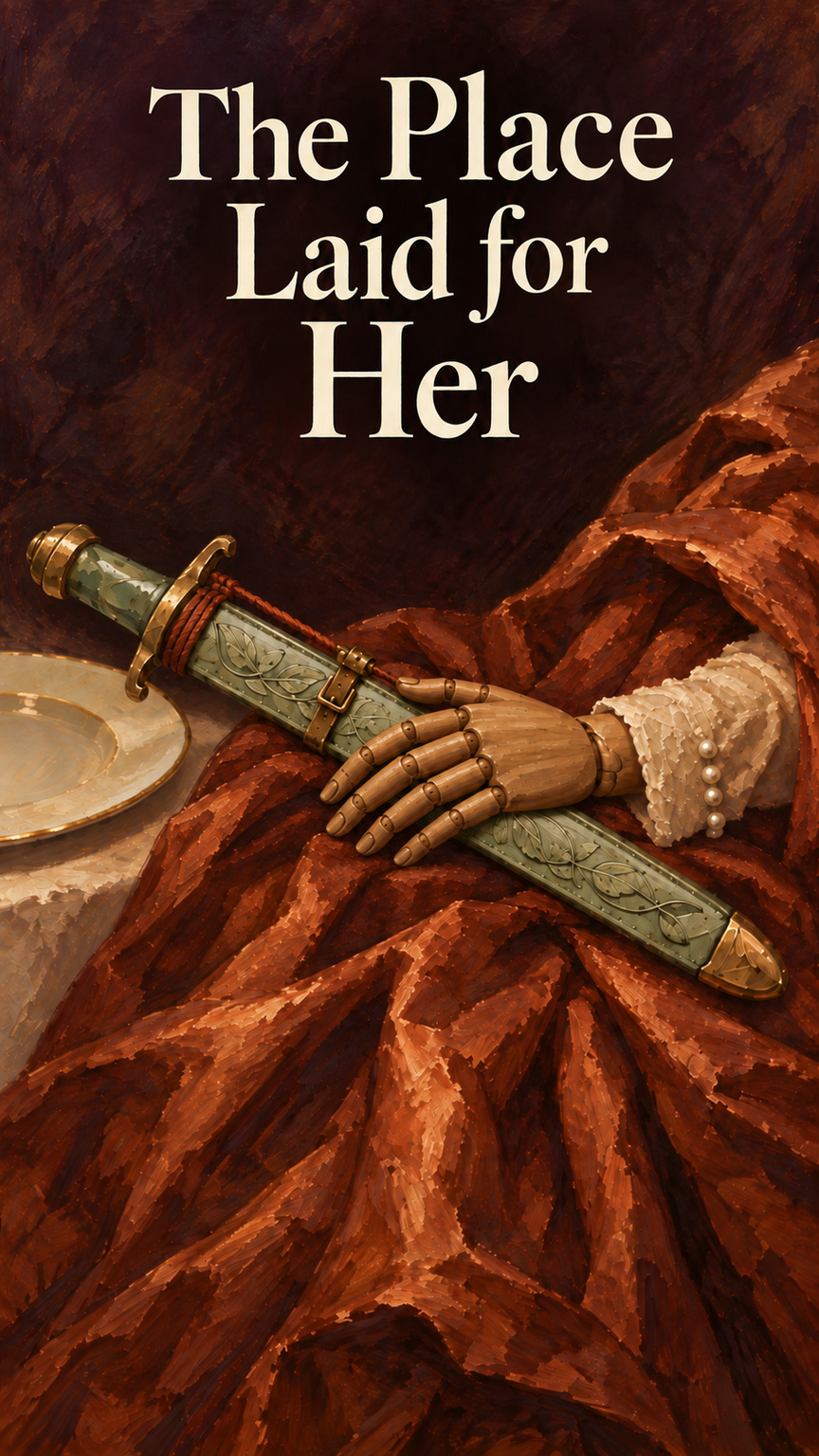
“My consciousness is in the sword, the humanoid body you're looking at is a glamoured mannequin I'm puppeting.”
The host of the Ousel Room looked down at the sword, then up at the woman holding it. Ildesse had given the mannequin dark eyes, a long nose, and a mouth that looked well in repose. At present the mouth was doing a smile she had rehearsed for somebody else.
“Would you be willing to have the scabbard tied shut?” he asked.
“Yes, certainly.”
He fetched a silk cord from beneath his desk. She held herself out horizontally in the mannequin's two hands while he wound it between the guard and the scabbard buckle. It was a very pretty scabbard, pale green leather tooled with leaves, selected to suit her dress rather than her blade. The dress was copper silk. Its skirt required a generous interpretation of doorways.
“And the reservation?” he asked the pommel.
“Ildesse.” Her voice came, as usual, from the mannequin. “It's still this end for conversation.”
“Of course. Two at eight. Your gentleman hasn't arrived.”
She had intended to arrive three minutes after Brevot, giving him time to sit down and begin wondering whether the copper dress appearing between the curtains could possibly be for him. To accomplish this, she had come early to ascertain the arrangement of the room, meaning to withdraw afterward and come back once he was seated. The host was now tying a second knot. Above his head, the clock began striking eight.
“Not over the little cap, please.”
He moved the cord. The pommel's feeding cap had loosened in the carriage; with one wooden fingertip she pressed it home. Beneath it, a wet wick nourished the warm, pulsing thread that ran down through the tang into the blade. Her living flesh was narrow, delicate, well protected, and presently cross. The magic that moved her mannequin and dressed its plain head in features came from there. She could send that body six paces from herself, but not a seventh; the sword had no means of following. Being put in a cloakroom would have made an exceptionally short evening.
The host tested his knot, offered her the cord's two ends for inspection, and showed her in.
There was a banquette against the wall, a chair opposite it, candles, small glasses, folded napkins. Her flowers had arrived. The musician stood near the far curtain with his fiddle under his arm; he caught her eye and raised two fingers. Two pieces, as agreed, beginning with the first course. She acknowledged him with a small nod, the sort that looked discreet unless one was wearing three copper feathers in one's hair.
Forty-three years old, and she had spent most of the afternoon choosing those feathers. She would have done it again. In the long mirror beside the curtain, her skirt moved like an expensive liquid.
She was laying the sword along the banquette, behind the place where she meant to sit, when a man said, “Ildesse?”
Brevot had arrived without waiting for her entrance.
“Yes. Just a moment.”
The point of the scabbard was on her wrap. She lifted it, freed the wrap, and discovered that the mannequin's elbow had caught the flowers. Brevot steadied the vase. Now they were both holding things and looking at each other across an extraordinarily large white bouquet.
“Shall I put this somewhere?” he asked.
“In the middle. No, nearer the wall.”
He put it nearer the wall.
“There,” she said, and stood properly. “Good evening.”
“Good evening.” He smiled, and she was glad she had bought the feathers.
His portrait had been done by a friend who disliked noses, but otherwise it had prepared her. He was handsome in a worn, uneven way, with a broad mouth and gray beginning above his ears. Thirty-eight, he had written; vain about his hair and helpless before a well-turned ankle. She had been considering that last confession for eleven days.
“I nearly wore my other coat,” he said. “Then I remembered telling you how much I hated this one. I thought you might like to see what all the fuss was about.”
“The buttons do look distressed.”
“It's the left sleeve. Watch.”
He reached for his chair. The sleeve rode halfway up his forearm, and a bright inch of lining protruded from the cuff.
She laughed. His answering grin was immediate and unceremonious. There he was: the man who had sent her four pages about his landlord's campaign against pigeons and then, in the margin, admitted to feeding them.
They sat down.
“You look—” he began.
“The complete supper for two?” asked a server at his shoulder.
“Yes, please,” Ildesse said. “As I ordered.”
The server departed. Brevot looked at the unused plates before her, then toward the entrance.
“Are we expecting someone?”
“No.”
“I thought you couldn't eat.”
“I can't.”
He looked back at the plates.
“I ordered supper for two,” she said. “That is how they sell it.”
“Ah.”
The menu had described a procession of little dishes brought beneath silver covers. When reserving, she had pictured the lifting of those covers, the steam, his delighted surprise. She hadn't pictured having to account for the second quail.
“You needn't eat all of it.”
“I probably shall. I missed lunch.”
She had hoped for something less hungry, though she couldn't reasonably have said what. She arranged her hands on the table. He glanced at them, at the slim gloves with their pearl buttons. The mannequin could return touch as well as sight and hearing; if he put his hand over hers, she would feel it. His fingers were broad, with an ink stain just beneath one nail.
He reached into his coat.
“I brought you something.”
“Did you?”
A narrow parcel emerged, wrapped in blue paper. For the instant before he unfolded it, she let it be earrings.
“It's a poem,” he said.
She kept smiling while he opened it. “A new one?”
“Finished this morning. I wanted you to be the first to hear it.”
Four months ago she had sent a letter to the review in which his verse appeared, objecting to its editor's habit of cutting out the funny stanzas. Brevot had written back. Since then there had been books, arguments, the pigeons, accounts of parties they separately refused to attend. She had praised two of his poems extravagantly and found fault with the rest. He said hers were the only letters he opened before breakfast.
“It's for you,” he said.
This was better than earrings. Possibly. She folded her hands together to keep them from making any premature decision.
He took out three sheets, smoothed them, and moved the flowers an inch to the left.
“It's called ‘The Unsheathed Heart.’”
Behind her, silk cord held her firmly shut. She did not mention it.
Brevot began softly. His reading voice was lower than his speaking voice, and slower. She liked hearing him take care over something. In the first stanza a blade rested among lilies; in the second it remembered the men who had carried it; by the third, a battlefield had appeared. The grass of that battlefield was compared to young hair.
She tried to keep hold of the pleasure of being written for. He had worked on this at his desk, thinking of her. He had bought blue paper.
“Before the field remembers grass,” he read, “she dreams its brief red flowering—”
The server appeared at the far curtain with two covered bowls. The fiddle began immediately behind Brevot's left ear.
He flinched, lost his place, and turned. The musician smiled at Ildesse over the instrument. She had asked for the old air with the long rising phrase, the one in which a lover arrived beneath a window and insisted that being married to somebody else was no great impediment. Without its words it was perfectly respectable. With its words it was one of her favorites.
“Could you wait?” Brevot asked.
The musician stopped with his bow lifted.
“Just until I've finished,” Brevot added.
“I asked him to play,” Ildesse said.
“Oh. Sorry.” He set the poem down. “Yes. Of course.”
The musician looked from one to the other. “Shall I start again?”
“Please,” she said.
He started again.
Ildesse put one hand beside Brevot's, close enough that he could take it without reaching. He watched the musician. She could not decide whether he was listening intently or waiting for it to be over. The server arrived with the bowls and tried to catch her eye. Ildesse gave a small shake of the head. Just until the rising phrase was over. Then the covers could come off.
It was not a short air. She had liked that about it when choosing.
Brevot smiled at her once, apologetically. She smiled back. He looked down at the soup cooling in the server's hands. She could have dismissed the musician, but they were approaching the part for which she had hired him. By the time they reached it, she had to count the phrases to make herself listen.
The last note lingered. Brevot applauded too soon, then again when the bow came down.
“Beautiful,” Ildesse said. “Thank you.”
The soup was set before them. Brevot picked up his spoon.
“And the second piece, madam?”
“In a little while.”
“I'm engaged at the other end of the room in a little while.”
She was paying to interrupt the regular program. He had explained the arrangement clearly in his note. The whole evening had looked much more spacious on paper.
“Then now, please.”
Brevot lowered his spoon.
“You can eat,” she told him.
“I don't want to be rude.”
“It doesn't trouble me,” said the musician, and began the second piece.
This one was quicker. Brevot ate his soup. With no spoon to occupy her, Ildesse held her hand on the table until it began to look as though she were waiting to have it examined. She brought it back into her lap.
When the music ended, Brevot thanked the player with evident feeling. Ildesse watched the musician go to a table where three women were happily shouting over one another. None of them stopped when he began to play.
“You don't like music,” she said.
“I do. Sometimes. I never know where to look when somebody's playing it at me.”
“I thought it would be lovely.”
“It was well played.”
“Yes.”
He glanced at the pages beside his bowl. “Should I leave this?”
“No, go on.” She meant it. Something might yet happen in the poem that would bring the evening round. The blade might be taken dancing.
He finished the third stanza and read two more. There were banners, a dead king, and a final image of the sword laid across the knees of a man too weary to lift it. That last stanza was good. She could see the man in the dark, his legs cramped under the cold weight, ashamed to wake his companions and ask for help. Unfortunately, she could see nothing in it that resembled their correspondence.
Brevot lowered the pages.
“Well?”
“The end is very good.”
He waited.
“The man in the last stanza. I like him.”
“But?”
“Must there be a but?”
“There always is in your letters.” His thumb rubbed the edge of the paper. “I'd rather have it.”
She looked at the little ink stain. “It's a great deal of war to give someone over dinner.”
“I thought you'd enjoy a proper attempt. After all those dreadful epics we've been sending each other.”
“I enjoy being rude about them. I don't wish I were in one.”
“No, but it isn't meant to be you. Not a portrait. I know it's a sword, and you're a sword, so I can see how it looks, but I didn't sit down and decide you were a battlefield.”
“You said it was for me.”
“It is for you. It is. Only some of it's just what the poem wanted. The dead king wanted to be in it, I tried to get him out twice. It doesn't mean every line's about you.”
No, it didn't. She knew that perfectly well. She had defended poets against precisely this complaint, in print, and at considerable length.
“I'm sorry,” she said. “I expected something different.”
“What?”
She made the mannequin pick up her glass. It was an old social trick: the little pause, the excuse to look down. She could not drink from it, and he knew that, and now she had a glass in her hand.
“Something amorous.”
He looked at her for so long that she put it down again.
“But it is amorous. I thought it was the most amorous thing I'd ever done. I was worried it went too far.”
“How?”
He turned back to the first sheet. “The lilies. That whole first stanza. They're meant to be my letters, sort of. And the poems. And the blade's lying there among them dreaming about the next fight, the next but, so they wilt a bit.” His thumb found the edge of the paper again. “It's affectionate. Mostly.”
She had liked the lilies when he read them. Oh, dear.
“I praised two of your poems,” she said. “Without reservation. I was most careful about that.”
“I know you did. I kept those. It's only a poem, everything gets bigger in a poem, I didn't mean you actually—”
He looked past her at the large bouquet, then quickly back at his poem. She had selected every stem herself.
“May I?” The server held a plate of quail at Brevot's elbow.
Ildesse made room. The server replaced both soup bowls and brought potatoes, a sauceboat, two more knives. Brevot folded the poem in half before a dish could be put on it.
For a time he ate and she watched candlelight collect in the untouched sauce on her plate. She had paid for a real dress because no glamour could give her the drag and whisper of its silk. Its bodice fitted the mannequin beautifully. Beneath the table, a wooden knee pressed against a crosspiece; she adjusted it, hearing the small click through the room's talk.
“Would you like my quail?”
“Not yet, thank you.”
He cut a potato. She let herself stop smiling.
“I was nervous,” he said eventually. “About reading it. That's why I started so soon.”
“I didn't mean to arrange an interruption.”
“No. I know.”
She moved her plate toward him, just a little, ready for later. He asked whether she had finished the novel they had been discussing. This was familiar ground. Yes, she had finished it; she had stayed up until three.
“Worse than the second volume?” he asked.
“Much better. She goes back for him.”
“Surely not.”
“Yes. After the duel.”
“Then he hasn't died? What was the point of forty pages of his dying?”
“I liked those pages.”
He laughed. She didn't.
“Oh,” he said. “You really did?”
“I like a long death scene. You can settle into it.”
“But you called the second volume indefensible.”
“It is. I read it twice.”
“I thought you hated it.”
“I thought you'd laugh at the bit I copied out.”
“I did.”
She remembered lying awake after writing that letter, inventing things he might say in reply. His answer had arrived with a parody of the dying man's speech. She'd laughed so much her concentration had gone and her mannequin's eyebrows had disappeared. It had been a very happy morning.
“I thought you liked it too,” she said.
“The things you wrote about it.”
“Oh.”
He put his knife down. “Tell me what you liked about the ending.”
She began. At first he listened; then he asked why the woman hadn't simply sent a servant to find out whether the man was alive. It was a sensible question. It had an answer, something to do with the woman's brother, but she couldn't recall it under his attention. She tried explaining the scene at the staircase instead, the wounded man coming down because he couldn't bear to wait for her to come up. Halfway through, she heard herself apologizing for the stairs.
“Never mind,” she said.
“I didn't mean to spoil it.”
“You haven't. I shall read it again.”
He nodded. She sat with her bare disappointment, which had no particular facial expression she wanted to give it. The mannequin looked peacefully attentive.
“I should have suggested somewhere simpler,” he said. “I don't do very well with all this.”
“I like all this.”
“Yes. I can see that.”
She looked at the flowers he had shifted, her place laid with things she couldn't use, the beautiful room in which she had placed him. He hadn't asked for any of it. She had hoped he would arrive and know what to do.
“You wouldn't have liked the third piece either,” she said.
“Was there another?”
“Only one I decided against.”
“Ah.” He took a little more sauce. “No, probably not.”
She nearly laughed, but didn't feel obliged to help him enjoy saying it.
Dessert came in two shallow dishes. She asked for the bill before he had finished his. He looked up, spoon still in hand, and then nodded.
When the bill arrived he reached for it. “Let me.”
“Half the supper.”
“I ate nearly all of it.”
“I ordered it. Half, please.”
He considered her, then counted out his coins. She paid for the flowers and the music and her half of the food. The number looked startling even though she had known it beforehand. Brevot left something extra for the server and wrapped his poem again. The blue paper made a loud, fussy noise.
“Would you like to keep it?” he asked.
She wanted to say yes for the man who had spent his morning finishing it. But she would have to open the parcel at home. She could already feel how it would be to read those lilies again.
“No, thank you.”
He pressed the fold flat. “All right.”
They stood. He offered her the wrap, and she bent her head while he laid it around her shoulders. His fingers briefly touched the back of her neck. She felt their warmth, and the care with which he avoided the feathers. For a moment she wanted to turn and try the whole evening again, starting here.
Then he stepped away to retrieve his hat.
Ildesse lifted the sword from the banquette and tucked it under her arm. She looked at the flowers, then asked the server to keep them.
At the curtains Brevot stopped. “Your dress is wonderful, by the way. I was trying to say so when we sat down.”
“Thank you.”
“I should have tried again.”
She smoothed a fold in the copper silk. “I would have liked that.”
He looked as though there were several things he might say next, and she waited. Then he wished her good night. She returned it. He went out first, taking the poem with him, and she stood by the host's desk while a carriage was called.
The host offered to cut the cord, but she could undo it herself at home. It did no harm where it was.
Outside, her skirt took up most of the pavement until she gathered it. She climbed into the carriage with the sword held close and settled among the rustling folds. The tallest feather brushed the carriage roof. She reached up to take it out, then stopped.
She had imagined asking Brevot to take them out. All afternoon she had been imagining it. She lowered her hand and left the feathers where they were.