
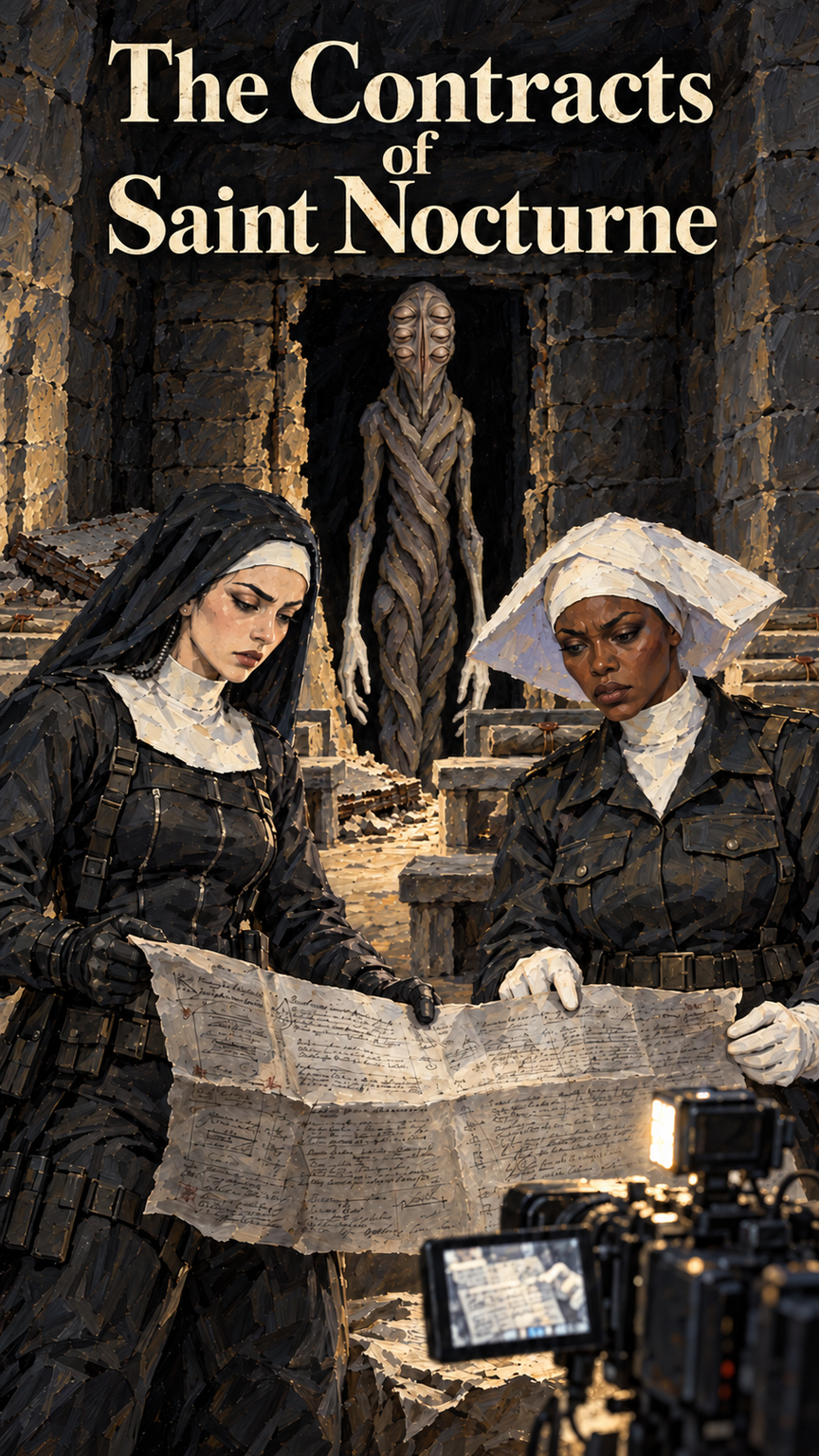
The sisters lost the courtyard at eleven in the morning. Until then, Sister Ione had only ever seen its palms from below.
Now a machine was carrying her above them. Its padded arms held her elbows against her ribs, and her boots hung clear of the battered fronds. The radio in her black veil crackled against her ear. Down on the paving, Sister Peret struck another machine with her empty rifle. It caught the rifle, considered her for a moment, and took her under both arms.
The expedition had promised to capture them alive. This was turning out to be worse than Ione had expected.
Across the court, Neri was still firing from the bell tower. Olwen, whose hands shook until she held a weapon, had made a barricade of the western gate. Maud sat beside a wounded expedition soldier and pressed both their hands against his bandage. Tavia's last small aircraft rose from the roof, struck a much larger one, and came down burning in a stone planter.
Sister Agnet emerged from the smoke. She was the oldest of them, and she had promised Ione they would never see the trees from above.
She looked up, saw Ione dangling there, and made an obscene gesture at the machine.
Then Mother Damaris came out of the library carrying a white cloth.
They had spent eleven days dismantling the most heavily guarded library on Earth. Six countries had supplied the expedition's machines; nineteen had supplied people; every government had signed its authority. Three centuries of secular custodians had added fortifications to the Vatican Archives without being permitted to ask what the fortifications protected. The eight women of Saint Nocturne had inherited all of it. Each generation had improved it.
None had improved the white cloth. It was an old towel from the infirmary, with a darn in one corner.
Damaris lifted it above her white coif. At her gesture, Neri stopped shooting.
The machine lowered Ione into a line of soldiers. A woman in a dusty blue jacket was waiting beside them. On her breast was the commission's eight-pointed seal, gold against blue. She looked at Ione's bound wrists, then at the palms, and seemed to decide against whatever she had meant to say.
“Dr. Ada Nasse,” she said instead.
“I know.” Ione had watched her announce the expedition. Everyone in the archives had watched.
“Is anyone left inside?”
“No.”
“Children? Trainees?”
“There are eight of us.”
Ada glanced at the library. Its reading rooms could have housed a town.
“There have always been eight of us,” Ione said.
Damaris arrived between two soldiers. Her white gloves were blackened. A thin line of blood had dried on her dark forehead, above one eyebrow.
“You may have the upper collections,” she told Ada. “No resistance. All the catalogues. Everything down to the red stair.”
“That was the offer before we came.”
“It is still an offer.”
“And what would you like me to tell the people whose money built those walls?” Ada pointed at the ruined tower. “Or him?” She indicated the wounded soldier beside Maud.
Damaris looked at him. “That I am sorry.”
“They've been told that before. By your predecessor, and hers. We're going down.”
“Then go as readers. Resign your mandate. Leave the commission's seal here.”
Ada touched the badge. “Why?”
“If you open an original before an accredited human assembly, you acknowledge receipt of a claim.”
For the first time, Ada seemed angry.
“You understand what you just said? That something down there makes a claim on the people who sent us?”
“Yes.”
“Then they have a right to see it.”
Damaris caught Ione looking at her. Ione had never heard this part.
“Let me show you an unopened instrument,” Damaris said. “Photograph it. Record its existence. Take that back to them.”
“And let you decide when we can read it?”
“There will be consequences.”
Ada took her hand from the seal.
“There have been consequences for centuries. We just haven't been allowed to know what they were.”
The camera above her shoulder turned toward the library.
Ione had stood guard at the red stair for six years. She had not been below it.
Agnet knew the way. She walked in front of Damaris, moving her right knee carefully after the fight. Tavia followed the camera with her eyes, working out what it could see. Neri and Peret were still furious; Olwen was silent; Maud kept trying to get a soldier to look at the burn on Peret's neck.
The expedition let all eight come. Ada said this was partly a matter of safety and partly a matter of witnesses.
“Also,” she added, “I think you should see it with us.”
“Mother has seen it,” Ione said.
“Yes,” Damaris answered.
Ione waited. Damaris walked on.
There were no crosses below the stair. The cross had been taken off the archives' public entrance when the last church closed, generations before Ione was born, but she had expected one here. Something left over. Instead there were calculations cut into the walls, lists of supplies in obsolete languages, and a succession of marks at shoulder height.
“Those are fingerprints,” Ada said.
“The early custodians,” Agnet told her. “Every one of them.”
Ada slowed to look. A soldier urged her on. Above them, behind several metres of stone, the breaching crew was finishing its work on the last door.
When the charge went off, grit fell from the fingerprints.
The door had no image on it. Eight women had spent their lives defending a grey slab. It lay inward on the floor, its broken edges showing layers of steel and something dark that smelled of crushed leaves.
One of the soldiers crossed himself, then looked embarrassed. The gesture survived in people who had never prayed.
“Are you expecting a body?” Damaris asked Ada.
“I don't know what I'm expecting.”
Inside were eight stone benches. On each lay a wrapped object. Some were flat, one was cylindrical, and the smallest would have fitted in Ione's palm. Clay seals marked the wrappings. The air smelled of dust and cedar.
Ada stood very still.
Above the benches, cut into the wall in a language Ione had been taught to read but never needed, were the words:
Here lie the undertakings, in their first and binding forms.
“Undertakings,” Ada murmured. “Not testaments.”
Her camera light moved along the benches. The labels gave dates by kings, eclipses, migrations. There were names of human peoples that had not survived into any language spoken upstairs.
Damaris turned toward the door.
“You have your pictures. We can leave.”
Ada went to the first bench.
Its label was repeated in several hands. The newest was only a few centuries old.
Concerning the safety of sleepers.
The seal beneath it showed a closed eye.
“Wait,” Ione said.
Ada looked round.
“Let me stand where I can see.”
Damaris shut her eyes. A soldier brought Ione forward.
The wrapper opened around a great folded sheet, supple and grey. Its writing was crowded, practical, amended in the margins. Different hands had made the lines. At the bottom were eleven human thumbprints and one deep impression like the track of a many-jointed foot.
Ada's breath caught.
“These names. We have fragments of these names.” She bent closer. “They aren't invocations. They're parties.”
The last line of the outer sheet lay beneath the camera:
We, who are not made by you, and who owe you nothing before this agreement.
Ione read it twice.
Ada took the commission's seal from her jacket. It was also the instrument with which she authenticated accessions. She set it beside the sheet so the camera could record the mandated commission receiving the original.
“Don't,” Damaris said.
Ada looked at her. Her hand stopped, but she did not remove the seal.
“If it concerns us, we have to receive it.”
Something beyond the broken door said, “Received.”
The soldiers turned their lights toward it.
At first Ione thought a strip of the doorframe had come loose. The thing was that narrow. It unfolded into the doorway, taller than a person, with long white hands and a head whose many folds moved independently around six shut eyes. Dust stirred where it breathed.
It had been outside. It had come in through the corridor they had just used.
“How comfortable you have all been,” it said.
The soldier nearest the door raised his weapon. Damaris shouted, “Wait.”
The thing reached past him toward the bench.
He fired. The shot struck its hand and drove it against the stone. Its mouth opened vertically between the folds of its face. The sound it made hurt Ione's teeth.
Three more weapons came up.
“Keep it there,” Damaris said. “It is alive.”
Ada looked at her, then at the captain beside the door.
“Their hands,” she said.
“Weapons too,” Damaris told her.
For a moment Ada did nothing. Then she nodded. The captain ordered the bindings cut and the confiscated rifles brought forward. He helped Olwen load hers, watching the doorway over her shoulder.
The creature drew its damaged hand against its chest. Dark fluid soaked into a fold of skin.
“Is that necessary?” it asked.
No one answered.
Ada was staring at the thumbprint beside her seal.
“The Guest Beneath the Eyes,” she said.
The thing inclined its head.
“Is it a god?” someone asked from behind the camera.
“Not any longer,” Damaris said. “That doesn't mean it died.”
The Guest smiled with its eyes still shut.
“We have business.”
Ada reached for the seal. The Guest's head turned precisely toward her hand.
“You may put that away. You have acknowledged receipt.”
On the little screen attached to the camera, the broadcast's heading changed. For a moment it read FIRST CONTACT: VATICAN ENTITY. Then someone somewhere replaced entity with DEITY.
Ione wanted to tell them to stop doing that.
The Guest extended its uninjured hand, palm upward.
“Services outstanding.”
“We haven't agreed to anything,” Ada said.
“You have received the agreement. Your ancestors agreed.”
“Our ancestors had no right to promise us.”
“An objection frequently made by heirs.”
Ada looked down. Ione read over her shoulder.
There were lists of beings: the Guest, its household, the things that followed its household, the things it could restrain. Against them stood an undertaking that no human sleeper would be entered, hunted, or carried away, so long as the promised services were rendered.
Beside one name was a restraint: It shall not call the sleeper in any loved voice, nor draw the sleeping body after the mind. The next line forbade carrying anyone into a place from which there was no waking road back.
Below it, the human obligation ran for two lines.
One night in every seven. From sunset to first light, kneeling and speaking the names of the Guest and its household. Their descendants were to do likewise.
“You sold them protection from yourselves,” Ada said.
“Among others.”
“And if they didn't want it?”
“They very much wanted it.”
The eleven thumbprints were small. One had been pressed twice, as though its owner had been frightened of doing it wrong.
Pinned behind the first sheet was another, much newer. Ione recognized the order's hand.
Collection being suspended in the sealed custody of the eight mortal watchers, and resuming only on presentation of this original before an accredited human assembly.
Beneath were successive renewals. Eight names. Eight more. Eight more.
The last list named all eight of them. Ione remembered signing its copy six years earlier. The form she had seen had said only that she would keep watch over the entrusted originals.
“You are the reason it stopped,” she said.
“The reason it stayed stopped,” Damaris answered.
The Guest looked toward the ceiling.
“But now it resumes.”
Dr. Kem Hazi's phone began to ring.
He was the expedition physician. He had a strip of black adhesive across his forehead where a fragment had cut him in the courtyard. Until then, he had been watching Peret's burn.
He silenced the call. It rang again. Then Ada's headset filled with voices, and the camera operator said, “They want you to look at this.”
The image on the camera screen divided.
In a hospital ward, four adults were kneeling on their beds. Their eyes were shut. They were speaking together. A nurse tried to lift one man's face; it turned back toward the wall.
“Sedation?” Kem asked at once.
The nurse shook her head.
“They were asleep. They won't wake up.”
Ione knew the words they were saying. She had just read the first of those names.
“Stop,” Ada told the Guest.
“They are still under my shelter. This is collection.”
“Stop collecting.”
“We may discuss terms.”
Kem answered his phone.
A boy's voice came out of it, thin and angry with fright. “Dad, he keeps singing. He's doing it again.”
Kem turned the screen. A younger boy sat upright in a bunk, eyes closed, swaying a little. Someone was calling his name out of view.
“Don't hold him down,” Kem said. “Let me see his face. Yes. Like that.”
“They remain safe,” the Guest said. “The services are overdue, but I do not hunt my own clients.”
“He's nine,” Kem said.
“He is an heir.”
“And the ones who can't speak? Babies?” Ada demanded.
“Sheltered. Owing what they cannot yet render. They are not forgotten.”
Kem made a noise and went toward it. A soldier caught his jacket.
The Guest did not move. “Your household can clear its arrears. Resume the observance, in waking life. One night in seven. You know how to arrange a rota, surely.”
“Everyone has to do it?”
“Everyone who wishes to continue receiving shelter. Each for themselves.”
Ada said, “There is a choice?”
The Guest's folded face turned away from her.
Ione looked at Damaris. Damaris was watching the small singing boy.
Ione bent over the original.
At the foot of the sheet was another line, partly covered by a fold. She drew it flat.
“Any heir,” she read.
Damaris put a hand on the sheet.
“Ione.”
“Any heir to whom the entire terms have been made known—”
“May refuse this agreement in their own person,” Damaris said, “owing neither service thereafter nor service outstanding, and receiving thereafter neither shelter nor ward.”
She said it without looking down.
Ione stared at her.
“A complete and faithful copy,” Ada read from the next line, “may stand for the original in the making known of these terms.”
“Do not,” the Guest said, “confuse information with safety.”
The camera was still showing the hospital. Ione looked up at its dark lens.
Her hands were on the page. Damaris's hand was on hers.
“You knew,” Ione said.
“Yes.”
“All of it.”
“Yes.”
“You let me promise my life without ever telling me.”
“So you could sleep. So they could.” Damaris indicated Kem's phone. Her voice had lost its command. “When I first read it, I refused. I thought I should know what we were guarding.”
“You went without?”
“One of them called in my father's voice. My predecessor woke me, but its hand was still in my hair. She had to pull me free.”
Ione looked at the list.
“I begged her to get me back under the shelter,” Damaris said. “The Guest agreed to readmit me under the suspended agreement. I wasn't owed that.”
“You got to choose. Why didn't I?”
Damaris did not answer.
The Guest bent toward the bench. The soldiers raised their weapons again. It paused, hands displayed.
It angled its folded face toward the camera.
“This can still be postponed,” it said.
A pale membrane unfolded from beneath its wrist and lay on the bench, marked in the same crowded hand as the old settlement.
“Eight living custodians,” it said. “Their remaining lives. The original resealed, the complete terms uncirculated. Collection suspended again. You have recorded our existence. Your achievement is secure.”
“Our achievement,” Ada repeated.
“You may leave with it.”
Agnet came forward. She held her bad knee straight and looked at Damaris.
“Give me a pen.”
“Agnet,” Ione said.
“I heard.”
“You don't have to.”
“I heard that too.”
Ada found a pen. Agnet took it with the hand that had made the gesture in the courtyard. She put her name beneath the offer.
The Guest's eyes tightened in their folds.
“Eight,” it said. “No bond until the eighth assent.”
Damaris read the membrane. “No replacement after signing.”
“For these lives, no. They end; another settlement may be offered.”
Olwen signed beside Agnet. Then Maud.
Neri, Peret and Tavia had come round the bench. They waited for the pen.
Ione could see the old life returning. The kitchen window she had looked through every morning. The drill hall. The red stair. The palms from below. A new girl brought in before one of them died, taught the languages and the weapons, told what she would preserve, never what she could refuse.
“I won't,” she said.
Agnet kept her place at the bench. She did not look hurt or surprised. “All right.”
“I will,” Kem said.
The boy on his phone was still singing. The older child had stopped trying to wake him and was sitting on the floor beside the bunk.
Kem looked at Damaris. “It doesn't have to be one of you?”
“No.”
“Then I'll replace her.”
Ione opened her mouth.
“Don't tell me I don't understand,” he said. “I understand enough. I can spend one night in seven on my knees, or I can stay here and they don't have to. I would rather stay here.”
“You'd never go home,” Maud said.
“Yes.”
He took the pen from Maud. His hand was steady. He signed beneath her name.
Ione stepped back from the bench.
It was possible. Someone could take her place. She could go out of the gates and sleep safely because Kem Hazi had stayed inside them. If he changed his mind, perhaps someone else would come forward.
She could not call that her imprisonment.
Ada looked from the membrane to the original. The camera above her shoulder still carried the divided picture: the hospital, the singing boy, the vault.
“If we accept this,” she said, “what may we publish?”
“What you have already shown. Our existence. The general nature of our undertakings.”
“The service. The shelter.”
“Yes.”
“But not the complete terms.”
The Guest inclined its head.
Kem said, “Then don't. Give us time.”
Ione looked at the boy beside the bunk. He was old enough to read the words on the sheet. He had not asked to be an heir.
She turned to the camera operator. “Put the page on.”
Damaris caught her wrist.
“You can leave,” she said. “You can leave now.”
“I know.”
“If we can pay, they need never make this choice.”
“We can keep it from them.”
“Yes,” Damaris said. “That is what I mean.”
There was nothing careless in her face. Ione saw how long she had been afraid for people she would never meet.
Kem held out the pen. “Mother.”
Damaris did not take it.
Ione drew the old sheet out from beneath her hand.
“I won't decide what they should do,” she said. “But I'm putting it where they can read.”
“That decides something too,” Kem said.
“Yes.”
She lifted it toward the lens.
The Guest moved.
It struck Ada aside without looking at her and caught the edge of the original. The grey sheet pulled tight between its white fingers and Ione's hands. A soldier shouted. Damaris seized Ione's jacket and hauled her sideways. Ione stumbled clear of the creature's face, both hands still locked on her edge of the sheet.
The first bullet struck stone. The second hit the Guest beneath the shoulder. It folded around the impact, made that terrible open-mouthed sound, and kept its grip.
“That is ours,” Damaris said.
“Then keep it,” the Guest answered. “Seal it.”
Its grip loosened. It held its corner out to Damaris, above the waiting wrapper.
The weapons stopped. For a moment Ione could hear Kem's son singing through the phone.
Damaris closed her hand over the corner in its grip. Only then did the Guest let go.
She looked down at the eleven thumbprints. She put a finger beside the doubled one.
“They made you put that in,” she said.
The Guest said nothing.
Ione was still holding the other edge. For six years she had obeyed Damaris at the red stair. She did not let go.
“I am frightened,” Damaris told her.
“So am I.”
Damaris looked at Kem. “You can still keep your shelter.”
“I was offering to keep theirs.”
“I know.”
She lifted her corner of the sheet and turned it toward the camera.
“Ada,” she said. “Can they read it?”
The Guest screamed. Olwen drove it back from the bench with a burst of fire. Neri hauled Ada to her feet, Peret caught the falling camera, and Tavia picked up a fallen light and aimed it at the wall.
“Both sides,” Ada said. “Every margin. Hold it still.”
Ione climbed onto the bench and spread the original against the wall. Damaris held its lower corners. The camera's little screen showed the sheet, whole and legible, then its reverse. A line of text appeared beneath it: DOWNLOAD ORIGINAL.
“Copies?” Damaris asked.
The operator was crouched behind the bench, holding a cable against its socket.
“Everywhere.”
The Guest came forward again. Maud fired once. It fell against the broken door, caught itself with a long hand, and began to drag itself upright.
“You will dream of me,” it said.
“Some of us,” Damaris answered.
Ada turned the camera toward the bench with the new settlement. Only four names stood on the membrane.
“Incomplete,” Damaris said.
“Incomplete,” the Guest agreed.
She drew a line through the four names, then tore the membrane across the blank places. Agnet let out a long breath. Kem put down the pen.
The thing in the doorway had opened one eye. Ione could not bear to look into it.
“Where may they send their refusals?” Ada asked.
“I will hear them.”
“They must understand all of it?”
“They must have received all of it. Tell them to be sure. Tell them what I keep out.”
“We will.”
“And tell them they may return.”
Damaris looked up sharply.
The Guest's face folded around its eye. “A new agreement. New terms. I am not obliged to offer the old price.”
It slipped backward into the corridor. Its wounded hand left a dark print on the stone.
No one followed it.
For a while there was only breathing. Then Tavia began checking the seven unopened seals. One by one she called them intact, and Ada photographed each against its bench number. No one suggested opening another.
Kem picked up his phone.
“I'm here,” he said. “I'm still here.”
They brought the original up to the courtyard in its wrapper, with the broken clay eye kept beside it. All eight sisters walked out. Agnet leaned on a soldier's arm and complained whenever he slowed down for her.
Above the palms, the sky was pale with the approach of evening.
Maud refused to let anyone talk to Peret until the burn had been dressed. Olwen sat under a tree and began to shake. Neri went to sit beside her. Tavia asked to use a terminal, and when the operator hesitated she held up both her empty hands.
The copies had spread beyond anything the expedition could recover. There were translations already, competing transcriptions, arguments over the marks made by people who had not expected a world like this one to inherit them. Lawyers were calling the commission. Parents were calling anyone who would answer. Some of the messages simply demanded that the vault be shut again.
Ada read one, put the screen facedown, and went to give another interview.
Kem was sitting on a folded blanket with the terms open on his phone. The physician who had relieved him offered a sedative. He shook his head.
His partner had sent a picture of their youngest eating breakfast. Dawn where they lived had ended the night's service. Kem enlarged the boy's face, then passed Ione the phone.
“I'm going to learn the observance,” he told Ione. “For me. My partner is reading it to the boys. We haven't decided what to tell them to do.”
“They stay sheltered unless they refuse.”
“Yes. And they owe.” He rubbed his face. “I know you didn't write it.”
She sat beside him for a minute.
“I hope you were right,” he said.
She handed the phone back. She could find nothing to say to that.
Agnet came out of the medical tent with a fresh bandage around her knee. She stopped by the phone and asked Kem to enlarge the line that began the spoken service. Together they worked out the first name.
Ione left them there.
The expedition had set up cots in the old infirmary. Its windows stood open to the palms. Ione had been awake for most of two days, but she waited until Damaris came in.
“You could wait,” Damaris said.
Ione had read the copy three times. She had gone back to the line about the sleeping body following the mind, and the places from which waking would not bring her home.
“I know.”
She pressed her fingers against her lips. “I need to sleep tonight. I don't want it singing with my mouth.”
Damaris stood beside the cot. There was no coif on her head now. Without it, Ione could see the white scar that ran back into her close-cropped hair.
“That's where it held you?”
Damaris touched the scar.
“Yes. Mother got hold of my collar. I wouldn't have come back by myself.”
Ione looked at it for a long time.
Then she spoke her own name, the name of the agreement, and her refusal. She did it without a camera or a seal.
Nothing in the room changed.
Damaris pulled a chair beside the cot and sat down, her rifle across her knees.
“That won't help,” Ione said.
“I know.”
From the courtyard came Agnet's voice, stumbling over an old word, and Kem gently correcting her. Ione could hear the palms moving above the roof.
She lay down and closed her eyes, leaving her rifle where it could not follow.