
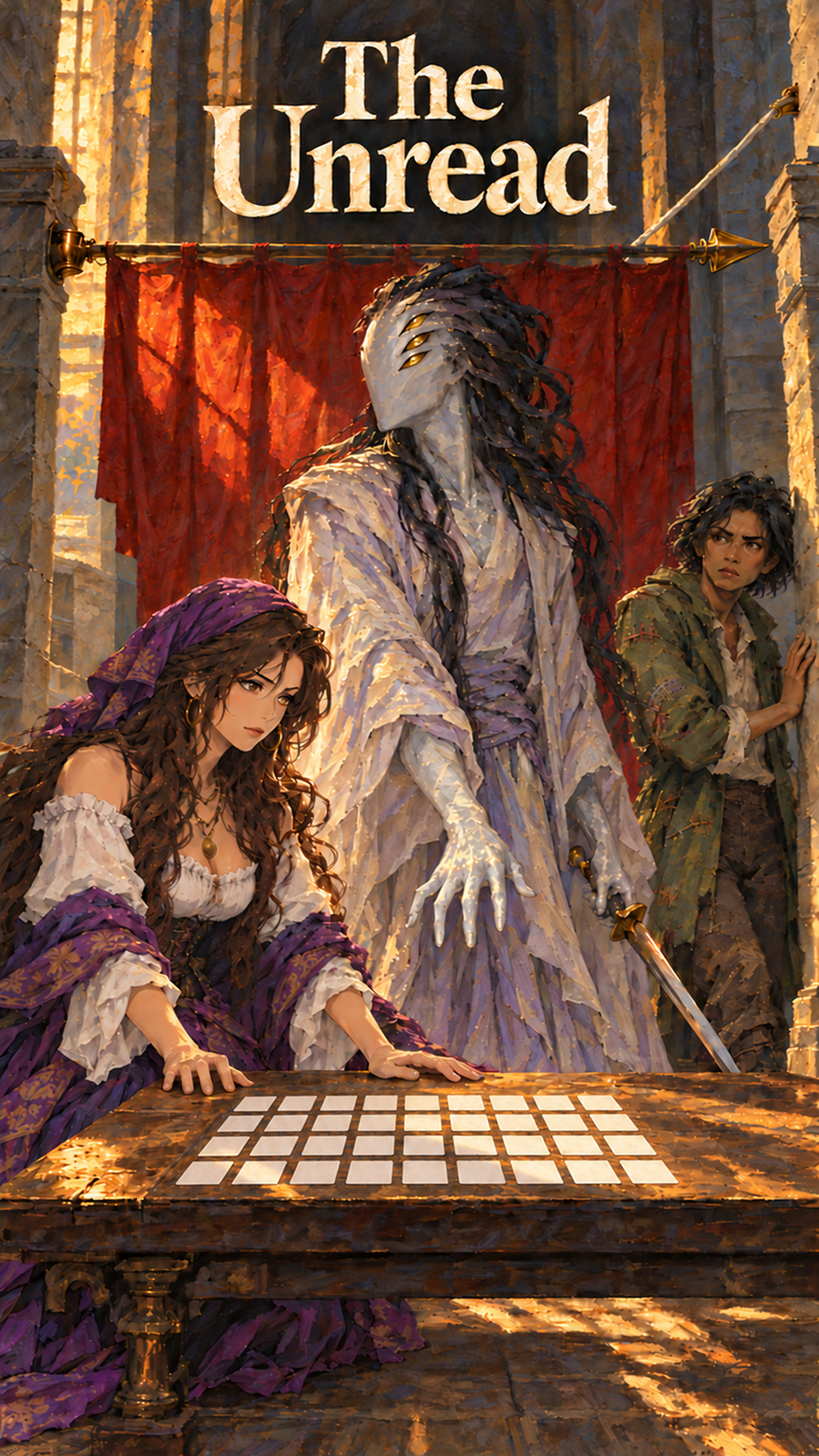
On the afternoon her cards went blank, Meret found a girl inside a wall.
She did it sitting on her terrace, with a cold pear on a plate beside her. The girl's father had brought a hammer. After three days of searching, he wanted something he could hit.
“The old bakehouse,” Meret said. “Behind the drying oven. There are flowers painted on the plaster. Break the blue one.”
“We've been in there.”
“You will hurt your thumb. Your daughter will tell you off for swearing.”
He stared at the cards. The little painted mason on the third one was lowering his hammer.
“She's alive?”
“Go.”
He went. His wife stayed, turning a copper coin over and over between her fingers. Meret left the pear alone. She had seen the woman put both hands over her mouth when the child came up the terrace steps, and she found she wanted to watch it happen.
While they waited, a royal servant arrived with the evening summons. Meret put it beneath the pear plate. The king wanted the full audience before he sealed the war orders. He had been very particular about that, although she had already given him his victory, his day of return, and the number of his dead.
Forty minutes later, the girl's father climbed the steps carrying her against his chest. His thumb was wrapped in his neckcloth. The child had lost a shoe.
“He said a wicked word,” she announced.
Her mother made the sound Meret had heard in the cards, and covered her mouth with both hands.
Meret had been doing this for twenty years. She had foretold three wars, a hundred marriages, the knife beneath a bishop's pillow, and the exact evening on which the king's father would die. The present king had threatened to hang her for that last reading. Later he had ordered his mourning clothes in good time.
She never accepted payment for a lost child. The mother set the copper down anyway, beside the untouched pear.
The terrace wind had loosened Meret's headscarf. She tucked a length of brown hair beneath the purple silk and reached for the deck.
Meret was putting away the cards when the stranger came up the steps.
They were young, perhaps twenty, with brown skin, black hair roughly cut at the jaw, and a green coat shiny at the elbows. There was white road dust in the stitching of their boots. They had waited at the bottom until the family left.
“Are you closing?”
“For the afternoon.”
“I've come a long way.”
Meret looked at the coat. It had been mended with three different colors of thread. She took the royal summons from beneath the plate and folded it.
“One question.”
The stranger sat. Meret smoothed the purple shawl over her knees and laid the deck between them. The gold sun on its back shone briefly as she turned it in her hands.
“Your name?”
“Oreth.”
“And your question?”
“When the king's army is finished, will I have a home to go back to?”
Meret dealt the first card.
There was nothing on it.
She had seen the moon on that card a moment before. She turned it over. The gold sun was gone too.
Oreth leaned forward. Meret put a hand over the card, an old habit from readings she did not want a client to see too soon. Under her palm, something gave a tiny, dreadful gasp.
She lifted her hand.
The next card was white. So was the next. She spread the rest across the table. The violet backs emptied as they slid over one another, the last gold stars vanishing at their edges. There was no face or border left anywhere.
“Close us,” said a thin voice.
Meret stopped breathing.
The cards had spoken to her before, once a year, in the royal audience. The painted king had a bass voice; the lovers spoke a word each; the child on the Hearth card could make a room of courtiers weep. All were mouths of the same living being. But she had never heard them without asking, and never heard them afraid.
“Close us. Turn us down.”
“They are down,” she said.
One of the white cards curled at a corner.
“Not that way.”
Oreth had gone very still. “What does it mean?”
Meret gathered up the deck. It was warm and damp as a small animal held too tightly.
“I don't know.”
She had told kings that they would lose their sons. She had told a condemned woman the hour of her pardon, and the woman had struck her for making a joke. She had never said those three words at this table.
From inside the closed deck, in the voice of the painted child, something whispered, “It has nowhere to look.”
“What hasn't?” Oreth asked.
“Fate,” said Meret.
The little voice became almost too faint to hear.
“Everywhere but that chair. Everywhere but that chair.”
Oreth looked down at themself, then back at Meret.
“I'm sitting in it.”
“Yes.”
“I know how that sounded. I mean, I'm here.”
Meret looked into their face. A pulse beat at the base of their throat. There was a healing split in their lower lip. They smelled of dust and orange peel.
She could not find the least sense of what they would do next.
Usually the future was quiet around her, unless she went looking for it. It waited like the next room of a familiar house. Now she felt the edge of something that had no other side.
“Has anyone read for you before?”
“Three people. One said I'd spilled something on his cards. One wanted money to lift a curse.”
“And the third?”
“Gave my money back and locked her door.”
Meret laid one card on the table. White.
“For me,” she said.
The violet border returned. The face filled with a painted stair, and beneath it a little silver cup. Meret let her sight settle on an ordinary future: herself entering the palace, a servant offering her wine. She caught the shape of the cup's chipped foot.
Oreth was still sitting opposite her.
“For the man on the scaffold,” she said.
Across the square, a mason in a yellow cap stood on a narrow plank beneath the eaves of a house. A new card showed him falling. Meret felt the sick weight of the fall, the broken wrist, the weeks of work lost. She looked for who would help him afterward.
“What's happening?” Oreth asked.
“That plank will go. The man will catch himself badly.”
Oreth was out of the chair.
“Wait.”
They did not wait. They went down the terrace steps three at a time and ran across the square. Meret rose, the card in her hand.
The mason turned at their shout. One end of the plank slipped.
The picture whitened.
Oreth caught the ladder and drove its top hard against the man's hip. He fell against the rungs instead of into the street. Two tiles smashed beside Oreth's feet. For a moment all three of them, man, ladder, and stranger, leaned at an impossible angle. Then the mason got his hands around the ladder, and Oreth dragged its feet outward until it stood firm.
Meret was halfway down her own steps. She had no memory of starting.
The mason was swearing. Oreth was laughing, a breathless, angry laugh.
“You might have shouted sooner,” they called to Meret.
She looked at the white card in her hand.
In twenty years she had learned to recognize a broken wrist in any deck, at any distance, through grief or drink or a king shouting in her ear.
The mason climbed down with both hands.
Back on the terrace, Oreth took off their coat and drank two cups of water. Their hands shook when they set the second one down.
“It was going to happen,” Meret said.
“The plank did fall.”
“He didn't.”
“Nearly.”
Meret watched them rub a scrape on their palm. The danger had not been an illusion. The tiles lay broken in the square. But the fall she had seen had acquired a cause she could not see, and become something else.
She read the mason again. She saw him that evening, eating with the yellow cap on the table beside him. He lifted a bowl. Both wrists were sound.
The cards had not hidden Oreth's destiny from her. There was none to show.
Oreth touched the edge of the royal summons.
“You're going to the palace?”
“Tonight.”
“Take me.”
“You haven't heard what happens there.”
“Tell me.”
Meret looked toward the royal hill. Above the roofs, the king's red standard moved in the late sun.
At the full audience, she told them, Fate stood above the deck, entire and breathing, its life in the room with her own. She held every card in mind while its pulse pressed against hers; even now the memory made her jaw ache.
“Could you hold it while I spoke?” Oreth asked.
“If it agrees to come. I decide when to let go.”
“Then make it look at me in front of the king,” Oreth said.
“Why?”
“Because you told him he would win.”
“I saw it.”
“And now?”
Meret had no answer ready.
“My town is on the road his army will take,” Oreth said. “We're getting out the good plates for them. Burying the grain. Both. Nobody knows which will help.” They rubbed their palm again. “If he hasn't counted me, what else hasn't he counted?”
“He has counted what I gave him.”
“Then take me to him.”
The deck began to murmur.
“Meret.”
She knew that voice. It was the gentle contralto in which Fate had answered her at her first royal audience. She had asked whether her father would recognize her when she went home. It had said yes. For one afternoon, before his fever took him, he had.
“Meret. In autumn there will be a boy in the north wood. His name is Iven. He will have a green glass marble in his mouth because he is afraid of losing it.”
Meret sat down.
“There will be snow before his family finds him. Unless I show the next reader where to look.”
Oreth's hand withdrew from the summons.
“I found the child today,” said Fate. “You have never asked me for a child I did not find.”
That was true. Some had already been dead. But every one had come home.
The next reader, Meret thought. It knew she understood.
She had read her own death eleven years ago, by accident, while teaching herself how to hold the full audience. Tonight, at the fifth stroke of the sunset bell, she would lie beside the royal table with the standard's spear-point at her throat. Her shawl would be caught beneath its gold head. Her eyes would be open. She had seen it as plainly as she had seen the girl coming up the steps without a shoe.
She had checked the standard's fastenings each year. She had considered burning the Hall. People who tried to avoid a reading generally supplied it with a more elaborate road. Eventually she had stopped spending every evening trying to imagine tonight.
It had comforted her to know that the gift would outlive her.
“I could still leave,” she said.
“Yes,” said Fate at once.
Meret took up the card with the stair and cup and let Oreth's request become her own intention.
The stair vanished. The silver cup went after it. Nothing took their place.
Her heart struck once, painfully.
She did not know whether she would die tonight.
Oreth watched her face. “What did you see?”
Meret put the white card in her pocket.
“Get your coat.”
They climbed toward the palace through streets already dressed for victory. Red ribbons hung between the houses. Outside an armorer's shop, two boys were trying on helmets, shouting through the visors at each other.
Oreth stopped to watch them.
“How many?”
“Three thousand and eighty-six,” Meret said.
“Is that us, or the people we're fighting?”
“Our soldiers.”
Oreth walked on.
Meret had been asked how many of the king's soldiers would die. She had answered the question. The other dead had not appeared in that reading. She had known there would be others.
At the first palace gate, she slid out a card for the guard. She saw his cap come off as he stepped back from the wicket. Then Oreth reached for the iron before he opened it.
The picture vanished. The guard kept his cap on and put his hand on his sword.
“Hands away.”
Oreth let go.
Meret showed the summons. It took five minutes of argument to secure what, a moment before, had seemed assured.
“Tell me before you do things,” she said as they crossed the court.
“I was opening a gate.”
“I know.”
At the inner stair, she saw a page coming down with the silver cup. She guided Oreth aside and caught the page before he turned toward the kitchen. The foot was chipped exactly where she remembered.
“Tell the king I'm here.”
“He knows, madam.” The boy looked at Oreth. “Who shall I say?”
“Oreth.”
“Oreth what?”
“He can ask me himself.”
The page went up the stairs instead of down. Meret lost the next piece of the way.
They waited beneath a painted king who had been dead for two centuries. Oreth examined a tear in their coat.
“You could send me away,” they said.
“I could.”
“You don't look well.”
“I expected to die tonight.”
They looked up sharply.
Meret took the white card from her pocket and told them what she had seen. Oreth listened without interrupting. When she finished, they took the card from her hand, looked at it on both sides, and gave it back. She slid it into the deck.
“And now you don't know.”
“No.”
“Good.”
She laughed. She could not help it. It was an ugly, startled laugh, and it left her trembling.
Oreth stayed beside her until the doors opened.
The Hall of Lots was narrow and very high. The king sat at its far end, with the war orders laid before him and the great seal beside his hand. A guard held the sword of state flat across his palms at the foot of the chair. Captains and ministers stood along the walls. Several had come in their armor.
The audience table occupied the raised floor below the king. It was low enough that Meret could kneel beside it, long enough for her four rows of nine cards. Above it hung the royal standard. The butt of its ash pole rested in a bronze cup on the left pillar; a heavy cord from the right pillar held its gilded iron spear-head up over the place where the reader stood. The red cloth fell behind the table like a second wall.
Meret looked at the cord. She had had it replaced last spring. New white silk, thicker than her thumb.
“You brought someone,” the king said.
“Someone I cannot read.”
“Then you should have brought another reader.”
“No reader could do it.”
A minister smiled. Meret had told him once that his secret marriage would become public. He still behaved as if she had betrayed him.
“We are rather occupied,” the king said.
Oreth stepped forward. “I'm from the border. The east road, below the watch hill.”
The king glanced at a captain, who nodded as if confirming the existence of a place were an answer.
“I want you to hear my reading,” Oreth said.
“You cannot demand the royal audience.”
“I can,” Meret said.
She knelt and laid out the cards.
The first row was white. So was the second. By the time she reached the fourth, nobody was smiling.
“For this person,” Meret said. “Their home, their life, their ending.”
The cards lay empty beneath the windows.
“You have damaged them,” said the minister.
“Remove it,” said the deck.
The king straightened. The minister's mouth closed.
The familiar contralto came from every card at once.
“Remove it from the Hall.”
“My name is Oreth.”
“Captain,” said the king.
Meret looked toward the man at the right-hand door and put a thumb on the Sword card. At the change of subject, a little hand rose on its face; she saw the captain's left arm lift, his right foot turn inward. Beyond that the sight failed. Whatever would happen when he reached Oreth was as blank as the card had become again. She opened her mouth to warn them.
Oreth stepped toward the table instead.
The captain's hand closed on air. Trying to catch them, he struck his shin against the low table and fell. His shoulder hit the edge of the spread.
“Mind the cards,” Meret said, and almost laughed again.
Two guards lowered their spears. Oreth backed against the right pillar, beneath the standard's supporting cord. They had turned pale.
“Enough,” the king said. “All of you.”
The guards stopped. The captain got up with blood on his lip.
“It cannot see what they will do,” Meret said. “Your Majesty, it can't promise you anything about them.”
The king looked from her to the fallen captain, then to the white deck.
“Can you still promise my victory?”
“Ask the source.”
He put both hands on the arms of his chair.
“I ordered the full audience.”
Meret laid her palms beside the spread. She found the small, separate attentions she had trained for twenty years: each card held in mind, each way open, all the ways meeting in one place. Even empty, they made a shape she knew. She offered it.
Nothing entered.
“Come before us,” she said.
The blank Hearth card whispered in its child's voice. “You know what will happen to you.”
“I know what you showed me.”
“Let it go.”
“Will the king win?” Oreth asked.
No answer.
“If he sends his army past my house. Will he win?”
The king rose.
“Answer.”
Meret felt the presence hesitate beyond the spread. She could feel its attention going outward, down all the ways that still opened for it: the captains, the army, the granaries, a boy not yet lost in a northern wood. Here in the Hall, a young person in a mended coat had become a place none of those ways could cross.
Then its attention returned to the sword of state. The captain had failed it. In a body, it would have a hand of its own.
“I will answer in my own person,” said Fate.
It accepted the offered shape.
Meret bore down on the deal as a weight entered the world.
A tall figure stood a hand's breadth above the cards. Its skin was silver, its hair black and fine as smoke, its robe the pale color of the sky before sunrise. Three narrow gold eyes lay along each temple. It turned its head toward the king. All six eyes were strained to the left.
Oreth stood on its right.
The king bent his head. Around the Hall people bowed, slowly or at once. Meret remained on her knees. Holding the whole living presence was already making her jaw ache.
“The sword,” said Fate.
A guard carried forward the sword of state and laid its hilt in the silver hand. This happened at every full audience. Fate touched the blade to the king's shoulder; the king undertook to govern according to what had been shown. Tonight the silver hand closed around the hilt, but did not lift the blade toward the king.
“Look at me,” Oreth said.
Fate's head turned a little farther away.
“Please. I want to know what's wrong.”
For an instant, its eyes opened wide. Meret saw terror without any human effort to hide it. Then the lids narrowed almost shut.
“There is no place for you,” it said.
Oreth pressed a scraped palm to the pillar.
“There wasn't room at the inn either. I slept outside.”
Nobody laughed. Meret thought the words had cost Oreth more courage than the run across the square.
“Meret,” said Fate. “Dismiss me.”
“Tell him what you cannot see.”
The sword moved.
Oreth hit her hard in the shoulder. Meret fell sideways, one hand skidding through the spread. The blade passed where her neck had been and cut the loose end of her shawl.
Two of the cards lifted. The silver body thinned.
Meret caught the shape in her mind. The two cards fell flat. Fate became solid again above the table, its arm still extended toward her.
The king shouted something. A guard started forward and stopped when the silver face turned toward him. He had spent his life in the service of a being that saw every weapon before it was drawn.
“You tried to kill her,” Oreth said.
Fate held the sword level. Its eyes did not move toward the voice.
Meret could let go. A little less attention to the Hearth, a failure to hold the Sword beside it, and the body would withdraw. She knew exactly how little effort it would take. The being would live. It would speak through the cards again. It would ask this king, another king, a frightened reader with a locked door, to remove the person it could not bear to look at.
It would also find the boy in the wood.
Meret rose to her feet.
“You missed,” she said.
Her teeth were chattering. She moved around the table to her appointed place, under the gold spear-head. The red banner touched her shoulder.
The silver eyes followed her. One by one, they opened.
Above the Hall, the sunset bell began to toll.
Meret saw recognition settle over the face she had known for twenty years. Here was something already seen. Here was an ending that had once been sure: the woman beside the table, the gold head at her throat, the deal broken by her death. It could still be done.
She was offering it that road.
She could not know that it would take it.
The second stroke sounded.
Oreth was against the right pillar, behind the source's turned face. Meret did not look at them. She held every blank card in her attention and waited beneath the point that had been waiting for her for eleven years.
“This much,” said Fate, “I know.”
It lifted the sword toward the white silk cord.
“Oreth,” Meret said. “The pole.”
The cord parted under the blade.
The standard fell. The gold head came down toward Meret's face; the long ash shaft swept the space above the cards.
Oreth jumped onto the low table. They caught the shaft in both hands below the spear-head, knees folding with its weight. The red cloth came over their head. For one dreadful moment Meret could see neither their face nor their hands.
Fate's head turned toward the falling weapon and stopped as if its neck had met a wall. Its sword came across blind and struck the table behind Oreth.
Under the cloth, Oreth heaved sideways. The pole's butt tore free of its bronze cup. The whole weight came down onto their shoulder.
Meret stood close enough to the source to touch its robe. She could still dismiss it. She held the shape.
Oreth shoved the bunched banner away from their face and turned the spear-point toward Fate's right side. The pale robe brushed their cheek. Bracing a foot against the table's edge, they drove the point upward with both hands.
Fate made the small gasp Meret had heard beneath her hand on the terrace.
The spear shuddered in Oreth's grip. Six gold eyes opened, searching the empty air beside their face. The source had moved out of the way of poisoned cups, falling stones, and hidden blades for centuries before Meret was born. This time there had been no next moment in which to see the weapon coming.
“Hold it,” Oreth said.
Meret held it.
The fifth stroke of the bell sounded.
The silver body grew heavy. It dropped onto the table, scattering the white cards. One table leg broke. Oreth went down with it, still holding the pole.
Meret felt every path through her cards close at once.
There was no voice behind the deck. No attention going outward through it. The tall body lay across the broken table with its six eyes shut. Its foot rested on the Hearth card.
Nobody moved until Oreth began trying to pull their coat free of the wreckage.
Meret helped them. Their left hand would not close properly. They tried once, then stopped. Their other hand was still clamped around the pole.
For a while they looked at the silver face. Then, very carefully, they let go.
“Stay there,” she said.
“I am.”
She put her fingers against the silver throat. No breath stirred the robe. Nothing answered her touch.
The king came down from his chair.
“Is it gone?”
“It's dead.”
He looked at the body for a long time. Behind him the captains waited, and beyond them the army waited in its new boots, with sharpened swords and wagons already loaded.
“Read the war again,” he said.
Meret picked up a card. She did not know which one. Its front and back were equally white.
“I can't.”
“Use another deck.”
“Every reader in your kingdom drew their sight from this.”
“You told me I would win.”
“I did.”
“Will I?”
“I don't know.”
The words seemed to anger him more than the sight of the body. His hand rose, then fell against his side.
“How many, then?”
“I don't know.”
Oreth sat on the edge of the broken table, holding their injured hand against their coat. The king looked at them. Meret could not tell what he was thinking, or what he would do with that thought.
She had changed what would come. She and Oreth, together. She had also left the next mother who climbed her terrace steps with nobody who could tell her where to look. Somewhere in a future she could no longer find, a boy might put a glass marble in his mouth and walk between the trees.
She kept the white card in her hand. She did not try to make it mean anything else.
“The orders, Your Majesty,” said a captain.
On the king's desk, a candle burned beside the seal. The wax had been warmed for him.
He went back to his chair. Meret watched him take up the seal, then set it down beside the waiting orders.
“No messengers leave tonight,” he said.
One of the captains began to object. The king turned toward him, and the man stopped.
Oreth put their sound hand against Meret's sleeve. She looked down. There was a piece of white silk caught in their hair.
“You're here,” they said.
Meret touched her throat. The bell had finished.
“Yes.”