
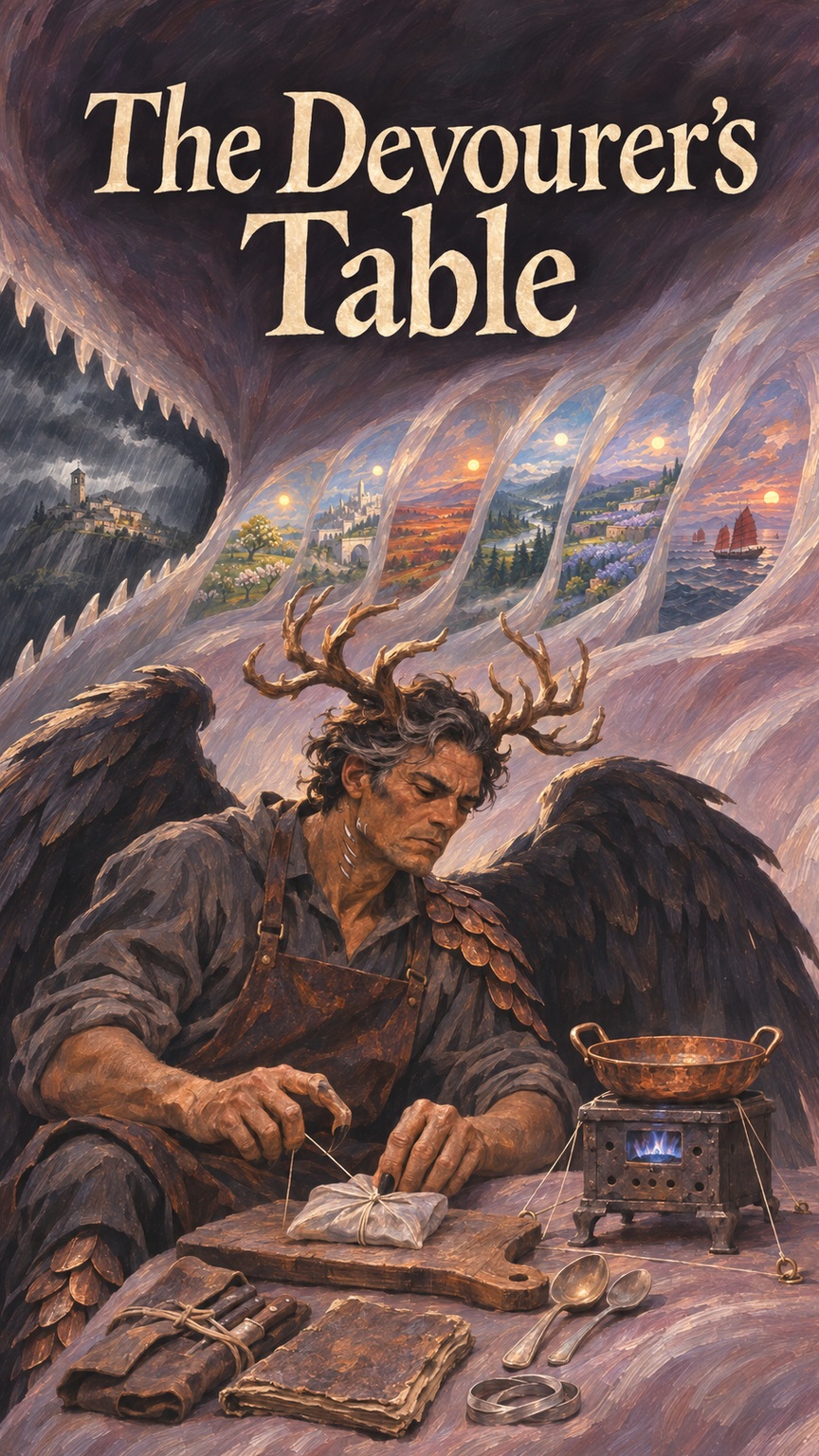
I caught the first village with my left hand. With my right, I took the onions off the heat.
There were forty houses in the village, and a bell tower, and a woman halfway across a square with a basket of eggs. The stormback had lifted the whole shelf of rock on which they stood. It was turning slowly above the mountain, shedding chimneys.
Silk ran from the pads of my left fingers. I gave it the strength of a bridge-worm's web and hooked the far end around my antlers. Then I made myself as heavy as the stone ox of the western passes.
The terrace broke beneath my feet.
“Away from the edge,” I told the people behind me.
Someone said, “But the table—”
“Leave it.”
I jumped.
For a moment the village and I hung on opposite ends of a glittering thread. Then my wings opened, the long black feathers lifting against the storm, and I pulled the village back toward its mountain.
The stormback came down after us.
They are beautiful creatures at a distance: a white ridge of plates along a blue back, six translucent sails, a head like a horse's skull carved out of ice. Up close, you discover that the dark hollow beneath each sail is a separate thunderstorm. Every thunderstorm wants to be let out.
I had two hundred and eighty-six useful answers to a creature like that. Unfortunately, a village was slipping off my left hand, so I could employ only the ones that did not require fingers.
I shone with the noon-moth's light. The stormback flinched. I put the frost-fox's silence around its head and cut off the thunder it used to feel its way through the air. When it struck at me, I let its lightning enter my antlers and ran it down the silk into the empty stone below.
The mountain flashed white. My antlers rang like struck glasses.
I set the village down a little crooked, on ground a hundred paces below where it had been. The woman with the eggs sat down very suddenly.
By then the stormback was trying to climb away. Its sails were ragged where its own lightning had passed through them. I spoke with the quarry giant's voice and brought loose rock down around it before it could reach the next village.
The silence afterward was full of small sounds. Slates falling. A man calling for his sister. The bell in the displaced tower, ringing once as its clapper settled. I folded my wings and went to help dig.
By evening we had found everyone. Three broken legs, a crushed hand, a great many cuts. I could close wounds and knit bone, although I had to sing while I did it, and the woman whose hand I healed said my singing was worse than the injury. She was holding a bowl of supper when she said this.
We ate on the terrace where I had started cooking that morning. Someone recovered the onions. Someone else brought bread from an oven that had survived the move, and we set the trestles far back from the new edge.
The stormback's cloud gland lay in my shallow copper pan. It looked like a folded white glove. There were two ways to prepare it. Sear it hard, and the flesh would contract around the pressure it had held: thunder, the power to fling stone and houses into the sky. Warm it gently in fat, keeping its little chambers open, and you might coax out the other thing a stormback could do.
Before it released a storm, it sheltered one. I wanted that shelter.
I turned the gland with two spoons. My right forefinger had a hook at the tip, and my left thumbnail was broad and black and could score granite. Neither was much good for turning delicate food.
The black claw had come from winter-lion dumplings. I could still remember the feel of the dough yielding under the human thumb I had used to fold them. The index finger had followed a dish of red harrier in honey. I had eaten it to reach a child stranded above a burning forest.
My recipe book gave the temperatures and the proportions. It did not record any of that.
“Does everyone have to eat it?” asked the bellringer, who was helping serve.
“No. That's mine.”
“Is there enough for you?”
“There will be.”
Her name was Hedrin. She had climbed out of the hanging bell tower that afternoon with a rope around her waist and refused to come down until I took the bell as well.
I finished the gland with three drops of amber citrus. A Runner had sold me the fruit under a crooked awning in Deepmarket, with strict instructions to keep the peel. The peel was bitter enough to make your teeth ache. I had used it in twelve excellent dishes.
The gland was tender, almost without substance, and tasted first of butter, then of the air just before snow.
I swallowed.
The change began beneath my ears.
Usually there was time to set down my fork. This time I dropped it. A line of pressure travelled along each side of my jaw, followed by a cool opening, as if someone had unfastened a row of buttons in my skin.
People stopped eating.
I put a claw to my cheek. Six narrow slits opened against it. They were smooth at the edges, pearly as the inside of a shell. I could breathe through them.
My mouth was still full of the taste of snow. Rain began falling out of the damaged sky. I lifted my head and breathed through the new slits, and the rain curved around the terrace. It made a clear, round chamber in the weather. Beyond it, the mountain disappeared behind silver curtains.
Someone laughed. A hundred faces looked up. The cook from the surviving bakery went to fetch more bread.
I picked up my fork. It caught against one of the little openings under my jaw. I had to learn a different way to lift it.
Hedrin watched me do this, then went inside without taking her bowl. She returned with a book. It was longer than my recipe book, bound in two boards blackened with age. When she laid it on the trestle, a little shower of wood dust fell beside the salt.
“We bring this out for the midsummer ringing,” she said. “The children like the ugly pictures.”
“I hope it isn't a cookbook.”
She did not smile.
The picture occupied a whole page. The creature in it stood on a curve of black ground. It had a branched crown, a mantle of feathers, plates over one shoulder and down one leg. Its right hand ended in five unlike claws. Beneath the jaw, the artist had painted six little pearl marks on either side.
In its body were seven small gold disks. Around each disk lay a scatter of squares, which I had first taken for scales.
They were houses.
I touched the edge of the page. The vellum was thin enough to show the writing on the other side.
“How old?”
“The binding is four hundred years old. We've replaced it twice, according to the first page.”
“And the picture?”
“Older.”
Under it, in the same faded ink, were two lines.
The Many-Made shall eat the seven skies.
No road shall run beyond its teeth.
I knew a little of the script. The words were ordinary words. Hedrin had not twisted them.
“There are other creatures with feathers,” I said.
She looked at the sides of my jaw.
Behind her, people were passing bread from hand to hand under the shelter I had breathed for them. A child was trying to catch the rain where it curved away. His mother moved him back from me without quite looking at what she was doing.
I shut the book.
“I won't eat another one.”
Hedrin's fingers tightened on its boards.
“I didn't come to ask you that.”
“I know.”
At the far end of the terrace stood the old door to the orchard country. Its lintel had split in the storm. Through it I should have smelled apples and the yellow flowers that grew between the trees.
Instead I smelled hot stone, something sweet and deep beneath it, and the sharp, beautiful savor that comes when fat first takes color.
My mouth filled with water. I had eaten supper. I had eaten enough.
The bell above us began to ring.
Hedrin turned so quickly that her sleeve caught the salt and spilled it across the picture book.
“That's the west rope,” she said.
Through the orchard door came a sound like a whole forest being dragged across a floor.
The Hollow Whale was white.
I had heard about it in six different kitchens and assumed that the cooks had embellished the account. There are stories told while a pot comes to the boil that improve with every telling.
It lay in the dark beyond the orchard door, curved around a distance I could not judge. Its lower jaw passed beneath the mountain. Its upper jaw was coming slowly down.
Between the jaws hung the country where the orchard had been.
I could see its sun through a panel of translucent flesh in the Whale's flank. The apple trees stood beneath it. There was a village on a low hill. Smoke rose from the chimneys and bent along the inner curve of the creature's ribs.
Farther down its body shone five other skies.
Hedrin came to the door behind me.
“There were six roads from our mountain,” she said. “We've had no travellers from any of them since yesterday.”
I opened the little clear lids behind my eyes and looked through the Whale's body.
A black plain, thick with white houses. A sea carrying red-sailed boats. Blue-flowered terraces climbing a steep valley. Forests. A red steppe. People were running through all of them. Some had seen the pale ribs forming across their skies. Some were still going about their day.
The Whale took a breath.
The doorframe shifted. Behind me, the terrace moved a finger's breadth toward it.
I went back for my knives.
“Can you kill it?” Hedrin asked.
“Probably.”
“Then why do you look like that?”
I could not tell her that it smelled delicious.
I divided myself into seven bodies. It hurt in the old familiar way, like pulling apart hands that had been clasped too tightly. Each body had my antlers, my bad right forefinger, my copper-and-black scales. Each was about half my usual height.
Six went through the door. The seventh took Hedrin down the terrace and told everyone to leave the buildings nearest the threshold.
I had learned division from a nest of mirror-wasps, cooked in their own crisp comb. I could be in twenty-three places if I needed to be, but there was a point beyond which I became clumsy and stupid. Seven let me use a knife.
Inside the Whale I walked into a white city. I stood on the red steppe. I caught a boat whose bow had fallen through a new gap in its sea and put it back beside the others. One of me climbed the blue terraces and helped a family get their grandfather out of a house that had begun to lean.
Another flew along the Whale's flank.
At the edge of the orchard country lay an empty cliff. The trees ended well back from it. I wrapped silk around a spur of stone and pulled it gently toward the opening through which I had entered.
The cliff stretched. A pace of it became a long strip, thin and black. I stopped. The strip fluttered from my hand, and through it I saw the dark beyond the Whale.
When I eased it back, the cliff thickened again. A crack remained across its face.
I flew farther forward, to where a great pale muscle flexed beneath the Whale's jaw. On each contraction, the six skies moved deeper under its ribs.
I cut the muscle.
Across the orchard country, a line opened in the blue. The little sun bent along it. Roofs slid on the hill.
I dropped the knife and pressed the edges of the wound together. Silk poured from both hands. I sang through my teeth until the muscle knitted.
The line in the sky closed. For a while I stayed there with my forehead against the Whale's skin. It was warm. The six places were warm inside it. I could feel them moving with its breath.
My old pocket-lark faculty stirred in the extra air-sac beneath my left lung.
I flew back to the orchard cliff. Near its edge was a rock garden, three white stones in moss, made by someone who had put a great deal of care into a very small patch of ground.
I opened the air-sac and breathed in. The garden folded. It passed into me without stretching. A snail on one of the stones drew in its horns.
I held the place under my ribs: its moss, its little weight, the warm square of sunlight above it. The snail came cautiously out again.
I tried to take the ground beside it. Pain ran through my chest. I stopped at once.
That was what a pocket-lark could carry. A place to land, no larger than a nest. I had once used it to bring a handful of unburned soil home for a woman whose whole country had turned to glass.
I set the garden back beside the cliff.
Inside the Whale, six of me looked up at six skies.
The living creature held their distances together. Cut it open and I would pull those distances apart. Kill it, and there would be nothing left to hold them at all.
I could save the mountain by doing that. Its sky was still outside the Whale. Its people still had ground beneath them.
Six places lost. One kept. Or I could learn to hold more than a lark's nest.
I returned to the terrace in my seventh body and picked up Hedrin's book. She read my face.
“You said you wouldn't.”
“I did.”
“Is there another way?”
I looked through the orchard door. My other selves were helping people climb away from the places where the ground was thinning. One was carrying three children. One was holding a bridge together with his back. The largest city I could see went on beyond the curve of the Whale's flank.
“I can bring out some people,” I said. “A few hundred. More, if it stops moving.”
The terrace shifted again. A spoon slid off the trestle and rang on the stone.
Hedrin went to the bell tower.
“Where are you going?”
“They can't all see the door. They need to know to climb.”
I put down her book and packed the stove.
I had cooked on the backs of moving beasts before. Once, on a dare, I had made a soufflé in the hand of a walking giant.
The Whale's tongue was worse.
It sloped toward the six swallowed suns. Each breath moved it. The mountain hung beyond the open jaws, and its lower villages were creeping toward us, leaving long pale scars in the ground.
I tethered the stove and both pans with silk. I put the knives in a roll and tied the roll to my wrist.
My other six bodies remained in the swallowed places. Through them I felt a railing give way, a child's fingers grip my feathers, a boat scrape over stone. The power was already expensive to hold. I could not close those senses.
Beneath the tongue lay a ring of folded tissue, silver and very fine. I had watched it move when the Whale swallowed. Each fold enclosed another fold. Its keeping-organ.
I took a narrow strip from the outside of the ring and closed the cut. The great muscle could go on working with that little part missing. For how long, I did not know.
On the board, the strip had the spring of a cuttlefish mantle. When I lifted one corner, I saw a thread of red steppe running in its layers.
I put it down. The first rule was clear. I must not break those layers. Mincing would destroy the very structure I needed to take into myself.
I opened my book with the back of a claw.
Pocket-lark: salt-crusted, the breast left whole. Dream carp: taken off the heat before the flesh lost its sheen. Hollow stag, which could make room inside its ribs for a whole herd: braised, but never allowed to boil.
There were two hundred and eighty-seven recipes now. Some occupied six pages. Some were only a line and a stain. I turned them with the fine thread I could spin from my fingertips, making a little loop around each page.
Behind me, the mountain bell rang.
I began with a shallow bath of warm butter. The heat had to enter the keeping-organ evenly. I made a dome of shelter over the stove, breathing through the pearl slits so the Whale's gusts would pass around us.
My old fire came readily into my hands. It had been the first faculty I learned to cook out of a monster. I set it under the pan in a low blue ring.
The strip trembled. Its silver folds softened.
The smell rose. Under the butter was the mineral sweetness I had smelled through the door. There was something green, too: the first bite of a peeled stalk. Then a warmer note, like a nut split fresh from its shell.
I leaned closer. Through the lifted corner of tissue I saw the white city. Sunlight lay on its flat roofs. The roofs had the crisp, delicate color of the top of a perfectly baked crust.
I knew, with a certainty beyond any recipe I had ever written, what would happen if I let the pan get hotter.
The folds would open. All that was held inside them would begin to give itself up to the butter. There would be depth in that sauce that no stock, however carefully tended, could possess. Brightness from the blue country. The long sweetness of the orchards. The city would supply an astonishing clean, toasted finish.
I took out the smaller pan.
That was the movement I remembered afterward.
I had not only imagined the flavor. I had reached for the pan I would use to make it.
I spooned a little of the warm butter into it and gave it a sharper flame. Only butter was in it yet. On one spoon I lifted the organ's outer fold, where the first street of the white city showed through. It still joined the rest of the tissue in the copper pan. I was about to lay its edge in the hotter butter.
The butter browned along the rim.
One of my bodies in the white city looked up. A boy was standing in an upper window with a brass basin. He was beating it with a spoon. He had heard the distant mountain bell and was trying to tell the people below him to climb.
The bright blows reached me through the fold of tissue.
I thought, very distinctly: Only that street.
My hand stopped.
The boy struck the basin again. I lowered the fold back into the copper pan. Then I caught the little pan by its handle and flung it out between the Whale's teeth. Brown butter made a brief gold fan in the dark.
I stood with both hands flat against the board.
It would have been easier to discover a stranger inside me. Easier to hear a monstrous voice demand its supper.
The hand that had lifted the pan was the hand I had used to cook for hungry people for thirty years. The pleasure was mine. I could still taste, without having tasted it, what I had thrown away.
The bell changed. Its next stroke sounded far below me.
The Whale's lower jaw was lifting. On the mountain, the nearest village slid toward it. My silk snapped at the far end of the tongue and the stove lurched. The butter ran over the rim of the copper pan.
I had lost more than the butter.
I caught the stove by its iron handle and the falling village in a fan of silk. My other six bodies heaved against the breaking ground: a collapsing hill in the red country, a split road in the forest, a wall beneath the white city.
The Whale flexed its keeping-organ. The piece in my pan began to curl. I breathed frost over it and killed the flame.
I could still cut through the great muscle and leave the mountain's people outside my mouth. The six other suns shone through the Whale's ribs.
I turned back to my pan. The flavor I had refused did not leave me.
There was no more butter. I had no time to warm another bath. I had a strip of citrus peel, the last of the amber fruit, and the clean fat the keeping-organ itself was beginning to release.
I shaved the bitter white pith from the peel with the sharp edge of my thumbnail. I laid it along the organ's seam and folded the tissue over it. Then I folded it again, preserving the soft chamber inside, as I had once folded a dumpling around a winter lion's breath.
The black claw caught the skin. I stopped before it tore.
I lowered my mouth to the board and used my teeth to hold the little packet shut while I tied it with silk.
Behind the cold, the organ was still warm. I put it in the copper pan, covered it, and held the pan between my palms. The fire I made there was small and exact.
The Whale began its final swallow.
Around the mountain, the last six thresholds tore out of their stone frames. A line opened in the sky above the bell tower. I had spent the time in which I could have kept that sky outside.
I let the gale serpent's body move through mine. My spine lengthened. My legs took the stone ox's weight again, then the weight of the iron-backed burrower, then all the weight I could bear without breaking the tongue beneath me.
With my hooked right hand I caught the upper jaw. The lower one pushed against my feet.
I opened my throat and sang the song that kept injured flesh together. I spread the stormback's shelter around the mountain. My six bodies breathed frost against the walls of their six failing skies.
I held the pan against my chest with my chin.
Every faculty I had ever acquired seemed to be trying to make room in me. I saw the Whale's muscles in the dark. I heard houses settling through miles of flesh. Tiny hairs on my shoulders told me where each gust would strike. The deepweb spider gave me another strand. The cliff bear gave me another moment.
Under my chin, the little packet warmed through. I kept my right claw hooked in the Whale's upper jaw. With my free left hand I tipped off the lid and unwound the silk, then gripped both spoon handles in that hand like tongs.
The edges of the folds had grown clear. I pinched the packet gently between the spoon bowls and lifted it to my mouth.
There was enough for one mouthful.
I thought of the hand reaching for the smaller pan.
Then I ate.
At first it was merely food.
Tender flesh, the clean fat, a fierce thread of bitterness. I had kept it from boiling. The folds were still whole.
I swallowed, and the space beneath my ribs opened.
The little air-sac where I had held the rock garden unfolded into something so large that my thoughts fell through it. My breath went after them. For one terrible moment I could not remember the way back to my own mouth.
My fingers lengthened against the Whale's jaw.
The black claw grew past the edge of its teeth. Scales lifted along my arm, each holding a faint reflection of a sun. My antlers branched across the dark. The feathers down my back opened one by one, long enough to cast shadows over the mountain.
The Whale tried to close its mouth.
I was larger than it.
My six divided bodies looked up from the swallowed places. Through the thinning walls I could see myself looking back at them.
I opened the new chamber inside me.
The Whale held fast.
Its great pale muscle contracted around the six skies. I could feel its grip: all those folded distances pressed together, all the separate days it meant to make into one meal.
I set my feet in the dark and pulled.
The orchard sun travelled first. It came through the Whale's flank slowly, carrying its blue sky around it. The trees followed, the hill and its houses, the cracked cliff. I took the whole place between my teeth without touching it and held it under my tongue.
I could have crushed it there.
The knowledge was exact. A small movement would be enough. All that brightness would break open.
I kept my jaw still and drew it down into the chamber beneath my ribs.
The pearl slits along my face breathed out. Shelter curved around the orchard sky.
I reached for the next. The sea passed cool through my mouth, all its red sails upright. The forest followed. I brought in the blue terraces with the old man still clinging to one of my smaller selves. The red steppe swept across my tongue. Last came the white city, and the boy at the window was still beating his basin.
I felt each of my six bodies return into me as its place settled. Their hands became my hands. The people they had been holding stood on their own ground.
The Whale was empty. Without its six great burdens it looked frail, a length of white flesh bent around a terrible mouth. It struck at the mountain.
I put my wing between them.
The teeth closed on my feathers. I felt them break. I brought the quarry giant's voice through my new throat, and the sound drove the creature away from the last sky.
It struck at me again. I caught it behind the jaws, and this time I did not have to wonder what its death would cost.
When I let it go, the empty body fell quietly into the dark.
The mountain was sliding.
The Whale's last swallow had stripped it from its horizon. Killing the creature had stopped its jaws, but the tear above the bell tower was widening. Through it lay the same dark I had seen through the stretched cliff. The terrace, the villages, the steep fields turned slowly toward me, their edges thinning.
I opened my mouth.
Hedrin stood in the bell tower. The tower had begun to lean. She was hauling on the rope with both hands, too busy to look up.
I made a shelter wide enough for the whole mountain.
Then I ate the seventh sky.
For a long time I did not move.
Seven days burned inside me. In one it was morning; in another, the last light lay red over the steppe. The sea touched its own shores. People were coming out of houses, counting one another, finding cracks in walls.
Under my lowest left rib, three white stones lay in moss. I could feel the snail.
I tried a breath. The seven skies held.
From the mountain, Hedrin's bell rang once, then stopped. I heard her call my name.
The sound reached me as plainly as it had across the supper table.
I looked down.
My right hand still had five unlike claws. The little hook at the forefinger's tip was large enough now to hold the white city. There was silk caught around it and, fastened to the silk, my copper pan.
Its bottom had blackened.
Beyond my scales lay the seven places I had saved. Their roads still led from one to another. At the outer doors, people looked out into the dark and saw the curve of my teeth.
Some screamed. A man in the orchard country fell to his knees. In the displaced village on the mountain, someone began shouting that Sennet had got them, Sennet was holding them, they were all right.
Hedrin called again.
I tried to answer her. My voice shook dust from the cliffs, so I stopped.
I could smell supper being put back on fires in the white city.
Beneath it was the smell of the city itself: sun-warmed stone, a deep sweetness, the beautiful toasted note I had almost brought to perfection.
I knew how each of the seven skies would taste. The knowledge arrived complete, as readily as the knowledge of where to put a knife.
Inside me, people were looking for the greatest hero alive.
I held my jaw steady until the wanting passed enough to bear.
Then I turned my mouth toward the empty dark, and kept all seven suns behind my teeth.